


What is a firming serum? Science, benefits, and results
TL;DR:
- A true firming serum delivers concentrated bioactive ingredients to skin’s deeper layers, promoting cellular change. It stimulates collagen and elastin production, leading to improved firmness, elasticity, and skin renewal over weeks of consistent use. Proper application and clinical-backed actives are essential for achieving measurable, lasting results.
Not all skincare products pull their weight equally, and nowhere is that gap more obvious than between a basic moisturizer and a true firming serum. A well-formulated firming serum delivers concentrated bioactive ingredients to deeper layers of skin, triggering measurable change at the cellular level rather than sitting on the surface. Clinical research has documented up to a 72.5% hydration increase and a 37.7% improvement in skin softness after just four weeks of consistent peptide serum use. If you are in your 30s, 40s, or 50s and noticing a gradual loss of firmness, elasticity, or volume, understanding exactly what a firming serum is and how it works is the most practical step you can take toward real results.
Table of Contents
- What is a firming serum?
- How do firming serums work?
- Key ingredients in firming serums
- How to use a firming serum for best results
- What most people get wrong about firming serums
- Upgrade your skincare routine with proven firming solutions
- Frequently asked questions
Key Takeaways
| Point | Details |
|---|---|
| Serums target firmness | Firming serums deliver concentrated actives that penetrate deeper than moisturizers for evidence-backed results. |
| Key ingredients matter | Look for peptides, retinoids, and biomimetic agents shown to improve hydration and elasticity. |
| Routine drives results | Apply serum before moisturizer and use consistently to see the best visible firming effects. |
| Results require patience | Most people notice improvement after several weeks of regular use, not overnight. |
What is a firming serum?
Firming serums are not simply moisturizers with a premium label. They are lightweight, fast-absorbing formulas built around high concentrations of active ingredients specifically chosen to stimulate collagen production, improve elasticity, and strengthen skin structure. Understanding this distinction will save you from wasting money on products that cannot deliver the depth of action your skin needs.
The fundamental difference comes down to molecular size and ingredient concentration. Serums are formulated with smaller molecules that can penetrate past the outer layer of the skin, known as the stratum corneum, and interact with deeper tissue. Moisturizers work primarily at the surface, forming a barrier to prevent water loss and smooth texture. Both have value, but they serve entirely different purposes in a routine.
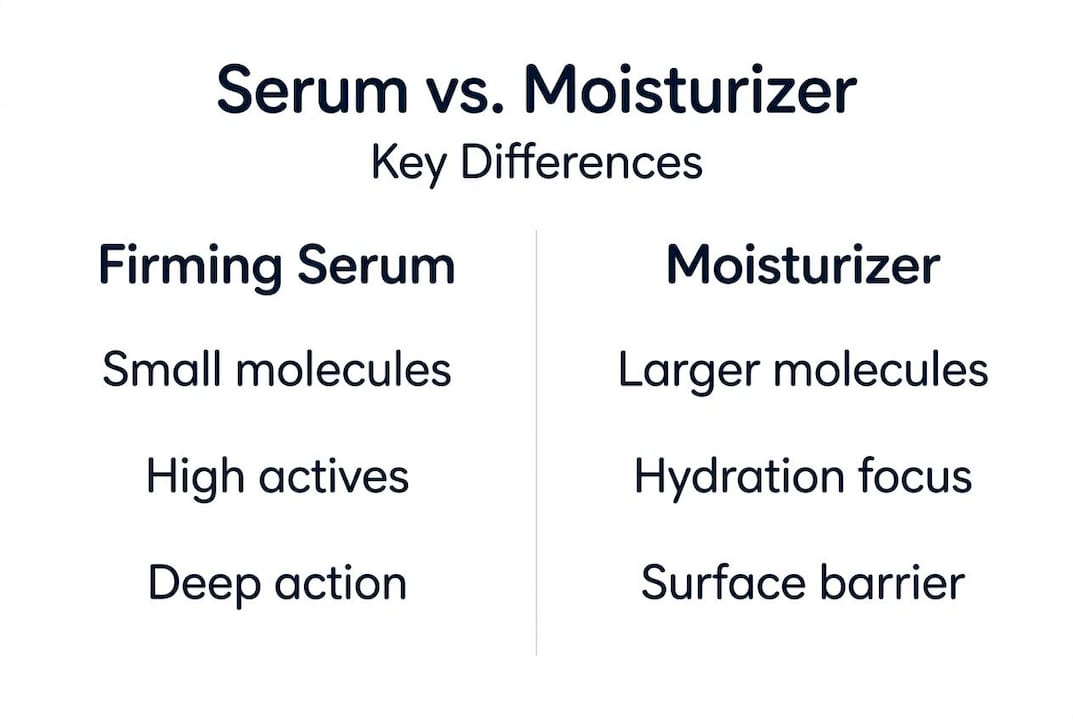
Here is how the two products compare side by side:
| Feature | Firming serum | Moisturizer |
|---|---|---|
| Primary focus | Stimulating collagen and elastin | Surface hydration and barrier repair |
| Active concentration | High, clinically dosed | Lower, supporting role |
| Texture | Lightweight, fast-absorbing | Richer, occlusive |
| When to apply | Before moisturizer, on clean skin | After serum, as the final layer |
| Core benefit | Firmness, elasticity, skin renewal | Hydration, softness, protection |
As established in skincare practice, serums have higher active concentrations for deeper treatment while moisturizers provide surface hydration and barrier protection. The recommended sequence is always serum first, moisturizer second.
Firming serums also play a specific architectural role. They support the production of collagen and elastin, the two proteins responsible for skin’s bounce and structural integrity. By supplying the signals and building blocks these proteins need, effective anti-aging serums create visible, measurable improvements that a moisturizer simply cannot replicate. To understand why serums’ role in anti-aging is so central, it helps to look at the biological mechanisms they trigger.
How do firming serums work?
Once you understand what sets a firming serum apart, it’s time to look under the hood at how these products achieve visible changes. The answer lies in a layered biological process that unfolds over weeks, not hours.
The mechanisms behind firming serums can be broken into four distinct actions:
- Peptide signaling. Peptides are short chains of amino acids that act as messengers, instructing fibroblast cells in the skin to produce more collagen and elastin. Specific peptides like Matrixyl (palmitoyl pentapeptide-4) have been extensively studied for their ability to reduce wrinkle depth and improve structural firmness.
- Growth factor stimulation. Growth factors are proteins that regulate cell growth and tissue repair. When delivered topically in a serum, they accelerate skin renewal and support the rebuilding of degraded collagen fibers.
- Moisture binding and retention. Ingredients like hyaluronic acid hold up to 1,000 times their weight in water. This deep hydration plumps the tissue below the surface, temporarily but meaningfully improving the appearance of firmness.
- Barrier reinforcement. By reducing transepidermal water loss (TEWL, meaning the rate at which your skin loses moisture to the environment), a well-formulated serum keeps the skin environment stable enough for repair processes to happen consistently.
Clinical research backs up each of these mechanisms. A 4-week peptide serum study documented a 72.5% hydration increase, a 37.7% improvement in softness, and a measurable reduction in TEWL. These are not marginal numbers. They represent the kind of change that shows up in the mirror.
“A biomimetic collagen peptide serum demonstrated a 72.5% hydration increase and 37.7% softness improvement after just four weeks, confirming that evidence-based firming formulas produce measurable, skin-level results.” (MDPI, 2025)
The following table summarizes the clinical performance data for the most studied active categories:
| Active ingredient | Primary mechanism | Documented effect |
|---|---|---|
| Biomimetic peptides | Collagen synthesis stimulation | 72.5% hydration gain, 37.7% softness gain |
| Matrixyl (Pal-KTTKS) | Fibroblast activation | Measurable wrinkle depth reduction |
| Retinoids | Cell turnover acceleration | Skin thickness increase over 12 to 24 weeks |
| Hyaluronic acid | Water binding | Immediate plumping and sustained hydration |
Understanding science-backed peptides is important because not all peptides perform equally. The specific chain length, carrier, and concentration all determine whether a peptide reaches its target site. Learning how peptides work in practical terms helps you read labels more critically.
Pro Tip: Results from firming serums typically become visible between 4 and 12 weeks of consistent daily use. Retinoid-based formulas may take longer, with peptide technology repair showing meaningful structural changes closer to the 8 to 12 week mark. Commit to that window before drawing conclusions.
Key ingredients in firming serums
Knowing how firming serums work brings us to the heroes of the formula, the specific ingredients responsible for visible transformation. Every effective firming serum is built around a small number of well-researched actives, each contributing to the overall result in a distinct way.
Here is a breakdown of the most impactful ingredients you should be looking for:
- Biomimetic peptides (e.g., Matrixyl). These mimic the fragments of collagen breakdown, which signal the skin to produce new collagen. Peptides like Matrixyl reduce wrinkle depth and significantly improve skin softness with consistent use.
- Retinoids. Vitamin A derivatives remain among the most researched anti-aging ingredients available. Retinoids speed up cell turnover, build collagen thickness, and smooth fine lines over a 12 to 24 week period. They require careful introduction, especially for sensitive skin types.
- Hyaluronic acid. A moisture-binding molecule found naturally in your skin, hyaluronic acid replenishes hydration at multiple depths when delivered in a serum format with varied molecular weights.
- Polynucleotides. Fragments of DNA that stimulate fibroblast activity and tissue regeneration. Increasingly used in clinical-grade serums for their cellular repair properties.
- Tranexamic acid. Primarily known for brightening uneven tone and reducing pigmentation, tranexamic acid pairs well in multi-active serums designed to address both firmness and discoloration simultaneously.
- Growth factors. Proteins like EGF (epidermal growth factor) encourage skin cell proliferation and collagen remodeling, making them especially valuable in serums targeting mature skin concerns.
One thing that separates average serums from exceptional ones is synergy. When peptides, hyaluronic acid, and growth factors are formulated together at the right concentrations, they amplify each other’s effects. Top peptides for skin often work most effectively alongside hydrating agents that keep the skin environment optimal for repair. The science behind peptides’ science-backed benefits reinforces why multi-peptide serums consistently outperform single-ingredient approaches.
Pro Tip: When evaluating a new serum, scan the ingredient list and check whether the actives you care about appear within the first third. Cosmetic regulations require listing ingredients in descending order of concentration, so if peptides or retinoids appear near the bottom, they may be present in amounts too small to produce visible results.
How to use a firming serum for best results
After exploring what makes an effective serum, learning proper application is the final key to unlocking consistent results. Even the most advanced formula underperforms when applied incorrectly or in the wrong order.
Follow these steps for optimal absorption and results every day:
- Cleanse thoroughly. Remove makeup, sunscreen, and surface debris with a gentle cleanser suited to your skin type. Applying serum to uncleansed skin creates a barrier that limits how well active ingredients absorb.
- Apply serum to damp skin. A slightly damp face helps the serum spread evenly and supports penetration. Use 2 to 4 drops and press gently into the skin using your fingertips rather than rubbing, which can create friction and reduce efficacy.
- Wait 60 to 90 seconds. Allow the serum to absorb fully before layering anything on top. Rushing this step is one of the most common mistakes people make.
- Apply a moisturizer. As confirmed by established skincare routine practice, moisturizer should always follow serum to seal in active ingredients and maintain the skin barrier.
- Apply SPF in the morning. Many firming actives, particularly retinoids and vitamin C derivatives, increase photosensitivity. A broad-spectrum SPF 30 or higher is non-negotiable in your morning routine.
Avoid these common mistakes that can dramatically reduce your results:
- Using too large a quantity of serum, which wastes product and can cause pilling under moisturizer
- Skipping moisturizer, which leaves skin vulnerable to TEWL and disrupts the repair environment
- Mixing actives like retinoids and acids in the same application without understanding how they interact
- Expecting results within a few days and abandoning the routine before real change has time to develop
- Applying serum over sunscreen or makeup instead of on clean skin
Learning the specifics of applying peptide serums correctly can make a measurable difference in how quickly you see results. If you are still on the fence about whether this level of effort is worth it, understanding why prioritizing skin firmness matters both aesthetically and biologically may shift your perspective.
What most people get wrong about firming serums
With clear application steps in mind, it’s time to unpack the truths that most marketing fails to mention about firming serums.
The biggest mistake people make is expecting overnight transformation. Skin at the cellular level works on its own timeline, and that timeline does not bend to wishful thinking or marketing copy. Collagen synthesis, fibroblast activation, and true structural change take weeks to accumulate. We have seen this pattern consistently: someone begins a serum, sees no dramatic change in two weeks, and switches to something new. What they do not realize is that they may have been one week away from their first visible results.
The second mistake is trusting hype over hard data. The skincare industry is full of products making remarkable claims with no clinical evidence to support them. Real firming comes from ingredients with published trials behind them, not from proprietary blends with exotic-sounding names and zero peer-reviewed backing. When a brand publishes actual clinical outcomes rather than vague before-and-after testimonials, that is a signal worth paying attention to.
There is also a common misconception that more actives automatically mean better results. Formulation chemistry is nuanced. A serum with 15 ingredients all competing for the same absorption pathway may perform worse than one with 4 carefully selected actives at the right concentrations. Simplicity combined with clinical dosing often wins.
Finally, there is the myth that one routine works for everyone. Your skin’s specific history, hydration levels, existing sensitivity, and rate of collagen depletion are all unique. What delivers outstanding results for someone else may need adjusting for you. Start with the evidence, be methodical about your routine, and adjust based on how your skin specifically responds. Learning to restore firmness with peptides as part of a tailored approach is far more effective than copying someone else’s regimen exactly.
Upgrade your skincare routine with proven firming solutions
The science is clear: consistent use of the right actives, applied in the right order, produces real and measurable change in skin firmness. But knowing the science is only half the equation. Having access to formulations that actually deliver those clinically dosed actives is the other.
At Cellure, every product is formulated around bioactive ingredients with published clinical backing. If you are ready to address firmness loss with a targeted approach, the Tranexamic Acid Peptide Serum combines multi-functional actives to tackle both tone and structural firmness simultaneously. For a full regenerative protocol, the Complete Skin Repair Kit gives you a coordinated system of serums and treatments designed to work synergistically, addressing the multiple dimensions of aging skin in a single routine.
Frequently asked questions
How long does it take to see results from a firming serum?
Visible improvements may begin within 4 weeks, but maximum firming often emerges after 2 to 3 months of consistent use, with retinoids building skin thickness over 12 to 24 weeks of continued application.
Can I use firming serum and moisturizer together?
Yes, and you should. Apply serum first, then layer moisturizer on top, as recommended for optimal absorption and to seal in the active ingredients.
What causes skin to lose firmness as we age?
Aging reduces collagen and elastin production naturally, causing skin to become progressively thinner, less elastic, and more prone to sagging, a process that accelerates after your 30s.
Are all firming serums safe for sensitive skin?
Not all formulas are suitable for sensitive skin. Avoid fragrances and high concentrations of retinoids if your skin reacts easily, and consult a dermatologist before introducing any strong actives into your routine.
What ingredients should I look for in a firming serum?
Prioritize clinically proven actives like peptides (especially Matrixyl), retinoids, hyaluronic acid, and polynucleotides, all of which have published evidence supporting their role in improving skin firmness and reducing visible signs of aging.
Recommended
- Restore Skin Firmness: Science-Backed Steps for Results – Cellure
- Why Prioritize Skin Firmness? Science-Backed Benefits – Cellure
- Science-backed serums: proven role in anti-aging skin – Cellure
- Role of Serums in Skin Health: Science and Impact – Cellure
- Serum guide: boost hydration and skin health simply – SMPL SKIN South Africa
Share