


Why targeted skincare works: science for real results
TL;DR:
- Targeted skincare addresses cellular deficits and biological changes caused by aging.
- Clinical evidence shows targeted products outperform generic ones in hydration, elasticity, and pigmentation.
- Active ingredients like peptides, retinoids, and ceramides stimulate skin repair at the cellular level.
Why targeted skincare works: science for real results
Most people assume that any well-reviewed anti-aging cream will deliver the same results on their skin. That belief is costing them years of wasted effort. Skin in adults 30 to 60 undergoes a cascade of biological changes — slowed collagen synthesis, extended cell turnover, and hormonal shifts — that generic formulas simply are not built to address. Targeted skincare is a different category entirely: it works at the cellular level, matching active ingredients to specific biological deficits. This guide will walk you through the science, the evidence, and the practical decisions that make a measurable difference for aging skin.
Table of Contents
- How aging affects your skin: Complex changes in your 30s to 60s
- What makes targeted skincare different: Science and ingredients
- Do targeted solutions really outperform generic skincare?
- Cellular mechanisms: How targeted skincare repairs and rejuvenates
- When and how to personalize: Nuance, risks, and expert advice
- A fresh perspective: The real key is not the most personalized, but the most strategic routine
- Where to find science-backed targeted skincare
- Frequently asked questions
Key Takeaways
| Point | Details |
|---|---|
| Aging needs change | Skin over 30 experiences complex changes requiring more than one-size-fits-all products. |
| Targeted works better | Evidence shows targeted solutions improve hydration, elasticity, and visible aging far more than generic routines. |
| Ingredients matter most | Peptides, retinoids, and ceramides make the difference by addressing cellular repair and rejuvenation directly. |
| Go strategic, not maximal | Smart, evidence-based targeting outperforms over-complicated or overly-personalized regimens. |
How aging affects your skin: Complex changes in your 30s to 60s
Understanding why generic skincare underperforms starts with understanding what is actually happening in your skin as you age. This is not a simple story about wrinkles. It is a layered set of biological changes, each compounding the others, that demand equally layered solutions.
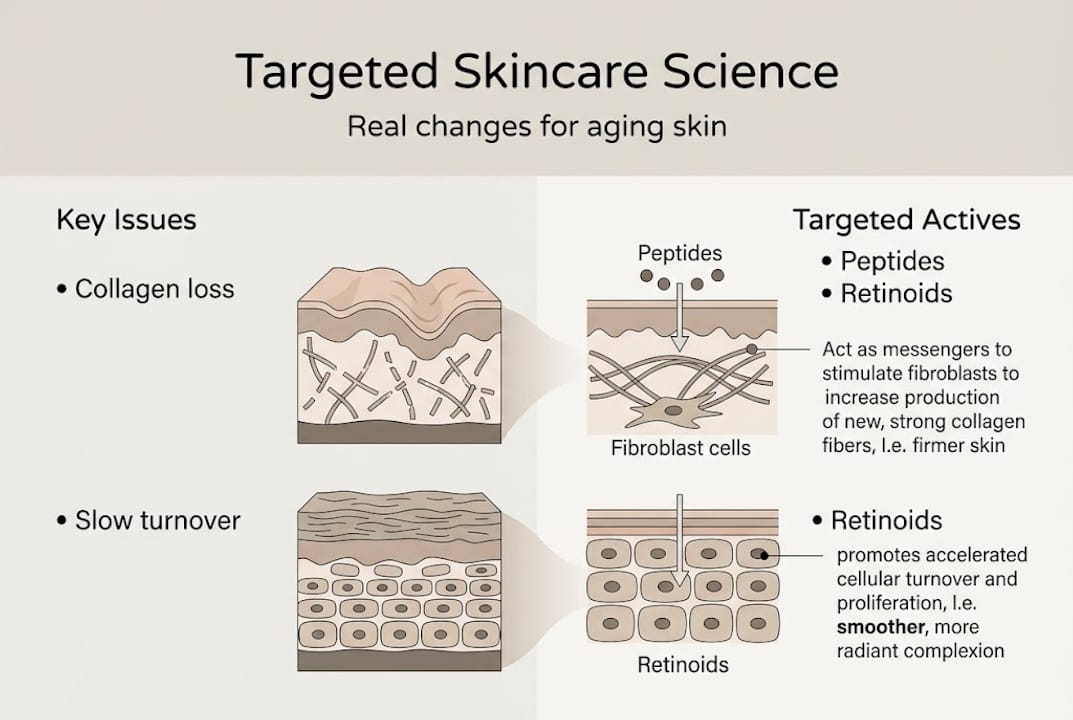
Collagen loss is faster than most people realize. Your body loses collagen at roughly 1 to 1.5% each year, and that rate accelerates sharply after menopause. Within the first five years after menopause, skin can lose up to 30% of its collagen content. The result is skin that thins out, loses resilience, and stops bouncing back the way it once did. Standard moisturizers were not formulated with this structural deficit in mind.
Cell turnover slows from 28 days to 45 to 60 days by the time you are in your 50s. Dead skin cells accumulate on the surface longer, contributing to dullness, uneven texture, and reduced radiance. When a product’s efficacy depends on ingredients being absorbed efficiently, slower turnover means slower and weaker results.
Here is a quick overview of how these changes stack up across decades:
| Skin change | In your 30s | In your 40s to 50s |
|---|---|---|
| Collagen synthesis rate | Declining gradually | Accelerating loss post-menopause |
| Cell turnover cycle | ~28 to 35 days | ~45 to 60 days |
| Barrier function | Slightly weakened | Significantly compromised |
| Hormonal influence | Early fluctuations | Pronounced disruption |
Key changes that matter most for treatment decisions:
- Collagen and elastin fibers break down faster than they are replaced
- The skin’s natural moisturizing factors (NMF) decrease, reducing water-retention capacity
- Sebaceous gland activity slows, making skin drier and more reactive
- Barrier lipids, including ceramides and fatty acids, decline substantially
- Chronic low-grade inflammation, sometimes called “inflammaging,” builds in the dermis
Key stat: Adults in their 50s can experience a cell turnover slowdown of more than 50% compared to their 20s, which is why a one-size-fits-all approach consistently falls short.
Generic anti-aging products are typically designed around the lowest common denominator. They may include a single moisturizing agent or a trace amount of antioxidant, but they are not dosed or formulated to account for these simultaneous, converging changes. For anyone serious about evidence-based aging repair, understanding these biological layers is the necessary starting point.
What makes targeted skincare different: Science and ingredients
With the aging process laid out clearly, the case for targeted ingredients becomes much stronger. Targeted skincare is not just marketing language. It refers specifically to formulas that use high-potency bioactive ingredients, dosed at clinically relevant concentrations, to address particular deficits in aging skin.
Peptides are among the most versatile and well-studied actives in this category. They function as cell-signaling molecules, communicating directly with skin cells to stimulate collagen and elastin production. Matrikine peptides, for example, are fragments of extracellular matrix proteins that trigger the skin’s own repair response. They do not just sit on the surface. They interact with fibroblasts, the cells responsible for producing structural proteins, and tell them to get to work.
Retinoids are the most clinically validated anti-aging actives in dermatology. They accelerate cell turnover, directly countering the slowdown that comes with aging. Tretinoin and its over-the-counter relatives (retinol, retinal) also stimulate collagen synthesis and help normalize skin tone. The mechanism is direct: retinoids bind to nuclear receptors in skin cells and influence gene expression at a fundamental level.

Ceramides are lipid molecules that make up a critical part of the skin’s barrier. As ceramide levels fall with age, the skin loses its ability to retain moisture and resist environmental damage. Targeted skincare uses peptides, retinoids, and ceramides alongside cellular signalers to repair specific deficits that broad products simply cannot touch.
| Ingredient | Mechanism | What it corrects |
|---|---|---|
| Peptides | Cell signaling, collagen stimulation | Loss of firmness and volume |
| Retinoids | Accelerated cell turnover, gene regulation | Fine lines, dullness, texture |
| Ceramides | Barrier restoration | Dryness, sensitivity, moisture loss |
| Niacinamide | Pigment suppression, barrier support | Uneven tone, enlarged pores |
| Tranexamic acid | Melanin pathway inhibition | Stubborn hyperpigmentation |
“When ingredients are matched precisely to biological deficits rather than applied generally, the skin’s repair capacity is actually engaged rather than bypassed.”
Pro Tip: Look for products where the active ingredient concentration is disclosed on the label. A peptide serum with 5 to 10% active content will do significantly more than one where peptides appear near the bottom of an ingredient list.
For anyone researching targeting cellular repair or looking for a primer on regenerative skincare solutions, understanding ingredient mechanisms is what separates informed choices from expensive guesses.
Do targeted solutions really outperform generic skincare?
Claims are easy to make in the skincare industry. The data is what matters. Fortunately, there is a substantial body of clinical evidence comparing targeted and personalized skincare against generic anti-aging approaches, and the results consistently favor the targeted side.
A review of 22 randomized controlled trials found that personalized and targeted skincare routines outperformed generic products across three key metrics: hydration, elasticity, and pigmentation. Specifically, targeted approaches produced a +15% improvement in hydration and a 9% reduction in transepidermal water loss (TEWL), the measure of how much water escapes through the skin. Targeted skin activation also reduced cellular senescence and improved the dermal-epidermal junction (DEJ) integrity in 83% of subjects, compared to just 17% in the control group using generic products.
A network meta-analysis in Scientific Reports confirmed that targeted topicals, including tretinoin, retinol, and specialized peptide serums, were superior for both wrinkle reduction and hyperpigmentation compared to general-purpose creams. One specific protocol involving a microneedle cream combined with targeted instruction produced a +28% increase in hydration and measurable reductions in wrinkle depth and pigmentation within just eight weeks.
Compare those outcomes with what generic products typically deliver:
| Outcome measure | Targeted skincare | Generic skincare |
|---|---|---|
| Hydration improvement | +15 to +28% | +3 to +7% |
| TEWL reduction | ~9% | Minimal or inconsistent |
| Pigmentation improvement | Significant in 8 weeks | Slow and variable |
| DEJ integrity improvement | 83% of subjects | 17% of subjects |
Key findings from the clinical evidence:
- Generic moisturizers often improve surface feel without affecting structural skin health
- Targeted actives at correct doses produce statistically significant changes in skin architecture
- Results from targeted approaches are more consistent and reproducible across skin types
- The gap in outcomes widens with age, meaning older skin benefits disproportionately from targeted care
Stat callout: In the 22-RCT review, targeted skin activation improved dermal-epidermal junction integrity in 83% of subjects, versus only 17% with generic controls.
For practical context on what these numbers mean day-to-day, the skin hydration results and cellular repair practices resources offer useful frameworks for applying this evidence to real routines.
Cellular mechanisms: How targeted skincare repairs and rejuvenates
Looking at clinical outcomes is one thing. Understanding exactly how targeted skincare produces those outcomes at the cellular level tells a more complete story, and explains why some people see transformative results while others using generic products plateau quickly.
Here is how targeted skincare works beneath the surface:
-
Reducing cellular senescence. As skin ages, more cells enter a state called senescence, where they stop dividing and begin secreting inflammatory signals. This process, sometimes called the senescence-associated secretory phenotype (SASP), drives low-grade inflammation that degrades collagen and disrupts tissue repair. Targeted ingredients, including certain peptides and antioxidants, reduce senescent cell burden and quiet this inflammatory signal.
-
Boosting NAD+ and activating sirtuins. NAD+ is a coenzyme essential for cellular energy and DNA repair. Levels decline with age, reducing the skin cell’s ability to maintain itself. Some targeted ingredients influence the NAD+/SIRT1/SIRT3/SIRT6 axis, essentially recharging the cell’s capacity to repair damage and resist stress.
-
Stimulating autophagy. Autophagy is the process by which cells clean out damaged proteins and organelles. When autophagy slows with age, cellular debris accumulates and skin function deteriorates. Certain actives in targeted formulas can reactivate this housekeeping process, helping cells function more like younger versions of themselves.
-
Exosome-mediated repair signaling. Some advanced formulas incorporate exosome-inspired signaling pathways. Exosomes are extracellular vesicles that carry repair instructions between cells. Products that mimic or support this signaling help coordinate tissue repair at a systems level, not just at the surface.
“True skin rejuvenation is a cellular event. When you address senescence, energy pathways, and repair signaling together, visible results follow naturally.”
Pro Tip: If you are post-menopause, note that collagen loss of up to 30% in the first five years makes peptide-based serums particularly valuable. Retinoids remain effective but may cause more irritation on barrier-compromised, hormonally shifted skin. Starting with peptides and ceramides, then layering in a low-dose retinoid, is often the smarter sequence.
For a complete breakdown of these mechanisms and how science-backed cellular skincare translates them into product formulations, the research goes deeper than most people expect.
When and how to personalize: Nuance, risks, and expert advice
Not every skin concern requires a highly specialized arsenal. It is important to apply the right level of intervention to the actual problem, without falling into over-customization that adds cost, complexity, and sometimes confusion.
When broad staples are enough:
- Mild early aging signs in your early 30s, such as minor dullness or slightly uneven tone
- Skin that responds well to basic retinoid plus vitamin C plus SPF routine
- Situations where barriers to compliance (cost, time, sensitivity) outweigh incremental gains from complex routines
When targeted skincare becomes essential:
- Persistent hyperpigmentation that has not responded to general brighteners
- Significant loss of firmness or volume after 45, especially post-menopause
- Compromised barrier leading to chronic dryness and reactivity
- Active inflammatory concerns like rosacea or ongoing breakouts that coexist with aging signs
Expert consensus from dermatology research recommends retinoids, vitamin C, and niacinamide as the core anchors for most anti-aging routines addressing lines and dark spots. Beyond that core, personalization should be driven by specific concerns that are not responding, not by ingredient trend-following.
The risk of over-customizing is real. When targeted skincare is worth pursuing, there is a clear clinical need. When people stack 10 actives based on influencer advice rather than skin response data, they often create more sensitivity and barrier disruption than benefit. Generic products, in that scenario, might actually outperform the overcomplicated routine.
Pro Tip: Use a simple benchmark to evaluate your current routine. After 8 weeks, your skin should feel meaningfully more hydrated, show some visible improvement in the concern you are targeting, and not be more reactive than when you started. If any of those markers are absent, re-evaluate rather than add more products.
A practical starting place for how cellular repair works in a real routine can help you apply these principles without overcomplicating things.
A fresh perspective: The real key is not the most personalized, but the most strategic routine
Here is something the skincare industry rarely admits: the people who get the best results are usually not using the most complex routines. They are using a small number of well-chosen, well-dosed actives, consistently, over months and years.
The conversation around targeted skincare has drifted too far toward micro-personalization for its own sake. People spend hours researching ingredient combinations and assembly-line their bathroom shelves with single-ingredient serums, yet they switch products every six weeks before giving anything a real chance to work.
What the firmer skin research consistently shows is that empirical benchmarks matter far more than ingredient lists. A 15% hydration increase, a visible reduction in transepidermal water loss, a measurable lift in skin density at 12 weeks. These are the numbers worth chasing. The path there is strategic simplicity: identify your most significant aging concern, select evidence-based actives that directly address it at the cellular level, and commit to consistent use. That approach, not the 12-step maximalist routine, delivers predictable and sustainable transformation for most people in their 30s to 60s.
Where to find science-backed targeted skincare
Putting this knowledge into practice means choosing products that are actually built on the science covered here, not just products that cite it loosely on a marketing page.
At Cellure, every formulation is built around clinically supported bioactive ingredients at effective concentrations, targeting real cellular deficits in aging skin. The Complete Skin Repair Kit brings together the core actives your skin needs for repair, volume, and barrier restoration in one cohesive system. For targeted brightening and pigmentation control, the Tranexamic Acid Peptide Serum delivers two of the most evidence-backed actives for uneven skin tone. Explore the full breakdown of how each ingredient works at the Cellure ingredients page to understand exactly what you are applying and why.
Frequently asked questions
What are the proven benefits of targeted skincare over generic products?
Targeted skincare outperforms generic across 22 RCTs, delivering greater hydration, better elasticity, and measurable pigmentation improvements that general products consistently fail to match.
Is targeted skincare necessary for all aging skin or just severe cases?
Mild aging concerns in early adulthood often respond to quality general products, but targeted approaches outperform when concerns are persistent, complex, or have not responded to standard routines.
Which actives should you look for in a targeted anti-aging routine?
Expert dermatology consensus recommends retinoids, vitamin C, niacinamide, and peptides as the core actives for addressing lines, dark spots, and firmness loss in aging skin.
What cellular effects does targeted skincare have that generic products do not?
Targeted skincare reduces cellular senescence and activates NAD+, SIRT pathways, and autophagy, which are fundamental repair mechanisms that generic formulas do not engage at any clinically meaningful level.