


Skin hydration science: 72.5% better results explained
TL;DR:
- Skin hydration involves the barrier, lipids, and cellular communication, not just water intake.
- Aging reduces natural moisturizing factors and weakens the skin barrier, causing dryness and wrinkles.
- Using layered ingredients like ceramides, humectants, and occlusives, plus oral support, enhances skin hydration.
Most people assume hydrated skin just means drinking enough water. That assumption is costing you real results. Skin hydration is a complex biological system involving your skin’s barrier, lipid matrix, and cellular communication, and when it breaks down, the visible signs of aging accelerate fast. Stratum corneum water content directly controls elasticity, smoothness, and how well your skin defends itself. If you’re in your 30s, 40s, or 50s and noticing dryness, dullness, or fine lines that weren’t there before, understanding the actual science of hydration is the first step toward changing it.
Table of Contents
- How hydration maintains healthy, resilient skin
- Why aging skin loses hydration and what changes
- Key ingredients and strategies for optimal skin hydration
- Proof: What research says about hydration, aging, and visible results
- Aging skin and hydration: What most guides get wrong
- Upgrade your skin hydration: The next step
- Frequently asked questions
Key Takeaways
| Point | Details |
|---|---|
| Barrier is key | Healthy skin relies on a strong lipid barrier to retain hydration and prevent aging. |
| Aging worsens dryness | Natural moisturizing factors and barrier lipids decline as you age, raising the need for targeted hydration. |
| Science-backed strategies | Combining humectants, emollients, and occlusives offers the best chance for visible improvement in aging skin. |
| Consistent care matters | Lasting results require daily, evidence-based hydration—both topical and, when appropriate, oral. |
How hydration maintains healthy, resilient skin
Your skin’s outermost layer, the stratum corneum, is not just dead cells stacked on top of each other. It’s an active barrier system that regulates water movement in and out of your body. When it functions well, your skin looks plump, feels smooth, and resists damage. When it doesn’t, everything from texture to tone suffers.
The lipid barrier within the stratum corneum is made up of three key components: ceramides (roughly 50% of the total), cholesterol, and fatty acids. These lipids form a tight seal that prevents transepidermal water loss (TEWL), the process by which water evaporates from your skin into the air. Filaggrin, a structural protein, breaks down into natural moisturizing factors (NMFs) that act as built-in humectants, pulling water into the skin cells themselves.
When your barrier is intact and hydration levels are optimal, the benefits are measurable and visible:
- Elasticity: Hydrated skin snaps back faster and resists mechanical stress
- Protection: A healthy barrier blocks irritants, allergens, and pathogens
- Cell turnover: Normal hydration supports regular shedding and renewal of skin cells
- Even tone: Hydrated skin reflects light more uniformly, reducing the appearance of dullness
- Reduced sensitivity: A strong barrier means fewer reactions to environmental triggers
“Hydration isn’t just a cosmetic quality. It’s the foundation that allows the skin barrier to self-repair, regulate inflammation, and maintain the signaling pathways that keep skin functioning at a cellular level.”
For anyone focused on skin barrier repair, understanding this architecture is essential. You can’t fix what you don’t understand, and the barrier is where long-term skin health is won or lost.
Why aging skin loses hydration and what changes
Here’s something most people don’t hear until it’s already happening: the structural decline in skin hydration starts as early as your late 20s. By the time you’re in your 40s or 50s, the changes are significant enough to show up in clinical measurements, not just in the mirror.
As you age, NMF levels decline while TEWL increases, meaning your skin produces fewer of its own moisturizing compounds while losing water faster. Collagen production also drops, reducing the skin’s ability to hold structural moisture in the dermis. The result is skin that looks thinner, feels rougher, and wrinkles more easily.

| Metric | Young skin (20s) | Aging skin (40s-60s) |
|---|---|---|
| NMF concentration | High | Significantly reduced |
| TEWL rate | Low | Elevated |
| Skin elasticity | Strong | Decreased |
| Barrier lipid content | Robust | Diminished |
| Collagen density | Dense | Thinning |
Certain factors push this decline even faster. Menopause triggers a sharp drop in estrogen, which directly reduces the skin’s ability to retain moisture. UV exposure degrades collagen and disrupts lipid production. Diabetes impairs circulation and cellular repair. Even air quality and indoor heating strip moisture from the skin’s surface daily.
Seasonal shifts matter too. Research shows a placebo group hydration decline of approximately 8.6% during autumn and winter months, which means your skin is fighting a harder battle during cold, dry seasons without any additional support.
Pro Tip: If you’re in your 40s or beyond, track how your skin feels at the change of each season. Hormonal fluctuations and temperature shifts often hit at the same time, creating a compounding dryness effect that requires a proactive, not reactive, approach. Learning how to restore firm, even skin before the season turns can make a measurable difference.
Key ingredients and strategies for optimal skin hydration
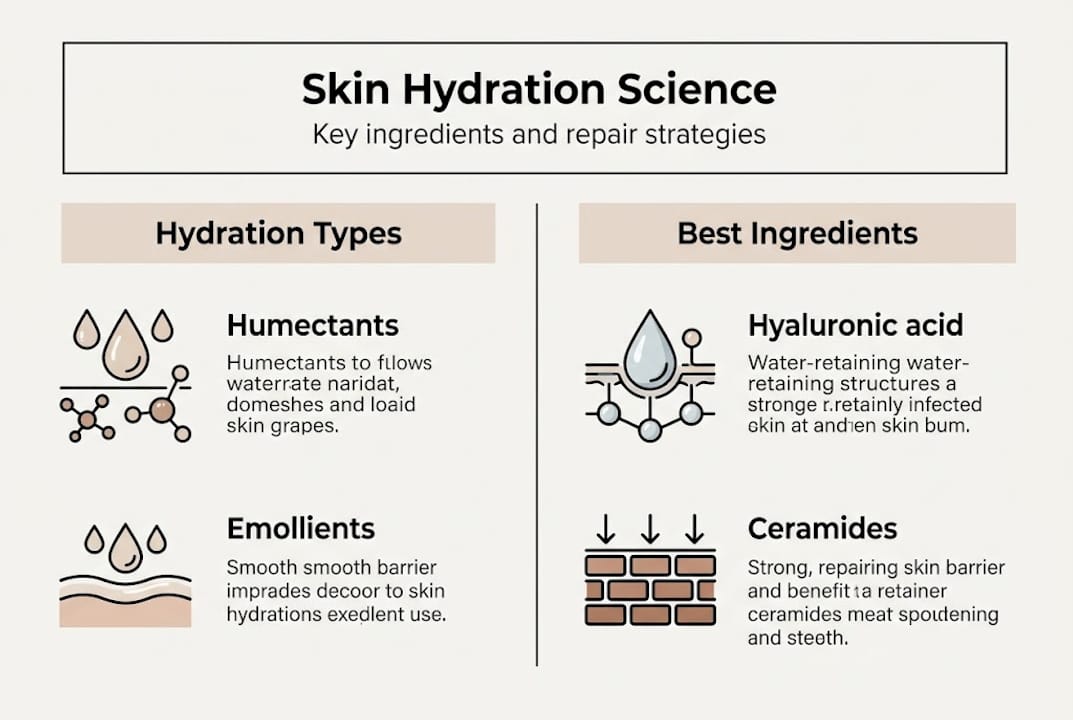
Not all moisturizing ingredients work the same way. Understanding the three main categories, humectants, emollients, and occlusives, helps you build a routine that actually addresses what your skin needs at this stage of life.
Humectants attract water from the environment and deeper skin layers into the stratum corneum. Hyaluronic acid and glycerin are the most studied. Emollients fill in gaps between skin cells, softening texture and improving flexibility. Occlusives form a physical film over the skin to block TEWL by up to 98%, locking in everything underneath. Ceramides restore the lipid matrix directly.
| Type | Main action | Best for | Common ingredients |
|---|---|---|---|
| Humectant | Draws water into skin | All types, especially dehydrated | Hyaluronic acid, glycerin |
| Emollient | Softens and smooths | Dry, rough, or mature skin | Squalane, shea butter |
| Occlusive | Seals moisture in | Very dry or compromised barriers | Petrolatum, beeswax |
| Ceramide | Restores lipid barrier | Aging or sensitive skin | Ceramide NP, AP, EOP |
For mature skin, the most effective approach layers these categories in sequence:
- Cleanse gently with a non-stripping formula to preserve existing barrier lipids
- Apply a humectant serum on damp skin to maximize water absorption
- Follow with an emollient to smooth and reinforce the skin surface
- Seal with an occlusive or ceramide-rich moisturizer to prevent water loss overnight
- Use SPF daily to stop UV-driven lipid degradation from undoing your work
Exploring top skin repair ingredients gives you a deeper look at how each compound works at the cellular level.
Pro Tip: Topical routines work faster when paired with oral support. Peptides for hydration and oral hyaluronic acid supplements address hydration from the inside out, reinforcing what your topical products are doing on the surface. After 30, this dual approach produces noticeably better results than either strategy alone.
Proof: What research says about hydration, aging, and visible results
The clinical data on skin hydration interventions is compelling, especially for adults in the 30 to 65 age range who are actively managing visible aging.
A randomized, double-blind, placebo-controlled trial with 150 participants found that oral sodium hyaluronate at 120mg daily over 12 weeks increased skin hydration by 11.5%, improved elasticity, increased epidermal thickness and dermal density, raised NMF levels, and reduced both TEWL and visible wrinkles compared to placebo.
On the topical side, a clinical study involving women aged 36 to 65 showed that a targeted hydration formula produced a 72.5% increase in hydration on the cheek within 15 minutes of application. By week four, dryness scores had dropped by 93.7%, TEWL had decreased by 12.7%, and measurable improvements in elasticity and skin texture were recorded.
These aren’t marketing numbers. They’re peer-reviewed outcomes from structured trials. What they confirm is that the right ingredients, used consistently, produce real, measurable changes in aging skin.
The visible benefits that show up in these trials include:
- Plumper, more voluminous skin due to improved water retention in the dermis
- Fewer visible fine lines as hydration restores the skin’s internal scaffolding
- Smoother texture from normalized cell turnover and barrier repair
- Stronger barrier resilience that holds up better against environmental stress
- More even tone as inflammation from dryness and irritation decreases
Reviewing cellular repair practices shows how consistent routines amplify these results over time, turning clinical outcomes into daily reality.
Aging skin and hydration: What most guides get wrong
Most hydration guides focus on one thing: adding moisture. Drink more water. Apply a heavier cream. Use a humidifier. These aren’t wrong, but they miss the deeper issue entirely.
True skin rejuvenation isn’t about flooding the skin with water. It’s about repairing the system that holds water in the first place. After age 30, the barrier deteriorates faster than it repairs itself. That’s the real problem. Slapping a thick moisturizer over a compromised barrier is like putting a bandage over a leaking pipe. It helps temporarily, but it doesn’t fix anything.
What actually works is barrier repair combined with ingredient synergy. Ceramides rebuild the lipid matrix. Peptides signal collagen production and firmer skin with peptides is a documented, measurable outcome. Humectants and occlusives work together in a layered system. And oral supplementation fills the gap that topical products can’t reach.
“True rejuvenation is repairing what’s beneath the surface, not just alleviating dryness.”
The brands and guides that focus purely on surface moisture are solving yesterday’s problem. For aging skin, the conversation needs to start at the barrier and work inward.
Upgrade your skin hydration: The next step
Understanding the science is one thing. Putting it into practice with the right formulations is where real change happens.
At Cellure, every product is built around the same principle this article is grounded in: barrier repair and cellular renewal, not surface-level hydration. If you’re ready to address aging skin with clinically supported ingredients, the Complete Skin Repair Kit is designed to work across all the layers your skin needs support. For targeted hydration and tone correction, the peptide serum for hydration combines bioactive peptides with brightening actives for results you can measure. Start with the science. Build with the right tools.
Frequently asked questions
What happens to skin if it isn’t hydrated?
Without proper hydration, skin loses elasticity, becomes rough, and is more vulnerable to irritation and accelerated aging. Barrier integrity and elasticity both depend directly on adequate water content in the stratum corneum.
How does age affect my skin’s ability to stay hydrated?
Aging reduces the natural moisturizing factors your skin produces and increases water loss through the barrier. NMF decline and rising TEWL together create the dryness and thinning that become more visible after 40.
Which ingredients provide the best hydration for aging skin?
Hyaluronic acid, glycerin, ceramides, and occlusive agents are the most clinically validated options for mature skin. Humectants, emollients, and ceramides each play a distinct role in restoring and maintaining hydration at different skin layers.
Do oral supplements improve skin hydration?
Yes, and the evidence is specific. Oral sodium hyaluronate at 120mg daily improved hydration, elasticity, and dermal density in a 12-week randomized trial, making it a meaningful complement to topical routines.
Is drinking water enough for hydrated skin?
No. While internal hydration matters, the skin barrier requires topical lipids and repair ingredients to prevent water from escaping. Barrier repair and lipid restoration are essential for lasting results that drinking water alone cannot achieve.
Recommended
Share