


Role of peptides in skin repair: a science-backed guide
Not all skincare peptides work the same way. Some stimulate collagen production, others deliver essential minerals deep into your skin, and a few even relax facial muscles to smooth wrinkles. Understanding these distinct mechanisms helps you choose formulations that actually repair aging skin instead of just moisturizing the surface. This guide breaks down the science behind peptide-driven skin repair, explains penetration challenges, reviews clinical evidence, and provides practical selection strategies so you can make informed decisions about peptide skincare that delivers measurable rejuvenation results.
Table of Contents
- Key takeaways
- Understanding how peptides repair skin
- Peptide size, skin penetration challenges, and formulation strategies
- Clinical evidence supporting peptides for skin repair and rejuvenation
- Practical guide: choosing and using peptides for effective skin repair
- Explore advanced peptide skincare solutions
- FAQ
Key Takeaways
| Point | Details |
|---|---|
| Peptide action types | Peptides repair skin through four mechanisms including signal peptides that boost collagen and elastin, carrier peptides that deliver trace minerals, neurotransmitter inhibitor peptides that relax facial muscles, and enzyme inhibitor peptides that slow collagen breakdown. |
| Penetration challenges | Delivery is hindered by molecular size and hydrophilicity plus skin peptidase activity, which often requires advanced systems to protect and transport peptides into the deeper layers. |
| Clinical evidence | Clinical studies indicate peptides can accelerate skin healing and improve elasticity when the right peptide types and delivery methods are used. |
| Formulation strategies | Formulation strategies such as nano encapsulation and liposomes, along with combining multiple peptide types, improve stability and tissue penetration for measurable rejuvenation. |
Understanding how peptides repair skin
Peptides promote skin repair primarily through four mechanisms: signal peptides stimulate collagen and elastin production; carrier peptides deliver trace elements; neurotransmitter inhibitor peptides relax facial muscles; enzyme inhibitor peptides block collagen-degrading enzymes. Each type addresses a specific aging concern at the molecular level.
Signal peptides like Palmitoyl Pentapeptide-4 act as messengers, triggering fibroblasts to ramp up collagen synthesis. When your skin detects these peptide signals, it responds by producing fresh structural proteins that restore firmness and smooth fine lines. This mechanism mimics your body’s natural repair response but amplifies it beyond what aging skin can achieve alone.
Carrier peptides such as GHK-Cu transport copper ions deep into skin tissue. Copper activates enzymes essential for collagen maturation and wound healing. Without adequate copper delivery, your skin cannot properly cross-link collagen fibers, leading to sagging and poor texture. These peptides solve a delivery problem that topical minerals alone cannot overcome.
Neurotransmitter inhibitor peptides like Acetyl Hexapeptide-8 work differently by reducing muscle contraction intensity. They interfere with the signals that cause repeated facial movements, which over time create expression lines. Think of them as a gentler alternative to neurotoxin injections, relaxing muscles enough to soften wrinkles without freezing expression.
Enzyme inhibitor peptides such as Tripeptide-10 Citrulline protect existing collagen from breakdown. Matrix metalloproteinases constantly degrade collagen as part of normal skin turnover, but this process accelerates with age and sun damage. By blocking these enzymes, inhibitor peptides preserve the structural integrity you have while other peptides build new collagen. Exploring top benefits peptides skin 2026 reveals how combining these mechanisms creates comprehensive anti-aging effects.
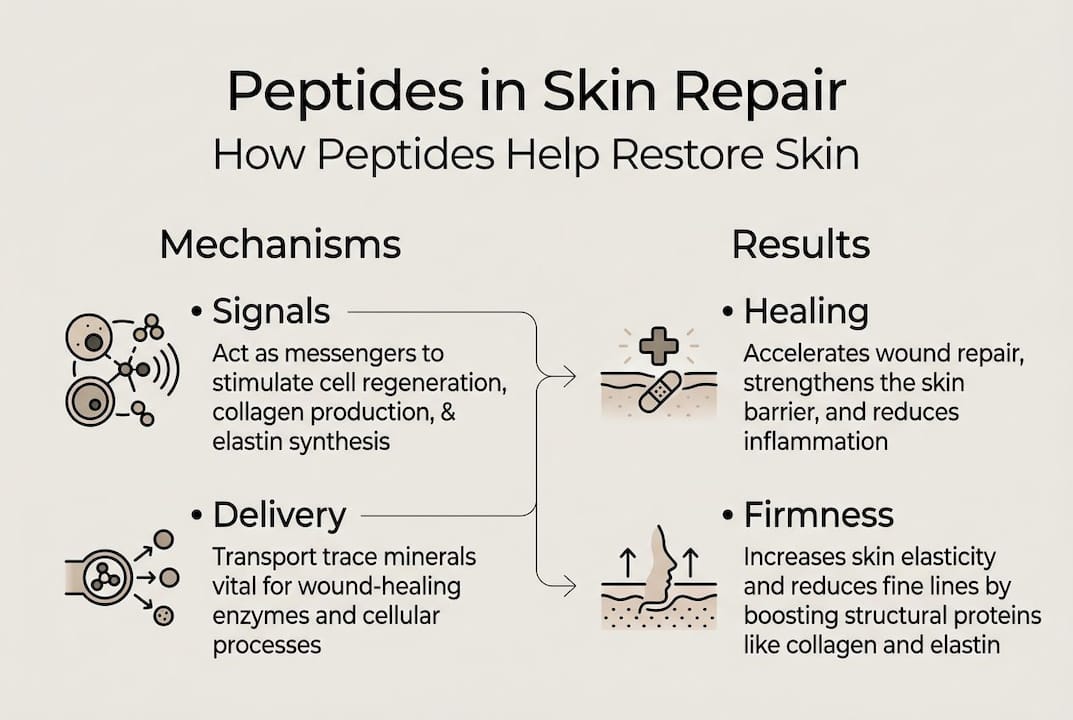
Pro Tip: Look for products containing multiple peptide types to address collagen production, delivery, wrinkle formation, and degradation simultaneously for maximum repair benefits.
Peptide size, skin penetration challenges, and formulation strategies
Your skin barrier evolved to keep molecules out, which creates a significant challenge for peptide delivery. Most peptides exceed the 500 Dalton molecular weight threshold for easy penetration. Even when peptides are small enough, their hydrophilic nature prevents them from crossing the lipid-rich stratum corneum effectively.

Peptidase enzymes in your skin actively break down peptides before they reach target cells. These enzymes recognize peptide bonds and cleave them, destroying the active molecule before it can signal fibroblasts or deliver cargo. This degradation happens rapidly on the skin surface and continues as peptides attempt to penetrate deeper layers.
Oligopeptides like GHK penetrate the skin barrier, but many peptides face poor permeability and degradation requiring nano-systems and enhancers. Advanced formulation technologies overcome these obstacles through several strategies:
- Nano-encapsulation wraps peptides in protective shells that shield them from peptidase degradation while facilitating membrane crossing
- Liposomes create lipid vesicles that fuse with skin cell membranes, directly depositing peptides inside cells
- Ethosomes use high ethanol concentrations to increase membrane fluidity, allowing larger peptides to squeeze through
- Penetration enhancers temporarily disrupt the stratum corneum structure, creating channels for peptide passage
- Chemical modifications add lipophilic groups to peptides, making them more compatible with the skin barrier
Oligopeptides containing three to six amino acids naturally penetrate better than longer chains. GHK, a tripeptide, reaches the dermis without extensive formulation assistance. Its compact size and specific amino acid sequence allow it to navigate the skin barrier while remaining stable enough to deliver copper and trigger repair signals.
The delivery system matters as much as the peptide itself. A potent signal peptide in a basic cream formulation will sit on your skin surface, degrading without reaching fibroblasts. The same peptide in a liposomal system penetrates to the dermis where it activates collagen production. Understanding science-backed benefits of peptides includes recognizing that formulation technology determines whether peptides actually work.
Pro Tip: Check product labels for terms like liposomal delivery, nano-encapsulation, or ethosomal formulation to ensure peptides can actually penetrate your skin barrier.
Clinical evidence supporting peptides for skin repair and rejuvenation
Clinical trials consistently demonstrate that peptides accelerate healing, improve skin quality, and reduce visible aging signs. Q-peptide significantly reduced post-procedure edema, erythema, and purpura versus control with a twofold reduction at two days. This trial used a split-face design where participants applied peptide serum to one side and placebo to the other after radiofrequency microneedling, providing direct comparison of healing speed.
Pea peptide with retinol increased collagen and elastin while reducing MMP1, improving skin hydration and elasticity in an eight-week trial. Participants showed measurable improvements in skin density and firmness through instrumental analysis, not just subjective assessments. The combination approach enhanced results beyond what either ingredient achieved alone.
| Peptide type | Study size | Duration | Key benefits |
|---|---|---|---|
| Q-peptide (angiopoietin-derived) | 20 participants | 14 days post-RFMN | 2x faster reduction in edema, erythema, purpura |
| Pea peptide with retinol | 33 participants | 8 weeks | Increased collagen/elastin, reduced MMP1, improved hydration |
| Palmitoyl peptides | 23 participants | 12 weeks | 20-50% wrinkle reduction, improved firmness |
| GHK-Cu complex | 67 participants | 12 weeks | Enhanced skin thickness, reduced fine lines, improved elasticity |
These trials reveal consistent patterns across peptide types:
- Wrinkle depth decreases by 20 to 50 percent with consistent use over 12 weeks
- Skin elasticity improves measurably through cutometer readings
- Hydration levels increase as peptides strengthen the moisture barrier
- Post-procedure recovery accelerates when peptides are applied immediately after treatments
- Collagen density increases while collagen-degrading enzymes decrease
The evidence shows peptides work through measurable biological changes, not just temporary plumping. Collagen synthesis increases, enzyme activity shifts favorably, and structural proteins accumulate in the dermis. These changes take time to manifest visibly, which explains why trials run eight to 12 weeks before assessing wrinkle reduction. Learning how to use peptides for skin includes understanding realistic timelines for visible improvement.
Pro Tip: Expect subtle improvements around week four, with significant wrinkle reduction becoming apparent between weeks eight and 12 of consistent peptide application.
Practical guide: choosing and using peptides for effective skin repair
Translating peptide science into smart skincare choices requires evaluating formulations systematically. Follow these steps to select products that deliver results:
- Identify the peptide types listed in the ingredient panel and match them to your primary concerns: signal peptides for collagen loss, carrier peptides for overall repair, neurotransmitter inhibitors for expression lines, enzyme inhibitors for collagen preservation.
- Verify the formulation includes penetration technology such as liposomes, nano-encapsulation, or ethosomes mentioned on the label or product description.
- Look for complementary ingredients that enhance peptide effectiveness: antioxidants protect peptides from oxidation, hyaluronic acid maintains hydration for optimal peptide activity, and gentle exfoliants improve penetration.
- Check the product pH and texture to ensure stability: peptides degrade in extreme pH environments, so formulations should maintain neutral to slightly acidic conditions.
- Start with one peptide product applied consistently for eight weeks before adding additional peptide formulations to accurately assess effectiveness.
Adults 30 to 55 should prioritize formulations with penetration aids and signal or carrier peptides for collagen boosting and repair. Key considerations when evaluating peptide products include:
- Peptide molecular weight: smaller oligopeptides penetrate more easily than longer chains
- Delivery system sophistication: advanced encapsulation dramatically improves results
- Synergistic active ingredients: peptides work better alongside antioxidants and hydrators
- Irritation potential: peptides generally cause minimal irritation, making them suitable for sensitive skin
- Concentration and stability: higher peptide concentrations do not always mean better results if the formulation lacks stability
Apply peptide serums to clean, slightly damp skin before heavier creams. The water content helps peptides spread evenly and begin penetrating immediately. Layer peptide products under moisturizer to seal them against your skin and prevent evaporation. You can safely combine peptides with retinol, vitamin C, and niacinamide, though introducing them gradually reduces the chance of irritation.
Monitor your skin weekly for subtle changes in texture, firmness, and fine line depth. Take photos in consistent lighting to track progress objectively. Most people notice improved skin feel before visible wrinkle reduction appears. If you experience no improvement after 12 weeks, the formulation likely lacks adequate penetration technology or contains insufficient peptide concentrations.
Exploring top skin repair ingredients how they work provides context for how peptides fit into a comprehensive anti-aging regimen. Reviewing detailed ingredients information helps you understand what to look for on product labels and how different actives complement peptide activity.
Explore advanced peptide skincare solutions
Now that you understand how peptides repair skin at the cellular level, consider formulations designed with these scientific principles in mind. The Complete Skin Repair Kit combines multiple peptide types with penetration-enhancing delivery systems to address collagen loss, firmness decline, and visible aging signs comprehensively. Each product in the kit targets specific repair mechanisms while working synergistically to accelerate rejuvenation.
The Tranexamic Acid Peptide Serum pairs signal peptides with brightening actives for those targeting both structural repair and tone correction. This formulation demonstrates how peptides integrate into targeted treatment regimens for specific concerns. Explore advanced cellular regeneration solutions that translate peptide science into practical skincare you can use daily for measurable skin quality improvements.
FAQ
What types of peptides repair skin best?
Signal peptides like Palmitoyl Pentapeptide-4 and carrier peptides such as GHK-Cu deliver the most comprehensive repair benefits by stimulating collagen production and delivering essential minerals. Neurotransmitter inhibitor peptides reduce dynamic wrinkles by relaxing facial muscles, while enzyme inhibitor peptides preserve existing collagen by blocking degradation. Combining multiple peptide types addresses aging from several angles simultaneously for optimal results.
How long does it take to see results using peptide skincare?
Wrinkle reduction of 20 to 50 percent typically occurs within four to 12 weeks of consistent peptide use. You may notice improved skin texture and hydration around week four, with visible wrinkle softening becoming apparent between weeks eight and 12. Consistent daily application as directed is essential because peptides work by gradually increasing collagen synthesis rather than providing immediate plumping effects.
Can peptides be safely combined with other anti-aging ingredients?
Peptides are generally safe and complementary with retinol, vitamin C, niacinamide, and antioxidants. Proper layering enhances results: apply peptide serums to clean skin first, then follow with other actives and moisturizer. Monitor your skin for any irritation when introducing multiple actives simultaneously, and consider alternating application times if sensitivity develops. Most people tolerate peptide combinations well because peptides cause minimal irritation compared to acids or retinoids.
Do peptides work better post-procedure like microneedling?
Clinical trials show peptides like Q-peptide reduce edema and redness, speeding post-RFMN recovery twofold. Peptides accelerate healing after microneedling, laser treatments, and chemical peels by providing the molecular signals and building blocks your skin needs for rapid tissue repair. Apply peptide serums immediately after procedures when your skin barrier is temporarily more permeable, allowing deeper penetration and faster recovery with reduced downtime.