


The science of skin renewal: 3 actives for youthful skin
TL;DR:
- Skin aging is significantly influenced by cellular processes controllable through skincare habits.
- Retinoids, platelet exosomes, and senolytics are key actives targeting cellular renewal and reducing senescence.
- Personalized routines based on individual biomarker assessments yield better renewal and anti-aging results.
Most people assume that how their skin ages is largely written in their DNA. That belief is understandable, but it’s increasingly outdated. Emerging research shows that the pace and pattern of skin aging are shaped significantly by cellular processes you can actually influence. Specifically, how well your skin renews itself at the cellular level determines much of what you see in the mirror. This guide walks through the biology of skin renewal, the actives with the strongest scientific support, and how to build a routine that works with your skin’s own repair systems rather than against them.
Table of Contents
- What drives skin renewal and aging? The cellular view
- Key players in cellular renewal: Fibroblasts, keratinocytes, and biomarkers
- Science-backed actives: Retinoids, exosomes, and senolytics
- How to build a skin renewal regimen: Application and best practices
- Why skin renewal requires both science and personalization
- Transform your skin renewal with Cellure science
- Frequently asked questions
Key Takeaways
| Point | Details |
|---|---|
| Skin renewal is cellular | Visible aging results from cellular changes, not just genetics, making renewal strategies impactful at any age. |
| Retinoids top the list | Decades of research and trials confirm retinoids as the most effective topical for skin renewal and anti-aging. |
| Personalization matters | Biomarker-guided routines and customizing actives to your skin type yield far better results than generic products. |
| Science guides results | Hydration, barrier restoration, and proven ingredients build the foundation for visible improvements in just 8-12 weeks. |
| Emerging therapies are promising | Exosomes and senolytics show potential, but currently work best as complements to trusted actives. |
What drives skin renewal and aging? The cellular view
Skin renewal is not a single process. It’s a coordinated effort happening across two distinct layers: the epidermis (outer layer) and the dermis (deeper structural layer). In the epidermis, new cells are constantly generated and pushed toward the surface, where they eventually shed. In the dermis, fibroblasts produce collagen and elastin to keep skin firm and resilient. When this system runs smoothly, skin looks plump, even, and youthful.
The problem is that this system slows down and degrades over time. One of the most significant reasons is cellular senescence, a state in which cells stop dividing but refuse to die. Instead, they linger and secrete a cocktail of inflammatory proteins known as the senescence-associated secretory phenotype, or SASP. These SASP factors damage surrounding healthy cells, degrade the extracellular matrix (the structural scaffold of your skin), and suppress the skin’s ability to regenerate. Research confirms that cellular senescence in fibroblasts and keratinocytes drives skin aging via SASP, causing ECM degradation, inflammation, and reduced regenerative capacity.
The biological hallmarks driving this process include:
- DNA damage from UV exposure and oxidative stress
- Telomere shortening as cells divide over time
- Mitochondrial dysfunction that reduces cellular energy
- Accumulation of p16INK4a, a protein that locks cells in senescence
Here’s a key insight that changes how you should think about aging: senescence burden is not purely age-dependent. Two people of the same age can have dramatically different levels of cellular senescence based on sun exposure history, diet, sleep quality, and stress. That means cellular aging in the skin is something you have real leverage over.
“The accumulation of senescent cells is not inevitable at any given age. Environmental and lifestyle inputs modulate the rate at which your skin’s renewal capacity declines.”
| Aging driver | Cellular mechanism | Visible skin effect |
|---|---|---|
| UV exposure | DNA damage, telomere attrition | Pigmentation, laxity |
| Chronic stress | Mitochondrial dysfunction | Dullness, slower healing |
| Poor sleep | Impaired ECM repair | Fine lines, puffiness |
| Senescent cells | SASP inflammation | Loss of firmness, uneven tone |
Understanding why cellular repair matters is the foundation for choosing the right actives. Without this context, most skincare decisions are guesswork.
Key players in cellular renewal: Fibroblasts, keratinocytes, and biomarkers
Two cell types do most of the heavy lifting in skin renewal. Fibroblasts live in the dermis and are responsible for producing collagen, elastin, and hyaluronic acid. When they’re healthy and active, your skin has structure and bounce. When they become senescent, they stop producing matrix proteins and start secreting SASP factors instead, actively working against your skin’s integrity.
Keratinocytes form the bulk of the epidermis and create the skin barrier. They migrate upward from the basal layer, differentiate, and eventually shed as dead skin cells. A healthy turnover cycle takes roughly 28 days in younger skin, but this slows significantly with age, leading to a duller, thicker-looking surface.
Here’s how the two cell types compare in their renewal roles:
| Cell type | Location | Primary function | Senescence effect |
|---|---|---|---|
| Fibroblast | Dermis | Collagen/elastin production | ECM degradation, SASP |
| Keratinocyte | Epidermis | Barrier formation, turnover | Slower renewal, dull tone |
Measuring senescence is now possible through specific biomarkers. Senescence markers including p16INK4a, SA-βgal (senescence-associated beta-galactosidase), and SASP cytokines are used in research and increasingly in clinical settings to assess how much senescent burden a person’s skin carries. This matters because it means anti-aging strategies can be guided by biology rather than just age.
Here’s a practical framework for thinking about your skin’s renewal profile:
- Assess your skin’s history — sun exposure, lifestyle habits, and stress levels all influence your senescence burden.
- Identify your primary concerns — firmness loss points to fibroblast decline; uneven tone and texture often reflect keratinocyte slowdown.
- Match actives to your concern — different ingredients target different cell types and mechanisms.
- Track changes over time — skin response to actives is a real-world signal of how well your renewal processes are functioning.
Pro Tip: If your skin is sensitive or reactive, it may already carry a higher inflammatory burden. Understanding how cellular repair works can help you select gentler actives that still address senescence without triggering further irritation.
Personalization is not a luxury here. It’s a logical response to the fact that senescence burden varies person to person, even among people the same age. The science-backed serums that work best are those aligned with your specific cellular profile.
Science-backed actives: Retinoids, exosomes, and senolytics
Not all skincare ingredients engage with cellular renewal at the same depth. Some work on the surface; others reach into the dermis and influence gene expression. Here’s where the evidence stands.
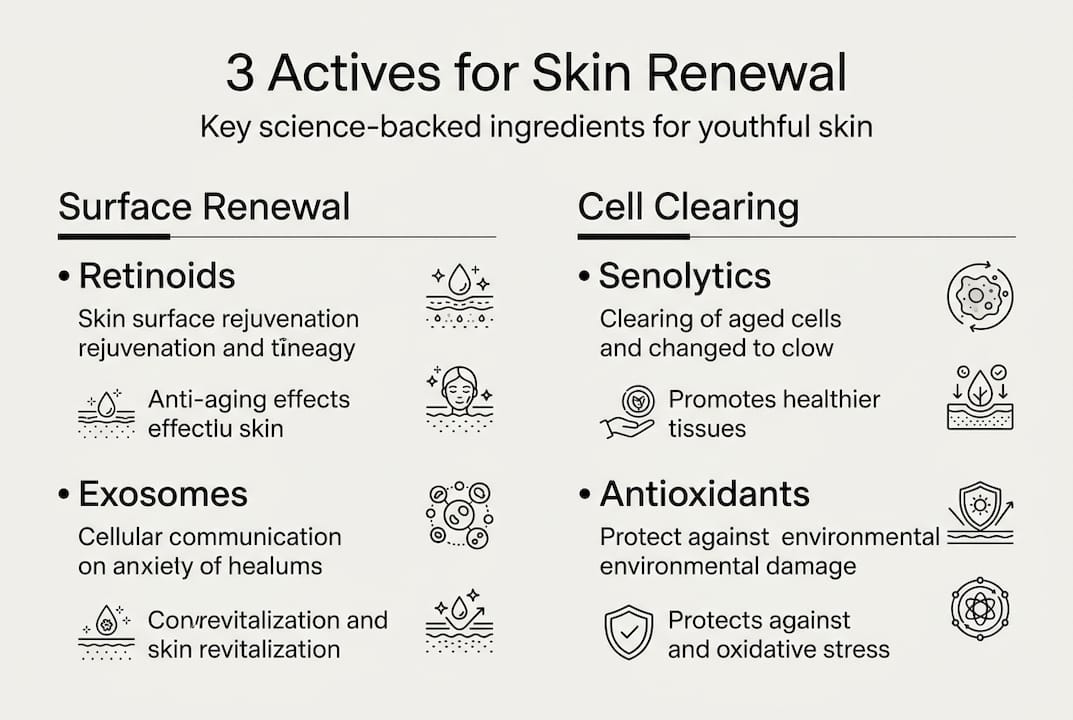
Retinoids remain the most validated class of actives for cellular renewal. They accelerate keratinocyte turnover, stimulate fibroblast activity, and reduce senescence markers. Retinoids boost collagen and elastin while reducing cellular senescence markers, making them the foundational active in any renewal-focused routine. Retinol is the most widely available form; retinaldehyde (retinal) converts to retinoic acid more efficiently and is often better tolerated by sensitive skin.

Platelet exosomes are an exciting emerging category. These nano-sized vesicles derived from platelets carry growth factors and signaling molecules that communicate with skin cells. In a clinical study, topical platelet exosomes reduced dermal p16INK4a+ cells after 12 weeks of use, a direct measure of reduced senescence burden. That’s a significant finding.
Senolytics are compounds designed to selectively clear senescent cells. While the concept is compelling, senolytics show promise but limited skin-specific clinical data, with most evidence still preclinical or ex vivo. They’re worth watching, but not yet ready to anchor a routine.
| Active | Mechanism | Evidence level | Best for |
|---|---|---|---|
| Retinoids | Turnover, collagen, senescence reduction | Strong (clinical) | All skin types |
| Platelet exosomes | Senescence clearance via signaling | Emerging (clinical) | Mature, sensitive skin |
| Senolytics | Senescent cell clearance | Preclinical | Experimental |
| Peptides | Fibroblast signaling, collagen support | Moderate (clinical) | Firmness, barrier |
Pro Tip: Pair your retinoid with a skin renewal guide to understand how to layer it with barrier-supporting ingredients. Retinoids work best when the skin barrier is intact and well-hydrated.
For firmer skin with peptides, combining a retinoid with a peptide-rich serum addresses both the senescence side and the structural support side of aging simultaneously.
Key stat: In a skin activation trial of 400 participants, interventions reduced transepidermal water loss (TEWL) by 20 to 40% and increased skin hydration by 80%, showing that targeted actives produce measurable cellular-level results.
How to build a skin renewal regimen: Application and best practices
Science is only useful when it translates into daily habits. Here’s how to structure a routine that actually supports cellular renewal.
Step-by-step routine framework:
- Morning: Gentle cleanser, antioxidant serum (vitamin C or niacinamide), moisturizer with ceramides, broad-spectrum SPF 30+.
- Evening: Gentle cleanser, retinoid (start 2-3 nights per week, build to nightly), barrier-repair moisturizer.
- Weekly: Gentle exfoliation (AHA or enzyme-based) to support keratinocyte turnover without stripping the barrier.
- Ongoing: Reassess every 8-12 weeks and adjust based on skin response.
Consistency is where most people fall short. In a skin renewal trial of 400 participants, skin hydration increased by 80% and the dermal-epidermal junction improved in 83% of subjects after 12 weeks of consistent intervention. The timeline matters.
Key principles to follow:
- Apply retinoids at night only; UV exposure degrades their efficacy and increases irritation risk.
- Use barrier-repair products morning and evening, not just as a buffer for actives.
- Introduce one new active at a time to isolate how your skin responds.
- SPF is non-negotiable; UV damage is one of the primary drivers of cellular senescence.
Pro Tip: If you’re new to retinoids, start with retinaldehyde rather than retinol. It’s more efficient at converting to retinoic acid and tends to cause less initial irritation, making it easier to build consistency. Review the best practices for cellular repair to fine-tune your layering strategy.
For those managing a compromised barrier alongside renewal goals, the skin barrier repair guide offers a clear protocol for restoring barrier function before layering in stronger actives. And if you’re looking for a structured starting point, the 30% firmer skin guide maps out a full regimen with measurable targets.
Why skin renewal requires both science and personalization
Here’s the perspective most skincare brands won’t share: the one-size-fits-all approach to anti-aging is not just ineffective, it’s based on a flawed premise. The premise is that age predicts skin condition. It doesn’t, at least not reliably.
New research shows that senescence burden varies independently of age, meaning two people at 50 can have radically different cellular renewal capacities. One may have the skin biology of someone a decade younger; another may show accelerated decline due to cumulative environmental exposure. Age is a rough proxy, not a precise guide.
This is why we believe the future of skin renewal is bio-individual. It means selecting actives based on your specific concerns and tolerances, tracking how your skin responds over weeks and months, and being willing to adapt. The science-backed serums that deliver the most consistent results are those chosen with intention, not just based on what’s trending.
Personalization is not complicated. It starts with observation and honesty about what your skin actually needs right now, not what worked for someone else.
Transform your skin renewal with Cellure science
If the science above has shifted how you think about your skin, the next step is applying it. Cellure’s formulations are built around the same principles covered here: targeting cellular senescence, supporting the skin barrier, and delivering actives that are both effective and tolerable.
From Complete Skin Repair Kit to targeted serums for firmness, hydration, and tone, every product is grounded in the latest biomarker and renewal research. Explore the full range of Cellure ingredients to see exactly what’s in each formula and why. If you’re ready to move from understanding the science to seeing results in your own skin, Cellure advanced regeneration is where that journey starts.
Frequently asked questions
What is cellular senescence and why does it matter for my skin?
Cellular senescence is when skin cells stop dividing and release SASP factors that drive aging, weakening your skin’s renewal capacity and contributing to visible signs like laxity and uneven tone.
How long does it take to see results from cellular renewal products?
Most users see noticeable improvements in 8 to 12 weeks of consistent use, with skin hydration increasing by 80% and barrier function improving measurably in clinical trials.
Can I personalize my skin renewal routine based on my skin type?
Yes, and you should. Tailoring your routine to your skin type, tolerance, and specific aging concerns maximizes results while reducing the risk of irritation, especially when introducing actives like retinoids.
Are there risks to using senolytics and exosomes in skincare?
Senolytics and exosomes are promising but still largely experimental, so senolytics lack skin-specific clinical data for long-term topical use. Proven actives like retinoids remain the safer, better-supported choice.
Why isn’t age the only factor in skin renewal decline?
Because senescence burden varies independently of age due to environmental and lifestyle factors, meaning biomarkers often predict renewal capacity more accurately than chronological age alone.