


How to repair aging skin: evidence-based steps for results
TL;DR:
- Aging skin results from collagen loss, environmental damage, and hormonal shifts, not just time.
- Gentle, evidence-backed ingredients like bakuchiol, niacinamide, and lipids offer effective repair for sensitive skin.
- Consistent routines over 8-12 weeks, with proper sun protection, lead to visible improvements.
You follow a routine. You moisturize. You avoid the sun. Yet the lines keep deepening, the skin feels less firm, and that uneven tone just won’t budge. This is one of the most frustrating experiences for adults navigating aging skin, and it’s more common than you’d think. The good news is that skin science has advanced significantly, and we now have clear, evidence-backed answers about what actually works. This guide walks you through the real causes of visible aging, the gentlest yet most effective ingredients available, a practical daily routine, and how to measure real progress, even if your skin is on the sensitive side.
Table of Contents
- Understanding the causes of visible skin aging
- Choosing gentle, evidence-backed ingredients for repair
- Step-by-step repair routine for aging, sensitive skin
- Verifying results: How and when to track progress
- Why sensitivity changes the anti-aging game
- Science-backed solutions for your skin repair journey
- Frequently asked questions
Key Takeaways
| Point | Details |
|---|---|
| Focus on gentle actives | Repair aging skin effectively with science-backed yet gentle ingredients like bakuchiol and niacinamide. |
| Follow a consistent routine | Visible improvements typically appear after 8-12 weeks of daily use of proven actives and SPF. |
| Monitor sensitivity | Sensitive skin needs special care—choose lipid-rich creams and slow introduction of retinoids. |
| Supplement collagen wisely | Collagen supplements are clinically proven to reduce wrinkles and boost hydration. |
| Track progress regularly | Use monthly photos and texture checks to verify the effectiveness of your repair routine. |
Understanding the causes of visible skin aging
Before you can repair something, you need to understand what broke it. Visible skin aging isn’t just about time passing. It’s a combination of internal biology and external damage working against your skin’s ability to renew itself.
Naturally, your skin produces less collagen and elastin starting in your late twenties. By your forties and fifties, that slowdown is visible: skin sags, fine lines settle in, and the plump, firm texture of younger skin becomes harder to maintain. Hormonal shifts, especially around menopause, accelerate this process significantly by reducing the skin’s oil production and moisture retention.
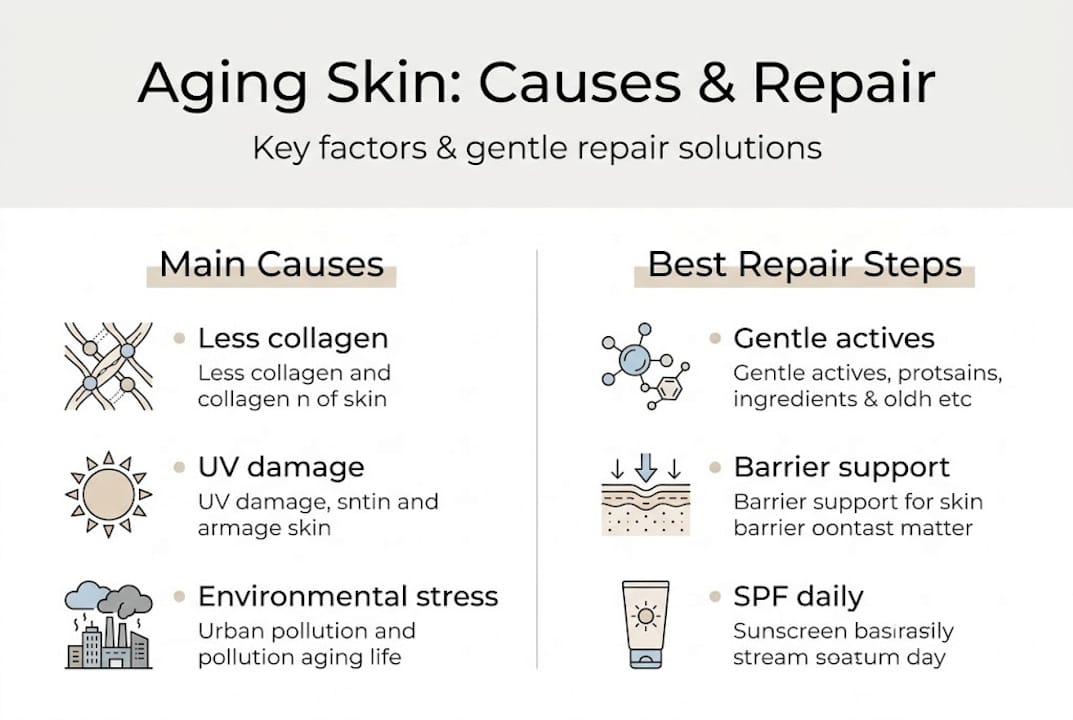
Environmental stressors pile on top of that. UV radiation is the single biggest external driver of premature aging. It breaks down collagen fibers, creates free radicals that damage skin cells, and triggers hyperpigmentation. Pollution adds another layer of oxidative stress, weakening the skin barrier over time.
For those with sensitive skin, this creates a real dilemma. Aggressive treatments designed to stimulate cell turnover can cause redness, stinging, and barrier breakdown, making skin look worse before it looks better. That’s why caring for sensitive skin requires a more strategic approach than simply applying the strongest actives available.
Diet also plays a more targeted role than most people realize. A collagen supplementation study published in the Journal of Physiological Anthropology found that dietary interventions target distinct phenotypes: collagen addresses wrinkles and pigmentation, lipids improve elasticity, and polyphenols reinforce the skin barrier. This means what you eat and supplement genuinely influences which aging concerns you can address.
Here’s a quick breakdown of the main aging drivers and what they affect:
| Aging driver | Primary skin impact |
|---|---|
| Collagen loss | Wrinkles, sagging, loss of volume |
| UV exposure | Pigmentation, fine lines, texture |
| Barrier disruption | Dryness, sensitivity, inflammation |
| Hormonal shifts | Reduced firmness, moisture loss |
| Oxidative stress | Uneven tone, dullness, cell damage |
Key factors that complicate repair for sensitive skin:
- Compromised barrier makes actives more likely to irritate
- Inflammatory responses slow down the repair process
- Over-treating can undo progress quickly
- Gentle, targeted strategies work better than high-concentration formulas
Understanding these root causes is what separates a routine that actually works from one that just feels like skincare. For a deeper look at repairing sensitive skin, the science points clearly toward targeted, low-irritation strategies.
Choosing gentle, evidence-backed ingredients for repair
Once you recognize the causes, the next step is selecting ingredients that are both powerful and safe for your skin type. Not all actives are created equal, and for sensitive skin, the delivery and concentration matter as much as the ingredient itself.
Retinoids remain the most studied anti-aging actives available. A network meta-analysis confirmed that topical retinoids improve fine wrinkles, hyperpigmentation, and elasticity, with tretinoin showing a favorable safety profile among the group. The challenge is that retinoids can cause dryness, peeling, and redness, especially when you’re starting out.

Bakuchiol is the gentler alternative that’s earned serious scientific attention. It activates similar pathways to retinol without the irritation, making it a strong option for those who can’t tolerate traditional retinoids. The Mayo Clinic review confirms that bakuchiol improves wrinkles and tone with significantly less sensitivity risk.
Vitamin C brightens and firms by stimulating collagen synthesis and neutralizing free radicals. It’s best used in the morning under SPF. Niacinamide (vitamin B3) is one of the most versatile actives available: it reduces pigmentation, strengthens the barrier, and calms inflammation, all with minimal irritation risk. Tranexamic acid targets stubborn hyperpigmentation at the source and pairs well with niacinamide for a brightening routine.
For gentle anti-aging tips that work across skin types, lipids and polyphenols round out a strong repair strategy. Lipids like ceramides and fatty acids restore barrier integrity, while polyphenols from plant extracts reduce oxidative stress. You can explore the full science behind top skin repair ingredients to understand how each one fits into a complete routine.
Here’s how key ingredients compare for aging and sensitivity:
| Ingredient | Primary benefit | Sensitivity risk |
|---|---|---|
| Retinol | Wrinkles, elasticity | Moderate to high |
| Bakuchiol | Wrinkles, tone | Very low |
| Vitamin C | Brightening, collagen | Low to moderate |
| Niacinamide | Tone, barrier | Very low |
| Tranexamic acid | Pigmentation | Very low |
| Ceramides/lipids | Barrier, elasticity | None |
Pro Tip: If you’re new to retinoids, start with bakuchiol three nights a week and build up. It gives your skin time to adapt without the classic purge phase that retinol often triggers.
A few non-negotiables for any repair routine:
- Always pair actives with broad-spectrum SPF 30 or higher every morning
- Introduce one new active at a time, spaced two weeks apart
- Never layer multiple strong actives (like retinol and vitamin C) in the same step
- Prioritize barrier support with lipids before adding stronger treatments
- Check out best peptides for skin as an additional layer for firmness and repair
Step-by-step repair routine for aging, sensitive skin
Knowing which ingredients to use, here’s how to seamlessly incorporate them into your routine for optimal results. Consistency and order matter more than most people realize.
Morning routine:
- Cleanse with a gentle, non-stripping formula (cream or micellar water works well)
- Apply a vitamin C serum or peptide serum while skin is slightly damp
- Layer niacinamide or tranexamic acid serum for tone correction
- Seal with a lipid-rich moisturizer to lock in hydration and reinforce the barrier
- Finish with broad-spectrum SPF 30 or higher, every single day without exception
Evening routine:
- Double cleanse if you’ve worn sunscreen or makeup
- Apply bakuchiol serum (or low-dose retinol if your skin tolerates it)
- Follow with a ceramide-rich moisturizer to buffer any potential irritation
- Once a week, use a mandelic acid or Centella asiatica treatment for texture improvement
The weekly treatment step is worth highlighting. A JDD study found that a mandelic acid and Centella cream measurably improved crepiness, skin density, and texture in aging, sensitive skin over 12 weeks. That’s a meaningful result from a single weekly addition.
On the nutrition side, lipids improve elasticity with a pooled effect size of 0.49, while polyphenols strengthen the barrier by reducing transepidermal water loss with an effect size of 0.50. These aren’t small numbers. They suggest that topical lipid-rich creams and polyphenol-based formulas genuinely move the needle on measurable skin health.
For guidance on finding the right formulas, the gentle serum guide covers how to layer serums without overwhelming your skin. And for the broader picture of how cellular renewal connects to visible results, cellular repair practices offers a strong framework.
Pro Tip: Apply your moisturizer while your skin is still slightly damp from your serum step. This traps water in the skin and significantly boosts hydration retention, especially important for aging skin that loses moisture faster.
Key things to avoid in your routine:
- Foaming cleansers with sulfates that strip the skin
- Alcohol-heavy toners that disrupt the barrier
- Layering too many actives at once
- Skipping SPF on cloudy days or when indoors near windows
Verifying results: How and when to track progress
Once your routine is in place, understanding how to track and optimize results is crucial for long-term skin health. One of the biggest mistakes people make is abandoning a routine too early because they don’t see immediate changes.
Skin repair works on a biological timeline. Most visible improvements appear within 8 to 12 weeks of consistent use. Fine lines and pigmentation spots tend to respond first. Elasticity and firmness take longer because they require actual structural changes in the deeper layers of skin.
Here’s a realistic timeline of what to expect:
| Timeframe | What you may notice |
|---|---|
| Weeks 1 to 4 | Improved hydration, smoother texture, less dullness |
| Weeks 4 to 8 | Reduced fine lines, early tone evening |
| Weeks 8 to 12 | Firmer feel, visible pigmentation reduction |
| Beyond 12 weeks | Improved elasticity, deeper wrinkle softening |
To track progress accurately:
- Take photos in the same lighting, same angle, once a month
- Note texture by feel: does skin feel smoother, bouncier, less rough?
- Track specific spots: a pigmentation patch, a fine line around the eye, the jawline
- Keep a simple log of which products you used and when you introduced changes
“Collagen supplementation reduces wrinkles significantly, with a pooled effect size of 0.94 for wrinkle reduction and 0.66 for hydration improvement, also targeting pigment spots.” — Journal of Physiological Anthropology meta-analysis
This is why collagen supplements, used alongside topical actives, can accelerate visible repair. The evidence is strong and the effect sizes are clinically meaningful.
If irritation appears, don’t push through it. Pause your actives for five to seven days, restore the barrier with a plain lipid-rich moisturizer, and then reintroduce actives one at a time at a lower frequency. For a full breakdown of barrier recovery, the skin barrier repair guide walks through exactly how to do this. And for ingredient-specific performance data, science-backed serums covers what the research actually shows.
Why sensitivity changes the anti-aging game
Here’s the uncomfortable truth most skincare content won’t tell you: the conventional anti-aging approach, which pushes the strongest retinoids and highest-concentration acids, fails a large portion of adults with sensitive skin. Not because those ingredients don’t work, but because irritation derails consistency, and consistency is what actually drives results.
Retinoids can deliver 40 to 60% wrinkle reduction in clinical settings. But bakuchiol delivers 20 to 30% improvement with less than 5% irritation rates. For someone whose skin flares at the first sign of aggression, bakuchiol used consistently for six months will outperform a retinoid that gets abandoned after two weeks of peeling.
The same logic applies to barrier support. Lipid-rich formulas and polyphenol-based creams build the kind of skin resilience that lets stronger actives work better over time. They’re not a compromise. They’re the foundation. We believe the best gentle anti-aging practices aren’t about settling for less. They’re about building a routine your skin can actually sustain.
Science-backed solutions for your skin repair journey
With practical routines and expert advice covered, here’s how to accelerate your repair journey with proven, specialist solutions.
At Cellure, we’ve built our product range around the same evidence-based principles covered in this guide. The Complete Skin Repair Kit brings together clinically supported actives into a structured routine, removing the guesswork of layering and compatibility. For targeted brightening and tone correction, the Tranexamic Acid Peptide Serum combines two of the most effective gentle actives into a single, results-driven formula. Every product at Cellure is formulated with sensitivity in mind, so you get real repair without the irritation that slows progress.
Frequently asked questions
What ingredients repair aging skin without causing irritation?
Bakuchiol, niacinamide, vitamin C, lipids, tranexamic acid, and polyphenols are all proven gentle options that improve wrinkles, tone, and firmness, especially for sensitive skin.
How soon will I see results from an anti-aging skin repair routine?
Most people see visible improvements in texture, firmness, and tone within 8 to 12 weeks, with a mandelic acid cream showing measurable texture improvement at that same 12-week mark in clinical trials.
Do collagen supplements really help repair wrinkles?
Yes. Clinical research shows collagen supplementation reduces wrinkles with a strong pooled effect size and also improves skin hydration meaningfully.
Why is SPF essential for repairing aging skin?
UV exposure breaks down the collagen your actives are working to rebuild, so always use SPF to protect your investment and prevent further photoaging.
What should I do if my skin reacts to actives?
Pause all actives, restore your barrier with a plain lipid-rich moisturizer, and reintroduce gently one at a time, since lipids and polyphenols are specifically shown to strengthen the barrier and restore comfort.
Recommended
Share