


Science-backed skin renewal guide for adults 30–55
TL;DR:
- A structured skincare routine focusing on gentle cleansing, barrier support, targeted actives, and daily sunscreen effectively promotes skin renewal for adults aged 30 to 55. Consistent application, rotating actives, and patience are key to achieving visible improvements over time, rather than relying on trend-based fixes. Supporting the skin’s natural processes with simple, science-backed steps leads to lasting, healthier skin.
You have tried the serums, the exfoliants, the ten-step routines, and the expensive “miracle” creams. Yet the mirror still shows more fine lines, uneven tone, and skin that feels thinner than it did five years ago. The frustrating truth is that without a clear, science-backed sequence, most routines become expensive guesswork. A well-structured renewal routine for adults 30 to 55 should center on four proven pillars: gentle cleansing, barrier support, targeted actives like retinoids, and daily broad-spectrum sunscreen. This guide walks you through each pillar clearly, so you spend less time guessing and more time seeing results.
Table of Contents
- What you need for step-by-step skin renewal
- Step-by-step routine: The daily skin renewal framework
- Troubleshooting: Common mistakes and solutions
- Verifying results: What to expect from skin renewal
- Our take: Why skin renewal should focus on simple cycles, not “miracle” fixes
- Support your skin renewal journey with Cellure
- Frequently asked questions
Key Takeaways
| Point | Details |
|---|---|
| Follow core steps daily | Gentle cleansing, barrier support, retinoids, and sunscreen form the backbone of skin renewal. |
| Patience produces results | Consistent routines yield changes in skin texture, tone, and radiance over weeks and months, not overnight. |
| Protect to repair | Daily sunscreen is essential to prevent further damage and maximize results from active ingredients. |
| Start slow with actives | Introduce and adjust retinoids and similar ingredients gradually to minimize irritation and boost tolerability. |
What you need for step-by-step skin renewal
Now that you know what you will gain from a structured renewal routine, let us cover exactly what you need to get started.
Skin renewal does not require a medicine cabinet full of products. It requires the right products, used in the right order, at the right frequency. For adults in the 30 to 55 range, skin is already experiencing measurable shifts: collagen production slows, cell turnover takes longer, and the barrier becomes more reactive. That context matters, because it determines which products belong in your lineup and which ones create more problems than they solve.
The core four you actually need:
- Gentle cleanser: Removes surface debris and excess sebum without stripping the acid mantle. Look for pH-balanced formulas (around 4.5 to 5.5) with no sulfates. Your skin barrier is not the enemy; do not treat it like one.
- Moisturizer or barrier support: Replenishes lipids, ceramides, and humectants like hyaluronic acid. This is not optional for aging skin. A compromised barrier amplifies sensitivity, makes actives feel harsh, and slows repair.
- Targeted actives: Retinoids are the most studied active ingredient for visible skin renewal. Beyond retinoids, top ingredients for skin renewal include peptides, tranexamic acid, and polynucleotides, each addressing specific aging mechanisms.
- Broad-spectrum SPF 30+ sunscreen: Non-negotiable. Every. Single. Day. More on this in the step-by-step section.
The “pulse and rotate” method is worth introducing here. Rather than applying every active daily, you cycle them throughout the week. For example, retinoids on Monday, Wednesday, and Friday; brightening actives on Tuesday and Thursday; rest on the weekend. This approach dramatically lowers irritation risk, especially for skin that tends toward sensitivity, and it allows each active to work at peak efficiency without competing for receptor sites or causing barrier breakdown. You can read more about the science behind this in our deep look at rejuvenation for aging skin.
| Product type | Key function | What to look for |
|---|---|---|
| Gentle cleanser | Remove debris, preserve pH | pH 4.5 to 5.5, sulfate-free |
| Moisturizer | Barrier repair, hydration | Ceramides, hyaluronic acid, niacinamide |
| Retinoid | Cell turnover, collagen support | Retinol (OTC) or tretinoin (Rx) |
| Sunscreen | UV protection, anti-aging defense | SPF 30+, broad-spectrum, daily use |
Pro Tip: Before combining products, check pH compatibility. Vitamin C (L-ascorbic acid) works best around pH 3. Retinoids prefer a neutral environment. Layering them without a buffer can destabilize both and irritate your skin faster than either would alone.
Step-by-step routine: The daily skin renewal framework
Once your products are ready, it is time to walk through every step in detail and build your daily skin renewal cycle.
A good routine is only as effective as how consistently and correctly you execute it. This framework is built around two sessions: morning and evening. Each has a distinct purpose, and the order of application matters more than most people realize.
Step 1: Gentle cleanse (AM and PM)
Morning cleansing can be as light as a splash of lukewarm water or a very gentle low-foam cleanser if you applied actives the night before. Evening cleansing is more important because it removes sunscreen, pollutants, and the metabolic byproducts your skin produces throughout the day. Use your fingers, not a rough cloth. Lukewarm water only. Hot water opens capillaries and accelerates transepidermal water loss.
Step 2: Barrier support with moisturizer
Apply moisturizer while your skin is still slightly damp. This step is where many adults cut corners, and it costs them. Barrier support is not just about comfort. It is the foundation that makes every active ingredient you apply afterward work more effectively. A compromised barrier means your retinoid or peptide serum sits on the surface rather than penetrating to the layers where it can drive cellular change.
Step 3: Introduce and rotate targeted actives
This is the transformational layer. Skin renewal actives like retinoids modulate epidermal processes and extracellular matrix remodeling, which is a scientific way of saying they help your skin produce collagen faster and shed dead cells more efficiently. Evidence confirms that topical retinoids are the gold standard for preventing and reversing visible signs of photoaging.

Start with a low concentration and use it 2 to 3 nights per week maximum. Apply it after moisturizer if you are very sensitive (the “sandwich method”), or directly onto cleansed, dry skin if your skin tolerates it. Dry skin before application matters because wet skin drives actives deeper and faster, which increases irritation risk.
Step 4: Sunscreen in the morning (the non-negotiable layer)
Daily sunscreen use is one of the most powerful anti-aging tools available, full stop. It protects against premature aging, hyperpigmentation, and skin cancer. Apply it as the last step in your morning routine, and use enough: about a nickel-sized amount for your face and neck. Reapply every two hours if you are spending time outdoors.
| Step | Morning | Evening |
|---|---|---|
| Cleanse | Light rinse or gentle cleanser | Full cleanse, remove sunscreen |
| Barrier support | Moisturizer | Moisturizer or barrier cream |
| Active | Antioxidant serum (vitamin C) | Retinoid or peptide serum (rotate) |
| Protection | SPF 30+ sunscreen | None needed |
Pro Tip: Start new actives 2 to 3 nights per week for at least four weeks before increasing frequency. Your skin’s tolerance is not built in days. It is built over weeks of consistent, measured exposure.
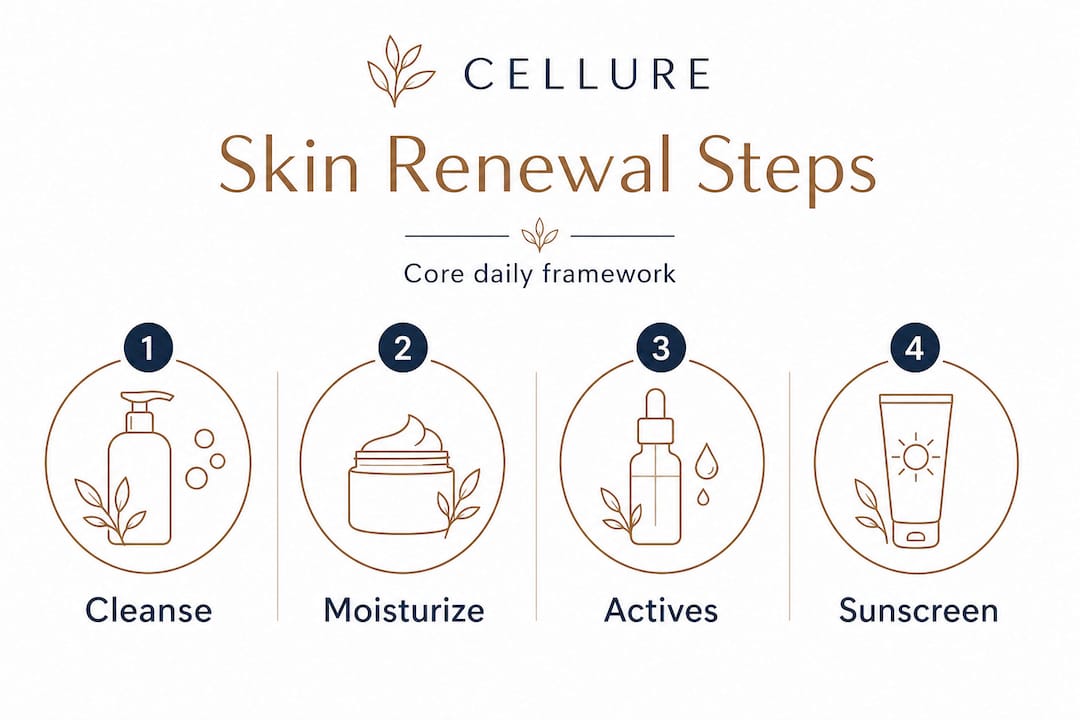
The cellular renewal workflow that drives visible results is simple at its core: cleanse, support, activate, protect. The mistake most people make is rushing the “activate” phase without first building the “support” foundation.
Troubleshooting: Common mistakes and solutions
After beginning any new routine, you might hit minor setbacks. Here is how to spot, avoid, and fix the most common issues.
Most skin problems that arise during a renewal routine are not caused by the wrong products. They are caused by the wrong approach to using otherwise good products. Recognizing the difference between irritation and normal adjustment is a skill that saves your skin and your wallet.
The most common mistakes:
- Overusing actives: Applying retinoids every night in week one is the fastest way to trigger peeling, redness, and a damaged barrier. More is not more. Frequency builds results; overuse destroys the foundation.
- Skipping sunscreen: Many adults apply retinoids faithfully but skip sunscreen because they “mostly stay inside.” UVA rays penetrate glass and cause the collagen breakdown retinoids are trying to repair. You are essentially running on a treadmill.
- Changing products too frequently: Switching serums every three weeks because you have not seen “instant results” means your skin never has the chance to complete a full cell renewal cycle, which takes roughly 28 to 40 days in your 30s and longer as you age.
- Layering incompatible formulas: Strong acids plus retinoids in the same session. Vitamin C plus niacinamide in a way that neutralizes both. These combinations do not always cause a dramatic reaction, but they quietly undermine your results.
How to tell normal adjustment from genuine irritation:
Normal adjustment typically includes mild flaking, a slight tight feeling, or temporary increased sensitivity in the first two to four weeks. Genuine irritation looks like persistent redness, burning, stinging that lasts beyond application, or breakouts in areas you do not normally break out.
“Barrier support and a gentle routine over time outperform aggressive product overuse. Real skin homeostasis is maintained by slow, deliberate change, not by forcing rapid turnover.”
Because aging skin is more fragile, introducing and rotating actives thoughtfully while relying on gentle cleansing and barrier support is the scientifically aligned strategy for maintaining skin homeostasis.
If your skin reacts: stop the active for one full week, focus only on gentle cleansing and moisturizer, then reintroduce the active at half the frequency. This is not failure. It is calibration. Read more about skin repair best practices to build a foundation that actually holds.
Verifying results: What to expect from skin renewal
Understanding what to expect keeps you motivated and better equipped to spot genuine improvement, not just wishful changes.
The biggest reason people abandon effective routines is unrealistic expectations. Skin renewal is not linear. There are weeks where nothing looks different, followed by a stretch where you suddenly notice your pores look tighter or your skin tone is more even. This is normal, and it is tied to the biology of skin turnover.
A realistic timeline:
- Weeks 1 to 4: Improved hydration, less dullness, a subtle glow. Your barrier is strengthening. This is the foundation phase.
- Weeks 4 to 12: You may notice reduced surface roughness, early improvements in fine lines, and more even tone if you have been consistent with sunscreen and an active like retinol.
- Months 3 to 6: Visible texture improvement, reduced hyperpigmentation, and measurable firming with consistent retinoid use. Clinical evidence of wrinkle, pigmentation, and texture improvement typically appears within this window.
- Six months and beyond: This is where sustainable, structural renewal becomes visible. Collagen remodeling is a slow process. Results in this phase are durable if you maintain the routine.
How to track your progress objectively:
- Take photos in consistent lighting (same angle, same time of day) every four weeks
- Note texture under your fingertips, not just in the mirror
- Track frequency of breakouts or dry patches as indirect markers of barrier health
- Watch for changes in how your skin holds makeup or responds to wind and temperature changes
Statistic to know: Studies on topical retinoids consistently show measurable improvement in wrinkle depth and pigmentation after 12 to 24 weeks of regular use, with some participants showing continued improvement at the one-year mark.
Use a firmer skin guide to understand how collagen-focused ingredients layer with your renewal routine, and explore skin renewal tips to fine-tune what you are already doing well.
Our take: Why skin renewal should focus on simple cycles, not “miracle” fixes
The skincare industry is extraordinarily good at selling urgency. Every season brings a new “breakthrough” ingredient, a new mechanism, a new reason to overhaul what is already working. From our vantage point, this creates a pattern where adults spend significant money chasing novelty instead of building the consistent cycle that actually produces durable skin renewal.
The science does not support complexity. The sources we keep returning to all reinforce the same core framework: sunscreen, barrier support, and retinoids. Not because the science is limited, but because these pillars address the actual mechanisms of skin aging with the highest degree of evidence. As one review we examined put it, mechanistic regeneration-like pathways are genuinely interesting at the research level, but day-to-day routines should be built on proven basics rather than “regenerative” marketing claims.
The uncomfortable insight is this: most people who are not seeing results from their skincare are not using the wrong products. They are using the right products inconsistently, in the wrong order, or with unrealistic timelines. The solution is almost never to add something new. It is to commit to the simple cycle for long enough to let it work.
What we advocate for is a rhythm: cleanse, support, activate, protect. Repeat. Adjust slowly. Trust the biology. The skin does know how to renew itself. Your job is to stop interfering with the process and start supporting it. Real skin renewal solutions are not built on trend cycles. They are built on repeatable, evidence-backed basics that your skin responds to over time.
Support your skin renewal journey with Cellure
To get the most benefit from step-by-step renewal, build on what works. Here is how Cellure helps you put these insights into action.
At Cellure, every product in our lineup is formulated to support the exact framework this guide describes. Barrier repair, targeted actives, and results you can actually measure over time.
The Complete Skin Repair Kit is built around the core renewal sequence, combining bioactive peptides and barrier-supporting ingredients designed to work together rather than compete. If uneven tone and pigmentation are your primary concern, our tranexamic acid serum directly addresses the enzymatic processes behind discoloration, complementing any retinoid-based routine you already have in place. Explore the full range of Cellure advanced solutions to find the targeted tools that match where your skin is right now.
Frequently asked questions
How long does it take to see results from a skin renewal routine?
Improved glow and smoothness are often noticeable within the first few weeks, but clinical evidence of improvement in wrinkles, pigmentation, and texture typically emerges after several months of consistent use.
Is sunscreen really necessary, even if mostly indoors?
Yes. UVA rays penetrate windows and drive premature aging at the cellular level. The AAD recommends applying sunscreen before going outdoors and reapplying every two hours, but daily indoor use remains important for anti-aging protection.
How should I start using retinoids without getting irritation?
Introduce retinoids 1 to 3 times per week, always with adequate moisturizer before or after application. Pulsing and rotating actives while maintaining gentle cleansing and strong barrier support is the most effective strategy for minimizing irritation during the adjustment period.
Can older adults (55+) start this routine too?
Absolutely, though it is especially important to go slower with actives and place extra emphasis on barrier support. Aging skin is more fragile and more reactive, so a gentler introduction to retinoids and a strong moisturizing foundation are essential before increasing frequency.