


Cellular rejuvenation: real solutions for skin renewal
TL;DR:
- Skin aging is driven by cellular senescence, leading to inflammation and structural tissue decline.
- Cellular rejuvenation targets senescent cells, improving hydration, skin thickness, and structural integrity over weeks.
- Consistent use of evidence-backed ingredients like retinoids and niacinamide gradually reverses visible aging.
Most people accept skin aging as a fixed biological sentence. Science says otherwise. Cellular senescence is now recognized as a key driver of visible aging, meaning the changes you see in the mirror aren’t just time passing. They’re specific cellular events that researchers are actively learning to interrupt. The gap between what’s possible and what most people believe is enormous, and this article is here to close it. We’ll walk through the real science of why skin ages, what cellular rejuvenation actually means, which strategies deliver measurable results, and how to apply them without falling for empty promises.
Table of Contents
- Why does skin age? The cellular science explained
- What is cellular rejuvenation? From senescence to renewal
- Evidence-based benefits of rejuvenating your skin cells
- Top science-backed strategies for cellular repair
- What most guides miss: Setting realistic expectations for rejuvenation
- Ready to activate your skin’s natural renewal?
- Frequently asked questions
Key Takeaways
| Point | Details |
|---|---|
| Skin aging starts at the cell | Cellular senescence drives visible aging and loss of skin strength. |
| Rejuvenation can be proven | Modern skincare strategies reduce signs of aging with real clinical data. |
| Science-backed ingredients work | Retinoids, niacinamide, and vitamin C show the greatest evidence for cellular renewal. |
| Results require consistency | Lasting changes happen over weeks to months, not overnight. |
Why does skin age? The cellular science explained
Skin aging isn’t a single event. It’s a cascade of cellular failures that build on each other over years. To understand why your skin loses firmness, volume, and tone, you need to understand what’s happening at the microscopic level beneath the surface.
The central player is cellular senescence, a state where a skin cell permanently stops dividing but refuses to die. Think of it like a factory worker who stops doing their job but won’t leave the building. These stalled cells, often called “zombie cells,” accumulate in the dermis and epidermis as you age. They’re triggered by DNA damage, oxidative stress, and telomere shortening, and once they reach this state, they begin secreting a toxic mix of inflammatory molecules known as the senescence-associated secretory phenotype, or SASP.
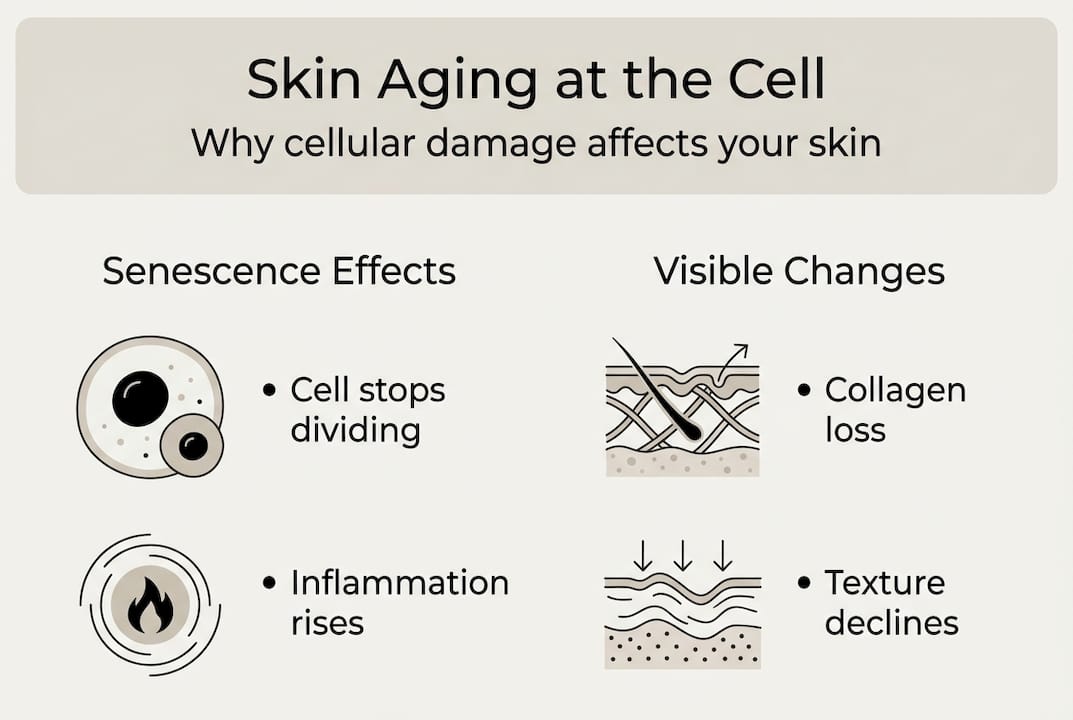
SASP is where the real damage happens. These secreted molecules degrade collagen and elastin, disrupt the extracellular matrix (ECM), and trigger inflammation in surrounding healthy tissue. This is why fibroblast senescence is so damaging. Fibroblasts are the cells responsible for producing collagen, and when they go senescent, collagen production drops sharply.
Here’s what’s counterintuitive: senescence isn’t entirely bad. In the short term, it acts as a tumor-suppression mechanism and supports wound healing. The problem is chronic accumulation. When senescent cells build up faster than the body can clear them, the inflammatory environment they create overwhelms the skin’s repair capacity.
The main triggers of cellular aging include:
- UV radiation and photooxidative stress
- Chronic inflammation from diet, pollution, and lifestyle
- Telomere shortening with each cell division
- Mitochondrial dysfunction reducing cellular energy
- Glycation from sugar damaging structural proteins
“The accumulation of senescent cells in aging skin is not a passive process. It actively reshapes the tissue environment in ways that accelerate visible decline.” Understanding why cellular repair matters is the first step toward reversing those effects. For a deeper look at the science, cellular skincare science breaks down how these mechanisms connect to real-world solutions.
What is cellular rejuvenation? From senescence to renewal
Cellular rejuvenation isn’t just a marketing phrase. It refers to a specific set of biological strategies aimed at clearing senescent cells, restoring mitochondrial function, and rebuilding the structural scaffolding of the skin. It’s a fundamentally different goal than traditional anti-aging.
Traditional anti-aging products mostly work on the surface. They smooth texture, temporarily plump fine lines, or block UV damage from accumulating further. Cellular rejuvenation goes deeper. Rejuvenation strategies target senescent cells directly, restore mitochondrial energy production, and reinforce the dermal-epidermal junction (DEJ), the structural boundary that keeps skin layers properly connected. The focus shifts from masking aging to reversing its biological causes.
| Approach | Traditional anti-aging | Cellular rejuvenation |
|---|---|---|
| Primary target | Surface texture, hydration | Senescent cells, ECM, mitochondria |
| Mechanism | Barrier support, UV protection | Senolytic clearance, cellular repair |
| Result timeline | Days to weeks | 8 to 12 weeks or longer |
| Longevity of results | Short-term | Progressive and cumulative |
| Skin activation | Minimal | Central goal |
The emerging concept of skin activation frames this well. Rather than slowing aging, skin activation asks: can we restart the cellular processes that keep skin young? The answer, increasingly, is yes, but only when you target the right mechanisms.
Understanding how cellular repair works reveals why ingredient selection matters so much. Not every active that claims to “renew” skin actually reaches the cellular level. For a structured starting point, the guide to cellular repair outlines what to look for and why.
Pro Tip: When evaluating any rejuvenation product, ask whether its active ingredients have been tested at the cellular level, not just for surface appearance. Ingredients with clinical data on senescence markers or ECM rebuilding carry far more weight than those tested only for hydration scores.
Evidence-based benefits of rejuvenating your skin cells
Knowing the theory is one thing. Seeing what cellular rejuvenation delivers in measurable terms is what makes it actionable for someone in their 40s or 50s wondering whether any of this actually works.
Clinical data from skin activation trials shows results that go well beyond typical moisturizer claims. In a controlled skin activation study, participants saw transepidermal water loss drop by 20 to 40%, hydration increase by 80%, skin thickness improve by 5%, and DEJ integrity rise from 17% to 83%. That last number is striking. DEJ integrity is what keeps the dermis and epidermis working together, and an improvement from 17% to 83% represents a near-complete structural restoration.
| Metric | Baseline | Post-treatment | Change |
|---|---|---|---|
| Transepidermal water loss | High | Reduced 20 to 40% | Significant improvement |
| Skin hydration | Baseline | +80% | Major gain |
| Skin thickness | Baseline | +5% | Measurable increase |
| DEJ integrity | 17% | 83% | Structural restoration |
Key stat: Skin that looks 4 years younger. A large multiethnic study found that sirtuin-targeting skincare reduced predicted skin age by 4 years and improved both wrinkling and laxity scores.
For adults in the 30 to 60 range, these numbers translate directly to what you see in the mirror. Better DEJ integrity means firmer skin that doesn’t sag as easily. Higher hydration means a plumper, more even surface. Reduced water loss means the skin barrier is functioning the way it did a decade ago. The cellular repair skincare guide connects these clinical outcomes to practical product choices, and the cellular repair workflow shows how to sequence them for maximum impact.
Top science-backed strategies for cellular repair
With the benefits clearly established, the practical question becomes: which ingredients and strategies actually deliver these results in a real-world routine?
Here are the most evidence-supported options, ranked by current clinical backing:
- Retinoids stimulate collagen production, accelerate cell turnover, and reduce senescence markers. They remain the most studied topical ingredient for cellular-level skin change.
- Niacinamide (vitamin B3) reduces SASP-related inflammation, supports the skin barrier, and improves uneven tone caused by senescent cell accumulation.
- Vitamin C neutralizes oxidative stress before it triggers senescence, while also boosting collagen synthesis in active fibroblasts.
- Hyaluronic acid (HA) replenishes the ECM’s water-binding capacity, supporting the structural environment where cellular repair takes place.
- AHAs (alpha hydroxy acids) clear away senescent surface cells and improve the skin’s ability to absorb active repair ingredients.
These five address senescence directly and have the broadest clinical support for adults experiencing aging-related changes. Beyond these, emerging actives are showing real promise. Topical platelet exosomes reduced senescence markers and SASP by 40% in high-senescence skin after 12 weeks. Sirtuin activators and senolytic compounds are also being studied, though they’re still in earlier stages of topical application research.
For a full breakdown of how to apply these in practice, best practices for cellular repair walks through sequencing and layering. The skin renewal actives resource covers the emerging ingredients in more detail.
Pro Tip: Layer your actives strategically. Apply vitamin C in the morning to block oxidative triggers, and use retinoids at night when skin repair cycles are most active. Add niacinamide to either routine as a buffer that reduces irritation while amplifying cellular benefits.
What most guides miss: Setting realistic expectations for rejuvenation
Here’s the part most skincare content skips because it doesn’t sell as well: cellular rejuvenation is real, but it isn’t magic, and the timeline matters more than most brands admit.
Skin cells don’t reset overnight. The clinical results we’ve cited, the 80% hydration gain, the 4-year age reduction, these came from consistent, sustained use over weeks and months. The biology moves gradually because that’s how repair works at the cellular level. Anyone promising dramatic results in seven days is selling you something the science doesn’t support.
There’s also an important nuance around senescent cell clearance. Senescence plays a double role: clearing accumulated senescent cells benefits aging skin, but overdoing senolytic activity can impair wound healing and tissue repair. Balance isn’t a marketing word here. It’s a biological requirement. This is why aggressive DIY senolytic protocols carry real risk, and why formulated, tested products matter.
Our perspective at Cellure is that the most powerful thing you can do is commit to cellular repair best practices consistently, using ingredients with actual clinical data, and resist the pull of trend-driven actives that haven’t yet earned their evidence base. The science is genuinely exciting. It just rewards patience more than enthusiasm.
Ready to activate your skin’s natural renewal?
If the science in this article resonated with you, the next step is finding products that actually deliver it. At Cellure, every formulation is built around clinically supported bioactive ingredients designed to work at the cellular level, not just the surface.
The complete skin repair kit brings together targeted actives for firmness, hydration, and structural repair in a single, sequenced system. For brightening and tone correction driven by cellular science, the tranexamic acid peptide serum is formulated to address the pigmentation changes that come with cellular aging. Explore the full range of Cellure solutions and find the approach that fits where your skin is right now.
Frequently asked questions
How quickly can I see results from cellular rejuvenation strategies?
Most people notice meaningful improvements in hydration and skin resilience within 8 to 12 weeks of consistent use. Structural changes like improved firmness take longer because they require actual collagen rebuilding.
Is cellular rejuvenation safe for all skin types and ages?
Established actives like retinoids and niacinamide are broadly safe for adults when used as directed, though sensitive skin may need lower concentrations. Newer actives like exosomes and senolytics still require more evidence before they can be recommended universally.
Can cellular rejuvenation actually reverse visible aging?
Studies show skin can measure 4 years younger with the right sirtuin-targeting regimen, with measurable gains in hydration and laxity. It’s a genuine improvement, not a complete reversal, and results build progressively over time.
What ingredients are best for effective cellular repair?
Retinoids, niacinamide, vitamin C, hyaluronic acid, and AHAs have the strongest clinical backing for cellular-level repair today. These are the ingredients worth prioritizing before exploring experimental options.