


Why Skin Renewal Matters: Restore Youthful, Resilient Skin
TL;DR:
- Skin renewal slows significantly with age, leading to dullness, roughness, and slower healing.
- Supporting internal renewal through gentle, barrier-friendly ingredients improves hydration, elasticity, and resilience.
- Long-term, consistent skincare focusing on cellular health fosters lasting skin vitality and resistance to aging signs.
Most people spend years chasing the next serum or cream, convinced that the right product will reverse the clock. But the real shift happens beneath the surface, where your skin is either renewing itself efficiently or quietly falling behind. Cell turnover slows dramatically as we age, moving from roughly 28 days in your 30s to 45 or more days by your 50s. That gap is why skin starts looking duller, feeling rougher, and recovering more slowly from damage. This article breaks down the biology behind that slowdown, what clinical evidence says about reversing its effects, and the practical steps that actually move the needle for adults in the 30 to 55 range.
Table of Contents
- What is skin renewal and how does it change with age?
- Why skin renewal matters: The science behind visible aging and resilience
- Clinically proven benefits of boosting skin renewal in your 30s, 40s, and 50s
- How to support and encourage skin renewal safely
- The overlooked truth: Long-term skin health beats quick fixes
- Proven solutions for powerful skin renewal
- Frequently asked questions
Key Takeaways
| Point | Details |
|---|---|
| Renewal slows with age | Adults 30-55 experience slower skin cell turnover, leading to dullness and slower healing. |
| Renewal boosts resilience | Support for skin renewal improves hydration, elasticity, and visible youthfulness according to clinical trials. |
| Safe routines are key | Gentle, barrier-protecting practices provide better long-term results than aggressive treatments. |
| Longevity over quick fixes | Modern skin care now focuses on durable health and function, not just chasing instant symptom relief. |
What is skin renewal and how does it change with age?
Skin renewal is your body’s built-in process for replacing surface skin cells. New cells form in the deepest layer of the epidermis, migrate upward, and eventually shed from the surface. When this cycle runs smoothly, skin looks fresh, heals quickly, and holds moisture well. When it slows, old cells pile up, and the results show up in the mirror almost immediately.
The skin renewal basics behind this cycle are worth understanding. In your 20s, the whole process takes about 28 days. That efficiency is a big reason younger skin looks so radiant. By your 40s, that timeline stretches to 40 or more days. By your 50s, turnover can take 45 to 60 days, almost double what it was just two decades earlier.
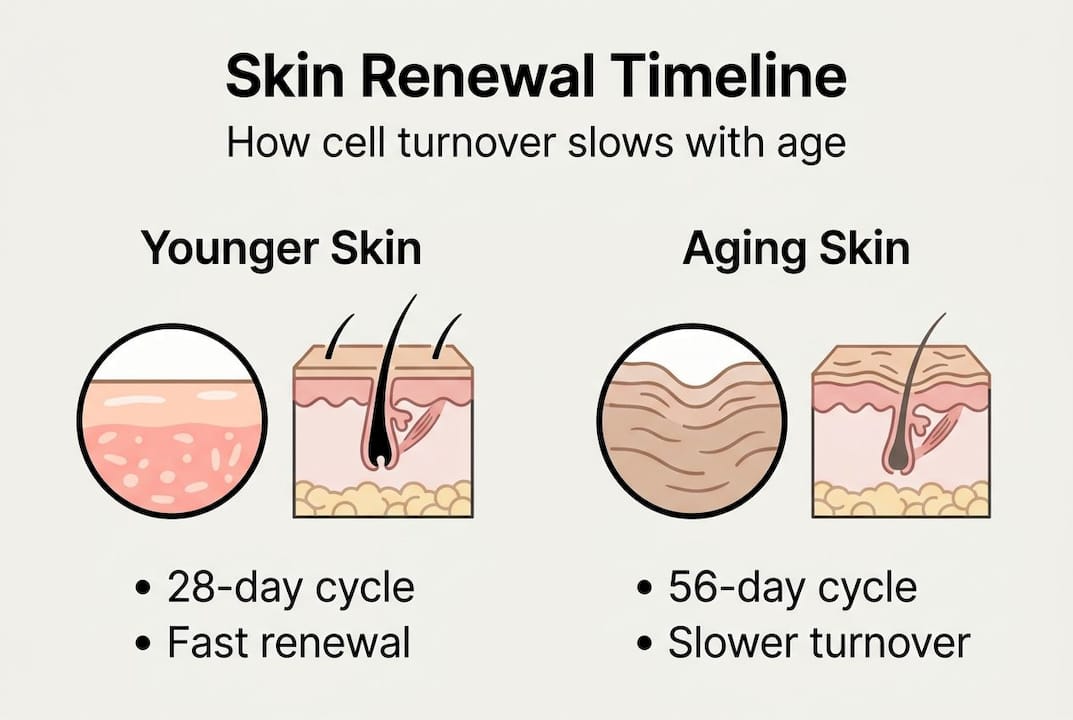
| Age decade | Average turnover time |
|---|---|
| 20s | ~28 days |
| 30s | ~30 to 35 days |
| 40s | ~40 to 45 days |
| 50s+ | ~45 to 60 days |
This slowdown creates a cascade of visible effects that most people attribute to simple aging, not a fixable biological process:
- Dullness: Dead cells accumulate on the surface, scattering light unevenly
- Rough texture: Uneven shedding creates micro-patches of thickened skin
- Slower healing: Cuts, spots, and sun damage linger much longer
- Deeper lines: Without steady renewal, the skin’s structural support gets less regular maintenance
- Uneven tone: Pigmentation clears more slowly, making dark spots more persistent
Pro Tip: Exfoliation removes surface cells manually, but it does not speed up the internal renewal cycle. Think of exfoliation as clearing the runway, while true renewal is about building new planes. Both matter, but they are not interchangeable.
Understanding renewal as a biological rhythm, not just a skincare step, is the foundation. The science-backed rejuvenation approach treats that rhythm as something that can be actively supported with the right inputs.
Why skin renewal matters: The science behind visible aging and resilience
Renewal is not just a cosmetic concern. It underpins your skin’s ability to hold moisture, defend against environmental damage, and recover from stress. When renewal slows, several structural systems start to deteriorate at once.

The extracellular matrix, or ECM, is the scaffolding beneath the skin’s surface made of collagen, elastin, and other proteins. As the science of renewal explains, the ECM requires constant remodeling to stay intact. When renewal slows, that remodeling stalls, and you get sagging, wrinkles, and loss of firmness. The dermal-epidermal junction, or DEJ, is the connection zone between skin layers. Flattening of the DEJ is a major reason aged skin looks less plump and bouncy.
There is also cellular senescence to consider. Senescent cells are essentially “retired” cells that stop functioning but do not leave. They accumulate with age and actively interfere with surrounding healthy cells. The expert view on longevity now points to ECM degradation and senescence as central drivers of visible aging, with renewal being the mechanism that counters both.
What improved renewal delivers, practically speaking:
- Better hydration: A well-renewed surface holds water more effectively
- Faster healing: New cells replace damaged ones more quickly
- Wrinkle reduction: Active ECM remodeling supports structural integrity
- Fewer sensitivity issues: A healthy barrier is less reactive to irritants
- Firmer feel: Restored DEJ integrity means more bounce and volume
“The conversation in skin science is moving away from ‘anti-aging’ and toward ‘skin longevity’ — prioritizing function and resilience over simply covering up symptoms.” This shift reflects a deeper understanding that visible improvement follows internal cellular health, not the other way around.
| Approach | Focus | Long-term outcome |
|---|---|---|
| Symptom-focused anti-aging | Covers signs (fillers, pigment correction) | Temporary improvement, no function change |
| Renewal-focused | Restores cellular and barrier function | Lasting improvement, improved resilience |
The regenerative science behind renewal-focused skincare targets these root mechanisms, not just surface appearance.
Clinically proven benefits of boosting skin renewal in your 30s, 40s, and 50s
Understanding the science is one thing, but what does boosting renewal actually achieve for real people aged 30 to 55? Here’s what the most convincing studies reveal.
A large clinical trial involving 400 participants found that targeted skin activation reduced TEWL by 20 to 40%, boosted hydration by 80%, increased skin thickness by 5%, and improved DEJ integrity in 83% of treated subjects versus only 17% in the control group. TEWL, or transepidermal water loss, is a core measure of barrier health. Reducing it means your skin is holding moisture more effectively and defending against environmental stress.
A separate mask trial results study with 33 participants aged 39 to 59 showed hydration increased 51% immediately after application, retained at 43% at 28 days, with TEWL reduced by 17%, elasticity improved by 17%, and firmness up by 16%.
| Parameter | Clinical result |
|---|---|
| Hydration | +51% immediately, +43% at 28 days |
| Barrier loss (TEWL) | Reduced 17 to 40% |
| Elasticity | +17% |
| Firmness | +16% |
| Skin thickness | +5% |
| DEJ integrity | 83% in treatment vs 17% in control |
What do those numbers feel like in real life? Here is how they translate day to day:
- Skin recovers faster: Blemishes and minor irritations clear in days rather than weeks
- Surface becomes noticeably smoother: Even without exfoliation, texture improves as turnover picks up
- Dryness decreases: Skin retains moisture across the day without needing constant reapplication
- Firmness feels real: Not temporary plumping from a cream, but structural resilience that holds
Pro Tip: Harsher is not better. Aggressive exfoliants and high-concentration acids can strip the barrier, which actually slows renewal further. The real renewal results worth pursuing come from ingredients that support the renewal cycle from within, not ones that force the surface to shed faster.
For a deeper breakdown of the clinical steps involved, the science-backed guide covers the most effective interventions in detail.
How to support and encourage skin renewal safely
So, if you want more resilient, younger-looking skin, what actions should you actually take, and which pitfalls should you avoid?
- Gentle exfoliation, two to three times weekly: Use low-concentration acids like lactic or mandelic to support surface shedding without stripping the barrier
- Barrier-repair actives daily: Peptides, ceramides, and polynucleotides actively support the skin’s own repair and renewal signals
- Consistent hydration: Hyaluronic acid and similar humectants maintain the moisture environment that renewal cells need to function
- Broad-spectrum sun protection every morning: UV exposure accelerates senescence accumulation, one of the most direct blockers of healthy renewal
- Lifestyle support: Quality sleep, adequate protein, and antioxidant-rich foods supply the raw materials for cellular repair
Many adults in their 30s to 50s are unknowingly sabotaging their renewal with these common habits:
- Over-exfoliating: More than three times per week disrupts the barrier and inflames renewal pathways
- Skipping moisturizer: Dehydrated skin slows cell migration, stalling the turnover cycle
- Chronic unprotected sun exposure: Cumulative UV damage overwhelms the skin’s repair capacity
- Using too many actives at once: Layering retinoids, high-dose vitamin C, and acids simultaneously can trigger reactive stress responses
The science-backed ingredients most supported by clinical evidence work by signaling renewal from the inside out, not by removing skin more aggressively. Understanding the clinically proven methods behind this distinction helps you build a routine that compounds results over months, not one that peaks and then plateaus.
Pro Tip: The most powerful renewal routines protect first and accelerate second. A compromised barrier will cancel out gains from even the best actives.
The overlooked truth: Long-term skin health beats quick fixes
Here is something most skincare marketing will never tell you: chasing fast results is often what keeps people from achieving lasting ones. Aggressive treatments and rapid-result promises typically work by temporarily inflaming or stripping the skin, which can look impressive short-term but quietly degrades barrier function over time.
The science is shifting toward skin longevity and activation, a framework that prioritizes sustained cellular function over quick cosmetic wins. This is not a minor semantic change. It represents a fundamentally different goal: a skin that works better, not just one that looks temporarily better.
From our perspective at Cellure, the adults who see the most meaningful and lasting improvement are those who commit to consistent, gentle support of the renewal cycle rather than rotating through harsh treatments chasing visible change. Explore the cellular repair perspective to understand why this patient, function-first approach is what actually builds resilient skin over decades.
Pro Tip: Think of your renewal routine as compounding interest. Small, consistent deposits outperform dramatic, irregular withdrawals every single time.
Proven solutions for powerful skin renewal
If you’re ready to move beyond products that only address the surface, it is time to invest in a protocol designed around cellular renewal. Cellure’s advanced cellular regeneration approach brings together clinically supported bioactive ingredients, including peptides, polynucleotides, and tranexamic acid, formulated specifically for adults experiencing the renewal slowdown that comes with age.
The Complete Skin Repair Kit is built to address the full renewal cycle: barrier support, active regeneration, and long-term resilience. This is not a quick-fix promise. It is a science-backed system designed for people who want results that last. Explore the kit and start building the kind of skin health that compounds over time.
Frequently asked questions
How can I tell if my skin renewal is slowing down?
Key signs include persistent dullness, rough or uneven texture, slower healing from breakouts or sun damage, and more noticeable fine lines. These typically become more obvious after 35 as turnover slows past 40 days.
Can skin renewal be safely increased without damaging the barrier?
Yes. Clinical evidence shows that gentle, barrier-focused renewal strategies improve elasticity, hydration, and barrier integrity simultaneously, without the irritation that aggressive approaches cause.
What is the difference between exfoliation and true skin renewal?
Exfoliation physically or chemically removes dead surface cells, while renewal is your skin’s internal biological cycle of producing and maturing new cells. Exfoliation supports renewal but cannot replace it.
Is there real evidence that renewed skin looks younger?
Strong clinical data confirms it. Trials show that targeted renewal improves hydration by up to 80% and elasticity by 17% in adults aged 30 to 59, with measurable improvements in firmness and barrier function.
Recommended
- The science of skin renewal: 3 actives for youthful skin – Cellure
- What is skin renewal: a guide to youthful skin repair – Cellure
- Cellular Repair Works: Science Behind Youthful Skin – Cellure
- Cellular skin renewal guide: science-backed steps for youthful skin – Cellure
- #AntiAging #Skincare #YouthfulSkin #WrinkleFree #SkinRenewal #HealthySkin #GlowingSkin #SkinMoisture #BeautyRoutine #NaturalBeauty #CollagenBoost #FineLines Αρχεία - Eneleo - Natural Skin Care
Share