


Regenerative skincare ingredients: science-backed guide
TL;DR:
- Regenerative skincare works by stimulating the skin’s natural repair and renewal processes.
- Ingredients like PDRN, peptides, and exosomes support collagen production and barrier repair with minimal irritation.
- Consistent use over time enhances skin firmness, tone, and resilience without the side effects of traditional anti-aging products.
Most anti-aging products promise transformation but deliver surface-level changes at best. The real shift in skincare science isn’t about covering up signs of aging. It’s about working with your skin’s own biology to restore what time has diminished. Regenerative skincare ingredients do exactly that. They support the processes your skin already uses to repair, renew, and rebuild, rather than forcing a temporary cosmetic result. This guide breaks down what regenerative actives are, the clinical science behind them, and how to use them in a routine that delivers lasting, visible change.
Table of Contents
- What does ‘regenerative’ mean in skincare?
- The most effective regenerative skincare ingredients
- Why choose regenerative ingredients? Gentle power for every skin type
- How to build your own regenerative routine
- Expert perspective: What most people get wrong about regenerative skincare
- Upgrade your routine with science-backed regenerative skincare
- Frequently asked questions
Key Takeaways
| Point | Details |
|---|---|
| Work with your biology | Regenerative ingredients support your skin’s natural repair for lasting youth, not just quick fixes. |
| Clinically-proven results | Key actives like peptides and PDRN show improved tone, elasticity, and resilience in studies. |
| Gentle for all skin types | Unlike harsh anti-agers, regenerative actives are suitable for sensitive, aging, or post-procedure skin. |
| Routine is everything | Consistent use and pairing with barrier support and sunscreen drives the best long-term results. |
What does ‘regenerative’ mean in skincare?
The word “regenerative” gets used loosely, so let’s be precise. In skincare, regenerative ingredients are actives that aid natural repair, renewal, and regeneration by stimulating cellular communication, collagen production, and barrier repair. They don’t just sit on the skin’s surface. They interact with living skin cells to encourage the processes that slow down as we age.
Traditional anti-aging ingredients like retinoids and alpha hydroxy acids work by accelerating cell turnover or exfoliating dead skin. That approach can deliver visible results, but it also creates stress on the skin. Redness, peeling, and sensitivity are common trade-offs. Regenerative actives take a fundamentally different path. Instead of forcing change, they signal your skin to do what it already knows how to do, just more efficiently.
Here’s a quick comparison to make that distinction clear:
| Approach | How it works | Typical side effects |
|---|---|---|
| Traditional anti-aging (retinoids, AHAs) | Speeds up cell turnover, exfoliates surface | Irritation, dryness, sensitivity |
| Regenerative actives (peptides, PDRN, exosomes) | Stimulates repair signals, boosts collagen | Minimal to none |
The benefits of incorporating skin repair ingredients into your routine go well beyond aesthetics:
- Improved skin firmness and elasticity over time
- Stronger barrier function and reduced moisture loss
- More even skin tone through cellular renewal
- Reduced fine lines without the irritation cycle
- Better resilience against environmental stress
For a deeper look at the biology behind this, the cellular repair guide walks through exactly how skin cells communicate and repair themselves at the molecular level. Understanding that process changes how you shop for skincare entirely.
“Regenerative ingredients aid natural repair, renewal, and regeneration processes by stimulating cellular communication, collagen production, and barrier repair.” — Vogue
The most effective regenerative skincare ingredients
Not all regenerative ingredients are created equal. Some have decades of research behind them. Others are newer but backed by compelling early data. The most credible formulations draw from a specific set of bioactives, including BIOMSC, exosomes, peptides, growth factors, PDRN, niacinamide, ceramides, hyaluronic acid, Glyco-Repair, and Eperuline, each targeting a distinct aspect of skin repair.
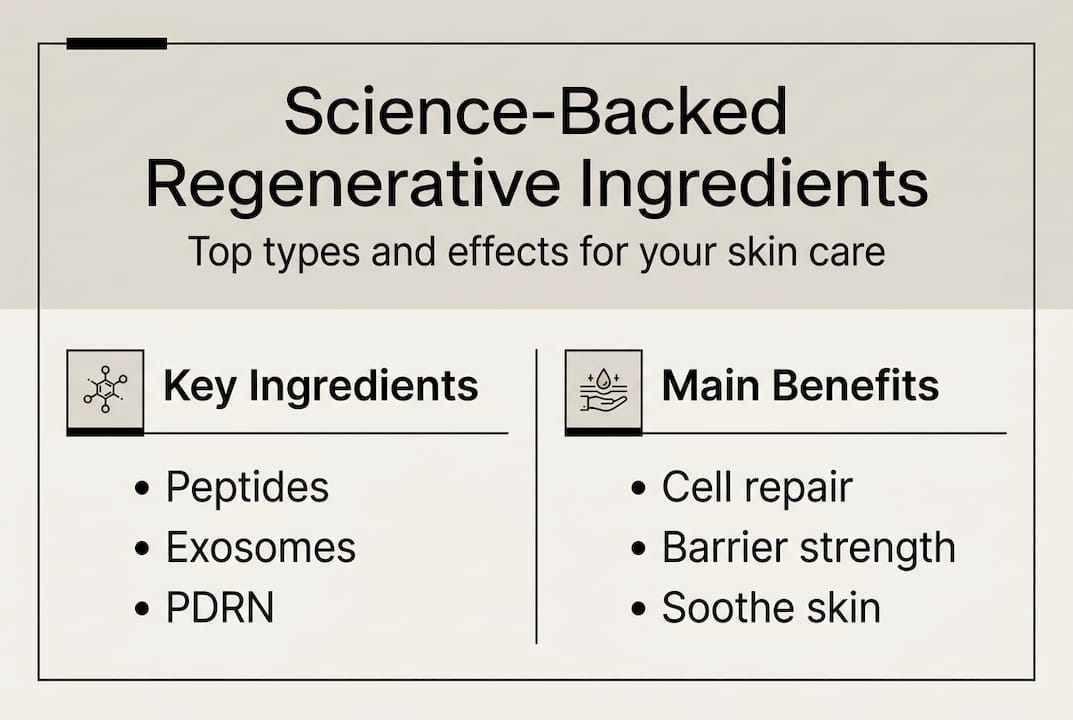
Here’s how the leading ingredients stack up:
| Ingredient | Source | Primary effect |
|---|---|---|
| PDRN (polynucleotides) | Salmon DNA | Dermal density, wound repair, collagen stimulation |
| Peptides | Amino acid chains | Collagen signaling, firmness, barrier support |
| Exosomes | Plant or stem cell derived | Cellular communication, anti-inflammatory |
| Niacinamide | Vitamin B3 | Tone, barrier, sebum regulation |
| Ceramides | Lipid molecules | Barrier repair, moisture retention |
| Hyaluronic acid | Fermentation derived | Hydration, plumping, surface smoothing |
The clinical outcomes for these ingredients are worth knowing. A PDRN clinical trial found that a PDRN eye cream improved dermal density by 8.67%, reduced under-eye bags by 18.42%, and diminished wrinkles within 28 days. Those are meaningful numbers for a topical product with no downtime.
Ingredients best suited to specific concerns:
- Texture and tone: Niacinamide, exosomes, Glyco-Repair
- Barrier support: Ceramides, hyaluronic acid, peptides
- Firmness and volume: PDRN, growth factors, collagen-signaling peptides
For a focused breakdown of how peptides work in formulations, see our guides on best peptides for skin and peptides in skincare. Peptides alone are one of the most versatile and well-studied categories in regenerative skincare, and they deserve more than a passing mention on a label.
Why choose regenerative ingredients? Gentle power for every skin type
Here’s where regenerative skincare separates itself most clearly from conventional options. It isn’t just about efficacy. It’s about who can actually use these ingredients without consequence.

Traditional anti-aging powerhouses like retinoids and chemical exfoliants are genuinely effective, but they come with a real barrier to entry. Sensitive skin, rosacea-prone skin, post-procedure skin, and even dry or compromised skin often can’t tolerate the inflammation they cause. Regenerative actives are gentle for all skin types, notably those with barrier issues or post-procedure needs, and unlike retinoids, they rarely cause irritation.
Dermatologists increasingly recommend regenerative actives for patients recovering from laser treatments, chemical peels, or microneedling. PDRN and exosomes in particular excel in post-procedure repair and barrier-compromised skin, accelerating recovery while supporting new collagen formation.
Skin types and situations that gain the most from regenerative actives:
- Adults 30 and older experiencing early to moderate signs of aging
- Sensitive or reactive skin that can’t tolerate retinoids or strong acids
- Post-procedure skin needing accelerated repair
- Dry or dehydrated skin with a weakened barrier
- Skin dealing with uneven tone, dullness, or loss of firmness
For those seeking firm, radiant skin without the recovery time of aggressive treatments, regenerative actives are a compelling alternative. And for a broader look at why this approach matters long-term, the guide on cellular repair for youthful skin covers the aging biology behind it.
Pro Tip: Pair your regenerative serum with a broad-spectrum SPF 30 or higher every morning. UV damage is the single biggest accelerator of cellular aging, and no regenerative ingredient can outwork daily sun exposure. Protecting what you’re rebuilding is just as important as the rebuilding itself.
“Unlike retinoids, regenerative actives rarely cause irritation, making them suitable for even the most sensitive or compromised skin.” — Vogue
How to build your own regenerative routine
Knowing which ingredients work is only half the equation. How you use them matters just as much. Here’s a practical, stepwise approach to building a regenerative routine that actually delivers results.
- Start with a gentle cleanser. Avoid sulfates or anything that strips your barrier. A compromised barrier limits how well any active ingredient absorbs.
- Apply your regenerative serum to damp skin. Slightly damp skin allows actives to spread more evenly and absorb more efficiently.
- Layer from lightest to heaviest. If you’re using multiple serums, apply the most watery formulas first, then thicker ones.
- Introduce regenerative actives gradually. Start with once daily use, then build to twice daily as your skin adjusts.
- Follow with a moisturizer to seal everything in. This is especially important for barrier-supporting ingredients like ceramides.
- Always finish your morning routine with SPF. This is non-negotiable.
What to combine and what to avoid: regenerative actives generally play well with niacinamide, hyaluronic acid, and ceramides. Be cautious layering them directly with high-strength vitamin C or low-pH acids, as these can destabilize some peptide formulations. The cellular repair best practices guide covers compatible pairings in detail.
Topical efficacy is limited by penetration, and results improve with smart delivery systems like liposomes, encapsulation, or nano-emulsions. When you’re evaluating products, look for these terms on the label. They signal that the brand has invested in getting the active ingredient past the skin’s outer layer, where it can actually do something.
Pro Tip: Look for products that list delivery system technology in their ingredient descriptions, not just in marketing copy. Liposomal encapsulation, for example, can significantly increase how much of an active ingredient reaches the deeper layers of the skin where repair happens.
For a full breakdown of how to structure your regimen, the skin renewal guide walks through timing, layering, and ingredient compatibility in practical terms. Consistency over weeks and months is what drives real change. Patience isn’t a passive strategy here. It’s an active one.
Expert perspective: What most people get wrong about regenerative skincare
With solid steps in mind, it’s worth examining what separates effective routines from hype in regenerative skincare.
The biggest misconception we see is the idea that one powerful ingredient is enough. People find PDRN or exosomes and expect transformation from a single product used sporadically. Real regeneration doesn’t work that way. Your skin’s repair systems respond to consistent, sustained signals, not occasional bursts of bioactives.
Another common myth: not all “stem cell” products are equal. Many products use plant stem cell extracts that have no meaningful effect on human skin biology. The actual science of regenerative skincare is far more specific. It requires ingredients with demonstrated mechanisms and clinical data, not just compelling labels.
The uncomfortable truth is that regenerative skincare rewards patience. The science-backed benefits of peptides and other actives accumulate over time. Skin that’s been consistently supported for three to six months looks and behaves differently than skin that’s been treated in short bursts. Focus on long-term repair, not quick fixes, and you’ll see results that actually last.
Upgrade your routine with science-backed regenerative skincare
If you’re ready to go beyond basics, here’s how Cellure can help you harness regenerative science.
At Cellure, every formulation is built around clinically supported bioactive ingredients designed for cellular skin repair and rejuvenation. Whether you’re targeting loss of firmness, uneven tone, or a weakened barrier, the product range includes targeted serums and treatment kits formulated with peptides, polynucleotides, and other regenerative actives. These aren’t surface-level solutions. They’re designed to work with your skin’s biology, the same way the science in this guide describes. Explore the full cellular regeneration line and find the formulation that fits your skin’s specific needs.
Frequently asked questions
Are regenerative skincare ingredients safe for sensitive skin?
Yes, most regenerative actives are gentle for sensitive skin and ideal for post-procedure recovery, making them a strong alternative to retinoids or strong acids that commonly cause irritation.
How quickly do regenerative ingredients show results?
Clinical studies show texture and tone improvements within one to four weeks, with dermal density increasing by 8.67% in 28 days with PDRN. Best results come with consistent, continued use.
Can I combine regenerative actives with sunscreen or retinoids?
Yes, and daily SPF is essential to protect your skin’s repair progress. Some experts suggest prioritizing regenerative actives over retinoids for gentler, equally effective long-term routines.
What makes peptides and exosomes special in regenerative skincare?
Peptides and exosomes boost collagen and elasticity by enhancing cellular communication, delivering resilience-building benefits with significantly less irritation than retinol-based approaches.
Recommended
- Regenerative Skincare: Science, Benefits & How to Use It – Cellure
- Unlock firm, radiant skin with regenerative science – Cellure
- How skin regeneration works: clinically proven methods – Cellure
- Evidence-based regenerative serums for youthful skin – Cellure
- Medical-grade skincare explained: unlock transformative results - The Aesthetics Room
- Postbiotic skincare: 5 key benefits for healthy skin – SMPL SKIN South Africa