


Regenerative Skincare: Science, Benefits & How to Use It
Most people assume skincare is a damage-control game. You apply your serum, slow the clock a little, and accept the rest. But regenerative skincare challenges that assumption directly. Instead of just protecting what’s left, it works at a cellular level to stimulate repair, rebuild structural proteins, and restore what aging has taken. Clinical trials now back this approach with real numbers, and the ingredients driving these results have moved from medical clinics into daily skincare routines. Here’s what the science actually says and how you can put it to work.
Table of Contents
- What is regenerative skincare?
- How regenerative skincare works: Key ingredients and technologies
- The scientific proof: What do studies show about regenerative skincare?
- Who can benefit from regenerative skincare?
- How to choose and use regenerative skincare for best results
- Discover advanced regenerative skincare solutions
- Frequently asked questions
Key Takeaways
| Point | Details |
|---|---|
| Cellular-level repair | Regenerative skincare stimulates your skin’s own repair and renewal systems for visible rejuvenation. |
| Science-proven ingredients | Clinical trials support ingredients like peptides, exosomes, and polynucleotides for anti-aging and repair. |
| Faster, lasting results | You can see smoother, firmer skin within days and maintain benefits with consistent use. |
| Personalized routines matter | Choosing evidence-backed actives and adjusting your regimen maximizes regenerative skincare results. |
What is regenerative skincare?
Regenerative skincare is a category of products and treatments designed to help skin repair and renew itself at a cellular level, rather than simply masking surface changes. Traditional anti-aging products often work by filling in fine lines or reflecting light. Regenerative formulas go deeper, targeting the biological processes that produce collagen, elastin, and new skin cells.
The science behind this approach draws from regenerative medicine, a field that has long used stem cells, exosomes, and PRP for skin repair and rejuvenation in clinical settings. What’s exciting now is that these same mechanisms are being translated into topical products you can use at home.
Here’s what regenerative skincare typically targets:
- Collagen and elastin production, which decline roughly 1% per year after age 25
- Cellular metabolism, keeping skin cells active and efficient
- Barrier repair, restoring the skin’s ability to retain moisture and resist damage
- Inflammation reduction, which accelerates visible aging
- Post-procedure recovery, speeding healing after laser or chemical treatments
Understanding what makes regenerative skincare unique helps clarify why it’s a fundamentally different approach from conventional anti-aging. It’s not about covering up. It’s about rebuilding.
How regenerative skincare works: Key ingredients and technologies
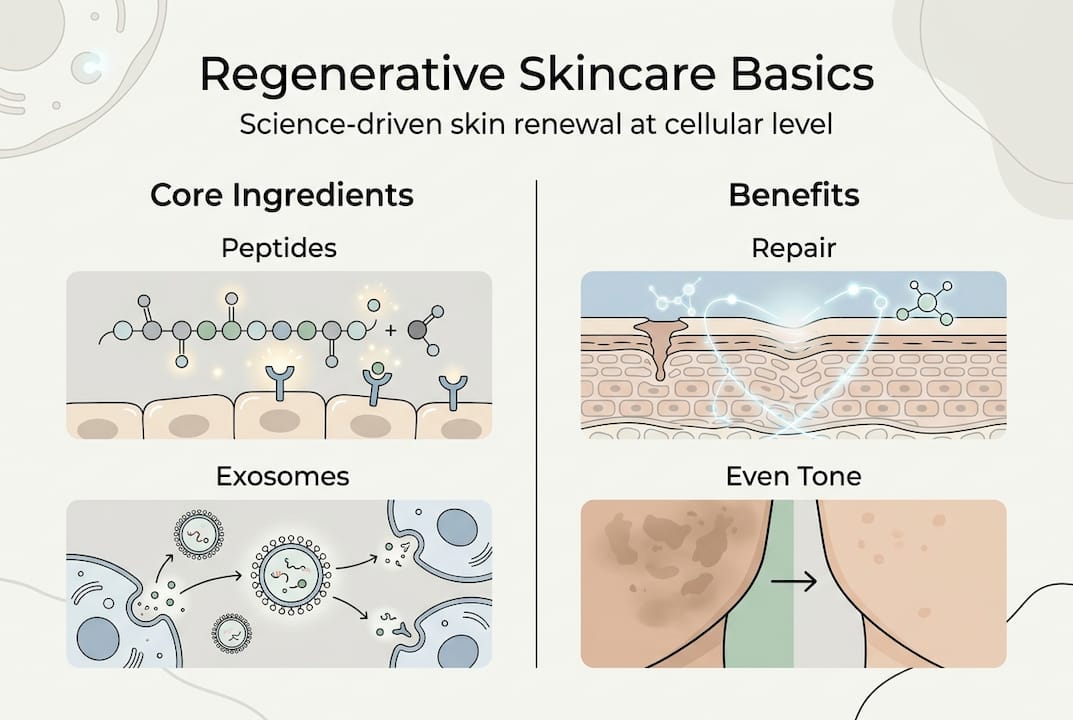
The real power of regenerative skincare comes from its active ingredients. These aren’t just moisturizers with a marketing upgrade. They’re bioactive compounds with measurable effects on skin biology.
Here’s a breakdown of the most clinically supported regenerative actives:
| Active ingredient | Mechanism | Proven effect |
|---|---|---|
| Polynucleotides (PN) | Stimulate fibroblasts, boost collagen and elastin | Improved acne scars, density, and hydration |
| Peptides | Signal proteins to trigger repair and firming | Reduced wrinkle depth, improved firmness |
| Exosomes | Deliver growth factors directly to cells | Reduced pore size, erythema, and melanin |
| Niacinamide | Regulates melanin transfer, strengthens barrier | Brighter, more even tone |
| Bioceramides | Restore lipid barrier, lock in moisture | Improved hydration and resilience |
| Hyaluronic acid (HA) | Attracts and holds water in the dermis | Plumper, smoother skin texture |
Formulations like regenerative skin repair ingredients are now combining several of these actives in one product. For example, SkinCeuticals’ RGN-6 uses patented actives including niacinamide, bioceramides, ectoin, and peptides to target six signs of aging simultaneously.
Polynucleotides deserve special attention. A clinical study found that PN HPT with hyaluronic acid significantly improved atrophic acne scars by stimulating both collagen and elastin, with an excellent safety profile. That’s not a minor cosmetic tweak. That’s structural skin repair.
If you want to understand the power of peptides for skin, they work by mimicking the body’s own signaling molecules, essentially telling your skin to behave younger. Combined with exosomes and polynucleotides, the results compound.
“The convergence of regenerative medicine and topical skincare is producing results that were unimaginable a decade ago. Cellular repair is no longer just a clinic conversation.”
The scientific proof: What do studies show about regenerative skincare?
The numbers behind regenerative skincare are genuinely impressive. Here’s a snapshot of what peer-reviewed research has found:
| Study focus | Key result | Timeframe |
|---|---|---|
| Regenerative cream post-laser | Hydration up 76%, uniformity up 49% | 7 days |
| Exosome therapy with microneedling | Pore size down 41%, erythema down 42% | 5.5 months, sustained at 21 months |
| PDRN (salmon DNA polynucleotides) | Dermal density up 8.67%, under-eye bags down 18.42% | 28 days |
Three things stand out from this cellular repair research:
- Results can appear fast. Hydration and texture improvements showed up within seven days in the post-laser trial.
- Benefits can last. Exosome therapy results were still measurable at 21 months post-treatment.
- Multiple concerns respond. From under-eye bags to pore size to skin tone, regenerative actives address a wide range of aging signs.
Pro Tip: When evaluating a product, look for peer-reviewed clinical data, not just brand-funded studies. Independent trials with measurable endpoints are the gold standard.
The field is moving fast, but researchers note that long-term studies across diverse skin types are still needed. What’s clear is that the early data is strong enough to take seriously.
Who can benefit from regenerative skincare?
Regenerative skincare isn’t a one-size-fits-all category, but it does serve a wide range of skin concerns. Regenerative medicine is particularly effective for aging concerns, wound repair, and sun damage, making it relevant for a large portion of adults over 30.
The people who tend to see the most benefit include:
- Those with visible aging signs: loss of firmness, volume, or uneven tone
- Post-procedure skin: recovering from laser resurfacing, chemical peels, or microneedling
- Acne scar concerns: polynucleotides and exosomes have shown strong results here
- Under-eye issues: PDRN has demonstrated measurable reduction in puffiness and dark circles
- Sun-damaged skin: regenerative actives help restore barrier function and even tone
Understanding why target cellular repair matters most for those who feel their skin has stopped responding to conventional products. If your current routine maintains but doesn’t improve, regenerative skincare may be the next step.
A note on who should be cautious: if you have known allergies to biological ingredients like salmon-derived PDRN or specific peptide chains, always check labels carefully. Those with highly reactive or compromised skin barriers should introduce actives gradually.
Pro Tip: Start with one targeted active at a clinically studied concentration rather than layering multiple new ingredients at once. Give your skin four to six weeks to respond before adding anything else.
How to choose and use regenerative skincare for best results
Knowing the science is one thing. Using these products correctly is what actually delivers results. Here’s a practical roadmap:
- Patch test first. Apply a small amount to your inner arm for 48 hours before full-face use, especially with polynucleotides or exosome-based products.
- Start low and slow. Introduce one new regenerative product at a time. Monitor your skin’s response over four to six weeks before drawing conclusions.
- Look for clinical backing. Products listing ingredients backed by clinical data such as PN, peptides, exosomes, and HA give you a stronger foundation for results.
- Layer correctly. Apply lighter serums before heavier creams. Regenerative serums generally go on clean skin before moisturizer.
- Always use SPF. Regenerative actives work to rebuild skin. UV exposure undoes that work. Daily broad-spectrum SPF 30 or higher is non-negotiable.
When it comes to combinations, some pairings work well and others don’t:
- Good pairings: Peptides with niacinamide, polynucleotides with hyaluronic acid, exosomes with gentle moisturizers
- Use with care: Retinol and strong vitamin C can be used in the same routine but on alternating nights if sensitivity is a concern
- Avoid: Harsh physical or chemical exfoliants on the same day as active regenerative treatments
For sensitive skin, the skin repair ingredient guide recommends focusing on barrier-first ingredients like bioceramides and HA before introducing more potent actives. And if you’re exploring using peptides for rejuvenation, consistency matters more than concentration. Daily use over weeks outperforms occasional high-dose application.
Discover advanced regenerative skincare solutions
You now have the science, the ingredient knowledge, and a practical routine framework. The next step is finding formulations that actually deliver on these principles.
At Cellure, every product is built around clinically supported bioactive ingredients designed for real cellular repair. The Complete Skin Repair Kit brings together targeted actives for firming, brightening, and barrier restoration in one cohesive system. Whether you’re addressing early aging signs or looking for intensive repair after sun damage or procedures, Cellure advanced regeneration formulations are designed to work with your skin’s biology, not against it. Explore the full range and find the right starting point for your skin’s specific needs.
Frequently asked questions
Can regenerative skincare actually reverse signs of aging?
Clinical studies show significant improvements in hydration, elasticity, and evenness. One trial found hydration improved by 76% in just seven days, confirming that visible aging signs can be meaningfully reversed, not just slowed.
How long does it take to see results with regenerative skincare?
Some improvements like smoother texture appear within seven days, while deeper structural changes build over months. Results from exosome therapy were still measurable at 21 months, showing both speed and durability.
Is regenerative skincare safe for sensitive skin?
Most formulations are well-tolerated and designed for gentle use. Polynucleotides with hyaluronic acid showed an excellent safety profile in clinical trials, though checking for specific allergens and consulting a dermatologist is always smart.
What ingredients should I look for in a regenerative skincare product?
Prioritize peptides, exosomes, polynucleotides, niacinamide, hyaluronic acid, and bioceramides. Products like SkinCeuticals RGN-6 combine several of these actives to target multiple aging signs at once.
Are regenerative skincare results permanent?
Results are substantial and can last well beyond a year, but maintenance is required as skin continues to age. Exosome therapy results persisted at 21 months, but consistent use of regenerative actives supports ongoing skin health.
Recommended
- Unlock firm, radiant skin with regenerative science – Cellure
- Role of Serums in Skin Health: Science and Impact – Cellure
- Cellular Repair Works: Science Behind Youthful Skin – Cellure
- Skin repair kits explained: restore firm, even skin in 2026 – Cellure
- What Is Regenerative Beauty and Why It Matters – Didis Beauty Center