


Top ingredients for cellular repair: science-backed skin renewal
TL;DR:
- Effective skincare ingredients should demonstrate a clear biological mechanism and strong clinical evidence.
- Retinoids, peptides, PDRN, growth factors, and antioxidants each have unique benefits and safety profiles.
- Simplicity and consistency in using one or two active ingredients are more effective than complex, multi-step routines.
The skincare market is flooded with promises, and separating genuine cellular repair from clever marketing is harder than it should be. If you’ve spent money on products that didn’t deliver, you’re not alone. Peptides significantly reduce wrinkles and improve hydration, yet most shoppers have no framework for knowing which ingredients actually work at the cellular level. This guide cuts through the noise. You’ll get a clear evaluation method, a ranked breakdown of the five most effective ingredients, a side-by-side comparison, and a personalized selection strategy, so your next skincare decision is grounded in evidence, not advertising.
Table of Contents
- How to evaluate cellular repair ingredients
- Top 5 best ingredients for cellular repair
- Comparing cellular repair ingredients head-to-head
- Choosing the right ingredient for your skin
- Our expert take: What most don’t tell you about cellular repair
- Discover science-driven cellular repair solutions
- Frequently asked questions
Key Takeaways
| Point | Details |
|---|---|
| Retinoids remain gold standard | Retinoids have the strongest evidence for cellular repair but can be irritating for sensitive users. |
| Peptides boost collagen safely | Signal and copper peptides offer wrinkle reduction and hydration with high tolerability. |
| Innovators like PDRN show promise | Polynucleotides represent new, effective options but are often more costly and newer on the market. |
| Choose based on your skin | Select ingredients based on your age, sensitivity, and results desired rather than chasing trends. |
How to evaluate cellular repair ingredients
Not all ingredients are created equal, and the gap between a well-marketed product and a genuinely effective one can cost you years of wasted effort. Before you invest in any serum or treatment, you need a reliable way to assess whether an ingredient actually promotes cellular repair or just sounds like it does.
Start with the scientific mechanism. The best ingredients work through measurable biological pathways. Extracellular matrix (ECM) regeneration, meaning the rebuilding of collagen and elastin scaffolding in the skin, is one of the most important. Fibroblast stimulation, which triggers the skin cells responsible for producing structural proteins, is another. If an ingredient can’t demonstrate a clear mechanism in peer-reviewed research, it’s a red flag. For example, retinoids promote scarless regeneration via anti-fibrotic ECM remodeling, a process backed by decades of controlled studies.
Next, look at clinical evidence quality. There’s a significant difference between a lab dish study (in vitro) and a randomized controlled trial on actual human skin. The gold standard is a meta-analysis, which pools data from multiple clinical trials to show consistent results across diverse populations. Look for measurable endpoints: wrinkle depth reduction expressed as a percentage, firmness scores measured by cutometry, or hydration levels confirmed by corneometry. Vague claims like “visibly younger skin” without quantified outcomes are not clinical evidence.
Also consider tolerability and safety. An ingredient that works brilliantly but causes significant irritation, redness, or peeling in your skin type isn’t a practical solution. Some of the most powerful actives, retinoids in particular, require a slow introduction period. Others, like peptides, are gentle enough for daily use from day one. Understanding cellular repair fundamentals helps you match ingredient strength to your skin’s current tolerance level.
Finally, weigh cost-effectiveness. A high price tag does not equal higher efficacy. Some of the most evidence-rich ingredients are also among the most affordable. Newer actives may carry a premium without the long-term data to justify it.
Here’s what to look for when evaluating any ingredient:
- Peer-reviewed mechanism of action (ECM, fibroblast, or collagen pathway)
- Clinical trial data with measurable, quantified outcomes
- Meta-analysis support rather than single-study claims
- Tolerability profile matched to your skin type
- Transparent cost-to-evidence ratio
Pro Tip: When reading product claims, search for the ingredient name plus “meta-analysis” or “randomized controlled trial.” If you can’t find either, the evidence base is thin.
Now that you know what makes an ingredient effective, let’s explore the science-backed options.
Top 5 best ingredients for cellular repair
Armed with evaluation criteria, here’s how the most powerful ingredients stack up.
-
Retinoids are the most evidence-backed ingredient class in anti-aging skincare. They work by binding to nuclear receptors in skin cells, accelerating cell turnover, stimulating collagen production, and reducing matrix metalloproteinase activity, the enzymes that break down collagen. The tradeoff is irritation, especially during the first few weeks. Retinoids are best for users who can commit to a gradual introduction and consistent sun protection.
-
Peptides (signal, copper, and matrixyl types) are shorter chains of amino acids that act as messengers, telling fibroblasts to produce more collagen, elastin, and hyaluronic acid. Signal, copper, and matrixyl peptides boost collagen I and III along with elastin synthesis, making them highly effective for firmness and texture. They’re also gentle enough for sensitive skin, which makes them one of the most versatile actives available. Explore science-backed peptides to understand which types address your specific concerns.
-
Polynucleotides (PDRN) are a newer class of regenerative ingredients derived from purified DNA fragments. They activate the PI3K-Akt and TGF-β pathways to support ECM regeneration and tissue repair. PDRN activates PI3K-Akt/TGF-β for ECM regeneration and showed measurable clinical improvement in just 28 days in periocular aging studies. The downside is cost and limited long-term data compared to retinoids.
-
Growth factors are proteins that signal skin cells to repair and regenerate. They’re among the most innovative actives available and show high efficacy in clinical settings, particularly for post-procedure recovery and significant volume loss. Their price point is higher, and formulation stability is a known challenge.
-
Antioxidants (vitamin C, niacinamide, resveratrol) play a supporting role rather than a lead one. They neutralize free radicals that accelerate cellular damage and enhance the effectiveness of other actives. They don’t rebuild collagen on their own, but they protect the repair work your other ingredients are doing. You can learn more about how each of these actives functions in our best skin repair ingredients explained guide.
“Retinoids have decades of evidence while new actives like PDRN are promising but come with higher costs and limited long-term data.”
Comparing cellular repair ingredients head-to-head
With the main ingredients introduced, let’s put them side by side for a quick decision framework.
| Ingredient | Mechanism | Evidence level | Speed of results | Cost | Irritation risk |
|---|---|---|---|---|---|
| Retinoids | ECM remodeling, cell turnover | Very high | 4 to 12 weeks | Low to moderate | Moderate to high |
| Peptides | Fibroblast signaling, collagen synthesis | High | 4 to 8 weeks | Moderate | Very low |
| PDRN | PI3K-Akt/TGF-β, ECM repair | Moderate (growing) | 4 weeks | High | Low |
| Growth factors | Cell signaling, tissue regeneration | Moderate | 4 to 8 weeks | Very high | Low |
| Antioxidants | Free radical neutralization | High (as support) | 2 to 4 weeks | Low | Very low |
A meta-analysis confirms peptides reduce wrinkles and increase firmness with a strong safety profile, making them an excellent choice for first-time users of active skincare. Meanwhile, PDRN improved periocular aging in clinical studies within 28 days, which is notably fast for a regenerative ingredient.
Here’s how to read the table based on your priorities:
- Easiest to use: Peptides and antioxidants require no adjustment period and suit all skin types
- Best for sensitive skin: Peptides and PDRN carry the lowest irritation risk
- Most rapid results: PDRN and retinoids show the fastest documented improvements in clinical settings
- Most budget-friendly: Retinoids and antioxidants offer the best value per evidence point
- Highest innovation ceiling: Growth factors and PDRN represent the frontier of regenerative skincare
For a deeper look at how to structure your routine around these actives, the cellular repair skincare guide walks through practical layering strategies. If firmness is your primary concern, understanding firmer skin with peptides offers targeted insight into how peptide signaling specifically addresses volume and lift.
Choosing the right ingredient for your skin
Here’s how to take the ingredient insights and apply them to your routine.
The right ingredient depends on four factors: your age and degree of visible aging, your skin type and sensitivity history, your tolerance for potential irritation during an adjustment period, and your budget. These four variables narrow your options quickly.
Retinoids are effective but can be irritating, making peptides a safer alternative for many users, while PDRN is promising but carries a higher price point. This contrast is important because it means the “best” ingredient isn’t universal. It’s the one that fits your skin’s current state and your commitment level.
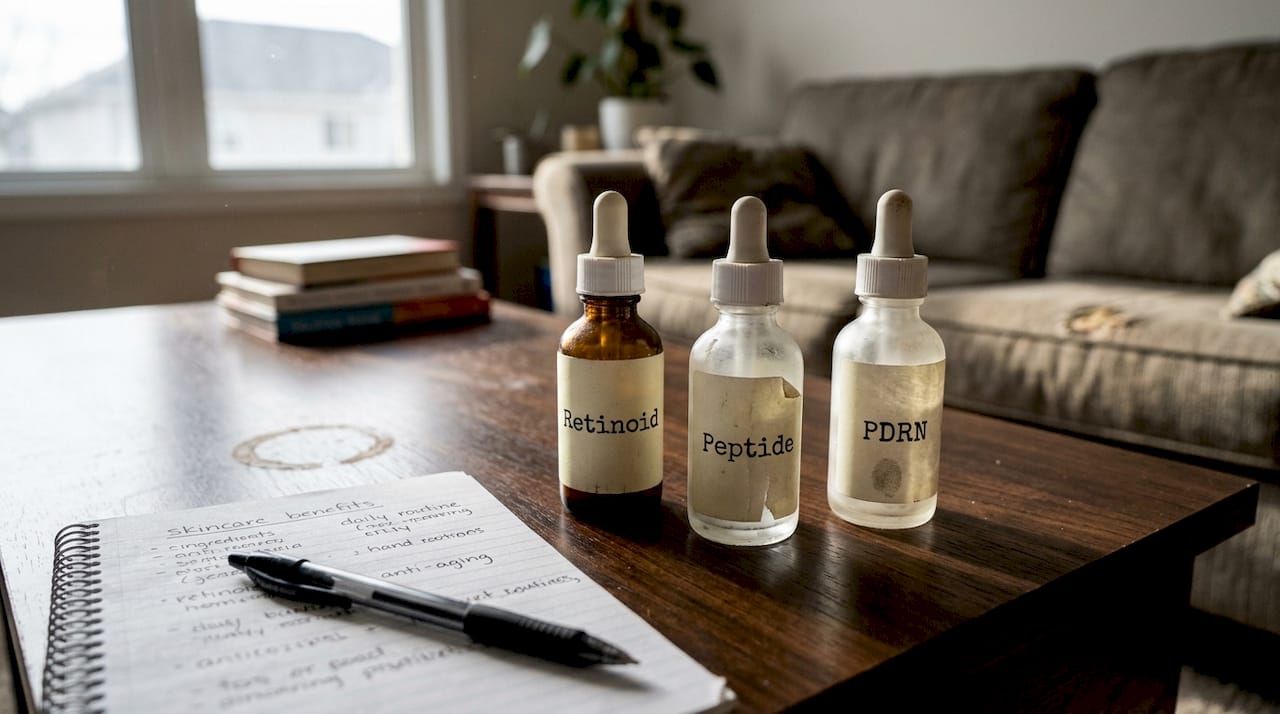
Knowing when to combine ingredients versus focusing on one hero active is equally important. Layering too many actives too quickly leads to irritation, barrier disruption, and confusion about what’s actually working. A smarter approach is to introduce one active at a time, assess results over four to six weeks, and then add a complementary ingredient if needed.
Here are sample skin profiles with suggested strategies:
- Sensitive skin, early signs of aging: Start with peptides plus a vitamin C antioxidant. Avoid retinoids until tolerance is established.
- Normal to combination skin, moderate wrinkles: Retinoids at night, peptide serum in the morning, antioxidant support daily.
- Mature skin with significant volume loss: Consider PDRN or growth factor formulations alongside a peptide base for structural support.
- Budget-conscious routine: Retinoids plus niacinamide offer the highest evidence-to-cost ratio available.
- Post-procedure or compromised barrier: Peptides and PDRN are the gentlest options for repair without additional stress.
For a structured approach to building your routine, the best practices for repair guide covers sequencing, frequency, and ingredient compatibility in detail.
Pro Tip: If you’re introducing retinoids, start with two nights per week and apply a peptide-based moisturizer on top to buffer irritation. This approach dramatically reduces the adjustment period without sacrificing efficacy.
Our expert take: What most don’t tell you about cellular repair
Here’s the uncomfortable truth about the cellular repair category: most people spend more than they need to because the industry profits from complexity. A 12-step routine featuring six different actives sounds impressive, but it’s often less effective than a focused two-step protocol using one or two well-chosen ingredients.
Ingredient fatigue is real. When you rotate through too many actives, your skin never fully adapts to any of them, and you lose the ability to measure what’s working. Worse, you risk barrier disruption, which actively reverses cellular repair progress.
Understanding how cellular repair really works at the biological level makes this clearer. Fibroblasts need consistent, repeated signaling to upregulate collagen production. Switching actives every few weeks interrupts that process. The brands that encourage constant product rotation are not serving your skin. They’re serving their sales cycle.
Our recommendation is simple: pick one primary active with strong clinical backing, add one supportive ingredient, and stay consistent for at least eight weeks before evaluating results. Simplicity, done consistently, outperforms complexity every time.
Discover science-driven cellular repair solutions
If you’ve identified the ingredients that match your skin’s needs, the next step is finding formulations that actually deliver them at effective concentrations. That’s where formulation quality matters as much as ingredient selection.
At Cellure, our Complete Skin Repair Kit combines clinically supported actives into a streamlined routine designed for measurable results. For brightening and barrier repair in one step, the Tranexamic Acid Peptide Serum pairs two of the most evidence-backed ingredients in a single formula. Browse our full range of advanced cellular regeneration solutions to find the combination that fits your skin profile and goals.
Frequently asked questions
Which ingredient works fastest for cellular repair?
Retinoids offer some of the most rapid and well-documented improvements for skin renewal, though irritation may occur initially. They accelerate re-epithelialization and ECM remodeling, which speeds visible renewal more quickly than most other actives.
Are peptides or retinoids safer for sensitive skin?
Peptides are generally better tolerated for sensitive skin, while retinoids can cause irritation in some users. Peptides boost collagen and are less irritating than retinoids, making them the preferred starting point for reactive skin types.
What is PDRN and is it worth it?
PDRN (polynucleotide) is a cutting-edge regenerative ingredient with strong early clinical results, but it costs more and has less long-term data compared to retinoids. It activates PI3K-Akt/TGF-β for ECM regeneration and is worth considering for mature or compromised skin.
Can I combine multiple cellular repair ingredients?
Yes, but start slowly to avoid irritation. Layering peptides with antioxidants and using retinoids at night is a common and well-tolerated strategy. Balancing safety and efficacy across ingredient combinations requires patience and a gradual introduction approach.