


How Aging Changes Skin Cells and What to Do About It
TL;DR:
- Wrinkles and sagging originate deep inside skin cells many years before surface signs appear, due to cellular aging processes. Key mechanisms like telomere shortening, oxidative stress, and mitochondrial dysfunction lead to senescent cells that promote tissue breakdown and degrade skin structure. Early, targeted interventions supporting fibroblast activity and reducing senescence can preserve skin’s youthful integrity over time.
Wrinkles and sagging don’t start at the surface. They start years earlier, deep inside your skin cells, long before any mirror reveals them. By the time most people begin looking for solutions, a significant amount of cellular damage has already accumulated. Understanding what actually happens inside your skin as you age gives you the power to intervene earlier, smarter, and with the right tools. This article walks you through the real biology of skin aging, decade by decade, and connects it directly to the interventions that science now supports.
Table of Contents
- Breaking down the skin aging process: Cellular changes revealed
- Visible consequences: From collagen loss to wrinkles
- Intrinsic vs extrinsic aging: More than just sun damage
- The decades of change: What happens to your skin cells from 30 to 60
- Science-backed solutions: Rejuvenating aging skin at the cellular level
- Rethinking anti-aging: Cellular repair matters more than covering up
- Take your next step: Science-formulated solutions for skin cell renewal
- Frequently asked questions
Key Takeaways
| Point | Details |
|---|---|
| Cellular aging drives visible changes | Wrinkles and sagging reflect profound changes in skin cells and collagen over time. |
| Both intrinsic and extrinsic factors matter | Natural aging and environmental exposures both accelerate skin cell dysfunction. |
| Science-backed actives work best | Ingredients like retinoids, antioxidants, and peptides show proven effects on cellular renewal. |
| Early intervention gives the biggest benefit | Addressing cellular aging in your 30s and 40s is more effective than waiting until later. |
| Cutting-edge therapies show promise | Emerging solutions like exosomes and senolytics reduce signs of cell senescence and may restore youthful skin function. |
Breaking down the skin aging process: Cellular changes revealed
Most people think of aging skin as a cosmetic inconvenience. The reality is more fundamental than that. Aging is primarily a cellular event, and the skin is one of the most visible places that process plays out.
Two cell types carry most of the load in healthy skin: fibroblasts, which live in the dermis and produce structural proteins like collagen and elastin, and keratinocytes, which form the skin’s protective outer barrier. When these cells are young and functioning well, they renew efficiently, communicate clearly, and repair damage. Over time, both age into cellular senescence, meaning they stop dividing and enter a state of permanent cell cycle arrest.
Senescent cells don’t just stop working. They actively disrupt the tissue around them. This is because of a phenomenon called SASP, short for Senescence-Associated Secretory Phenotype. Senescent cells release inflammatory signals, enzymes, and growth factors that promote chronic low-grade inflammation and break down the surrounding skin structure.
The key cellular mechanisms that drive this process include:
- Telomere shortening: Each time a cell divides, telomeres (the protective caps on chromosomes) get shorter, eventually triggering arrest
- Oxidative stress: Free radicals from UV exposure, pollution, and metabolism damage DNA and proteins faster than cells can repair them
- DNA strand breaks: Accumulating damage activates stress response pathways that push cells into senescence
- Mitochondrial dysfunction: Aging mitochondria produce more reactive oxygen species and less energy for cellular repair
- Pathway activation: Signaling networks like p16INK4a/RB, p53, NF-κB, mTOR, and TGF-β all play roles in driving senescence and SASP
Understanding the science behind youthful skin begins with recognizing that these aren’t isolated events. They form an interconnected cascade, and addressing them requires targeted, evidence-based strategies rather than surface-only treatments.
“The accumulation of senescent cells in skin tissue creates a feedback environment that progressively impairs the skin’s ability to regenerate, respond to damage, and maintain structural integrity.” This insight, drawn from current dermatological research, reframes aging as a dynamic biological process, not an inevitable, unchangeable decline.
For a deeper orientation, the guide to cellular repair explains how modern regenerative skincare targets these mechanisms at their source.
To see how these internal cell changes manifest in your skin, let’s look at aging’s effect on structure and appearance.
Visible consequences: From collagen loss to wrinkles
Inside a young, healthy dermis, fibroblasts actively produce collagen and elastin, maintaining skin’s firmness and bounce. Aging changes that equation sharply. Senescent fibroblasts reduce collagen production while simultaneously increasing the output of matrix metalloproteinases (MMPs), enzymes that degrade the extracellular matrix (ECM). The result is a double hit: less new collagen built, more existing collagen destroyed.
The numbers from sun-protected skin make this visible decline concrete. Compared to adults aged 18 to 29, skin aged 80 and over shows a 35% reduction in fibroblast density, a 68% reduction in type I procollagen, and a 30% decrease in overall collagen synthesis capacity. These aren’t small changes. They’re the cellular story behind every wrinkle you can see.
| Parameter | Young skin (18-29) | Aged skin (80+) | Change |
|---|---|---|---|
| Fibroblast density | Baseline | Significantly reduced | -35% |
| Type I procollagen | Baseline | Markedly lower | -68% |
| Collagen synthesis rate | Baseline | Reduced | -30% |
| MMP activity | Low | Elevated | Increased |
| Dermal thickness | Full | Thinned | Gradual loss |
This table illustrates why cellular skin rejuvenation must go deeper than moisturizing the surface. Hydration masks the appearance of thinning skin temporarily, but it doesn’t address the fibroblast activity driving the structural decline.
Pro Tip: To meaningfully boost collagen synthesis, look for ingredients that directly communicate with fibroblasts. Peptides signal fibroblasts to increase collagen production, while retinoids suppress MMP activity and stimulate TGF-beta, a growth factor that drives new collagen formation. Using both together creates a layered approach that addresses collagen loss from two directions at once.
Now that you understand how internal cell changes translate into wrinkles and thinning, we can clarify the difference between natural (intrinsic) aging and environmental (extrinsic) aging and why both matter.
Intrinsic vs extrinsic aging: More than just sun damage
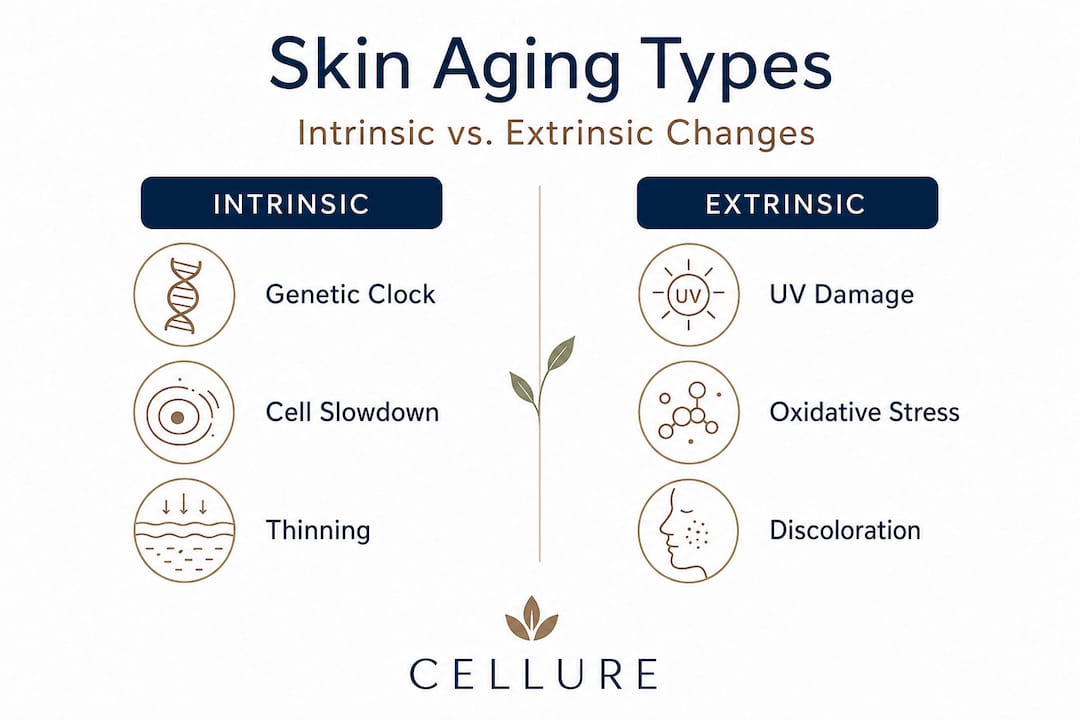
Not all aging is created equal. Intrinsic aging is biological and chronological. It’s the natural slowing of cellular activity driven by telomere shortening, oxidative stress, and reduced hormonal signaling that happens regardless of lifestyle. Intrinsic aging tends to produce fine lines, mild epidermal thinning, and a gradual loss of elasticity.
Extrinsic aging, primarily driven by UV radiation, involves a more aggressive cellular response. UV exposure generates reactive oxygen species (ROS) that directly damage DNA, overactivate MMPs, and accelerate SASP. Extrinsic aging produces coarser wrinkles, elastosis (a breakdown of elastic fibers), and significant pigmentation changes. Intrinsic aging, by contrast, brings epidermal thinning and fine wrinkles driven by slower telomere and oxidative mechanisms.
An important and often overlooked factor is skin type and ethnicity. People with darker skin tones (higher phototype) tend to experience more volume loss and dyschromia (uneven pigmentation) with photoaging, while lighter skin types more often develop rhytids (wrinkles) and elastosis. This difference matters when choosing targeted interventions. A brightening serum addresses different cellular targets than a firming one.
Hormonal changes add another layer, particularly for women. Menopause accelerates collagen loss by approximately 30% within five years, due to declining estrogen, which normally supports fibroblast activity and collagen synthesis. This isn’t just cosmetic. It’s a measurable change in skin architecture that requires proactive support.
Practical strategies to address both forms of aging include:
- Daily broad-spectrum SPF 30+ sunscreen to block UV-induced ROS production
- Antioxidants like vitamin C to neutralize free radicals before they cause DNA damage
- Hormone-supportive skincare ingredients such as phytoestrogens and peptides for women in perimenopause
- Consistent use of ingredients that restore barrier function, including ceramides and niacinamide
For a closer look at how all of this connects to daily practice, cellular repair for youthful skin offers a structured perspective on prioritizing these steps.
Pro Tip: Sun damage compounds biological aging rather than replacing it. You’re dealing with both systems simultaneously after age 30. Addressing only one while ignoring the other leaves half your skin’s aging story unaddressed.
With the drivers of aging now distinguished, let’s focus on what happens during your 30s, 40s, and 50s, and how quickly these changes progress.
The decades of change: What happens to your skin cells from 30 to 60
Cellular aging doesn’t announce itself loudly at first. It builds. And understanding the timeline helps you act before the visible damage accumulates to the point where it becomes harder to reverse.
Here’s a decade-by-decade picture of what’s happening beneath the surface:
| Decade | Key cellular changes | Visible signs |
|---|---|---|
| 30s | Collagen at ~90% of youthful levels; fibroblast activity slowing; early MMP rise | Subtle fine lines; mild dullness |
| 40s | Accelerated collagen loss, up to 30% in 5 years for perimenopausal women; thinner dermis | Deeper lines; reduced firmness; uneven tone |
| 50s | Dermal thickness down ~6% per decade; collagen production ~75% lower than peak | Visible sagging; pronounced wrinkles; significant texture changes |
Collagen drops approximately 1% per year starting in your mid-20s, but the compounding effect doesn’t become clearly visible until your 30s and beyond. By your 50s, the combination of reduced fibroblast density, elevated MMP activity, and hormonal decline creates a structural deficit that surface treatments alone cannot reverse.
A stepwise intervention approach aligned with each decade includes:
- In your 30s: Introduce retinoids and vitamin C to support fibroblast signaling and counter early oxidative damage. This is the window where prevention yields the highest return.
- In your 40s: Add peptide-based serums and consider niacinamide for barrier support. Address hormonal factors proactively, particularly if you’re approaching perimenopause.
- In your 50s: Prioritize regenerative formulations targeting fibroblast activity directly. Polynucleotides and advanced peptides become particularly relevant at this stage, working at the cellular level to restore synthesis capacity.
The key insight here is that waiting until you see significant damage means your cellular reserves are already depleted. Early, consistent intervention preserves the fibroblast function you still have and slows the accumulation of senescent cells. For practical guidance, science-backed skin renewal steps provides a useful framework organized by skin type and concern.
Armed with specifics about when and how your skin changes, let’s look at evidence-based ways to counteract or slow these processes, from topicals to emerging therapies.
Science-backed solutions: Rejuvenating aging skin at the cellular level
The skincare market generates enormous noise. Every ingredient claims transformation. What separates effective cellular aging interventions from well-marketed moisturizers is whether the ingredient actually influences fibroblast behavior, senescence pathways, or collagen dynamics.
Here’s what science currently supports:
- Retinoids: Activate TGF-beta signaling to drive new collagen production and suppress MMP activity. One of the most studied and validated topical anti-aging ingredients
- Vitamin C (ascorbic acid): A direct antioxidant that neutralizes UV-induced ROS, and also a cofactor in collagen synthesis. Protects and produces
- Niacinamide (vitamin B3): Strengthens the epidermal barrier, reduces inflammatory signaling, and evens out tone by inhibiting melanosome transfer
- AHAs (alpha-hydroxy acids): Accelerate keratinocyte turnover, improving texture and allowing active ingredients to penetrate more effectively
- Peptides: Signal fibroblasts directly to increase collagen, elastin, and hyaluronic acid production. Different peptides target different pathways, making formulation specificity important
At the cutting edge of the field, senolytics and exosomes are showing genuine promise. Topical platelet exosomes, for example, have demonstrated a 40% reduction in SASP markers and measurable collagen upregulation in clinical studies. These aren’t yet mainstream products, but they signal where the field is heading.
Pro Tip: Combining a retinoid at night with a vitamin C serum in the morning creates a complementary system. The retinoid drives fibroblast activity and collagen synthesis while you sleep. The vitamin C protects against oxidative damage during the day. Together, they address both the repair and protection arms of cellular aging simultaneously.
Explore the skin renewal actives that support fibroblast signaling, along with advanced skincare science frameworks for building a protocol around your decade of concern. The cellular repair best practices guide also covers layering strategies for optimal ingredient synergy.
Rethinking anti-aging: Cellular repair matters more than covering up
Here’s the perspective that mainstream beauty media rarely emphasizes: most anti-aging products are designed to create the appearance of youthful skin, not to address the cellular environment that creates youthful skin. Foundation covers lines. Hyaluronic acid temporarily plumps them. Neither one reaches fibroblasts.
The real leverage point is the senescence-collagen feedback loop. Here’s what that means. As fibroblasts age and collagen fragments accumulate in the dermis, those fragments physically signal fibroblasts to reduce synthesis even further. The mechanical signal that once told fibroblasts to produce collagen gets disrupted. This is called reduced mechanotransduction, suppressing synthesis, and it’s a self-reinforcing cycle that gets harder to break the longer it runs.
Breaking this loop early, especially between 30 and 60, requires ingredients that either clear fragmented collagen, signal fibroblasts past the senescent feedback, or selectively reduce the burden of senescent cells using retinoids, antioxidants, or senolytic compounds. This is precisely why people who start targeted cellular repair in their 30s look meaningfully different at 55 than those who start at 50. The window matters.
The cosmetic industry profits from complexity. In reality, a focused, evidence-based protocol with a small number of validated actives will outperform an elaborate routine built around beautiful packaging and vague claims. Your skin doesn’t need ten products. It needs the right signals sent to the right cells. Explore real solutions for skin renewal to see how this translates into a practical, targeted approach.
Take your next step: Science-formulated solutions for skin cell renewal
If this article has shifted how you think about aging, the next move is choosing products built around the same science. Not surface treatments designed to temporarily improve appearances, but formulations that actively work with your skin’s cellular biology.
At Cellure, every formulation is built around bioactive ingredients with clinical support for cellular repair: peptides that signal fibroblast activity, tranexamic acid for tone and barrier support, and polynucleotides that support cellular regeneration at the tissue level. The Complete Skin Repair Kit offers a structured, multi-step approach targeting the key mechanisms covered in this article. For brightening and barrier repair, the tranexamic acid peptide serum combines two clinically studied actives in a single, easily layered formula. Explore all Cellure solutions to find the right match for your decade and concern.
Frequently asked questions
How quickly does collagen decline in your 30s and 40s?
Collagen decreases approximately 1% per year from your mid-20s onward, with women in perimenopause potentially losing up to 30% over just five years during their 40s. Early intervention with retinoids and peptides can meaningfully slow this rate.
What role does menopause play in accelerating skin aging?
Menopause accelerates collagen loss by roughly 30% within five years as estrogen levels drop, reducing the hormonal support fibroblasts rely on for collagen synthesis and skin structural maintenance.
Are senolytic treatments effective for visible anti-aging?
Senolytics show biomarker reductions in clinical trials, including lower levels of SASP markers and improved collagen signaling, but dramatic visible reversal across large populations hasn’t yet been consistently demonstrated.
How does skin of color age differently at the cellular level?
Photoaging by phototype shows that skin of color tends toward volume loss and dyschromia with sun exposure, while lighter skin types more commonly develop wrinkles and elastosis, reflecting differences in melanin protection and inflammatory response patterns.
What’s the most important first step for anti-aging skin care?
Retinoids, antioxidants, and peptides form the foundation of any evidence-based cellular anti-aging protocol, alongside daily broad-spectrum sunscreen to block the UV-induced oxidative damage that accelerates senescence.