


Clinically supported skincare: real science for aging skin
TL;DR:
- “Clinically supported” skincare involves ingredients tested with independent, objective, peer-reviewed trials.
- Key anti-aging actives include retinoids, vitamin C, peptides, and niacinamide, showing results in 8-12 weeks.
- Trustworthy clinical evidence requires proper study design, adequate size, control groups, and transparent outcome measures.
Walk into any pharmacy or open any skincare website, and you’ll see it everywhere: “clinically proven,” “dermatologist-tested,” “scientifically validated.” These phrases are everywhere, yet they rarely mean the same thing twice. For anyone in their 30s, 40s, or 50s who is serious about reversing the visible signs of aging, the difference between a genuine clinical claim and a clever marketing phrase is enormous. This article gives you the tools to tell them apart, explains which ingredients are actually backed by rigorous evidence, and shows you how to read product claims the way a scientist would.
Table of Contents
- Defining clinically supported skincare: science versus marketing
- Key ingredients and mechanisms behind science-backed skin rejuvenation
- Sensitive skin and formula nuances: how efficacy and safety are balanced
- Reading between the lines: how to evaluate clinical evidence and avoid pitfalls
- Why “clinically proven” isn’t enough: what actually delivers real skin results
- Take the next step: science-backed solutions for cellular skin repair
- Frequently asked questions
Key Takeaways
| Point | Details |
|---|---|
| Objective trials matter | True clinically supported skincare relies on well-controlled, peer-reviewed studies with measurable outcomes. |
| Top actives deliver results | Retinoids, vitamin C, peptides, and niacinamide drive anti-aging and barrier repair with proven clinical impact. |
| Safety for sensitive skin | Gentle formulas and biotech-driven actives can achieve results without irritation, validated in sensitive skin trials. |
| Evidence beats marketing | Always examine clinical evidence and study quality before trusting ‘clinically proven’ labels. |
| Practical evaluation tips | Checking for objective metrics and study controls is crucial to choose genuinely effective skincare. |
Defining clinically supported skincare: science versus marketing
The phrase “clinically proven” sounds authoritative. The problem is that it carries no legal weight in the cosmetics space. The FDA does not require cosmetic brands to prove efficacy before putting a product on the market. That means a brand can run a small, six-week study with 20 participants, ask them whether their skin feels softer, and then print “clinically proven” on the label. Technically, they are not lying. Practically, that tells you almost nothing.
Clinically supported is a meaningfully different standard. It refers to ingredients backed by science: actives that have been tested in well-controlled, peer-reviewed human trials, ideally independent of the company selling the product. These studies use objective measurements, not just survey responses. They include vehicle controls, meaning a control group uses the same base formula without the active ingredient, so any improvement can be attributed to the active itself rather than simple moisturization.
“The term ‘clinically proven’ is used without standardization across the cosmetics industry, with many supporting studies being industry-sponsored, small in scale, and short in duration. High-quality independent trials with objective endpoints remain comparatively rare.”
Understanding this distinction is the first step in decoding skincare terms that sound scientific but may be doing more marketing work than informational work. Once you know what to look for, the landscape becomes far less confusing and far more useful.
Key ingredients and mechanisms behind science-backed skin rejuvenation
The good news is that a solid body of independent research does exist. Certain ingredients have earned their reputations through repeated, rigorous testing. For the 30 to 55 age group, the biology of skin aging centers on three main problems: collagen breakdown, oxidative stress from environmental exposure, and a weakening skin barrier. The most effective actives target at least one of these mechanisms directly. According to research published in MDPI, retinoids, vitamin C, peptides, and niacinamide are the cornerstone actives, with meaningful improvements typically visible in 8 to 12 weeks of consistent use.
Here is how each of these ingredients works at the cellular level:
- Retinoids accelerate cell turnover, pushing newer, healthier cells to the surface faster while also stimulating fibroblasts to produce more collagen. They are among the most studied topical anti-aging ingredients in dermatology.
- Vitamin C (ascorbic acid) neutralizes free radicals before they can damage collagen fibers, and it also acts as a co-factor in collagen synthesis. It visibly brightens uneven skin tone by interrupting melanin production.
- Peptides signal the skin to ramp up collagen and elastin production. Some peptides also inhibit the enzymes that break collagen down. The science on peptides’ science-backed benefits has expanded dramatically in recent years.
- Niacinamide (vitamin B3) strengthens the skin barrier by boosting ceramide production, reduces inflammation, and minimizes the appearance of pores and uneven tone.
| Active ingredient | Primary mechanism | Visible results timeline | Wrinkle reduction benchmark |
|---|---|---|---|
| Retinoids | Cell turnover, collagen synthesis | 8 to 12 weeks | Up to 30%+ in controlled trials |
| Vitamin C | Antioxidant, collagen co-factor | 8 to 10 weeks | Significant tone improvement |
| Peptides | Collagen/elastin signaling | 4 to 12 weeks | Hydration +72%, dryness reduced 93% |
| Niacinamide | Barrier repair, anti-inflammatory | 4 to 8 weeks | Pore and tone improvement noted |
The empirical benchmarks are worth paying attention to. Clinical data from MDPI reports that top-performing formulas achieve over 30% wrinkle reduction, a 77% improvement in overall skin appearance in barrier serum trials, a perceived age reduction of four years after just 12 weeks with a sirtuin-activating regimen, and a 72% increase in hydration combined with a 93% reduction in dryness within four weeks of peptide use. These are not vague feel-good numbers. They come from trials using tools like optical profilometry, corneometry, and cutometry, which measure real, physical changes in the skin.
If you want to understand how these mechanisms work on a deeper level, the breakdown of top peptides for anti-aging is a useful reference point. You can also find a broader overview of how these actives are used in anti-aging serums explained with practical guidance on building a results-driven routine.
Sensitive skin and formula nuances: how efficacy and safety are balanced
One of the most important things a clinical study can tell you is not just whether an ingredient works, but whether it works without causing harm. For skin in the 30 to 55 age range, which often becomes more reactive over time, this matters enormously. A product that delivers a 20% improvement in wrinkle depth while also triggering chronic redness is not a win.
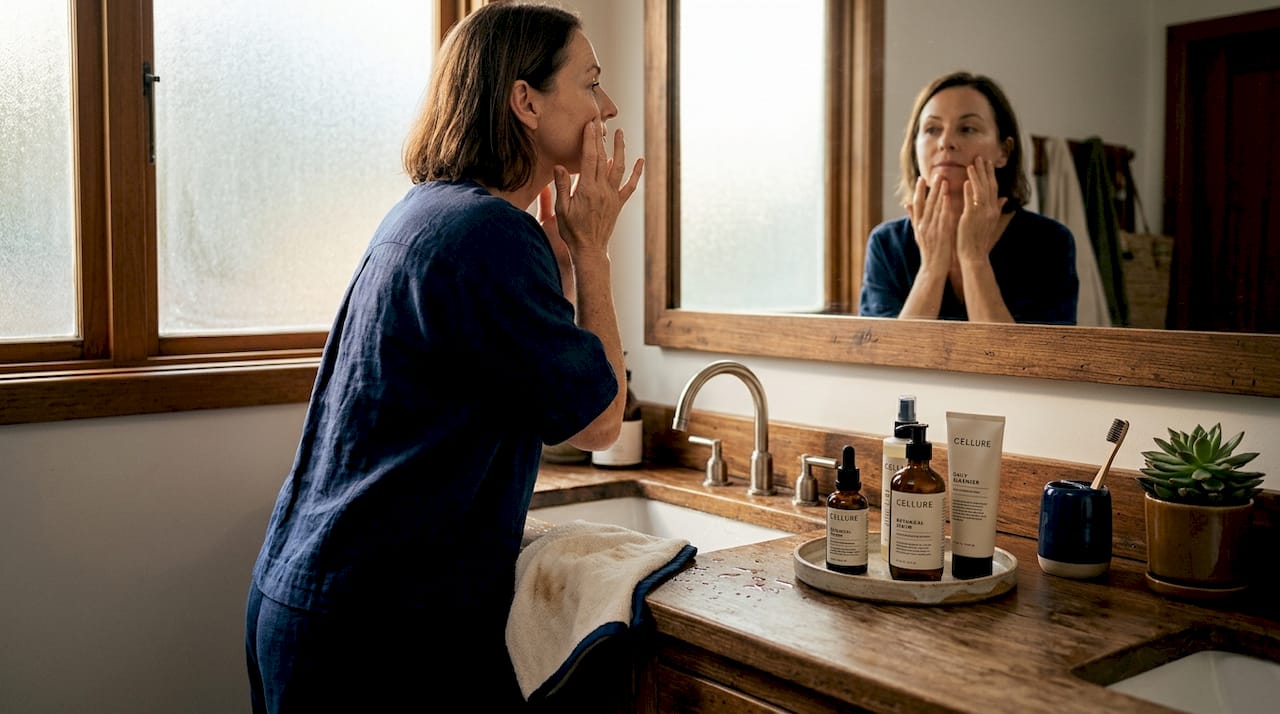
The concept of the “vehicle” in skincare science is often overlooked by consumers. The vehicle is the base formula that carries active ingredients into the skin. A well-moisturizing vehicle can make skin look and feel better on its own, which is why the best clinical trials always include a vehicle-only control group. Without that control, it is impossible to know whether the active ingredient did the work or whether simple hydration from the base formula was responsible for the perceived improvement. Research highlighted by PRNewswire describes a biotech serum trial that achieved 77% skin appearance improvement with zero irritation reported, specifically noting that vehicle effects were accounted for and that systemic absorption in split-face designs was negligible.
For gentle anti-aging tips that address sensitive or reactive skin specifically, a few best practices stand out:
- Look for trial data that specifically included sensitive skin participants, not just a general adult population
- Prioritize formulas where the active concentration is clinically tested rather than arbitrarily chosen
- Start with lower frequency use, especially with retinoids, to allow your skin barrier to adapt
- Avoid formulas with synthetic fragrance, high alcohol content, or known sensitizers as carriers
- Check whether the brand publishes the full study protocol or only summary statistics
Additionally, insights from MDPI specifically suggest that for the 30 to 55 age group, the best outcomes come from multi-active systems that rapidly support barrier repair and elasticity gains while avoiding the irritation pitfalls that are common with single-active, high-concentration approaches.
Pro Tip: When evaluating a product for sensitive skin, ask specifically whether the clinical trial reported adverse effects, irritation scores, or transepidermal water loss measurements. If a brand cannot answer those questions, that tells you something important about the quality of their evidence.
Reading between the lines: how to evaluate clinical evidence and avoid pitfalls
This is where most people get tripped up. Even when a brand publishes a study, the quality of that evidence varies enormously. Knowing how to assess that quality puts you in a completely different position as a consumer.
“True clinical validation requires objective, measurable outcomes and vehicle-controlled study designs to isolate the effect of active ingredients. Subjective or self-reported improvements alone are insufficient to establish efficacy, yet they remain common in industry-sponsored research.”
Here is a practical checklist to apply when you encounter a clinical claim:
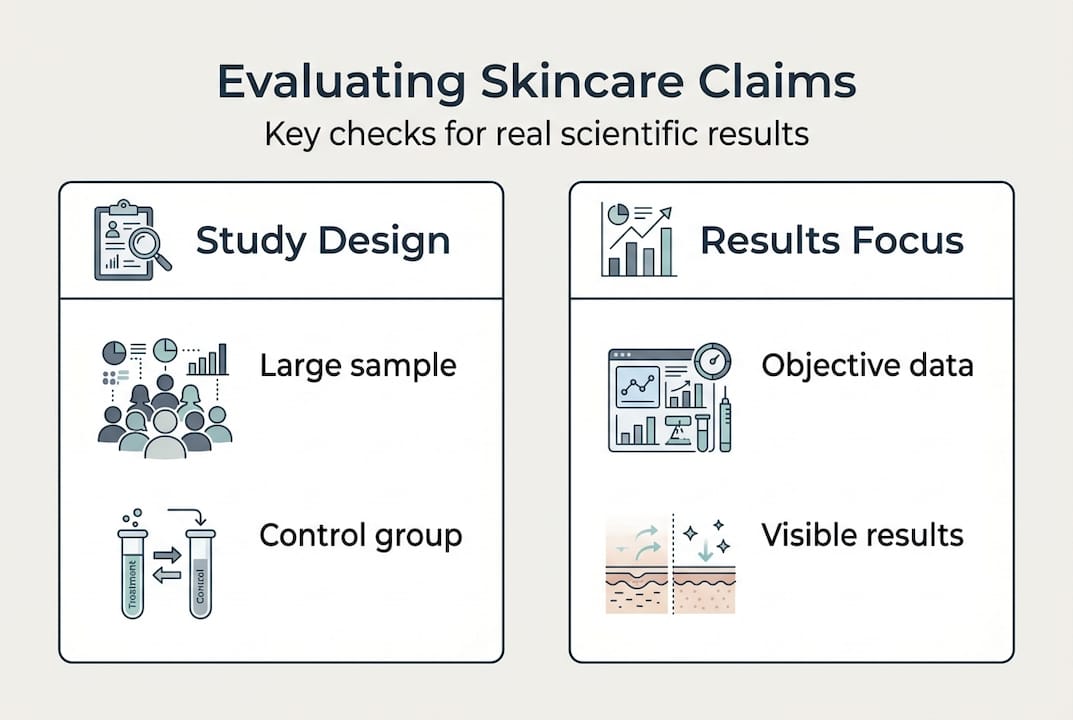
- Check the study size. Fewer than 30 participants is a red flag for any conclusion about efficacy. Meaningful studies typically enroll at least 50 to 100 participants.
- Look for the control group. Was there a placebo or vehicle-only group? If not, you cannot attribute the results to the active ingredient.
- Identify the outcome measures. Were results measured with instruments (like a cutometer for skin elasticity or a colorimeter for pigmentation), or were they based on survey responses asking “does your skin feel better”?
- Check who funded the study. Industry-funded research is not automatically invalid, but independent replication of findings adds credibility.
- Assess the study duration. Four weeks may be enough to show hydration changes but is not sufficient for collagen remodeling outcomes. Twelve weeks or more is the standard for wrinkle and firmness claims.
- Read the adverse effects section. Trustworthy studies report side effects honestly, including redness, peeling, or sensitivity. A study claiming zero adverse events across all participants should be viewed with some skepticism unless the formula was specifically designed and tested for gentleness.
You can find a useful framework for understanding the science behind barrier function in this skincare science hydration resource, and a focused explanation of how signaling molecules work in peptides explained. Both are worth bookmarking as reference points when you are comparing products.
The single most useful question to ask about any clinical claim is: “What exactly was measured, when, and by whom?” That question alone will filter out the majority of weak or misleading evidence.
Why “clinically proven” isn’t enough: what actually delivers real skin results
After years of examining the evidence, reading trial data, and watching the gap between marketing language and actual ingredient science, a pattern becomes clear. The products that genuinely transform aging skin are not the ones with the most impressive sounding labels. They are the ones built on ingredients that have withstood independent scrutiny and replicated their results across different skin types, climates, and age groups.
The industry’s reliance on the phrase “clinically proven” has actually made it harder for consumers to trust genuinely good science, because the term has been used so loosely for so long that it has lost its meaning. What experienced dermatologists and formulation scientists actually look for is far more specific: a named active at a tested concentration, a randomized controlled design, objective endpoint measurements, and a study duration appropriate for the biological change being claimed. That is the standard we hold ourselves to, and it is the standard you should expect from any brand asking for your trust and your investment.
True skin transformation at the cellular level, the kind that addresses collagen loss, barrier compromise, and oxidative damage simultaneously, requires properly validated ingredients working through understood mechanisms. It also requires realistic expectations about timelines. Eight to twelve weeks is not a slow result. It reflects the actual biology of skin renewal, and understanding that helps you stay committed to routines that work rather than abandoning them after two weeks because you do not see a miracle.
The most meaningful shift you can make as a skincare consumer is to stop asking “is this clinically proven?” and start asking “how was this tested, and what did the test actually measure?” That shift in thinking is what separates educated choices from expensive guesswork. For a deeper look at the science of cellular renewal, the regenerative science insight resource explores what the latest research says about how skin genuinely repairs and renews itself.
Take the next step: science-backed solutions for cellular skin repair
Knowing the science is only useful when it connects to real products that apply it correctly. At Cellure, every formulation is built around clinically validated actives at concentrations that match the evidence, not concentrations optimized for marketing claims.
If you are ready to move from understanding the science to experiencing the results, the complete skin repair kit brings together multi-active systems for barrier repair, firmness, and cellular renewal in one structured protocol. For targeted brightening combined with barrier support, the tranexamic acid peptide serum uses two of the most rigorously validated actives in modern anti-aging science. Both are formulated for all skin types, including sensitive skin, with the same standard of evidence discussed throughout this article.
Frequently asked questions
How long does it take for clinically supported skincare to show results?
Most evidence-backed products show measurable improvement in 8 to 12 weeks, with some barrier serums achieving a 77% skin appearance improvement within that window in controlled trials.
Which ingredients are actually backed by clinical science for anti-aging?
Retinoids, vitamin C, peptides, and niacinamide are the most rigorously studied actives, each targeting collagen degradation, oxidative stress, and barrier impairment through distinct, well-understood mechanisms.
Are “clinically proven” claims on skincare labels trustworthy?
Many are not, because the phrase lacks regulatory standardization and is frequently supported by small, industry-funded, or subjective studies that do not meet independent research standards.
Can sensitive skin benefit from clinically supported formulas?
Yes. There are gentle biotech serums tested specifically for zero irritation in clinical settings, making them well-suited for reactive or sensitive skin types.