


Your complete guide to using serums for skin rejuvenation
TL;DR:
- Serums deliver active ingredients deep into the skin for visible anti-aging results.
- Consistent use of targeted serums like retinoids, peptides, and hyaluronic acid improves skin texture and firmness.
- Proper layering, patch testing, and patience are essential for effective, safe serum skincare routines.
If you’ve been consistent with your skincare routine but still see dullness, fine lines, or loss of firmness when you look in the mirror, you’re not doing anything wrong. Most standard moisturizers simply can’t deliver active ingredients deep enough to make a real difference. Serums can. With smaller molecules and higher concentrations of actives, they penetrate where it counts. Visible improvements in hydration, elasticity, and wrinkle reduction are achievable within weeks when you use the right serums correctly. This guide walks you through every step, from choosing the right formula to applying it properly, so you can stop guessing and start seeing results.
Table of Contents
- What serums do: The science behind their skin-renewing power
- What you need before you start: Choosing and prepping your serums
- Step-by-step: How to apply serums for best results
- Troubleshooting and avoiding common mistakes
- How to tell it’s working: Benchmarks and results to expect
- Our take: The smart way to use serums for lasting results
- Level up your skincare: Rejuvenate with advanced serums
- Frequently asked questions
Key Takeaways
| Point | Details |
|---|---|
| Layer serums correctly | Apply serums from thinnest to thickest, pausing 30-60 seconds between each for best results. |
| Pick proven ingredients | Retinoids, vitamin C, peptides, and hyaluronic acid serums have the strongest evidence for rejuvenating aging skin. |
| Start simple | Begin with one or two serums to gauge how your skin reacts before adding new actives. |
| Track your progress | Noticeable results like smoother skin and fewer wrinkles usually appear within 4-12 weeks of consistent use. |
| Avoid common mistakes | Prevent irritation by avoiding harsh ingredient combinations, patch testing, and not over-layering products. |
What serums do: The science behind their skin-renewing power
A serum is a lightweight, fast-absorbing formula with a higher concentration of active ingredients than a standard moisturizer. Because serums use smaller molecules, they can reach the deeper layers of your skin where collagen production, cell turnover, and hydration regulation actually happen. A moisturizer sits mostly on the surface, sealing in moisture. A serum works underneath that, targeting the root causes of aging.
The science-backed serums for aging that consistently show results fall into a few key categories. Retinoids boost collagen and accelerate cell turnover. Vitamin C neutralizes free radical damage and brightens uneven tone. Peptides signal your skin to produce more collagen and elastin. Hyaluronic acid draws moisture into the skin, plumping fine lines from within. Growth factors in skincare are a newer category that mimics the body’s own repair signals, showing strong results for firmness and texture.
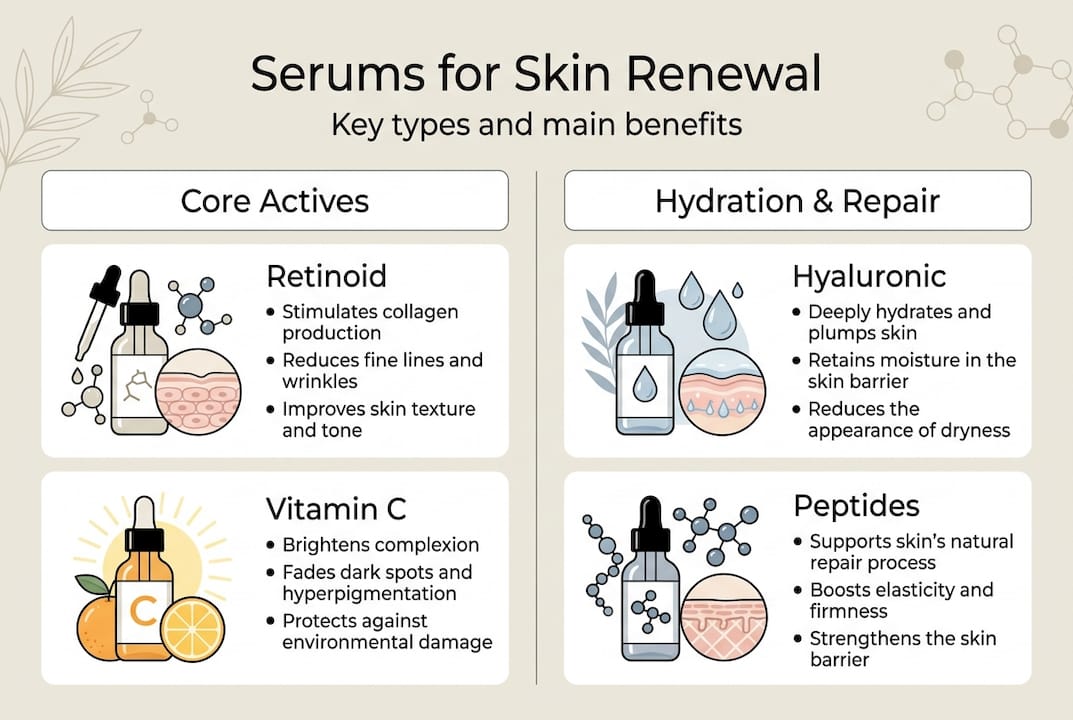
The clinical data backs this up. Collagen peptides at 2.5g/day delivered a 20% improvement in skin elasticity and a 13% reduction in wrinkles over 12 weeks in adults aged 30 to 55. That’s a meaningful shift, not a marginal one.
Here’s a quick-reference breakdown of the most effective serum types:
- Retinoids: Increase cell turnover, reduce wrinkles, improve texture
- Vitamin C: Brightens, protects against UV damage, evens skin tone
- Peptides: Signal collagen production, firm and smooth skin
- Hyaluronic acid: Deeply hydrates, plumps fine lines
- Growth factors: Support cellular repair, improve firmness and elasticity
| Serum type | Primary benefit | Best for |
|---|---|---|
| Retinoid | Collagen boost, cell renewal | Wrinkles, texture |
| Vitamin C | Antioxidant, brightening | Dull tone, dark spots |
| Peptide | Firming, repair signaling | Loss of firmness |
| Hyaluronic acid | Hydration, plumping | Dryness, fine lines |
| Growth factors | Cellular regeneration | Advanced aging signs |
Understanding the role of serums in skin health helps you stop buying products randomly and start building a routine that actually targets what you’re seeing in the mirror.
What you need before you start: Choosing and prepping your serums
Knowing the science, your next step is to select the right products and prepare yourself for flawless application. Not all actives play well together. Combining vitamin C with retinoids, for example, can cause irritation and reduce the effectiveness of both unless a practitioner has specifically recommended it for your skin. Key scientifically-backed serums for aging skin include retinoids, vitamin C, peptides, growth factors, and hyaluronic acid, but knowing which ones to combine is just as important as knowing which ones to use.

Before applying any new serum, patch-test it. Apply a small amount to the inside of your wrist or behind your ear, wait 24 hours, and check for redness, itching, or swelling. This one step saves you from a full-face reaction.
Here’s what to look for and what to avoid when building your lineup:
- Seek: Peptides, hyaluronic acid, niacinamide, growth factors, vitamin C (AM), retinoids (PM)
- Avoid mixing without guidance: Vitamin C + retinoids, AHAs/BHAs + retinoids, multiple strong actives at once
- Prep your skin: Cleanse thoroughly, pat dry, and consider light exfoliation 1 to 2 times per week to remove dead skin cells that block absorption
Knowing what makes serums effective comes down to ingredient quality, formulation, and how you prepare your skin to receive them. A clean, slightly damp face absorbs actives more efficiently than dry, product-covered skin.
| Active ingredient | Benefit | Possible side effect |
|---|---|---|
| Retinoid | Wrinkle reduction, cell renewal | Dryness, peeling, sensitivity |
| Vitamin C | Brightening, antioxidant | Mild tingling, oxidation if stored poorly |
| Peptides | Firmness, collagen support | Rare, generally well tolerated |
| Hyaluronic acid | Hydration, plumping | None in most cases |
| Niacinamide | Pore minimizing, tone evening | Flushing in rare cases |
Pro Tip: Start with a single active serum for two to three weeks before adding a second. This lets you isolate what’s working and catch any irritation early, before you have multiple variables to untangle.
For those exploring regenerative serums for youthful skin, the principle is the same: introduce slowly, observe carefully, and build from there.
Step-by-step: How to apply serums for best results
With the right serums ready and your skin prepped, let’s break down exactly how to layer and apply them like a pro. Application order matters more than most people realize. Put the wrong formula first and you’ll block absorption, waste product, and potentially irritate your skin.
Follow these steps every time:
- Cleanse your face with a gentle, pH-balanced cleanser. Pat dry, leaving skin slightly damp.
- Apply any water-based serums first (like vitamin C or hyaluronic acid). Use 2 to 3 drops, press gently into skin, and don’t rub.
- Wait 30 to 60 seconds. Layer serums from thinnest to thickest to allow each formula to absorb before the next one goes on.
- Apply oil-based or thicker serums (like retinoids or peptide-rich formulas) after water-based layers.
- Seal with a moisturizer to lock in actives and support your skin barrier.
- In the morning, always finish with SPF 30 or higher. Actives like vitamin C and retinoids increase sun sensitivity.
“Retinoids are the gold standard for anti-aging, but buffer with hydration to prevent irritation.”
Pro Tip: If you’re using a retinoid and experiencing dryness, try the “sandwich” method: apply moisturizer, then retinoid, then moisturizer again. This slows absorption slightly but dramatically reduces peeling.
| Routine | Step 1 | Step 2 | Step 3 | Step 4 |
|---|---|---|---|---|
| Morning | Cleanser | Vitamin C serum | Hyaluronic acid | Moisturizer + SPF |
| Evening | Cleanser | Peptide serum | Retinoid | Moisturizer |
When applying peptide serums, press them gently into the skin rather than rubbing. This preserves the integrity of the peptide chains and ensures even distribution. If you want to use peptides for firmness, consistency at this step is where results are built or lost.
Troubleshooting and avoiding common mistakes
Even with the best intentions, serum routines can go sideways. Here are practical solutions to stay on track.
The most common mistakes adults make when starting a serum routine include:
- Over-layering: Using four or five actives at once overwhelms the skin and makes it impossible to know what’s causing a reaction
- Skipping the patch test: A five-minute shortcut that leads to days of irritation
- Not waiting between layers: Wet-on-wet application causes pilling and reduces absorption
- Harsh mixing: Combining AHAs with retinoids, or vitamin C with niacinamide at high concentrations, without building tolerance first
- Expecting overnight results: Most actives need four to twelve weeks of consistent use to show visible change
If irritation occurs, scale back immediately. Drop to every other night for retinoids. Stop the newest addition for a week and see if your skin settles. Limit serum layering for sensitive skin and introduce growth factors carefully, since they’re powerful but well-tolerated by most when used correctly.
“Mixing actives without a plan doesn’t accelerate results. It accelerates irritation.”
Pro Tip: For sensitive skin, a routine with one peptide serum and one hydrating serum is often more effective than a complex five-product stack. Simplicity builds a stronger skin barrier over time.
Cycling powerful actives is a smart strategy. Use retinoids three nights a week to start, then increase frequency as your skin adapts. Research on pterostilbene in skin aging also suggests that newer antioxidant actives can be rotated in to complement retinoids without the same irritation risk. Knowing the best peptides for skin helps you make smart swaps when your skin needs a break from stronger actives.
How to tell it’s working: Benchmarks and results to expect
Once you’ve refined your routine and stuck with it, here’s how to know it’s making a difference.
Signs that your serum routine is working include:
- Skin feels more hydrated within the first one to two weeks
- Texture becomes smoother and pores look smaller by week four
- Fine lines appear less deep and skin looks more “plumped”
- Tone becomes more even, with less redness or brown spots
- Skin has a natural brightness that wasn’t there before
Timelines vary by active. Hyaluronic acid shows hydration results within days. Vitamin C and peptides typically show visible tone and firmness improvements between four and eight weeks. Retinoids take longer, often eight to twelve weeks, but the results are more structural.
The numbers from clinical research are encouraging. A four-week peptide serum study recorded 93.7% reduction in dryness, a 72.5% increase in hydration, and a 32.7% reduction in wrinkles. Those are significant shifts in a short window. Separately, pterostilbene boosted elasticity by 32.6% in just 28 days in a randomized controlled study.
To track your own progress, take a photo in the same lighting, same angle, every two weeks. It’s easy to miss gradual improvement day to day. Side-by-side photos over eight weeks often reveal changes you didn’t notice in real time.
For a deeper look at the ingredients driving these results, the top peptides in skincare page breaks down which peptide complexes are showing the strongest clinical outcomes right now.
Our take: The smart way to use serums for lasting results
Here’s something the skincare industry doesn’t say loudly enough: more products don’t mean better skin. We see it constantly. Someone reads about a new active, adds it to an already packed routine, and then wonders why their skin is reacting badly. The problem isn’t the ingredient. It’s the overload.
The most consistent results we see come from people who commit to a small, well-chosen lineup and stick with it for at least eight weeks before making changes. One peptide serum. One hydrator. One targeted active. That’s often enough to produce real, visible improvement.
“It’s not about the most products, but about what your skin truly needs.”
Chasing every trending ingredient is a cycle that keeps your skin in a constant state of adjustment. Real change happens when your skin barrier is stable, your actives are consistent, and you give your cells enough time to respond. An evidence-backed serum approach built on patience and precision will outperform an aggressive, product-heavy routine every single time.
Level up your skincare: Rejuvenate with advanced serums
If this guide has helped you see exactly where your routine can improve, the next step is finding serums that are actually formulated to deliver on these principles. Cellure’s product range is built around the same bioactive ingredients covered here: peptides, growth factors, and regenerative actives that work at the cellular level.
Whether you’re starting fresh or looking to optimize what you already have, the Complete Skin Repair Kit gives you a structured, science-backed routine in one place. Each formula is designed to complement the others, so you’re not guessing about compatibility or layering order. Explore the full range at Cellure and find the targeted solutions that match your skin’s specific needs.
Frequently asked questions
How long should I wait between serum layers?
Wait 30 to 60 seconds between each serum layer to let your skin absorb the active ingredients and avoid product pilling between layers.
How soon will I see results from using serums?
With consistent use, most people see visible improvements like better hydration or fewer wrinkles within 4 to 12 weeks depending on the active ingredient.
Can I use multiple serums at once?
Yes, but layer from thinnest to thickest and introduce new actives gradually. Limit layering for sensitive skin to avoid overwhelming your skin barrier.
What’s the best serum for fine lines and wrinkles?
Retinoids are the gold standard for smoothing wrinkles, while peptides and vitamin C also show strong, clinically proven results for reducing fine lines.
Is it normal to feel tingling when using some serums?
A mild, brief tingling is common especially with vitamin C or retinoids, but stop use if there’s burning or prolonged discomfort. Retinoids and vitamin C may need buffering if your skin is reactive.
Recommended
Share