


Age-related skin firmness: causes, changes, and solutions
TL;DR:
- Skin firmness reflects the structural integrity of the dermal extracellular matrix, influenced by collagen and elastin health. Age-related decline in firmness results from intrinsic cellular changes and external factors like UV damage, affecting both appearance and skin function. Evidence-backed strategies include photoprotection, retinoids, peptides, professional treatments, and cellular renewal ingredients to support long-term skin resilience.
Skin firmness isn’t just about looking younger. It’s a measurable property of your skin’s internal architecture, and when it changes, the effects reach much further than a few wrinkles or a looser jawline. A 2025 finite-element modeling study confirmed that age-related firmness is primarily a biomechanical property of the dermal extracellular matrix, shaped by collagen’s tensile strength and elastin’s ability to recoil. What follows is a clear breakdown of why this happens, how it’s measured, what it means for your skin’s long-term health, and what the science actually says about fixing it.
Table of Contents
- What is age-related skin firmness and how is it measured?
- What causes skin to lose firmness with age?
- How firmness loss impacts skin health, not just appearance
- Evidence-based strategies: what actually helps restore firmness?
- What most people miss about aging skin and firmness
- How Cellure supports advanced skin firmness solutions
- Frequently asked questions
Key Takeaways
| Point | Details |
|---|---|
| Firmness is structural | Loss of skin firmness reflects deep changes in collagen, elastin, and cell function, not just surface wrinkles. |
| Prevention matters | Sun protection and reducing inflammation are essential for slowing firmness loss. |
| Not all solutions work | Many supplements lack evidence; prioritize treatments that target ECM renewal and fibroblast health. |
| Health, not just beauty | Well-maintained firmness supports better barrier function and long-term skin health. |
| Holistic approach wins | Combining skincare, lifestyle changes, and, if needed, professional treatments offers the best outcomes. |
What is age-related skin firmness and how is it measured?
To understand firmness loss, you have to look past the mirror. What you see as sagging or wrinkling is the visible result of structural changes happening deep in the dermis, the thick middle layer of your skin.
Firmness is fundamentally a structural property. Your skin’s extracellular matrix (ECM) is a dense network of proteins, primarily collagen and elastin, that gives your skin its mechanical strength. Collagen provides tensile support, basically holding things together under stress, while elastin acts like a rubber band, allowing the skin to stretch and snap back. When these fibers degrade or become disorganized with age, the skin loses its ability to resist deformation. That’s firmness loss at the biological level, and the 2025 modeling research identifies this ECM deterioration as the central driver.
“True firmness loss is not a surface phenomenon. It’s a measurable change in how the skin’s structural proteins respond to mechanical stress, and these changes are quantifiable long before they become visible.”
How do researchers and clinicians actually measure it? Several tools exist, each capturing a slightly different aspect:
- Cutometers use suction to lift the skin and measure how far it deforms and how quickly it returns, capturing elasticity and viscoelasticity as separate values.
- Clinical wrinkle scales grade visible signs of aging, but these are subjective and less precise than mechanical tools.
- Finite-element models simulate how skin tissue responds to compression and stress using digital reconstructions of skin layers.
- Ultrasound imaging visualizes the thickness and organization of dermal collagen in real time.
The practical takeaway: different studies measure different things. Elasticity, viscoelasticity, and clinical firmness are related but not identical. A product or treatment may improve one measure without shifting another, which is why comparing study results can be tricky.
| Measurement tool | What it captures | Limitation |
|---|---|---|
| Cutometer | Elasticity and recoil speed | Only measures superficial deformation |
| Clinical grading scales | Visible wrinkles and laxity | Subjective, observer-dependent |
| Finite-element model | Full mechanical behavior of skin layers | Requires computational modeling |
| High-frequency ultrasound | Dermal thickness and collagen density | Expensive, specialist equipment |
Clinically, wrinkles are well-recognized as a normal part of aging, but it’s the underlying mechanical deterioration that explains why they appear at all. Understanding these science-backed causes of firmness loss is the first step in evaluating any solution. The benefits of firm skin extend well beyond aesthetics, as we’ll explore shortly.
What causes skin to lose firmness with age?
Age-related firmness decline has two main drivers: the internal, biological clock of your cells (intrinsic aging) and the environmental pressures your skin faces every day (extrinsic aging). Both matter, and both are worth addressing separately.
Intrinsic aging begins earlier than most people realize. From your late 20s onward, fibroblasts (the cells responsible for producing collagen and elastin) gradually slow their output. At the same time, enzymes called matrix metalloproteinases (MMPs) become more active, accelerating the breakdown of existing ECM proteins. The net result is a slow but steady erosion of the structural scaffolding.
A 2025 review of skin aging mechanisms confirmed that both intrinsic chronological aging and extrinsic photoaging drive firmness decline through reduced matrix synthesis and increased ECM degradation. These two forces compound each other, so someone with significant UV exposure ages structurally faster than someone who has protected their skin.
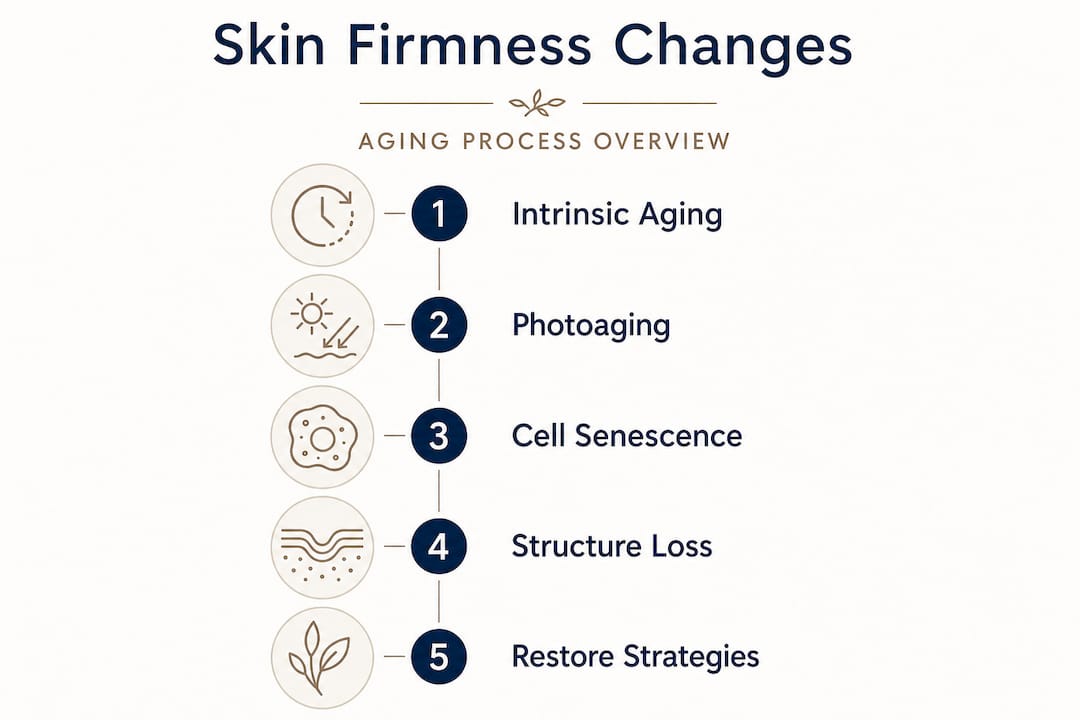
Extrinsic aging is dominated by UV radiation from the sun. UV triggers the production of MMPs directly, fragments collagen fibers, and generates reactive oxygen species (free radicals) that damage both cells and the surrounding matrix. Pollution, cigarette smoke, and chronic stress add to this oxidative burden.
Here are the main mechanisms ranked by their impact on structural firmness:
- Collagen loss and fragmentation from decreased synthesis and increased MMP activity
- Elastin fiber degradation leading to reduced recoil capacity
- Fibroblast senescence (aging cells that stop working and start causing damage)
- Chronic low-grade inflammation that accelerates ECM breakdown
- UV-induced oxidative stress that damages collagen cross-links and cellular DNA
- Glycation where sugar molecules attach to collagen fibers, making them stiff and brittle
The fibroblast senescence issue deserves special attention. A 2025 Frontiers in Pharmacology review describes how senescent fibroblasts develop what’s called a senescence-associated secretory phenotype (SASP). This means they don’t just stop producing collagen; they actively secrete inflammatory signals that degrade the surrounding ECM. It’s a double loss: less production and more destruction happening simultaneously.
Pro Tip: The importance of skin renewal becomes especially clear when you understand fibroblast senescence. Ingredients that stimulate fibroblast activity or reduce SASP signals, such as certain peptides and polynucleotides, are not just trendy; they have a rational biological basis for targeting this mechanism. Learn more about the actives for youthful skin that current research supports.
| Aging type | Primary drivers | Key structural impact |
|---|---|---|
| Intrinsic aging | Cell clock, reduced fibroblast activity | Gradual collagen and elastin loss |
| Extrinsic aging | UV, pollution, smoking, oxidative stress | Fragmented collagen, accelerated MMP activity |
| Senescent cell damage | SASP inflammatory environment | Active ECM degradation from within |
How firmness loss impacts skin health, not just appearance
Most conversations about skin firmness focus on how it looks. That’s understandable, but it misses a significant part of the picture.
Firmness is tied directly to skin function. The structural integrity of the dermis underpins the skin’s ability to act as a physical barrier, resist mechanical injury, and mount an effective healing response. When the ECM is compromised, the skin is slower to close wounds, more susceptible to bruising and tearing, and less effective at keeping irritants and pathogens out.
Research is increasingly treating skin firmness as a systemic biomarker, not just a cosmetic metric. The INSPIRE-T project (2025) found that poorer skin elasticity and viscoelasticity are associated with broader systemic indicators of aging and inflammation, not purely cosmetic changes. In other words, the condition of your skin’s mechanical properties may reflect what’s happening throughout your body’s aging process.
“Skin mechanics tell us more than we once thought. A measurable decline in viscoelasticity is not just about appearance—it’s an indicator of how well the tissue can do its job at every level.”
Here’s a practical breakdown of what firmness loss actually means for skin function:
- Slower wound healing: Disorganized collagen networks take longer to remodel after injury
- Reduced barrier effectiveness: Structural degradation in the dermis affects the skin’s outermost defensive layers
- Higher inflammation sensitivity: SASP signals from senescent fibroblasts create a background of chronic irritation
- Greater UV vulnerability: Degraded ECM is less effective at limiting UV penetration into deeper skin layers
- Increased susceptibility to bruising: Lower mechanical resilience means blood vessels have less structural support
Understanding this broader picture makes it easier to restore skin firmness with the right goals in mind, not just improved appearance, but genuinely healthier, more resilient skin.
Evidence-based strategies: what actually helps restore firmness?
Here’s where the noise gets loud. The market is full of claims about firmness restoration, and the science does not back all of them equally. Knowing what the evidence actually says saves you time, money, and frustration.
What has strong evidence behind it:
- Photoprotection is the single most evidence-supported strategy for preventing further ECM degradation. Daily broad-spectrum SPF 30 or higher, combined with antioxidant actives like vitamin C, addresses the dominant cause of extrinsic collagen breakdown.
- Topical retinoids (retinol and prescription-strength tretinoin) have decades of data showing they stimulate fibroblast activity, increase collagen synthesis, and improve clinical skin firmness over 12 to 24 weeks.
- Peptide-based serums targeting specific collagen-stimulating or MMP-inhibiting pathways are well-supported by in-vitro and an increasing body of clinical data. Evidence-based peptides such as matrikines and copper peptides show genuine signaling activity in fibroblasts.
- Fractional microneedle radiofrequency (MNRF): A 2025 split-face study in women aged 60 and older showed measurable improvements in wrinkles, elasticity, and both collagen and elastin density following MNRF treatment. This approach targets the dermis directly, triggering controlled wound healing and collagen remodeling.
- Polynucleotides: A newer but increasingly supported ingredient category, polynucleotides stimulate fibroblast proliferation and support ECM renewal at the cellular level.
What has weaker or contested evidence:
- Oral collagen supplements remain controversial. A 2025/2026 evidence summary00283-9/abstract) found that higher-quality analyses show limited to no clinical benefit for age-related skin-aging outcomes from oral collagen. Most supporting studies are small, industry-funded, or use composite outcomes that don’t isolate firmness specifically.
- Hyaluronic acid fillers can restore volume and create a short-term appearance of firmness, but they don’t address the structural ECM deficit.
Pro Tip: Your most cost-effective move is building a two-part routine: prevention first (sunscreen, antioxidants, retinoids) plus targeted repair (peptides, polynucleotides, or professional treatments). For a deeper look at how this translates to real-world use, the clinically supported skincare for aging skin resource maps out how to evaluate product claims against actual evidence.
Here is a practical sequence for addressing firmness loss with a rational, layered approach:
- Lock in daily SPF use as a non-negotiable baseline
- Add a topical retinoid at night, starting low and building tolerance
- Incorporate a peptide or polynucleotide serum targeting fibroblast activity
- Consider professional options like MNRF if topical results plateau
- Reassess every 3 to 6 months using consistent lighting and photos
For a more detailed framework, the guide on steps to repair aging skin walks through how to sequence these interventions based on your skin’s current condition.
What most people miss about aging skin and firmness
Here’s the uncomfortable truth that most skincare content glosses over: skin firmness is not a single outcome, and treating it as one is why so many approaches fail.
When researchers measure firmness, they capture different mechanical properties depending on the tool. Clinical elasticity, viscoelasticity, and visible skin tightness do not always move together. You could improve your skin’s snap-back speed on a cutometer reading without seeing a meaningful change in how lifted your jawline looks, or vice versa. This isn’t a flaw in the science; it reflects the genuine complexity of skin tissue. But it means that a product showing a “firmness improvement” in a study may be targeting a property that doesn’t match what you’re actually trying to change.
The other thing most people underweight is prevention. We’re wired to focus on repair because it feels active and hopeful. But the evidence is blunt: stopping further ECM damage through consistent photoprotection is at least as important as any repair-focused treatment. Collagen that hasn’t been fragmented yet is infinitely easier to preserve than collagen that needs to be rebuilt from scratch.
There’s also a real problem with single-solution thinking. We see a compelling before-and-after and assume that one treatment or one product did all the work. In practice, the best outcomes in clinical studies come from combined approaches, where photoprotection, topical actives, and when appropriate, professional interventions work together over sustained periods of time.
Our view at Cellure is that skin rejuvenation insights should always start with realistic expectations and a clear-eyed reading of the evidence. Skepticism is healthy here. Ask whether a study was done on actual humans, whether the outcome matched what you care about, and how long the effect lasted. That filter alone will save you from a lot of ineffective products.
How Cellure supports advanced skin firmness solutions
You’ve read the science. Now the question is what to actually use.
At Cellure, every formulation is built around the biological mechanisms covered in this article, targeting fibroblast activity, ECM renewal, and the key drivers of structural firmness decline. Our products use peptides, polynucleotides, and other bioactive ingredients selected for their documented effects on collagen synthesis and cellular regeneration. The Complete Skin Repair Kit brings these ingredients together into a sequenced system designed for measurable, long-term results. If you want to understand the thinking behind our formulations, our science story explains how we approach the evidence and why we chose these specific actives. Effective firmness support starts with understanding the problem deeply, and then using solutions built to match it.
Frequently asked questions
What age should I start caring about skin firmness?
Starting in your 30s is ideal, since intrinsic and extrinsic aging both begin reducing firmness well before visible signs appear. Prevention strategies work best when they precede structural damage, not follow it.
Are wrinkles and sagging the same as firmness loss?
No. Wrinkles and sagging are surface expressions of firmness loss, but the underlying changes are structural and happen deep in the dermis before they become visible.
Is loss of skin firmness reversible?
Partial improvement is achievable. MNRF clinical studies show measurable gains in elasticity and collagen density, but complete reversal of age-related structural changes is not currently possible with any available approach.
Do collagen supplements work for skin firmness?
The evidence is weak at best. Higher-quality analyses00283-9/abstract) find limited to no clinical benefit from oral collagen for age-related firmness outcomes, despite widespread marketing claims.
Does improved firmness actually affect skin health beyond appearance?
Yes. The INSPIRE-T research links better viscoelasticity to stronger barrier function, greater resilience, and healthier biological aging markers, making firmness a genuine indicator of overall skin health, not just cosmetic quality.