


Skin repair: The essential role of hydration explained
TL;DR:
- True skin hydration involves repairing the skin barrier and stimulating cellular renewal, not just surface moisture.
- Combining multiple molecular weights of hyaluronic acid with ceramides enhances both surface hydration and deeper skin repair.
- Consistent use of science-backed formulas can lead to visible improvements in skin elasticity, wrinkle reduction, and barrier function within 8 to 12 weeks.
Most moisturizers promise hydrated, glowing skin. But here’s what the label won’t tell you: the majority of them sit on the surface and never address what’s actually breaking down underneath. For adults in their 30s, 40s, and 50s, the real problem isn’t dry skin in the traditional sense. It’s a failing skin barrier, slowing cell turnover, and a steady loss of the molecules that keep skin structurally sound. True hydration, the kind that drives cellular repair, works at a biological level most products never reach. This article unpacks the science, the ingredients that actually work, and what clinical evidence says about reversing visible aging through targeted hydration strategies.
Table of Contents
- Why hydration is fundamental to skin barrier repair
- Cellular repair: How hydration drives renewal and recovery
- Hydration strategies: Choosing ingredients that truly repair
- Real-world results: Clinical outcomes and benchmarks for hydrated vs. dehydrated skin
- The truth most skincare advice misses: Hydration alone isn’t enough
- Ready for proven hydration-powered repair?
- Frequently asked questions
Key Takeaways
| Point | Details |
|---|---|
| Hydration powers repair | Optimal hydration using multi-molecular hyaluronic acid and ceramides is critical for restoring and maintaining aging skin. |
| Ingredient synergy matters | Combining hydration with antioxidants and barrier-supporting ingredients enables maximum cellular repair. |
| Visible results take weeks | Evidence shows measurable improvements in hydration, elasticity, and wrinkle reduction within 8 to 12 weeks. |
| Not all hydration is equal | Effective repair depends on ingredient type and delivery, not just surface moisturizing or drinking more water. |
Why hydration is fundamental to skin barrier repair
Hydration isn’t just about how your skin feels after applying a cream. At the cellular level, it refers to the water content within the extracellular matrix (ECM), the structural scaffolding that holds your skin together. The ECM is made up of collagen, elastin, and a key molecule called hyaluronic acid (HA). HA can hold up to 1,000 times its weight in water, making it the primary driver of skin plumpness, elasticity, and structural integrity. Skin hydration science shows that when HA levels drop, the ECM loses its ability to retain moisture, and the entire repair process slows.
Ceramides are equally important. These lipid molecules form the “mortar” between skin cells, sealing the barrier and preventing transepidermal water loss (TEWL). When ceramide levels decline with age, water escapes faster, and irritants penetrate more easily. The result is a compromised barrier that struggles to repair itself.
Hyaluronic acid benefits extend well beyond surface moisture. HA maintains skin ECM integrity, elasticity, and water retention essential for repair. And in aging skin, reduced HA leads to impaired barrier function with symptoms like dryness, reduced elasticity, and slower wound recovery.
Signs of an impaired skin barrier in aging adults:
- Persistent tightness or flaking, even after moisturizing
- Increased sensitivity or redness to products you used to tolerate
- Fine lines that appear deeper, especially after cleansing
- Dull, uneven tone that doesn’t respond to brightening products
- Slow recovery after sun exposure or minor irritation
| Skin component | Function | Effect of age-related decline |
|---|---|---|
| Hyaluronic acid | Water retention in ECM | Dryness, loss of volume, reduced elasticity |
| Ceramides | Barrier sealing | Increased TEWL, sensitivity, slower repair |
| Natural moisturizing factors | Surface hydration | Rough texture, tightness, flaking |
“The skin barrier is not just a passive wall. It’s an active, dynamic system that requires constant hydration to function and repair itself.”
Pro Tip: Look for formulas that combine multiple molecular weights of HA with ceramides. High molecular weight (HMW) HA hydrates the surface, while low molecular weight (LMW) HA penetrates deeper to signal repair. Together, they address both barrier sealing and cellular recovery.
Skin barrier repair explained in detail shows why a single-ingredient approach rarely delivers the structural improvement aging skin actually needs.
Cellular repair: How hydration drives renewal and recovery
Now that we understand hydration’s core role in barrier function, let’s dive deeper into how it directly enables your skin cells to rebuild and renew.
Your skin renews itself through two key cell types: fibroblasts, which produce collagen and elastin in the deeper dermis, and keratinocytes, which form the protective outer layers. Both depend on adequate hydration to function properly. Without it, fibroblasts slow their collagen output and keratinocytes shed irregularly, leaving skin looking dull and feeling rough.

Here’s what makes HA particularly powerful: HA stimulates collagen and elastin production and modulates inflammation through receptors called CD44 and RHAMM. These receptors act like docking stations for HA molecules, triggering repair signals inside the cell. High molecular weight HA also has notable anti-inflammatory effects, calming the low-grade chronic inflammation that accelerates aging.
Cellular repair: Hydrated vs. dehydrated aging skin
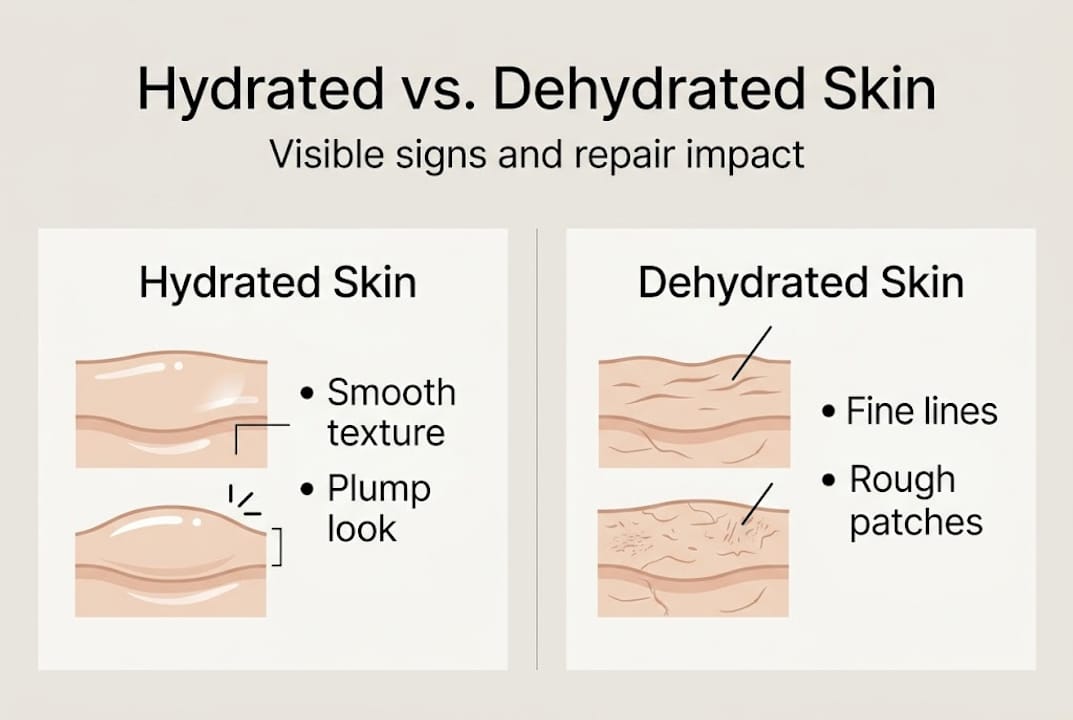
| Factor | Hydrated skin | Dehydrated aging skin |
|---|---|---|
| Cell turnover rate | 28 days (young skin) | 45 to 60 days with age |
| Collagen production | Active fibroblast output | Reduced, fragmented collagen |
| Inflammation | Controlled | Chronic low-grade inflammation |
| Recovery speed | Fast | Significantly delayed |
How cellular repair unfolds in well-hydrated skin:
- HA binds water in the ECM, maintaining the fluid environment fibroblasts need
- CD44 receptors detect HA signals and activate collagen synthesis
- Keratinocytes migrate efficiently across a moist surface to close micro-damage
- Ceramides seal the repaired barrier, locking in moisture
- Anti-inflammatory signals from HMW-HA calm reactive skin during recovery
One 12-week clinical trial with 150 participants found +11.5% increase in skin hydration alongside measurable reductions in wrinkle depth when participants used a multi-molecular HA formula consistently. That’s not a cosmetic effect. That’s structural change.
Hydration also needs to work alongside antioxidants. Free radicals from UV exposure and pollution directly damage fibroblasts and break down HA in the ECM. Without antioxidant support, even the best hydration strategy gets undermined. Explore top skin repair ingredients to see how these work together in practice, and review repair aging skin steps for a structured approach.
Hydration strategies: Choosing ingredients that truly repair
Understanding the cellular processes is empowering, but what does this mean practically when choosing your hydration products?
Not all hydrating ingredients are equal. Molecular size determines where an ingredient acts in the skin. HMW-HA (above 1,000 kDa) forms a film on the surface, reducing water loss and calming inflammation. LMW-HA (below 50 kDa) penetrates the epidermis and reaches the dermis, where it activates those CD44 repair receptors. Using only one size leaves half the job undone.
Ingredients to prioritize for aging skin hydration and repair:
- Multi-molecular weight HA: Covers surface hydration and deep repair signaling
- Ceramides (types 1, 3, and 6-II): Restore lipid barrier and reduce TEWL
- Natural moisturizing factors (NMF): Amino acids, urea, and lactic acid that keep the stratum corneum supple
- Antioxidants (vitamin C, niacinamide, resveratrol): Protect HA from free radical degradation
- Peptides: Signal fibroblasts to increase collagen and elastin output
For adults aged 30 to 60 dealing with visible aging, a multi-functional approach for aging skin using HA combined with ceramides and NMF boosters delivers the most complete repair. Topical application targets the barrier directly, while oral HA supplementation supports systemic hydration from within.
Clinical data confirms that topical and oral HA increases hydration by 7 to 30%, with measurable reductions in TEWL and wrinkle depth across multiple trials. That range depends heavily on the formulation quality and ingredient combination.
What doesn’t work: products that rely on a single humectant like glycerin alone, or formulas that are mostly water with no occlusive or emollient support. Water evaporates. Without ceramides or lipid barriers to hold it in, you’re essentially moisturizing and then losing it all within hours.
Pro Tip: When reading a product label, look for HA listed at multiple molecular weights (sodium hyaluronate and hydrolyzed hyaluronic acid together) alongside ceramides and at least one NMF ingredient. That combination signals a formula built for real repair, not just temporary softness.
For a deeper look at what’s worth including in your routine, top hydration ingredients and cellular repair best practices are worth reading before your next product decision.
Real-world results: Clinical outcomes and benchmarks for hydrated vs. dehydrated skin
Equipped with ingredient knowledge, let’s see what real results look like and how you can measure progress in your own routine.
Dermatologists use two primary tools to assess skin hydration and barrier function objectively. The Corneometer measures electrical capacitance in the skin’s surface layers, with readings above 40 arbitrary units (AU) indicating healthy hydration. The TEWL meter measures how much water evaporates through the skin per hour. A TEWL below 12 g/m2/h with hydration above 40 AU represents effective barrier function for aging skin.
| Study type | Intervention | Key outcome |
|---|---|---|
| 12-week topical HA trial | Multi-MW HA serum | +11.5% hydration, reduced wrinkle depth |
| Oral HA supplementation | 120 mg/day HA | Hydration increased up to 72.5%, TEWL reduced |
| Ceramide-based moisturizer | Ceramide + NMF formula | TEWL normalized within 4 weeks |
| Combined topical + oral | HA + ceramide + antioxidant | Barrier score improved, elasticity +18% |
“A moist wound environment consistently accelerates healing compared to a dry one. The same principle applies to the micro-damage aging skin experiences daily.”
How long before you see real repair:
- Weeks 1 to 2: Surface hydration improves, tightness and flaking reduce
- Weeks 3 to 4: TEWL begins to normalize as ceramide levels rebuild
- Weeks 5 to 8: Fibroblast activity increases, early improvements in firmness
- Weeks 9 to 12: Measurable reduction in fine lines and improved tone consistency
At home, you won’t have a Corneometer, but you can track meaningful signals: how long your skin stays comfortable after cleansing, whether fine lines look less pronounced in the morning, and how quickly your skin recovers after sun exposure or stress. These are real indicators of barrier and cellular repair progress.
Review clinical hydration results to see how these benchmarks translate into visible outcomes over time.
The truth most skincare advice misses: Hydration alone isn’t enough
All the evidence points to hydration’s critical role in skin repair. But here’s what most articles won’t say plainly: hydration is the foundation, not the complete solution.
Think of it this way. Hydration creates the environment where repair can happen. It keeps the ECM fluid, activates repair receptors, and supports cell migration. But if free radicals are simultaneously breaking down your collagen and HA faster than your skin can rebuild, you’re running in place.
Antioxidants synergize with hydration to provide cellular protection in aging skin, particularly against UVA damage and reactive oxygen species (ROS). Without that protection, even a well-hydrated skin environment gets undermined daily.
Repair peptides add another layer. They directly signal fibroblasts to produce more collagen, working alongside HA rather than replacing it. The brands and routines that deliver the most visible, lasting change are the ones that combine all three: hydration, antioxidant protection, and peptide-driven repair signaling.
This is why we believe in formulations built around synergy, not single-ingredient shortcuts. Learn more about how using skin repair kits that combine these elements can accelerate the results you’re looking for.
Pro Tip: Build your routine in layers. Start with a multi-MW HA serum on damp skin, follow with an antioxidant-rich treatment, and seal with a ceramide moisturizer. That sequence mirrors the biological repair cascade your skin naturally uses.
Ready for proven hydration-powered repair?
You now understand what your skin actually needs to repair itself at a cellular level. The next step is putting that knowledge into action with formulations designed to deliver it.
At Cellure, our products are built around the same science covered in this article: multi-molecular HA, ceramides, peptides, and antioxidants working together for real structural repair. The Complete Skin Repair Kit brings these ingredients together in a clinically inspired routine designed for adults experiencing visible signs of aging. If you want to understand exactly what goes into our formulas, explore our ingredients page for full transparency. Discover everything Cellure offers and find the right solution for your skin’s specific repair needs.
Frequently asked questions
Can drinking water alone heal aging skin?
Drinking water supports overall health, but HA maintains skin ECM integrity in ways that general water intake simply cannot replicate. Targeted topical and oral ingredients like multi-molecular HA and ceramides are required for true structural skin repair.
How fast can I see results from advanced hydration strategies?
Most clinical trials show visible improvements after 8 to 12 weeks of consistent use, with +11.5% hydration and reduced wrinkles documented in 12-week trials using multi-MW HA formulas.
Does molecular weight of hyaluronic acid really matter?
Yes. HMW-HA hydrates the surface and reduces inflammation, while LMW-HA penetrates deeper to activate repair signaling through CD44 receptors. Both are needed for complete repair.
Is it possible to over-hydrate skin?
Over-hydration can disrupt barrier cohesion and cause maceration. Excess water disrupts barrier integrity, which is why balanced, scientifically formulated products matter more than simply applying more moisture.