


Gentle skincare that actually works for sensitive, aging skin
TL;DR:
- Gentle skincare uses pH-balanced, minimalist formulations with barrier-repairing actives avoiding irritants.
- Proven effective ingredients include niacinamide, peptides, ceramides, and botanicals like centella asiatica.
- Clinical validation through metrics like TEWL reduction and hydration increases ensures genuine tolerability and results.
Somewhere along the way, “gentle” became synonymous with weak. If a product didn’t sting, tingle, or leave your face looking flushed, it wasn’t doing much. That assumption has sent countless people with sensitive, aging skin chasing high-concentration acids and prescription-strength retinoids, only to end up with a compromised barrier, persistent redness, and skin that reacts to everything. The clinical reality tells a very different story. Gentle, scientifically formulated products can drive meaningful cellular renewal, support collagen, and restore skin function without triggering inflammation. This article breaks down exactly what makes a formulation genuinely gentle, which actives deliver results, and how to tell real evidence from marketing noise.
Table of Contents
- What defines a gentle formulation in skincare
- The science of gentle anti-aging: cellular renewal without irritation
- Gentle botanical actives: nature’s barrier repair tools
- Evaluating gentle formulations: benchmarks, tolerability, and clinical validation
- Why gentle skincare outperforms aggressive routines for sensitive, aging skin
- Explore advanced gentle formulations with Cellure
- Frequently asked questions
Key Takeaways
| Point | Details |
|---|---|
| True gentle science | Gentle formulations are minimalist, pH-balanced, and use evidence-backed actives with clinical results for sensitive, aging skin. |
| Barrier-protecting actives | Ingredients like niacinamide, peptides, and botanicals safely promote renewal and target signs of aging without inflammation. |
| Benchmarks matter | Look for clinical benchmark data like hydration increase or TEWL reduction to validate gentle formulation claims. |
| Long-term benefits | Gentle routines preserve the acid mantle and microbiome for sustained skin health, outperforming aggressive approaches. |
What defines a gentle formulation in skincare
Gentle is not a feeling. It is a measurable, formulary standard built on specific ingredient choices, pH calibration, and clinical tolerability testing. Sensitive skin formulations are minimalist, pH-balanced between 4.5 and 5.5, fragrance-free, and built around barrier-repairing actives like ceramides, niacinamide, hyaluronic acid, panthenol, and botanicals, while deliberately excluding irritants such as fragrances, sulfates, drying alcohols, and harsh exfoliants. That is the working definition, and every word in it carries clinical weight.
pH balance matters because your skin’s acid mantle functions optimally within that narrow 4.5 to 5.5 window. Products formulated above this range, particularly those with high alkalinity, disrupt tight junction proteins, elevate transepidermal water loss (TEWL), and create conditions where bacteria thrive and inflammation accelerates. Minimalism matters because fewer ingredients mean fewer potential reactants. Every additional compound is another variable, and for reactive skin, variables are liabilities.
What to avoid in any formulation you call “gentle”:
- Synthetic and natural fragrances (even essential oils can trigger contact dermatitis)
- Sodium lauryl sulfate and other sulfate-based surfactants
- Denatured alcohol (ethanol, SD alcohol), which strips sebum and disrupts barrier lipids
- High-concentration AHAs and BHAs without buffering
- Formaldehyde-releasing preservatives
- Propylene glycol at high concentrations
What to look for instead:
- Ceramides (NP, AP, EOP) to restore lamellar barrier structure
- Niacinamide (vitamin B3) to regulate ceramide synthesis and reduce inflammatory cytokines
- Hyaluronic acid (multiple molecular weights) for layered, sustained hydration
- Panthenol (provitamin B5) for wound-repair and water retention
- Allantoin for cell proliferation and soothing
| Gentle ingredient | Function | Irritant equivalent to avoid |
|---|---|---|
| Ceramides | Barrier lipid restoration | Harsh surfactants that strip lipids |
| Niacinamide | Ceramide synthesis, anti-inflammatory | High-concentration glycolic acid unbuffered |
| Hyaluronic acid | Multilayer hydration | Denatured alcohol |
| Panthenol | Wound repair, water retention | Synthetic fragrance complexes |
| Allantoin | Cell proliferation, soothing | Formaldehyde-releasing preservatives |
| Centella asiatica | Collagen synthesis, barrier repair | Essential oil blends |
Pro Tip: When evaluating a product, skip the front-of-pack claims and go straight to the full ingredient list. If “fragrance” or “parfum” appears anywhere, it fails the first test, regardless of how many times the word “gentle” appears on the label.
For more context on how these principles apply in practice, our gentle anti-aging tips resource walks through routine structure step by step. If you’re still defining what sensitive skin means for you specifically, caring for sensitive skin covers the physiological nuances worth understanding before building your regimen.
The science of gentle anti-aging: cellular renewal without irritation
Understanding what gentle means, let’s explore how these formulas can deliver true anti-aging results without compromising the skin’s tolerance. The misconception is that cellular renewal requires disruption. It doesn’t. Renewal is a biological process that the right actives can support and amplify without forcing the skin into a stress response.
For anti-aging and cellular renewal in sensitive skin, tolerated actives like niacinamide include peptides, bakuchiol as a retinol alternative, biomimetic collagen peptides, and ectoin, all of which support renewal without triggering inflammation. Here is how each works at the cellular level.

Niacinamide activates the skin’s own ceramide synthesis pathway, increases production of involucrin and filaggrin (two proteins critical for barrier integrity), and downregulates pro-inflammatory interleukins. It addresses pigmentation by inhibiting melanosome transfer without cytotoxicity. At 4%, it begins showing measurable ceramide increases within four weeks.
Peptides are short amino acid chains that act as signaling molecules. Biomimetic peptides like Matrixyl (palmitoyl pentapeptide-4) signal fibroblasts to increase collagen I, III, and IV production. They do this without the receptor-level irritation that retinoids can cause, making them ideal for reactive skin that cannot tolerate vitamin A derivatives.
Bakuchiol is the botanical retinol alternative derived from Psoralea corylifolia seeds. Clinical trials show it upregulates retinol-responsive genes, including those coding for collagen synthesis, with significantly less dryness, peeling, and photosensitivity than retinol at equivalent concentrations.
Ectoin is a stress-protection molecule produced by extremophilic bacteria. It stabilizes cellular membranes, reduces UV-induced DNA damage, and lowers inflammatory signaling. It is particularly relevant for urban skin exposed to particulate pollution, which accelerates the kind of low-grade chronic inflammation researchers now call “inflammaging.”
| Clinical outcome | Measurement | Gentle formula result |
|---|---|---|
| Hydration increase | Corneometry | +42% to +72.5% over 4 weeks |
| TEWL reduction | Tewameter | 18% to 28% reduction |
| Ceramide increase | Tape-strip analysis | Up to +34% (niacinamide 4%) |
| Dryness score reduction | Visual analog scale | Up to 93.7% (Tripeptide-29 + niacinamide) |
| Itch reduction | Patient-reported outcome | 29% reduction (niacinamide, >70yo) |
How to incorporate gentle anti-aging actives into your routine:
- Start with a pH-balanced, surfactant-free or low-surfactant cleanser containing ceramides or panthenol.
- Apply your niacinamide or peptide serum to damp skin to enhance penetration without barrier disruption.
- Layer hyaluronic acid on top while skin is still slightly damp to seal in hydration.
- Use a barrier-repair moisturizer with ceramides and fatty acids as your third step.
- Apply mineral sunscreen every morning. UV damage directly accelerates collagen degradation and worsens barrier permeability.
“Gentle formulations with clinically validated actives consistently match or outperform aggressive approaches in measurable skin health outcomes, particularly in populations with compromised or reactive skin.”
If you want a deeper look at how these mechanisms translate to visible change, our guide on how to repair aging skin covers the evidence-based steps in detail. For specific product categories, anti-aging serums and the skin renewal actives overview explain how each ingredient class fits into a coherent renewal strategy.
Gentle botanical actives: nature’s barrier repair tools
In addition to lab-formulated actives, botanicals bring unique benefits to gentle formulations if chosen wisely. The phrase “naturally derived” has been used so aggressively in marketing that it no longer carries reliable information. Some of the most potent sensitizers in skincare are entirely natural. What matters is not origin; it is evidence.
Gentle botanical formulations use ingredients like centella asiatica, chamomile, and aloe vera while carefully excluding botanical irritants like high-linalool lavender oil, citrus-derived bergapten, and cinnamaldehyde-containing spice extracts. The distinction is critical for anyone with reactive skin who has been drawn to “natural” products and found them just as irritating as synthetic ones.
Top gentle botanicals and their clinically supported effects:
- Centella asiatica (Gotu kola): Rich in asiaticoside and madecassoside, centella stimulates collagen synthesis, accelerates wound healing, and reduces inflammation. It is one of the best-studied botanical actives for barrier repair in both dermatological and cosmetic research.
- Chamomile (bisabolol, apigenin): Alpha-bisabolol inhibits multiple inflammatory enzymes and reduces skin reactivity. Apigenin has antioxidant properties that protect against UV-induced damage. Both have strong tolerability profiles even in compromised skin.
- Aloe vera (acemannan): The mucopolysaccharide fraction of aloe increases fibroblast activity, promotes wound repair, and provides transient surface hydration. Most of its benefit comes from its gel fraction, not from whole-plant extracts preserved with alcohol.
- Oat (avenanthramides): Among the most rigorously studied botanical ingredients in dermatology. Colloidal oat has received FDA approval as a skin protectant. Avenanthramides specifically inhibit NF-kB, a key inflammatory pathway, making oat extract genuinely anti-inflammatory, not just soothing in feel.
- Licorice root (glabridin): Inhibits tyrosinase (the enzyme that drives pigmentation) and reduces UVB-triggered erythema. It brightens without the irritation risk of hydroquinone.
Pro Tip: When you see a botanical on an ingredient list, check whether it appears in its extract, powder, or essential oil form. Essential oil forms of lavender, rose, and eucalyptus contain volatile organic compounds that trigger contact sensitization in a significant proportion of reactive skin types, even at low concentrations. Extract forms are far safer and clinically preferred.
For practical guidance on how to rebuild a reactive or compromised barrier using these ingredients, our resource on how to repair sensitive skin is worth reading alongside the top skin repair ingredients overview, which explains the mechanism behind each botanical and synthetic active.
Evaluating gentle formulations: benchmarks, tolerability, and clinical validation
Now, let’s look at how you can identify gentle formulations that don’t just claim effectiveness but actually deliver measurable results. The skincare industry is not short of claims. It is short of transparency around the data behind those claims. Knowing what to ask for changes what you settle for.
Clinical validation benchmarks for effective, gentle skincare include TEWL reduction exceeding 20%, hydration increases of 40% or more, and a passed Repeat Insult Patch Test (RIPT), which specifically evaluates irritation and sensitization potential. These are the measurements that separate genuine performance from well-worded label copy.
The numbers behind specific ingredients are compelling. Niacinamide at 4% increased epidermal ceramides by 34% and reduced itching by 29% in a UCSF trial of 89 participants over 70 years old. A cleanser formulated with niacinamide, ceramides, and hyaluronic acid achieved hydration increases of 42% and TEWL reductions of 28%. A lotion combining Tripeptide-29 with niacinamide reduced dryness scores by 93.7% and increased hydration by 72.5% over four weeks in a cohort of 47 participants. These are not marginal improvements.
| Outcome metric | Gentle routine result | Aggressive routine risk |
|---|---|---|
| TEWL | Reduced 20 to 28% | May increase with barrier disruption |
| Hydration | Increased 40 to 72.5% | Temporary gains, rebound dryness |
| Ceramide levels | Up 34% with niacinamide | Stripped by harsh surfactants |
| Irritation events | Near zero with RIPT-passed products | 15 to 30% in reactive skin cohorts |
| Long-term tolerance | Builds over time | Can decrease with prolonged use |
Signs that a formulation is genuinely tolerable and evidence-based:
- Published clinical trial data referenced on the brand’s website or in the product description
- RIPT completion documented for the specific formulation
- pH range disclosed (or independently testable with litmus paper)
- Full ingredient list with no fragrance or “parfum” entry
- Independent dermatological testing noted, especially for sensitive or reactive skin populations
When assessing a product, ask for the actual percentages of key actives and the clinical context those percentages come from. A product with “niacinamide” at 0.1% is not delivering the outcomes in the data above. Efficacy is dose-dependent, and dose transparency is a hallmark of brands that take evidence seriously.
Our resources on cellular repair for aging skin and the skin renewal guide provide additional frameworks for building a routine that meets these benchmarks from the ground up.
Why gentle skincare outperforms aggressive routines for sensitive, aging skin
The skincare conversation has a bias toward intensity. More retinol. Higher acid percentage. More frequent exfoliation. This framing is not just unhelpful for sensitive skin; it actively causes harm in a way that compounds over time.
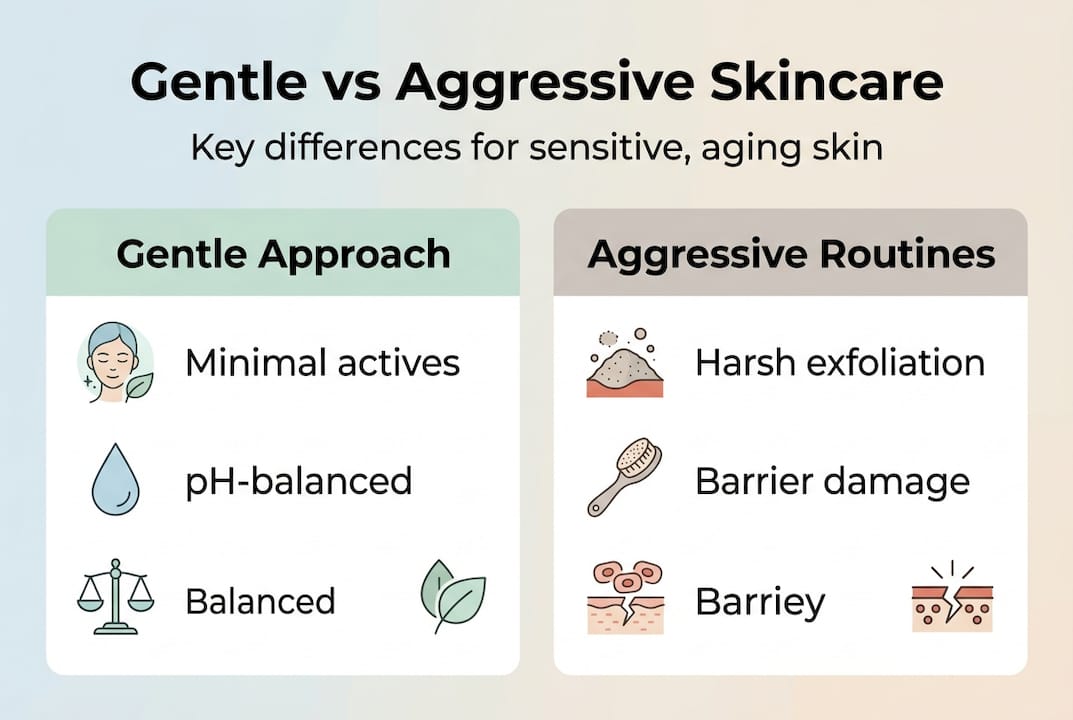
Aggressive routines disrupt the skin’s barrier and microbiome, causing inflammaging, while gentle approaches preserve the acid mantle and microbiome diversity for sustained, long-term renewal. Inflammaging is not a dramatic event. It is a slow, low-grade inflammatory state driven by a disrupted barrier, altered pH, and a depleted microbiome. It accelerates collagen degradation, worsens pigmentation irregularities, and paradoxically ages skin faster than doing nothing at all.
What most skincare advice misses is that the barrier is not just a passive shield. It is an active immunological structure. When you repeatedly strip it with high-pH cleansers, concentrated retinoids, or frequent acid peels, you train it toward reactivity. The skin’s immune cells upregulate inflammatory signaling as a baseline response. That baseline is extraordinarily hard to walk back.
Gentle routines, by contrast, lower the baseline. Ceramides restore lamellar structure. Niacinamide regulates immune-modulating cytokines. Polyhydroxy acids (PHAs) exfoliate at a cellular level without penetrating to the dermis, avoiding the TEWL spikes associated with AHAs. Over months, this approach builds tolerance rather than eroding it.
It is also worth noting that evidence-based tolerability is not the same as marketing “gentleness.” A product can be fragrance-free, minimalist, and still contain poorly tolerated preservatives or high concentrations of alcohol. The standard we apply at Cellure is not marketing-driven. It is clinical. Every formulation decision should trace back to a published mechanism, a tolerability study, or a documented clinical outcome. For practical application of these principles, gentle anti-aging practices outlines how to structure a routine that holds up over years, not just weeks.
Explore advanced gentle formulations with Cellure
If you’re ready to put these principles into action, discover proven solutions designed for your sensitive, aging skin.
At Cellure, every formulation starts with clinical evidence and ends with tolerability testing. Our targeted serums incorporate peptides, niacinamide, and polynucleotides at concentrations backed by published data, not trend cycles. Whether you’re looking to address loss of firmness, uneven tone, or barrier vulnerability, our advanced repair kits are designed to work together as a coherent, gentle renewal system. Explore the full Cellure skincare collection to find formulations matched to your skin’s specific renewal needs, built on the science this article covers, and formulated to perform without compromise.
Frequently asked questions
Are gentle formulations effective for anti-aging compared to traditional products?
Yes, gentle formulations with ingredients like niacinamide and peptides have proven clinical effects on hydration, ceramide production, and barrier repair. Niacinamide at 4% increased epidermal ceramides by 34% and reduced dryness by 93.7% in combination with Tripeptide-29, delivering visible anti-aging results without irritation.
What should I look for to ensure a gentle formulation is truly evidence-based?
Seek products with published clinical benchmark data including TEWL reduction over 20%, hydration increases of 40% or more, and a passed RIPT, along with references to peer-reviewed sources whenever possible.
Are all natural ingredients gentle for sensitive skin?
No. Some natural substances like essential oils act as contact sensitizers. Evidence-based botanicals such as centella asiatica, chamomile, and aloe vera are preferred for sensitive, aging skin because they have documented tolerability profiles.
How do gentle formulations benefit the skin barrier and microbiome?
Gentle routines preserve the acid mantle and microbiome diversity, supporting sustained renewal and reducing the risk of inflammaging. Aggressive routines disrupt the barrier and microbiome, creating a chronic low-grade inflammatory state that accelerates visible aging over time.