


Bioactive ingredients explained: Science for younger, healthier skin
TL;DR:
- Most skincare products only sit on the skin’s surface, providing temporary benefits like softness and plumpness. Bioactives, however, interact with biological pathways such as inflammation, oxidative stress, and collagen production to generate real, measurable changes inside the skin. Effective anti-aging routines depend on the presence of well-delivered, clinically supported bioactives that target multiple points in the skin’s aging cascade.
Most skincare products do one thing well: sit on the surface. They soften, smooth, and temporarily plump the skin with humectants and emollients. Bioactive ingredients are fundamentally different. Instead of resting on top, they interact with biological pathways such as oxidative stress, inflammation, and cellular signaling to create real, measurable change inside the skin. This distinction matters enormously for anyone in their 30s, 40s, or 50s who wants more than a temporary glow and is ready to invest in formulations that work at the level where aging actually begins.
Table of Contents
- What makes an ingredient bioactive?
- How do bioactive ingredients work for aging skin?
- Key bioactive ingredients for skin rejuvenation
- Why mechanism and delivery are just as important as the bioactive itself
- How to evaluate bioactive skincare: Evidence, endpoints, and best practices
- Why most people misunderstand bioactives—and what the science actually demands
- Discover evidence-based skincare for real results
- Frequently asked questions
Key Takeaways
| Point | Details |
|---|---|
| Bioactives target aging | Bioactive ingredients interact with your skin’s biology to address aging signs, not just mask them. |
| Mechanism matters | The effectiveness of a bioactive relies on both its action and how well it penetrates the skin. |
| Evidence over hype | Trust objective results from clinical trials, not just marketing claims, when choosing products. |
| Peptides and delivery | Peptides can rejuvenate skin but need effective delivery systems to work their best. |
| Smart selection wins | Choosing bioactives with proven benchmarks leads to better long-term skin health. |
What makes an ingredient bioactive?
The word “bioactive” gets used loosely in marketing, but scientifically it has a precise meaning. A bioactive compound is one that interacts with biological pathways such as oxidative stress, inflammation, and extracellular matrix signaling to produce a measurable biological response. That is the core distinction. A basic moisturizer carries water to the outer skin layer. A bioactive ingredient, by contrast, signals cells, modulates enzymes, or triggers protein synthesis.
Most ingredients on a standard label fall into two categories: functional fillers and bioactives. Functional fillers include humectants like glycerin, emollients like squalane, and preservatives. They are important for texture, stability, and basic hydration, but they do not change how your skin functions at a cellular level. Bioactives do. They operate on specific biological targets, which is why their presence in a formula elevates it into a different category entirely.
The skin pathways that bioactives influence include:
- Oxidative stress regulation: Neutralizing free radicals that break down collagen and disrupt DNA repair
- Inflammatory signaling: Reducing chronic low-grade inflammation (sometimes called “inflammaging”) that accelerates visible aging
- Extracellular matrix (ECM) remodeling: Stimulating collagen and elastin production, which restores structure and firmness
- Cellular renewal cycles: Supporting natural turnover so fresh, resilient cells replace older, damaged ones
- Barrier protein synthesis: Reinforcing the proteins that keep moisture in and irritants out
For a deep breakdown of how these mechanisms translate into visible results, top skin repair ingredients provides an excellent starting point.
Pro Tip: When reading an ingredient label, look for the mechanism listed alongside the ingredient name in a brand’s published literature. If no mechanism is described, the formula is likely surface-focused rather than bioactive.
How do bioactive ingredients work for aging skin?
Aging skin is not simply skin that has lost moisture. The visible signs you notice, including fine lines, sagging, uneven tone, and dullness, reflect real biological changes happening beneath the surface. Aging signs reflect oxidative stress, inflammation, and structural degradation in the extracellular matrix and barrier, which bioactive ingredients are specifically designed to modulate.
Understanding the three main shifts that happen in aging skin helps clarify exactly where bioactives intervene:
-
ECM breakdown: Collagen and elastin fibers degrade faster than they are replaced, causing loss of firmness and elasticity. Bioactives like peptides and retinoids directly stimulate fibroblasts, the cells responsible for producing these structural proteins, to rebuild the matrix.
-
Barrier compromise: The lipid bilayer that forms the outer skin barrier thins and loses integrity, increasing transepidermal water loss (TEWL). Elevated TEWL is one of the most reliable early markers of aging skin. Bioactives like niacinamide strengthen ceramide synthesis to restore barrier function.
-
Cellular senescence: Older cells accumulate and stop dividing properly. They also release inflammatory signals that damage surrounding healthy tissue. Certain bioactives, particularly antioxidants and specialized peptides, help manage this process and encourage healthier cell turnover.
Clinical trials measuring bioactive efficacy do not rely solely on how a subject feels after use. Trials use multi-parameter endpoints like TEWL, hydration levels, and elasticity measurements using devices such as corneometers and cutometers. This objective, instrument-based measurement standard is what separates genuinely clinically supported skincare from products that rely on self-reported surveys.
“Aging in the skin is not a single event but a cascade of biological failures at the structural, cellular, and barrier level. Effective bioactives must target multiple points in that cascade simultaneously.”
| Aging sign | Underlying mechanism | Bioactive approach |
|---|---|---|
| Fine lines and wrinkles | ECM collagen loss | Peptides, retinoids stimulate fibroblasts |
| Loss of firmness | Elastin degradation | Growth factor peptides, antioxidants |
| Dullness | Slowed cell turnover | Retinoids, niacinamide, AHAs |
| Uneven tone | Melanin overproduction | Tranexamic acid, niacinamide |
| Dryness and sensitivity | Barrier compromise (elevated TEWL) | Niacinamide, ceramide-supporting ingredients |
Key bioactive ingredients for skin rejuvenation
Not all bioactives are equal. Some have decades of rigorous clinical data behind them. Others are newer with promising early evidence. Here is a focused look at the most relevant bioactives for adults dealing with aging skin concerns.
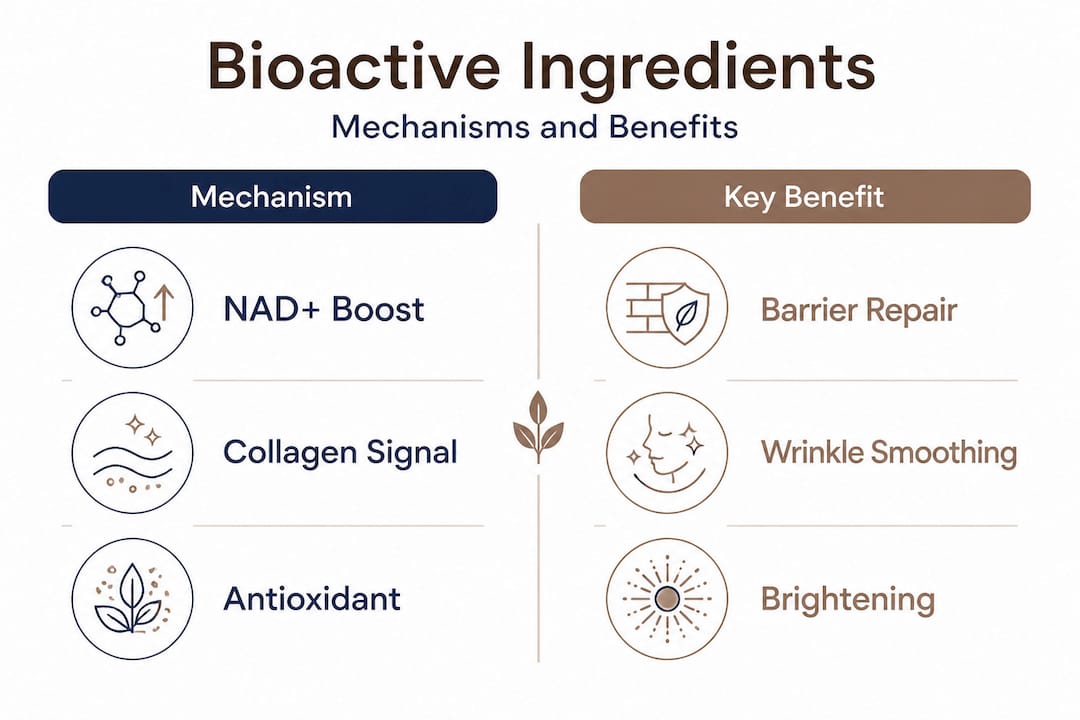
Niacinamide (Vitamin B3) Niacinamide is one of the most thoroughly studied bioactives in dermatology. It acts on NAD+ metabolism, barrier proteins, and anti-inflammatory processes simultaneously, making it one of the few ingredients that genuinely multi-tasks at a biological level. It improves ceramide production, reduces the transfer of melanin to skin cells (which means brighter, more even tone), and calms the low-grade inflammation that worsens sensitivity and accelerates visible aging. Concentrations between 5% and 10% are most commonly studied in trials. It is well tolerated across all skin types, which makes it a near-universal inclusion in well-formulated anti-aging products.
Peptides Peptides are short amino acid chains that act as biological messengers. Peptides support collagen signaling and regeneration, but they face significant delivery challenges because of their size and structure. Different peptide classes target different aging mechanisms: signal peptides stimulate fibroblasts to produce collagen, carrier peptides deliver essential minerals for enzyme function, and neurotransmitter-inhibiting peptides temporarily soften expression lines. For anyone interested in the newest research behind these categories, science-backed peptide picks offers practical guidance. The role of peptides in overall skin repair strategy is increasingly central to advanced formulation design.
Retinoids The retinoid family, which includes retinol, retinaldehyde, and prescription-grade tretinoin, remains the most evidence-rich category in anti-aging skincare. Retinoids increase cellular turnover, stimulate collagen synthesis via retinoic acid receptors, and improve pigmentation. The primary limitation is tolerability, especially at higher concentrations. Buffered delivery formats and lower-concentration encapsulated versions now make retinoids accessible to more sensitive skin types.
Antioxidants (Vitamin C, Resveratrol, Coenzyme Q10) Antioxidants intercept free radicals before they cause oxidative damage to collagen, lipids, and DNA. Vitamin C (L-ascorbic acid) also directly stimulates collagen synthesis and inhibits melanin overproduction. Resveratrol activates sirtuins, proteins involved in cellular longevity signaling. These are most effective when paired with other bioactives because oxidative stress is a trigger for nearly every aging cascade.
| Ingredient | Primary mechanism | Key benefit | Challenge |
|---|---|---|---|
| Niacinamide | NAD+ metabolism, barrier proteins | Barrier repair, brightness, anti-inflammatory | Formulation stability at high concentrations |
| Peptides | Collagen signaling, ECM remodeling | Firmness, structural renewal | Penetration across the skin barrier |
| Retinoids | Cellular turnover, fibroblast activation | Lines, texture, tone | Irritation, sun sensitivity |
| Vitamin C | Antioxidant, collagen synthesis | Radiance, photoprotection support | Oxidation instability in formula |
| Tranexamic acid | Melanin pathway inhibition | Hyperpigmentation, brightening | Optimal concentration calibration |
Pro Tip: The most effective anti-aging routines layer bioactives strategically rather than stacking them all at once. For example, retinoids at night paired with niacinamide in the morning allows each to work in its optimal environment without competing for receptor sites.
Why mechanism and delivery are just as important as the bioactive itself
Here is a truth that most product marketing quietly skips over: the presence of a bioactive ingredient in a formula is not the same as that bioactive reaching the target layer of your skin at an effective concentration.
Skin is designed to keep things out. Its barrier function, the very thing bioactives help repair, is also the wall that prevents most topically applied compounds from penetrating to the dermis where they are needed most. Peptide bioactivity is constrained by penetration, and emerging vehicles like extracellular vesicles are being actively researched to overcome these barriers.
What this means practically is that when you see a peptide or antioxidant on a label, you need to also ask how it is being delivered. The most common delivery innovations used in advanced formulations include:
- Encapsulation: The active ingredient is encapsulated in a lipid sphere or polymer that releases it at a specific skin depth or pH, protecting it from breaking down before it arrives at the target site
- Nanotechnology: Reducing particle size dramatically increases surface area and improves penetration through lipid channels in the skin barrier
- Extracellular vesicle technology: Tiny biological vesicles that can carry peptides and bioactives into deeper skin layers with high specificity
- pH-matched formulas: Many bioactives are only biologically active within a precise pH window. A well-formulated product accounts for this to ensure the active is functional at the point of application
Formulation transparency is a reliable proxy for quality. Brands invested in real peptide technology will publish their delivery mechanism, the concentration of key actives, and ideally the clinical data that demonstrates efficacy in final-formula testing, not just on isolated ingredients. The peptide benefits in skincare discussion also covers how delivery directly affects the results you should expect from peptide-based products.
“A beautifully packaged serum with the right active on the label but the wrong delivery system is essentially an expensive moisturizer.”
How to evaluate bioactive skincare: Evidence, endpoints, and best practices
You now have a working understanding of bioactives and their delivery. The next practical skill is evaluating whether a specific product actually delivers on its scientific claims. This is where many consumers, and even some skincare enthusiasts, lose confidence.
Here is a clear, step-by-step method for assessing any bioactive skincare product before you buy:
-
Look for clinical evidence on the final formula: Individual ingredient research is useful context but it does not prove the formula you are buying is effective. A rigorous trial tests the actual finished product on real participants. Ask whether the brand publishes or references this.
-
Identify the measurement endpoints used: Strong clinical evidence uses objective, instrument-based measures. Trials that measure TEWL and hydration alongside wrinkle and elasticity scoring are far more credible than studies based purely on participant self-reporting. Both matter, but objective data is harder to manipulate.
-
Understand the mechanism of the key actives: A brand that can explain not just what an ingredient does but which biological pathway it targets, and at what concentration, is demonstrating genuine scientific literacy. Vague descriptions like “revitalizing complex” or “youth-boosting blend” are red flags.
-
Watch for delivery transparency: Does the brand explain how the active reaches the target skin layer? Brands doing serious work in this area will mention their delivery system or encapsulation technology as a selling point.
-
Check for science-backed anti-aging results: Consumer reviews are useful for tolerability and texture feedback, but they are not clinical evidence. Real anti-aging results should be measured and published, not just testimonials collected through post-purchase surveys.
Pro Tip: Before purchasing, search for the product name alongside terms like “clinical study” or “in vivo results.” If nothing comes up beyond brand-owned marketing pages, treat the efficacy claims with skepticism.
The most important red flag of all is overloading a formula with trendy actives without explaining the concentration or delivery of any of them. More ingredients does not mean more efficacy. Focus and formulation precision matter far more.
Why most people misunderstand bioactives—and what the science actually demands
After years of watching the skincare industry evolve, one pattern stands out clearly: the gap between what is marketed and what is actually proven keeps widening. Consumers are more ingredient-savvy than ever before, and brands have responded by loading up their labels with the right buzzwords. But bioavailability, which is the actual amount of an active that reaches its target tissue in a functional form, is almost never discussed in marketing materials.
The inconvenient reality is that peptide and antioxidant claims are frequently overstated in the absence of real delivery and endpoint evidence. A brand can honestly include a peptide in a formula at a concentration so low that it exerts no measurable biological effect, yet call the product a “collagen-boosting peptide serum.” Technically accurate. Practically meaningless.
What genuinely differentiates an advanced bioactive product from a well-marketed average one comes down to three things: a credible, specific mechanism, a delivery system appropriate to that active, and transparent clinical evidence for skincare measured with objective tools. Brands that meet all three criteria are genuinely rare, which is precisely why it is worth learning to ask these questions before you invest in any anti-aging routine.
The other misunderstanding worth addressing directly is the idea that more complex formulas are inherently more effective. A single well-delivered peptide with proven collagen-stimulating activity in a stable, pH-optimized base will outperform a 15-ingredient serum where no individual active reaches a therapeutic threshold. Simplicity and precision, backed by data, beat complexity every time. This is the standard worth holding the industry to.
Discover evidence-based skincare for real results
Understanding the science behind bioactive ingredients is only the beginning. The more meaningful step is putting that knowledge into practice with formulations that are designed around real mechanisms, clinical validation, and transparent delivery strategies.
At Cellure, every product is built around this exact standard. The Complete Skin Repair Kit brings together targeted bioactives for comprehensive cellular renewal, addressing firmness, tone, barrier integrity, and hydration in a single cohesive regimen. For those focused specifically on brightening and structural support, the Tranexamic Acid Peptide Serum combines two of the most evidence-backed actives for uneven skin tone and collagen support. Explore the full range of Cellure advanced skincare to find formulations matched to your skin’s specific needs.
Frequently asked questions
What is a bioactive ingredient in skincare?
A bioactive ingredient interacts with skin’s biological pathways to trigger specific responses, like reducing inflammation or stimulating collagen, rather than simply sitting on the surface to hydrate.
How do I know if a skincare product contains effective bioactives?
Look for clinical evidence with objective measures, since trials measuring TEWL and hydration indicate genuine biological testing, and check that the brand explains both the ingredient’s mechanism and its delivery system.
Which bioactive ingredient helps restore skin barrier function?
Niacinamide is one of the strongest options because it promotes ceramide synthesis and improves moisture retention, directly strengthening the barrier layer that deteriorates with age.
Are peptides really effective as anti-aging ingredients?
Peptides can meaningfully support collagen signaling and ECM regeneration, but require advanced delivery systems to overcome the skin’s penetration barrier and achieve real biological effect.
Recommended
- The science of skin renewal: 3 actives for youthful skin – Cellure
- Clinically supported skincare: real science for aging skin – Cellure
- Top ingredients for skin rejuvenation backed by science – Cellure
- Top skin renewal tips for 2026: Science-backed rejuvenation – Cellure
- Skin health explained: simple science for better results – SMPL SKIN South Africa
- Top Hyaluronic Acid Products for Youthful, Hydrated Skin