


Why Use Bioactive Ingredients for Younger, Healthier Skin
TL;DR:
- Bioactive ingredients act at the cellular level to address aging and skin issues more effectively than conventional ingredients. They provide multi-target effects like collagen preservation, oxidative defense, and inflammation reduction, supported by clinical validation. Using products with proven bioactives ensures better results and long-term skin health.
Bioactive ingredients are defined as active molecules that produce measurable physiological effects on skin, going well beyond surface hydration or basic nutrition. The reason to use bioactive ingredients in skincare is straightforward: they work at the cellular level to address aging, inflammation, and barrier breakdown in ways that conventional ingredients simply cannot. The anti-aging skincare segment is forecasted to exceed $60 billion by 2030, driven by consumer demand for products that combine natural origin with clinical proof. That shift reflects a growing understanding that the benefits of bioactive substances are not marketing language. They are measurable, reproducible, and increasingly well-documented in peer-reviewed science.
Why use bioactive ingredients: the molecular case
Bioactive compounds exert physiological and pharmacological effects that make skincare products work beyond basic surface care. That distinction matters because most conventional ingredients, such as basic emollients or humectants, address symptoms. Bioactives address causes.
The science behind how bioactive compounds work comes down to multi-target action. A single bioactive molecule can simultaneously inhibit collagenase (the enzyme that breaks down collagen), reduce oxidative stress, and modulate inflammatory pathways. That is fundamentally different from a single-mechanism ingredient like a basic antioxidant vitamin that only neutralizes free radicals.
Here is what that looks like in practice:
- Collagenase inhibition: Bioactives bind to or block the enzymes responsible for collagen degradation, preserving skin firmness at the structural level.
- Oxidative stress reduction: They neutralize reactive oxygen species before those molecules damage skin proteins, lipids, and DNA.
- Anti-inflammatory modulation: They signal skin cells to reduce pro-inflammatory cytokine production, which slows the chronic low-grade inflammation that accelerates visible aging.
- Protease regulation: They help balance the enzymes that control skin cell turnover, preventing both excessive shedding and cellular buildup.
A 2026 study on quinoa bioester demonstrated this multi-target approach directly. The research showed that quinoa bioester shifts the skin proteome toward molecular profiles associated with younger age by simultaneously modulating barrier function, oxidative defense, and protease regulation. That kind of multi-pathway action is what separates high-performance bioactives from conventional ingredients.
Pro Tip: When evaluating a product’s bioactive claims, look specifically for evidence of multi-mechanism action. A single antioxidant claim is not the same as a clinically validated bioactive.
What are the real advantages of bioactives over regular skincare ingredients?
The advantages of using bioactives go beyond efficacy. They reshape how brands build credibility and how consumers make decisions.
Scientific validation is the differentiator
Clinical assays are now the standard for verifying bioactive efficacy in anti-aging skincare. Anti-collagenase and anti-tyrosinase tests, for example, provide measurable proof that a product can claim lifting or brightening benefits. Without that validation, “bioactive” is just a label. Brands that skip this step risk product recalls, regulatory issues, and loss of consumer trust. Investing in bioactive compound analysis is a strategic requirement for any brand that wants to sustain premium positioning.
For you as a consumer, this means one thing: look for products that cite specific assays or clinical testing, not just ingredient lists.
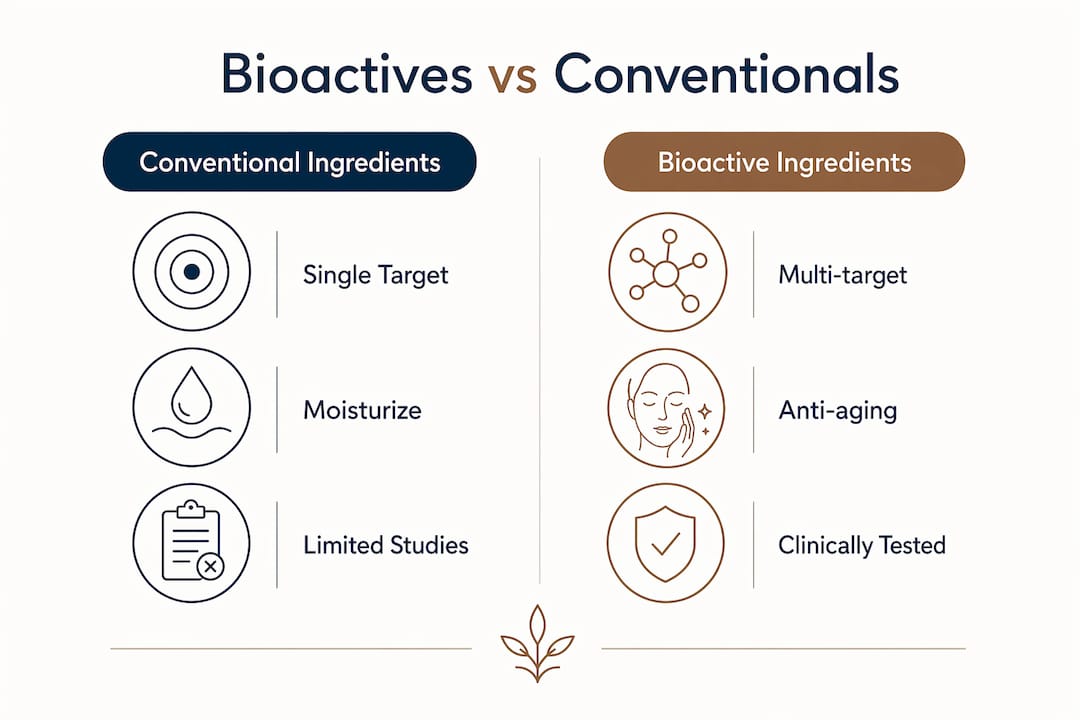
Bioactives vs. conventional ingredients: a direct comparison
| Feature | Conventional ingredients | Bioactive ingredients |
|---|---|---|
| Mechanism | Single target (e.g., moisturize) | Multi-target (barrier, oxidative, enzymatic) |
| Validation | Sensory or cosmetic testing | Clinical assays (anti-collagenase, etc.) |
| Skin depth | Surface level | Cellular and molecular level |
| Aging impact | Temporary symptom relief | Addresses root causes of aging |
| Sourcing | Synthetic or basic natural | Natural origin with measurable efficacy |
Natural origin plus measurable results
Plant-derived bioactive compounds including polyphenols, terpenoids, and alkaloids provide antioxidant, anti-inflammatory, and antimicrobial benefits by modulating metabolic and immune pathways. That combination of natural sourcing and documented biological activity is exactly what the current skincare market demands. You get the clean-ingredient story and the clinical proof in one formulation.
Which bioactive ingredients actually work for aging and hydration?
Not all bioactives are equal. The most effective ones for aging and hydration share a common trait: they act on multiple skin systems at once, rather than addressing a single concern in isolation.
Quinoa bioester
The 2026 research on quinoa bioester is among the most compelling evidence available for multi-target anti-aging action. It modulates barrier proteins, reduces oxidative damage markers, and regulates proteases that control skin renewal. The result is a measurable shift in the skin’s molecular profile toward younger-age patterns. This is not a theoretical benefit. It is documented in human skin proteome data.

Peptides
Peptides are short chains of amino acids that signal skin cells to produce collagen, elastin, and other structural proteins. They are among the most studied bioactive ingredients in skincare, with strong evidence for improving firmness and reducing the appearance of fine lines. Unlike retinoids, peptides achieve these results without irritation, making them suitable for sensitive and mature skin types.
Polyphenols
Polyphenols from sources like green tea, resveratrol, and pomegranate extract are potent antioxidants that also carry anti-inflammatory properties. Their value in skincare comes from their ability to protect existing collagen from oxidative degradation while simultaneously calming reactive skin. They are a core class of plant-derived bioactive compounds with decades of research behind them.
Seaweed extracts
Seaweed bioactives are highly compatible with human skin, offering hydration, barrier integrity, anti-inflammatory, and antioxidant benefits. Their compatibility comes from millions of years of evolutionary adaptation to environmental stress, including UV exposure and osmotic pressure. Whole seaweed extracts provide synergistic benefits that isolated compounds often cannot replicate. This is the argument for using full-spectrum botanical extracts rather than single isolated molecules.
Tranexamic acid and polynucleotides
Tranexamic acid targets uneven skin tone by interrupting melanin transfer pathways, making it one of the most effective brightening bioactives available without a prescription. Polynucleotides, derived from salmon or trout DNA, support cellular repair and hydration at a structural level. Both are featured in Cellure’s formulations because they address specific aging concerns with documented clinical backing. You can explore how these bioactive ingredients work in detail to understand why they are included in targeted treatment protocols.
How to incorporate bioactive ingredients into your routine
Getting results from bioactive skincare requires more than buying the right product. Formulation, concentration, and consistency all determine whether you see measurable improvement.
-
Read beyond the ingredient list. Look for products that specify the concentration of key bioactives or reference clinical testing. A product listing “peptides” without specifying type or concentration is not giving you enough information to evaluate efficacy.
-
Prioritize formulation stability. Bioactives like polyphenols and peptides degrade when exposed to light, air, or heat. Choose products in opaque, airtight packaging. Serums in pump dispensers protect bioactives better than open jars. Skincare formulations that enhance bioactive absorption use delivery systems that protect active molecules until they reach the skin.
-
Match the bioactive to the concern. Peptides and quinoa bioester for firmness and structural repair. Polyphenols and seaweed extracts for oxidative defense and hydration. Tranexamic acid for brightening and tone correction. Using a product with the wrong bioactive profile for your concern wastes both time and money.
-
Use serums as your primary delivery vehicle. Serums have higher concentrations of actives and thinner formulations that allow deeper penetration than creams. Science-backed serums are the most efficient way to deliver bioactives to the skin layers where they produce results.
-
Commit to consistency. Bioactives work through cumulative cellular signaling, not overnight surface changes. Most clinical studies measure results at 4, 8, and 12 weeks. Expect the same timeline in your own routine.
Pro Tip: Layer your bioactive serum on slightly damp skin after cleansing. Hydrated skin has a more permeable barrier, which improves absorption of active molecules.
Key takeaways
Bioactive ingredients outperform conventional skincare because they act on multiple aging pathways simultaneously, with clinical validation to prove it.
| Point | Details |
|---|---|
| Multi-target action | Bioactives address collagen loss, oxidative stress, and inflammation at once, not one at a time. |
| Clinical validation matters | Look for products backed by anti-collagenase or anti-tyrosinase assays, not just ingredient labels. |
| Ingredient matching | Pair the right bioactive to your concern: peptides for firmness, polyphenols for oxidative defense, tranexamic acid for tone. |
| Formulation stability | Choose serums in airtight, opaque packaging to protect bioactives from degradation before use. |
| Consistency drives results | Clinical studies measure bioactive results at 4–12 weeks. Short-term use will not show the full benefit. |
What I’ve learned from watching the bioactive market evolve
The biggest shift I have observed in skincare science over the past several years is not the discovery of new ingredients. It is the demand for proof. Consumers are no longer satisfied with ingredient lists. They want to know what a bioactive actually does, at what concentration, and how that was measured.
That shift is healthy. It forces brands to invest in real validation rather than riding trend cycles. The 2026 quinoa bioester research is a good example of where the science is heading: proteome-level evidence that a natural ingredient can measurably shift skin biology. That is a different category of claim than “contains antioxidants.”
What I find most underappreciated is the synergy argument. Whole botanical extracts consistently outperform isolated compounds in clinical settings, yet most consumers still evaluate products by scanning for a single hero ingredient. The seaweed research makes this point clearly. Isolating one compound from a whole extract often loses the biological context that made it effective in the first place.
My practical advice: stop evaluating bioactive products by ingredient name alone. Ask what the clinical evidence shows, what assays were used, and whether the formulation is designed to protect the actives through to delivery. Brands that can answer those questions clearly are the ones worth your investment. You can find a deeper breakdown of evidence-backed skincare science if you want to go further into how to evaluate these claims yourself.
— Sara
How Cellure uses bioactive ingredients to repair and renew skin
Cellure builds its formulations around clinically validated bioactives because the science demands it. The Complete Skin Repair Kit combines peptides, tranexamic acid, and polynucleotides in a targeted protocol designed to address barrier repair, oxidative stress, and loss of firmness together, not separately. Each ingredient is selected based on documented efficacy, not trend cycles.
If you want to understand exactly what goes into each formula, Cellure’s ingredient overview details the scientific rationale behind every active compound used. For anyone serious about addressing aging at the cellular level, this is where results-driven skincare starts.
FAQ
What are bioactive ingredients in skincare?
Bioactive ingredients are active molecules that produce measurable physiological effects on skin, including collagen preservation, oxidative defense, and barrier repair. They differ from conventional ingredients by acting at the cellular and molecular level rather than the surface.
How do bioactive compounds work differently from regular ingredients?
Bioactive compounds target multiple aging pathways simultaneously, such as inhibiting collagenase, reducing inflammation, and regulating skin proteases. Regular ingredients typically address a single function, like moisturizing or exfoliating.
Which bioactive ingredients are best for aging skin?
Peptides, quinoa bioester, polyphenols, seaweed extracts, tranexamic acid, and polynucleotides are among the most research-supported bioactive ingredients for aging concerns. Each targets a specific mechanism, from firmness to tone correction to barrier repair.
How do I know if a bioactive skincare product actually works?
Look for products validated through clinical assays such as anti-collagenase or anti-tyrosinase testing. A product that lists bioactives without citing measurable efficacy data has not been properly validated.
How long does it take to see results from bioactive skincare?
Most clinical studies on bioactive ingredients measure results at 4–12 weeks of consistent use. Surface changes may appear sooner, but structural improvements to collagen and barrier function require sustained application.