


The role of science in skincare: evidence-backed solutions
TL;DR:
- Social media-driven skincare routines often lack clinical support and can harm the skin barrier.
- A science-based approach prioritizes evidence of ingredient penetration, barrier health, and proven outcomes for aging skin.
Social media has made skincare simultaneously more accessible and more confusing. Platforms push 10-step routines, trending ingredients, and before-and-after transformations that rarely reflect clinical reality. The role of science in skincare is to cut through that noise and answer one simple question: what actually works? Dermatologists increasingly see patients arriving with social-media-driven routines built around unproven products that have caused irritation, barrier damage, and worsened conditions. If you are in your 30s, 40s, or 50s and dealing with loss of firmness, uneven tone, or early volume loss, you deserve answers grounded in evidence, not algorithm-driven trends.
Table of Contents
- Why science matters in skincare: cutting through hype and complexity
- Understanding skin aging and the scientific basis for effective interventions
- How formulation science improves skincare efficacy and safety
- Molecular pathways and clinical research driving next-generation skincare
- Practical evidence-based skincare steps for aging adults
- Why evidence, safety, and simplicity should guide your skincare choices
- Advanced scientific skincare solutions with Cellure
- Frequently asked questions
Key Takeaways
| Point | Details |
|---|---|
| Science cuts through hype | Scientific evidence helps identify effective and safe skincare, avoiding unproven, complex routines. |
| UV protection is key | Daily broad-spectrum sunscreen is the most important intervention to prevent visible skin aging. |
| Formulation matters | Stable, well-delivered actives penetrate skin better, maximizing clinical benefits. |
| Clinical evidence is essential | Topical ingredients must be supported by rigorous studies, not just in vitro or marketing claims. |
| Simplicity promotes safety | Minimalist, evidence-based routines reduce risk of irritation and harmful effects. |
Why science matters in skincare: cutting through hype and complexity
The skincare industry generates hundreds of billions of dollars annually, yet the gap between marketing claims and clinical evidence has never been wider. Social-media-driven skincare often involves many steps and weakly supported products that may damage skin, particularly the outer barrier that keeps moisture in and irritants out. When that barrier is compromised, every active ingredient you apply afterward either stings, fails to absorb properly, or both.
Science provides a framework for evaluating claims before you apply something to your face. A clinically supported skincare approach asks: Has this ingredient been tested in randomized controlled trials? Does it penetrate to the layer where it needs to act? Are there known irritation profiles? Those questions protect your skin and your wallet.
Here is what a scientific approach actually prioritizes:
- Barrier health first. A compromised barrier undermines everything else in your routine.
- Evidence of penetration. An ingredient sitting on the skin surface does not address dermal collagen loss.
- Clinically measured outcomes. Firmness scores, melanin index readings, and transepidermal water loss measurements beat before-and-after photos.
- Minimal, purposeful steps. Dermatologists consistently recommend fewer products used correctly over many products layered thoughtlessly.
- Lifestyle foundations. UV protection, sleep, and hydration drive outcomes that no serum can replicate.
“The best skincare routine is not the most complicated one. It is the one built on interventions with the strongest evidence and the lowest risk of harm.” This is the core philosophy separating science from skincare theater.
It is worth noting that some of the most evidence-supported treatments for concerns like scarring and photoaging require professional assessment. Expert skin treatments for more significant concerns may go beyond what topical products alone can address, reinforcing why understanding the science matters before you invest.
Understanding skin aging and the scientific basis for effective interventions
Skin aging happens on two parallel tracks. Intrinsic aging is driven by genetics, time, and cellular senescence, the gradual slowdown of collagen production and cellular turnover that begins in your late 20s. Extrinsic aging is driven primarily by UV radiation, and it accounts for the majority of what you actually see in the mirror: the uneven tone, the loss of elasticity, the deepening of lines.
UV photodamage is a central driver of accelerated skin aging, and many commercial claims fail due to poor absorption and weak evidence. The mechanism is well understood: UV radiation generates reactive oxygen species that break down collagen and elastin fibers, activate matrix metalloproteinases (enzymes that degrade the skin’s structural proteins), and cause direct DNA damage in skin cells. The visible result is loss of firmness, sagging, and the irregular pigmentation known as hyperpigmentation.
Here are the key biological targets that science has validated for anti-aging intervention:
- Photoprotection. Preventing UV damage daily is far more effective than trying to reverse it. UV radiation also causes melanoma, making sunscreen the one intervention with both cosmetic and life-saving evidence.
- Collagen stimulation. Retinoids (vitamin A derivatives) are the most studied class of topical actives for increasing dermal collagen synthesis.
- Pigmentation regulation. Tranexamic acid, niacinamide, and azelaic acid have clinical evidence for reducing melanin production without the irritation profile of older agents like hydroquinone.
- Cellular renewal. Exfoliation via alpha hydroxy acids improves surface texture and enhances absorption of subsequent actives.
Pro Tip: When evaluating any anti-aging product, look for the specific skin layer its active ingredient is designed to reach. Epidermal actives improve texture and brightness. Dermal actives address firmness and volume. A single product rarely does both effectively.
| Aging concern | Primary cause | Evidence-backed intervention |
|---|---|---|
| Loss of firmness | Collagen breakdown | Retinoids, peptides |
| Uneven tone | UV-induced pigmentation | Broad-spectrum SPF, tranexamic acid |
| Fine lines | UV + intrinsic aging | Tretinoin, SPF 30+ daily |
| Dullness | Reduced cell turnover | AHAs, niacinamide |
Your science-backed skin renewal guide can walk you further through how each of these mechanisms translates into targeted product choices.
How formulation science improves skincare efficacy and safety
Even the most clinically validated ingredient fails if it cannot survive in a formula long enough to reach its target. This is where formulation science separates real results from disappointing ones. Vitamin C is a perfect example: in its active form (L-ascorbic acid), it oxidizes rapidly when exposed to air or light. Poorly formulated vitamin C products deliver an orange, ineffective product within weeks of opening.

Nanocarrier delivery systems improve permeability, stability, and bioavailability but come with challenges including safety evaluation and controlled release. Nanocarriers, which include liposomes, solid lipid nanoparticles, and polymer-based systems, encapsulate active ingredients and protect them until they reach the skin layer where they need to act. A liposome, for context, is a tiny spherical structure made from the same phospholipid molecules found in cell membranes, which makes it naturally compatible with skin tissue.
What formulation science currently delivers:
- Controlled release. Actives are released gradually rather than all at once, reducing irritation and improving long-term efficacy.
- Enhanced barrier crossing. Nanocarriers physically cross the stratum corneum (the outermost skin barrier) more effectively than free molecules.
- Protection from degradation. Encapsulation shields unstable actives like retinol and vitamin C from oxidation before they reach target tissue.
- Reduced irritation. Lower free-molecule concentration at the surface means less stinging while maintaining dermal activity.
Pro Tip: When a product label lists retinol alongside a delivery system like liposomal or encapsulated retinol, that is formulation science reducing the irritation barrier to effective retinoid use. It is not marketing language. It reflects measurable differences in tolerance and penetration depth.
| Feature | Traditional formulation | Nanocarrier formulation |
|---|---|---|
| Ingredient stability | Lower, prone to oxidation | Higher, protected until delivery |
| Skin penetration | Surface-dependent | Enhanced across stratum corneum |
| Irritation potential | Higher with potent actives | Lower with controlled release |
| Safety data | Extensive, long-term | Growing, ongoing validation needed |
| Cost | Lower | Higher |
The trade-off is important: advanced delivery systems require rigorous long-term safety evaluation. Responsible formulation science in skincare means a brand that embraces nanocarrier technology should also be transparent about its safety testing protocols.
Molecular pathways and clinical research driving next-generation skincare
The most exciting development in modern skincare science is not a single ingredient. It is the shift toward understanding skin biology at a molecular level and designing products that interact with specific pathways rather than just sitting on the surface and hoping for results.
Research now connects molecular pathways like Wnt/β-catenin to clinical skin outcomes, improving targeted treatments in ways that were not possible even a decade ago. The Wnt/β-catenin pathway, for instance, plays a direct role in regulating skin cell proliferation and wound healing. When this pathway is better understood, scientists can design actives that specifically support dermal repair rather than applying broad-spectrum stimulation that may cause unintended effects.
What this translational research model means in practice:
- Shorter bench-to-bathroom timelines. When researchers collaborate directly with clinicians, insights from cell studies get tested in humans faster.
- More precise formulations. Understanding which receptor a peptide binds to means you can design delivery systems that put it there reliably.
- Reduction in trial-and-error skincare. Molecular knowledge reduces the number of ingredients you need to test on your own skin.
- Supramolecular formulations. These structures mimic biological assemblies and offer improved delivery with significantly less irritation than conventional emulsions.
- AI-assisted diagnostics. Emerging tools can analyze skin tone, texture, and barrier function to model which interventions will perform best for a specific individual.
The connection between molecular pathways in skincare and real clinical outcomes is no longer theoretical. Ingredients like polynucleotides, which are short chains of DNA or RNA fragments that stimulate fibroblast activity and tissue repair, are being used in clinical practice and are now entering evidence-based topical formulations with measurable results.
Practical evidence-based skincare steps for aging adults
Theory matters. But what you do every morning and evening is what actually determines your skin’s trajectory. Here is how to apply the science to a daily routine built around the concerns most common in adults aged 30 to 55.
- Use broad-spectrum SPF 30+ every morning, without exception. Daily SPF 30+ sunscreen is the most evidence-supported anti-aging intervention available. Apply it last in your morning routine, after moisturizer.
- Start tretinoin if you are ready to commit. Tretinoin has the strongest retinoid evidence for treating photodamage, wrinkles, and uneven tone. Begin at a low concentration (0.025%) two or three nights per week to build tolerance before increasing frequency.
- Skip topical collagen creams. Collagen molecules are too large to penetrate intact skin and do not replace dermal collagen. They hydrate the surface, which is fine, but the anti-aging claims are not supported by the evidence.
- Use a gentle, pH-balanced cleanser. Harsh cleansers strip the acid mantle (your skin’s natural protective pH layer), which increases sensitivity and reduces the effectiveness of every active you apply afterward.
- Choose moisturizers with ceramides or hyaluronic acid. These support barrier function and are among the best-studied skin hydration ingredients. They are neither exciting nor expensive, but the evidence behind them is solid.
- Be skeptical of prestige ingredients without clinical backing. An ingredient featured in a luxury brand’s campaign is not the same as an ingredient with peer-reviewed human trial data. The price tells you about the packaging, not the biology.
Pro Tip: If you are introducing tretinoin into your routine, sandwich it: apply moisturizer first, then tretinoin, then another thin layer of moisturizer on top. This reduces irritation significantly while still allowing the active to reach the epidermis.
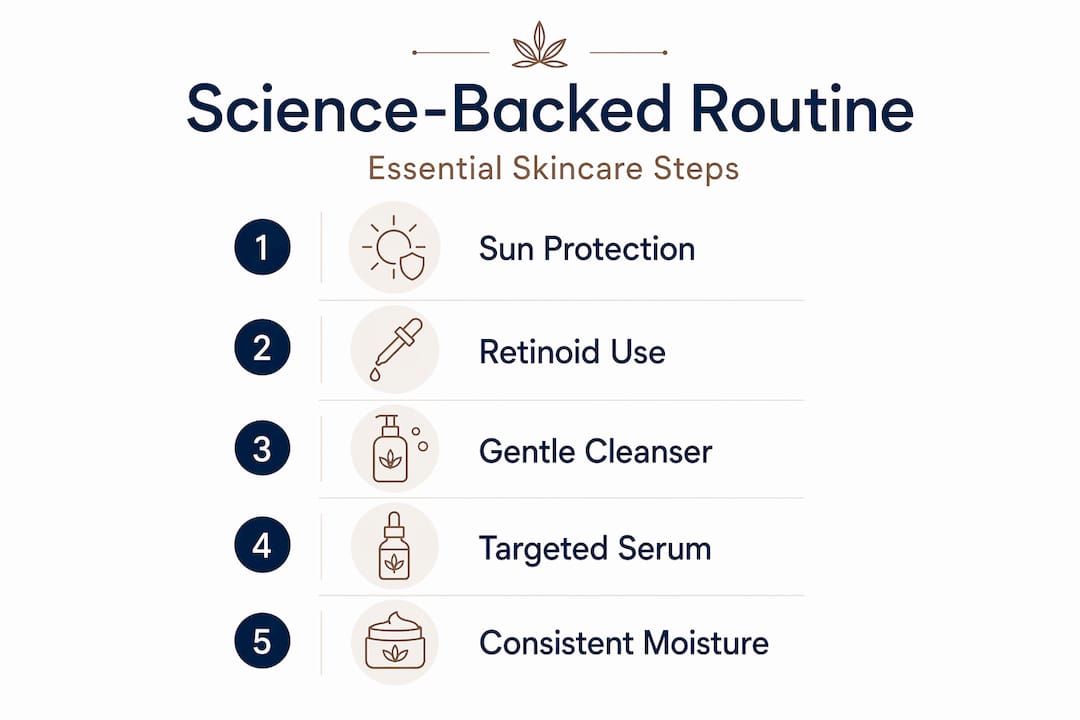
The evidence-based skincare steps that dermatologists return to consistently are simple: sun protection, a proven retinoid, barrier support, and targeted actives where the evidence exists. That is it.
Why evidence, safety, and simplicity should guide your skincare choices
Here is the uncomfortable truth about the skincare industry: most people experimenting with trending products are running uncontrolled experiments on their own faces. People experiment on themselves leading to use of ineffective or harmful products, and the consequences are often silent, a weakened barrier here, a sensitized reaction there, until the cumulative damage becomes a clinical problem.
We hold a clear view at Cellure: the most important thing science has taught us about skincare is that less, done right, outperforms more, done impressively. A two-product routine with clinically validated actives and a well-studied delivery system will consistently outperform a 12-step routine assembled from trending ingredients with no penetration data.
The nanotechnology example is worth sitting with. Nanocarriers improve efficacy but require long-term safety validation, which means innovation alone does not guarantee benefit. We find that framing important. At Cellure, we use advanced delivery science precisely because the clinical evidence supports it, and we continue to monitor safety data because the responsibility does not end at formulation.
The importance of clinical support in skincare cannot be overstated when you are in your 40s or 50s and the decisions you make now will affect your skin’s resilience for decades. Chasing every new ingredient announcement is not a skincare strategy. Building a routine on the most durable scientific evidence available, and updating it as better evidence emerges, is.
Advanced scientific skincare solutions with Cellure
If you are ready to move from understanding the science to applying it, Cellure was built for exactly that purpose.
Cellure’s formulations are built around clinically supported bioactive ingredients including peptides, tranexamic acid, and polynucleotides, each chosen for their evidence base and their ability to act at the cellular level. The Complete Skin Repair Kit brings together targeted actives with delivery systems designed to maximize stability and absorption, addressing loss of firmness, volume, and uneven tone in a coordinated protocol rather than a random stack of products. Everything about the story behind Cellure reflects a commitment to regenerative science over trend-chasing. Browse the full range of serums and repair kits at Cellure and find formulations that match your skin’s actual biology.
Frequently asked questions
What is the role of science in effective skincare?
Science identifies which ingredients safely reach skin targets, confirms clinical benefits through controlled trials, and guides formulation to ensure both efficacy and safety. Without it, skincare avoids harmful trends that lack clinical validation.
Why is sunscreen important in anti-aging skincare?
Sunscreen is the most evidence-supported anti-aging intervention available, preventing photoaging and protecting against melanoma. Daily broad-spectrum SPF is the single intervention with the strongest clinical and epidemiological backing for visible aging prevention.
Are expensive ingredients like collagen creams effective against aging?
No. Collagen molecules are too large to penetrate intact skin and cannot replace dermal collagen loss. They provide surface hydration, but their anti-aging claims are not supported by the clinical evidence.
What should I watch out for when choosing skincare products?
Look for products with published clinical evidence, proven ingredient stability, and transparent delivery mechanisms. Many commercial claims suffer from poor absorption, chemical instability, or weak mechanistic validation, so the evidence standard matters more than price or prestige.