


What Is Soothing Skincare and Why Your Skin Needs It
TL;DR:
- Effective soothing skincare targets inflammation, repairs the skin barrier, and maintains hydration, not merely gentle formulations. It emphasizes ingredient synergy, proper timing, and routine simplicity to calm sensitive or reactive skin. Consistent, minimalist routines with anti-inflammatory, barrier-repair, and hydrating ingredients support skin health and reduce flare-ups over time.
If your skin flushes after washing your face, stings when you try a new product, or seems permanently irritated no matter what you do, the answer is almost never more products. What is soothing skincare, really? It goes far deeper than a label on a bottle. It is a targeted, science-backed approach that calms active inflammation, reinforces the skin barrier, and creates the conditions your skin needs to recover and stay calm. This guide breaks down the ingredients, routines, and product choices that actually work for sensitive, reactive skin.
Table of Contents
- Key takeaways
- What soothing skincare actually means
- What ingredients soothe skin most effectively
- How to choose soothing skincare products
- Building your best soothing skincare routine
- Mistakes that make sensitive skin worse
- My take on what soothing skincare really requires
- Soothing skincare from Cellure that actually repairs
- FAQ
Key takeaways
| Point | Details |
|---|---|
| Soothing goes beyond “gentle” | Soothing skincare actively repairs the barrier and reduces inflammation, not just avoids irritation. |
| Ingredient synergy matters | Combining anti-inflammatory, barrier-repair, and humectant ingredients outperforms relying on any single active. |
| Timing your moisturizer is critical | Applying moisturizer within 3 minutes of damp skin seals in hydration and prevents water loss. |
| Remove before you add | Eliminating irritants like fragrance and dyes produces faster results than stacking more calming products. |
| Consistency beats intensity | A simple, repeatable routine practiced daily delivers lasting calm far better than occasional intensive treatments. |
What soothing skincare actually means
Most people assume soothing skincare is just “gentle” skincare with softer packaging and pastel branding. That assumption leads to disappointment. Soothing skincare has a specific physiological purpose: it interrupts the inflammatory cycle that keeps sensitive skin in a constant state of reactivity, while simultaneously rebuilding the barrier that allows irritants, pathogens, and environmental stressors to enter the skin in the first place.
Your skin barrier is a lipid matrix made up of ceramides, cholesterol, and fatty acids arranged in a specific ratio. When that ratio breaks down through over-cleansing, harsh actives, environmental damage, or chronic stress, skin barrier function deteriorates. Water escapes. Irritants get in. Inflammation follows. Redness, stinging, tightness, and flaking are all symptoms of this cycle.
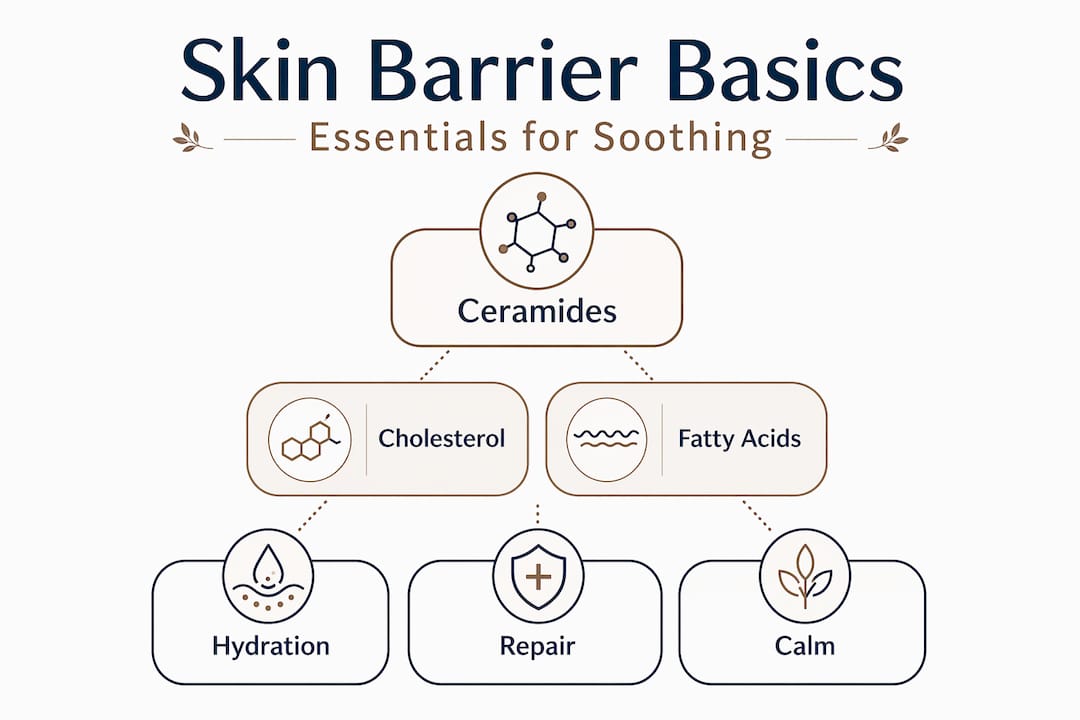
Soothing skincare targets that cycle at multiple points simultaneously. It calms existing inflammation with anti-inflammatory ingredients, seals gaps in the barrier with lipid-replenishing agents, and locks in water with humectants and occlusives. That is different from merely avoiding harsh ingredients. A product can be free of sulfates and still do nothing to actively repair a compromised barrier.
Here is what a complete soothing approach covers:
- Gentle cleansing that removes surface impurities without stripping the acid mantle
- Hydration support through humectants that draw water into the skin
- Barrier repair using lipid-rich emollients and occlusives
- Anti-inflammatory actives that calm redness and reduce immune-mediated irritation
- Ritual consistency because repetitive gentle rituals reduce cortisol levels that directly trigger inflammatory flare-ups
Pro Tip: If your skin is perpetually reactive, look at what you are currently using and ask what to remove before adding anything new. Simplification is frequently the most powerful soothing step.
What ingredients soothe skin most effectively
Understanding what ingredients soothe skin gives you the ability to read product labels and evaluate claims with real confidence. The most effective soothing formulations work through multiple pathways at once.
Anti-inflammatory agents form the first line of defense. Colloidal oatmeal inhibits inflammatory cascades and creates a physical film on the skin surface that reduces friction and irritant exposure. Bisabolol, the active constituent of chamomile, has measurable anti-irritant properties that work well even at low concentrations. Centella asiatica extracts (including madecassoside and asiaticoside) support collagen synthesis and reduce inflammatory signaling simultaneously.
Barrier-repair lipids are non-negotiable for genuinely compromised skin. Ceramides, cholesterol, and free fatty acids at a physiological ratio (roughly 1:1:1) directly replenish what a damaged barrier has lost. Without them, every other soothing ingredient is working against a structural deficit. Ceramide-rich emollients reduce itch and measurably improve barrier function in eczema-prone skin.
Humectants and hydrators pull water into the skin and hold it there. Glycerin is the most studied and cost-effective of these. Hyaluronic acid works best in layered formulations and is most effective when applied to damp skin. Neither ingredient repairs the barrier on its own, which is why they work best paired with occlusives or emollients.
Here is a quick comparison of the two most clinically relevant soothing ingredients:
| Ingredient | Primary mechanism | Best suited for |
|---|---|---|
| Niacinamide | Reduces water loss, calms redness, supports ceramide production | Reactive, redness-prone, barrier-compromised skin |
| Colloidal oatmeal | Inhibits inflammatory mediators, forms protective film | Eczema-prone, itchy, acutely irritated skin |
| Panthenol (B5) | Accelerates epidermal repair, deeply humectant | Post-procedure, sensitized, or inflamed skin |
| Ceramides | Directly replenishes barrier lipids | Dry, flaking, structurally compromised skin |
A multi-pathway approach that combines anti-inflammatory, barrier-support, and repair ingredients consistently outperforms formulations that rely on a single star ingredient. When you see oat plus niacinamide plus panthenol in a serum, that is intentional ingredient architecture, not a marketing list.
Pro Tip: Check the ingredient list for fragrance compounds including “parfum,” linalool, and limonene. These are among the most common sensitizers in skincare and can appear in products marketed as soothing.
How to choose soothing skincare products
Knowing how to choose soothing skincare starts with your skin’s specific condition, not a product’s marketing claims. Reactive skin is not one-size-fits-all. Someone with dry, flaky, barrier-compromised skin needs very different textures than someone with oily but redness-prone skin.
When evaluating soothing skincare products, work through these criteria before purchasing:
- Identify your sensitivity type. Is your skin dry and tight, or oily and prone to flushing? Eczema and rosacea have overlapping symptoms but respond to different formulations.
- Match texture to skin condition. Emollient textures range from lightweight lotions to thick ointments. Severe dryness and eczema benefit most from cream or ointment textures. Oily reactive skin does better with gel-cream or lightweight lotion formats.
- Prioritize fragrance-free formulations. Fragrance-free and dye-free formulas are the single most consistent dermatologist recommendation for sensitive skin. “Unscented” does not mean fragrance-free. Masking fragrances are still irritants.
- Check for known irritants. Beyond fragrance, watch for alcohol denat, menthol, eucalyptus, witch hazel, and high concentrations of acids in formulas marketed as calming.
- Adjust for season and skin changes. Barrier integrity deteriorates in low humidity environments. A lotion that works in summer may be insufficient in winter. Be prepared to layer or swap textures.
- Patch test everything new. Apply a small amount to your inner forearm for 48 hours before introducing a product to your face. This is especially critical when trying multi-ingredient formulas.
For sensitive skin care, simplicity and compatibility matter more than novelty. A short ingredient list with proven calming actives will reliably outperform a complex formula packed with botanical extracts you cannot assess individually.
Building your best soothing skincare routine
The best soothing skincare routines share a common structure: minimal steps, maximum barrier support, and consistent timing. Here is how to build one that actually works.
- Cleanse with lukewarm water and a non-foaming cleanser. Hot water and sulfate-based foaming cleansers both strip the acid mantle. A low pH, cream or oil-based cleanser removes what needs to go without disrupting the skin’s natural lipid layer.
- Apply water-binding serums to damp skin. Hyaluronic acid, glycerin, and panthenol draw more water into the skin when there is already moisture present. Apply within 60 seconds of cleansing.
- Follow with a barrier-repair moisturizer within 3 minutes. The soak-and-seal technique applies moisturizer immediately after bathing to trap water in the epidermis and prevent transepidermal water loss. This timing window is genuinely meaningful, not a marketing detail.
- Seal with an occlusive at night if your barrier is compromised. Petrolatum, dimethicone, or squalane work as physical locks over your moisturizer, reducing overnight water loss. This step is especially helpful during active flares or dry-season skin stress.
- Eliminate active ingredients during flare-ups. Continuing retinoids and acids during active inflammation prolongs the irritation cycle. Pause them until your skin is stable, then reintroduce gradually.
- Build a repeatable ritual you actually enjoy. Research shows that gentle skincare rituals lower cortisol and reduce stress-driven flare-ups. Conditions like acne, rosacea, and eczema all have a stress component. A routine you find genuinely pleasant is not indulgent. It is therapeutic.
Pro Tip: Keep a skin journal for two weeks when starting a new routine. Note weather, stress levels, diet changes, and new products. Patterns become obvious quickly and help you isolate triggers that ingredient lists alone cannot reveal.
When symptoms are severe, persistent, or worsening, consult a dermatologist before adding more products. Some reactive conditions like perioral dermatitis or contact dermatitis require prescription intervention, not just a gentler cleanser.

Mistakes that make sensitive skin worse
The most common error people with sensitive skin make is adding more products in search of relief, rather than removing the irritants already in their routine. More steps mean more variables, more potential sensitizers, and a longer path to identifying what is actually causing the problem.
Here are the mistakes worth actively avoiding:
- Using actives during flares. Retinoids, exfoliating acids, and vitamin C in certain forms all increase cell turnover and can deepen inflammation in already reactive skin. A minimalist routine focused on fragrance-free cleansing and barrier repair during a flare leads to faster recovery.
- Assuming natural oils are universally safe. Coconut oil, essential oils, and many botanical extracts are among the most common contact allergens. “Natural” is not a synonym for gentle.
- Skipping barrier repair between active phases. Many people treat sensitive skin only when it flares. Consistent barrier maintenance between flares is what reduces both frequency and severity over time.
- Ignoring environmental and lifestyle triggers. Hard water, low humidity, dry heating systems, stress, and diet all affect skin reactivity. Products cannot compensate for systemic triggers.
The most powerful thing you can do for chronically reactive skin is reduce the total number of ingredients it encounters every day. Subtraction is a skincare strategy.
My take on what soothing skincare really requires
I have spent years working with people who arrive convinced their skin is uniquely broken and untreatable. What I have found again and again is that their routines are the problem, not their skin.
In my experience, the clients who see the most lasting results are the ones willing to strip back to three or four products and stay there patiently. The skin needs time to recalibrate. It cannot do that when you are cycling through new formulas every two weeks. I have seen genuinely eczema-prone skin transform over 90 days with nothing more than a gentle cleanser, a ceramide moisturizer, and a niacinamide serum applied consistently.
What I think the industry underestimates is the mind-body connection in skin health. A skincare routine that feels genuinely calming, not just chemically functional, matters. If you dread your skincare steps, that stress response is physiologically real and it shows up on your face. Build a routine that supports your nervous system, not just your stratum corneum.
My honest advice: do not measure success at two weeks. Measure it at 90 days. Patience and consistency are the active ingredients most people are missing.
— Sara
Soothing skincare from Cellure that actually repairs
If you want a routine built around barrier repair, ingredient synergy, and genuine science, Cellure’s approach is worth exploring. Every Cellure formulation is developed with bioactive ingredients at therapeutic concentrations, not decorative label claims.
The Complete Skin Repair Kit from Cellure is designed specifically for skin that needs structured recovery: ceramide-based barrier support, peptide-driven repair, and calming actives that work together as a system rather than as isolated steps. If you are building a sensitive skin routine from scratch or overhauling one that has stopped working, this kit gives you a coherent starting point. You can also explore the full Cellure ingredient philosophy to understand exactly what goes into each formulation and why. This is skincare built for results, not reassurance.
FAQ
What is the definition of soothing skincare?
Soothing skincare is a targeted approach that calms inflammation, reinforces the skin barrier, and restores hydration balance for reactive or sensitive skin. It goes beyond avoiding irritants to actively repair skin function.
What are the best ingredients for soothing sensitive skin?
Colloidal oatmeal, niacinamide, ceramides, panthenol, and bisabolol are among the most well-supported soothing ingredients. They work best in combination, addressing inflammation and barrier repair simultaneously.
How do I build a soothing skincare routine for sensitive skin?
Start with a non-foaming cleanser, apply a hydrating serum to damp skin, and seal with a ceramide-rich moisturizer within 3 minutes of bathing. Eliminate active ingredients like retinoids during any flare-up.
Should I patch test soothing skincare products?
Yes. Even fragrance-free, hypoallergenic products can trigger reactions in sensitized skin. Apply any new product to your inner forearm for 48 hours before using it on your face.
Can soothing skincare help with eczema and rosacea?
Soothing skincare with barrier-repair lipids, anti-inflammatory actives, and fragrance-free formulas is a core part of managing both eczema and rosacea. For moderate to severe cases, it should complement, not replace, dermatologist-prescribed treatment.