


Signs of Cellular Aging: What Your Skin Is Telling You
Signs of cellular aging are the visible skin changes caused by failing skin-cell repair — thinning, loss of firmness and volume, fine lines, uneven tone, and slow healing — and they trace directly to cellular senescence, extracellular matrix (ECM) breakdown, and oxidative stress happening beneath the surface. The immediate next step: evaluate a repair kit built around named, clinically supported actives, and always patch-test before committing to a full routine.
Quick self-check — do you notice any of these?
- Fine lines and wrinkles, especially around the eyes and mouth
- Skin that feels less firm or looks flatter than it used to
- Thinning skin that bruises or tears more easily
- Uneven tone, dark spots, or persistent dullness
- Slower healing after minor cuts or breakouts
- Enlarged pores or persistently rough texture
- Dryness that moisturizer alone doesn’t fix
If two or more of those sound familiar, the sections below explain what is driving each one and which ingredients have the most meaningful evidence behind them.
Key Takeaways
The most effective approach to cellular skin aging is pairing named, mechanistically supported actives — peptides, PDRN, antioxidants, and SPF — with consistent use over 8–24 weeks and professional oversight for any in-office procedures.
| Point | Details |
|---|---|
| Identify your top signs | Fine lines, firmness loss, thinning, uneven tone, and slow healing each map to specific cellular causes. |
| Demand named actives | Look for specific peptides (Pal-KTTKS, GHK), PDRN or polynucleotides, and antioxidants — not vague “complex” labels. |
| Patch-test before full use | Apply to the inner arm for 48 hours; stop if redness, swelling, or itching develops. |
| Expect 8–24 weeks for ECM results | Texture and hydration improve faster; structural collagen changes take months of consistent topical use. |
| Cellure Complete Skin Repair Kit | Combines peptides, PDRN-like active, antioxidant, and SPF to target the core cellular failure cascade. |
Table of Contents
- What “cellular skin aging” actually means
- Visible signs of cellular aging you can check for yourself
- What happens at the cell level: senescence, SASP, ROS, and ECM loss
- How clinicians and studies measure cellular skin aging
- What actually works: topical actives and in-office options
- How to evaluate a serum or repair kit that promises cellular benefits
- How long until you see results
- Safety, contraindications, patch-test guidance, and when to see a dermatologist
- An editorial perspective on what the evidence actually demands
- Cellure’s Complete Skin Repair Kit: a ready option for cellular-level repair
- Sources
What “cellular skin aging” actually means
Cellular skin aging is the progressive decline in skin-cell function — particularly in fibroblasts and keratinocytes — that produces the visible changes listed above. This article is specifically about skin-cell decline and its surface effects, not systemic aging across organs or tissues. Cellure’s focus is exactly this remit: topical, cellular-level repair using clinically supported bioactive ingredients.
That distinction matters for product choice. A serum that only hydrates the surface does not address the signaling failure underneath.
Visible signs of cellular aging you can check for yourself
Each sign below maps to a specific cellular event. Knowing the connection helps you judge whether an ingredient is actually targeting the cause.
- Fine lines and wrinkles: Collagen and elastin fibers fragment as MMP enzyme activity rises with UV exposure and oxidative stress. Topical peptides and retinoids address this most directly.
- Loss of firmness and volume: Senescent fibroblasts stop producing structural proteins. The dermis literally thins. Peptide combinations and PDRN-like ingredients target fibroblast function; deeper volume loss often needs in-clinic support.
- Thinning and fragility: MedlinePlus documents that thinning skin and loss of subcutaneous fat are reliable markers of reduced dermal activity. Topical actives improve this slowly; expect months, not weeks.
- Uneven tone and hyperpigmentation: Oxidative stress and UV-triggered inflammation dysregulate melanin distribution. Tranexamic acid and niacinamide address tone most consistently among topical options.
- Slow healing: Senescent cells accumulate in both the epidermis and dermis and correlate with impaired tissue remodeling. Repair-focused actives (PDRN, growth-factor peptides) help restore the healing microenvironment.
- Enlarged pores and rough texture: Reduced collagen density around pore walls lets them appear wider. Texture responds faster to topical regimens than structural volume loss does.
- Persistent dryness: Epidermal turnover slows with age, weakening the barrier. Hyaluronic acid and barrier-repair actives help, but pairing them with cell-signaling ingredients produces more durable results.
Signs like uneven tone and rough texture tend to respond to topical kits within 8–12 weeks. Structural changes — thinning, volume loss — usually need longer regimens or in-clinic procedures for visible structural remodeling.
What happens at the cell level: senescence, SASP, ROS, and ECM loss
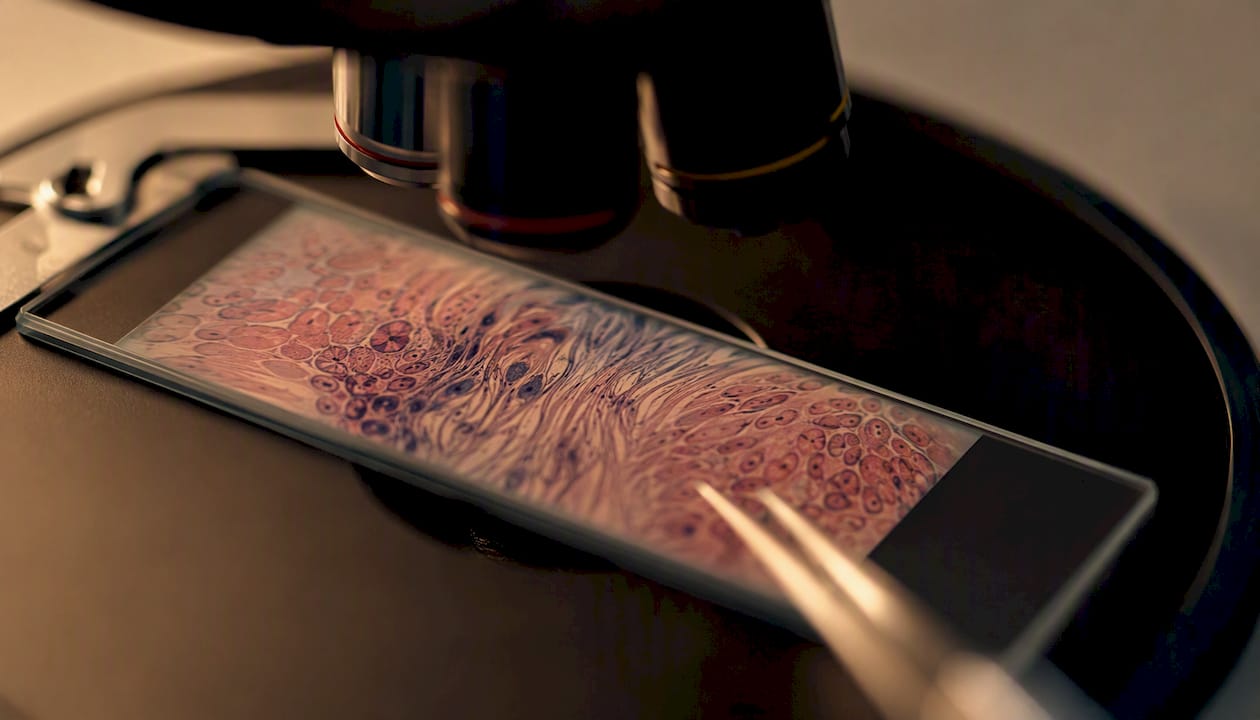
Senescent skin cells stop repairing tissue and secrete SASP (senescence-associated secretory phenotype) factors that promote inflammation and ECM breakdown. That is the core problem regenerative skincare is trying to solve.
The cascade works roughly like this:
- Cellular senescence: Damaged cells arrest permanently (marked by p16 and p21 proteins) instead of dividing or dying cleanly.
- SASP: Those arrested cells release inflammatory cytokines and proteases that degrade surrounding collagen and elastin.
- ROS and oxidative stress: UV radiation and pollution generate reactive oxygen species that activate AP-1 and NF-κB transcription factors, which in turn upregulate MMP enzymes and fragment the ECM.
- Slowed epidermal turnover: Keratinocyte renewal slows, leaving older, less functional cells at the surface longer.
Pro Tip: Ingredients that prime NRF2 (the cell’s main antioxidant regulator), restore ATP, or engage PI3K–Akt and TGF-β signaling are targeting the repair machinery itself — not just the surface symptom. That is the distinction worth looking for on an ingredient list.
How clinicians and studies measure cellular skin aging
Researchers use a layered set of tools to confirm that a product is actually changing skin at the cellular level, not just improving surface appearance temporarily.
- Molecular biomarkers: p16 and p21 protein expression (senescence load), SA-β-galactosidase activity, and MMP levels in biopsy or ex vivo tissue confirm cellular change.
- Imaging: 3D surface imaging quantifies wrinkle depth and volume; high-frequency ultrasound measures dermal thickness. Both are used in PDRN/PN clinical trials to document structural improvement.
- Clinical scales: The Global Aesthetic Improvement Scale (GAIS) and standardized wrinkle-grading systems give clinicians a reproducible way to track visible change across time points.
- Histology: Collagen density and elastin fiber organization in skin biopsies remain the most direct proof of ECM repair.
For consumers, standardized photography in consistent lighting is the most practical tracking tool. It is lower confidence than clinical imaging, but it catches real change over 8–12 weeks if you are consistent.
The Frontiers in Physiology review links p16-positive cell accumulation in aged skin directly to wrinkle formation and ECM changes — which is why senescent-cell burden is increasingly used as a primary endpoint in aging research, not just a secondary marker.
What actually works: topical actives and in-office options
The most evidence-backed topical actives for cellular-level skin repair are peptides (particularly Pal-KTTKS and GHK variants), polynucleotides and PDRN, retinoids, tranexamic acid, targeted antioxidants, and niacinamide. In-office, microneedling, energy devices, and polynucleotide injections have the strongest mechanistic and clinical support.
How each targets the cellular problem:
- Peptides (Pal-KTTKS, GHK, RGD-GHK): Signal fibroblasts to produce collagen and reduce MMP-1 expression. Chimeric peptides like RGD-GHK showed improved collagen retention and antioxidant activity in preclinical models. Peptide combinations synergistically activate NRF2 and restore ATP — single-peptide formulas are less effective than well-designed blends. See Cellure’s breakdown of best peptides for skin repair for evidence-ranked options.
- PDRN / polynucleotides: Topical PDRN engages PI3K–Akt and TGF-β/Smad signaling, increasing multiple collagen subtypes and elastin in UV-damaged skin. A split-face clinical study showed earlier improvement versus retinol. In-office PN injections require physician oversight and produce faster structural results.
- Retinoids: Strong evidence for increasing epidermal turnover and collagen synthesis; tolerability is the main limitation. Retinoid irritation is real — start low, use at night, and do not layer with strong acids.
- Tranexamic acid: Addresses oxidative-stress-driven hyperpigmentation by interrupting melanin transfer. Pairs well with barrier-repair actives.
- Antioxidants (vitamin C, resveratrol, niacinamide): Reduce ROS load and downstream MMP induction. Botanical antioxidant approaches, such as reishi and pomegranate found in natural firming serums, represent one formulation direction in the broader market.
- In-office polynucleotide injections: Clinically meaningful ECM improvement, but require a trained physician. For a comparison of injectable regenerative options, this clinician-facing overview covers the landscape well.
Pro Tip: Formulation synergy matters more than any single star ingredient. A peptide blend that restores ATP and primes NRF2 alongside a PDRN-like active and a targeted antioxidant covers more of the cellular failure cascade than a high-concentration single active.
How to evaluate a serum or repair kit that promises cellular benefits
Before buying, run through this checklist:
- Named actives with supported concentrations: The ingredient list should name specific peptides (e.g., Pal-KTTKS, GHK-Cu), PDRN or polynucleotides, and antioxidants — not just “peptide complex.”
- Peer-reviewed or clinical backing: Ask which published studies support the formula. Mechanism studies and clinical endpoints (GAIS, 3D imaging, collagen histology) carry more weight than consumer surveys.
- Delivery system: Penetration matters. Peptides and PDRN need a delivery strategy to reach the dermis. Check for encapsulation, carrier systems, or formulation notes. Cellure’s peptide technology overview explains what to look for.
- Patch-test guidance: Any reputable kit includes clear patch-test instructions. If it does not, that is a red flag.
- Sensitive-skin safety data: Look for fragrance-free, tested-on-sensitive-skin claims backed by actual tolerability data, not just marketing language.
Red flags: vague “cellular renewal” language with no ingredient list; single-study claims from a company-funded trial with no independent replication; no patch-test advice; hidden low-concentration actives buried at the bottom of a long INCI list.
How long until you see results
Minor texture and hydration changes can appear within 2–4 weeks. Measurable ECM or wrinkle improvements from topical regimens typically take 8–24 weeks. In-office procedures can show earlier structural signals, but full remodeling takes months regardless of method.
| Timeframe | What you may notice | What to track |
|---|---|---|
| Weeks 2–4 | Improved hydration, smoother texture | Skin feel, pore appearance |
| Weeks 4–12 | Reduced fine lines, more even tone | Standardized photos, firmness |
| Months 3–6 | Measurable ECM improvement, volume | Clinical imaging or dermatologist assessment |
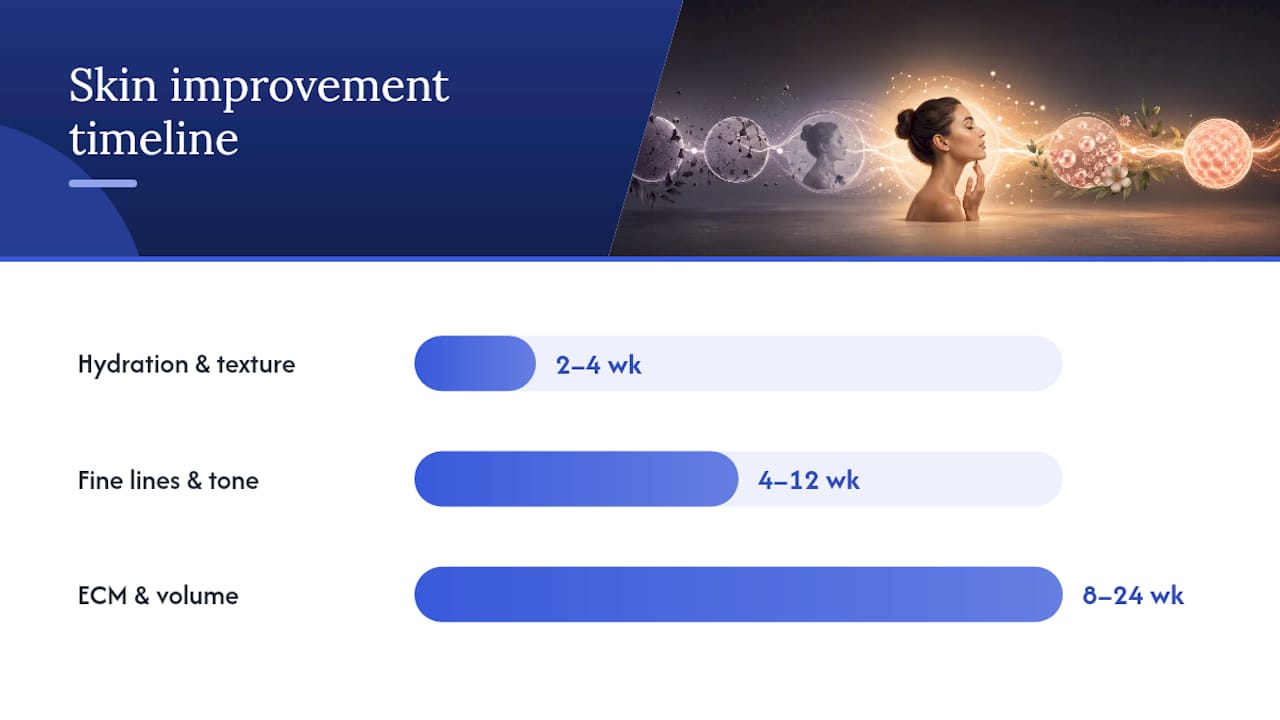
Progress slows with high UV exposure, smoking, poor sleep, and inconsistent use. Sun protection is not optional — it is the single factor most likely to undo topical repair between applications.
Safety, contraindications, patch-test guidance, and when to see a dermatologist
- Patch-test every new active: Apply a small amount to the inner arm for 48 hours before full-face use. Redness, itching, or swelling means stop.
- Layering cautions: Do not combine retinoids with high-concentration vitamin C or strong exfoliating acids in the same application. Irritation compounds quickly.
- Irritation vs. allergic reaction: Mild tingling that fades is often irritation. Hives, persistent swelling, or spreading redness suggest an allergic response — stop use and consult a clinician.
- When to stop and see a dermatologist: Persistent inflammation after 72 hours, worsening texture, any suspect lesion (changing mole, non-healing spot), or if you are considering in-office polynucleotide or PDRN injections. Those procedures require physician oversight — not an esthetician.
Pro Tip: Pregnant or nursing? Skip retinoids entirely and confirm any active with your OB or dermatologist before use. Many peptides and hyaluronic acid are considered low-risk, but physician clearance is the only safe standard here.
Special populations — those on immunosuppressants or with active inflammatory skin conditions — should get dermatologist clearance before starting any repair kit, regardless of how gentle the formula claims to be.
An editorial perspective on what the evidence actually demands
The skincare market is full of products that use “cellular” as a marketing adjective rather than a mechanistic claim. After reviewing the peer-reviewed literature on senescence, SASP, and ECM repair, one thing stands out: the gap between what sounds cellular and what actually targets cellular dysfunction is wide.
A product that lists “peptide complex” without naming which peptides, at what concentration, and with what delivery rationale is not making a cellular claim — it is making a surface claim dressed in scientific language. The research on peptide synergy is clear that formulation design matters as much as ingredient selection. A single peptide at a low concentration does not activate NRF2 or restore ATP the way a well-designed blend does.
The same logic applies to PDRN. The mechanistic evidence for PI3K–Akt and TGF-β engagement is genuinely compelling, but it depends on molecular weight and concentration. “Polynucleotide” on a label tells you almost nothing without those details.
Cellure’s mission is to use clinically supported actives at meaningful concentrations, with formulation rationale that maps to the cellular mechanisms described in peer-reviewed research. If you want to go deeper on ingredient evidence before buying, the bioactive ingredients guide is a good starting point, or reach out to a skincare advisor directly.
Cellure’s Complete Skin Repair Kit: a ready option for cellular-level repair
Readers who want a turnkey option built around the criteria in this article should look at the Cellure Complete Skin Repair Kit. The kit combines named peptides (including GHK variants), a PDRN-like active targeting PI3K–Akt and TGF-β pathways, a targeted antioxidant, and SPF protection — covering the four main cellular failure points this article describes: ECM loss, oxidative stress, slowed turnover, and UV-driven damage.
Before you order, review the full ingredient list and suggested use schedule on the product page. Patch-test the kit on your inner arm for 48 hours first, then follow the phased application schedule for at least 8–12 weeks before assessing results. For questions about which products fit your specific skin concerns, Cellure’s team can help you match the kit to your starting point.
Sources
The sources below are the peer-reviewed and authoritative references cited throughout this article. Each supports specific mechanistic, clinical, or consumer-facing claims — use them to verify ingredient rationale, clinical endpoints, and visible-sign descriptions.
- Skin senescence—from basic research to clinical practice - PMC
- Comparison of Polynucleotide and Polydeoxyribonucleotide in Dermatology: Molecular Mechanisms and Clinical Perspectives - PMC
- Skin senescence—from basic research to clinical practice - PMC
- The role of cellular senescence in skin aging and age-related skin pathologies - Frontiers in Physiology
- Age-related changes in the skin - MedlinePlus
Recommended
Share