


Calm Retinol Irritation in 48–72 Hours With PLG, Ceramides, Panthenol
Stop the retinol immediately, strip your routine down to the essentials, and shift into barrier repair mode: a gentle cleanser, a ceramide-rich moisturizer, and daily SPF. If redness is intense, a short course of 1% hydrocortisone can calm the inflammation. Retinol irritation repair works best when you act in the first hours, not after days of pushing through it.
TL;DR:
- A short course of hydrocortisone can reduce intense redness and swelling if skin feels hot or inflamed, but should be limited to three to five days.
- Use only lukewarm water and a fragrance-free, non-foaming cleanser during the initial repair phase to avoid further irritations.
- Incorporate ingredients like ceramides, panthenol, centella extract, acetyl glucosamine, and pentylene glycol in your moisturizer to support barrier repair and minimize irritation.
- Wait at least seven days after symptoms subside before reintroducing retinol at a lower concentration and frequency, gradually increasing over months.
- Severe reactions with blistering, spreading redness, or systemic symptoms require immediate medical attention rather than self-care.
Table of Contents
- The First 48 to 72 Hours: What to Stop, What to Do, What to Expect
- Repairing the Barrier: Which Ingredients Actually Work
- Calming Inflammation and Knowing When to See a Doctor
- How Long Does Retinol Irritation Actually Last?
- How to Restart Retinol Safely After It Irritates You
- Preventing the Next Flare-Up
- Cellure’s Barrier-First Approach to Repair
- The Long Game: Why Patience Beats Persistence With Retinol
- Give Your Skin the Repair Ingredients It’s Asking For
- Sources
- FAQ
The First 48 to 72 Hours: What to Stop, What to Do, What to Expect
The first three days decide whether you’re looking at a few days of pink skin or weeks of flaking, stinging misery. What you do right now matters more than anything you’ll do later.
Retinoid dermatitis is a dose-dependent irritant reaction, meaning the damage scales with how much retinol hit your skin and how fast. It shows up most often in the early weeks of using a new product, which is exactly why beginners get hit hardest. The Cleveland Clinic explains that retinol speeds up cell turnover and can strip the lipid barrier, which raises transepidermal water loss and triggers the inflammatory cascade you’re feeling as burning and tightness.
Here’s the exact sequence to follow:
- Stop all retinoids and active ingredients. No exfoliating acids, no vitamin C, no benzoyl peroxide. Give your skin a complete break from anything that exfoliates or oxidizes.
- Skip hot water and scrubs entirely. Lukewarm water only, and pat dry with a clean towel instead of rubbing.
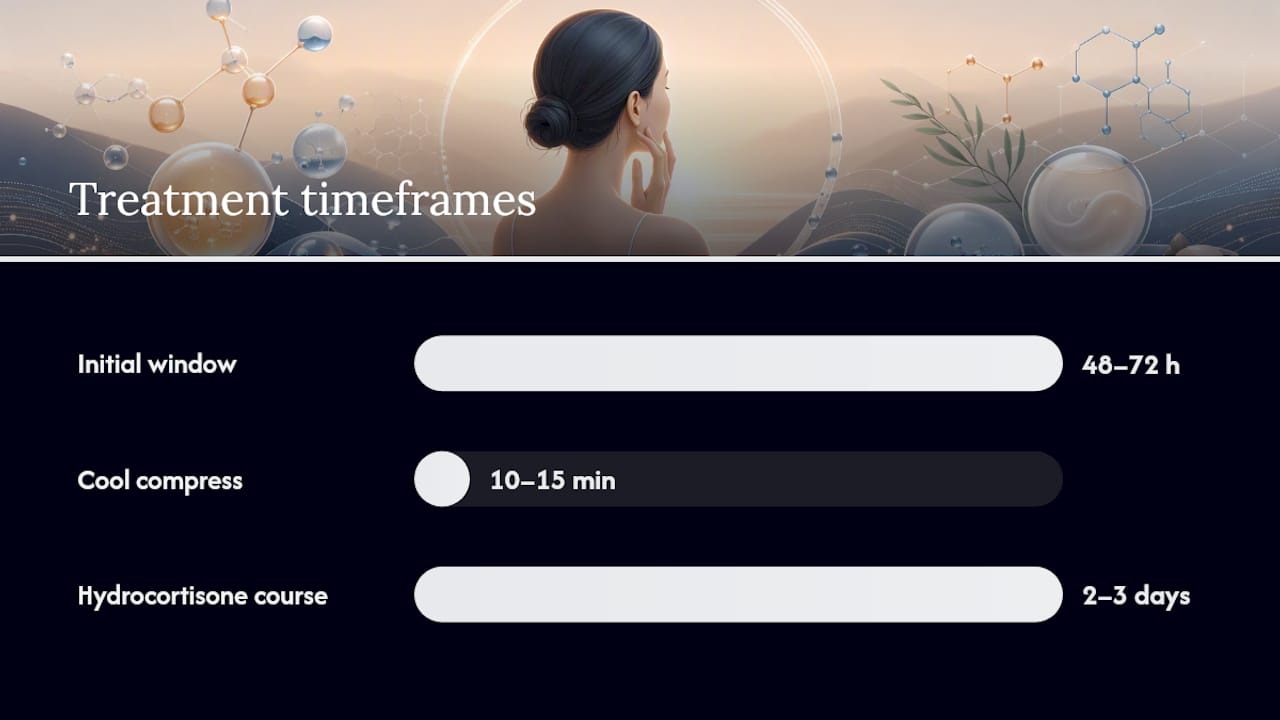
- Apply a cool compress for 10 to 15 minutes if your face feels hot or swollen. A clean, damp washcloth from the fridge works fine.
- Cleanse minimally, once at night if needed, with a fragrance-free, non-foaming cleanser. Some mornings you can skip cleansing altogether and just rinse with water.
- Layer on a bland, ceramide-based moisturizer while skin is still slightly damp to lock in hydration.
- Skip makeup for a day or two if your skin is weeping or flaking, since pigments and preservatives will sting compromised skin.
- Sleep on a clean pillowcase and change it more often than usual. Bacteria and residual product buildup only slow healing.
Clinical guidance on retinol burn recovery consistently points to the same short list: pause the retinoid, simplify everything else, and let the skin’s own repair mechanisms take over before reintroducing anything active, according to Ubie’s Doctor’s Note.
Pro Tip: Keep your moisturizer in the fridge for the first 48 hours. The cold application does double duty, calming inflammation while it hydrates, and it feels genuinely better than room-temperature cream on hot, tender skin.
If swelling is significant or the burning feels disproportionate to typical dryness, a short course of over-the-counter 1% hydrocortisone applied once daily for two to three days can take the edge off. Anything beyond that timeframe, or any sign of the reaction worsening, is a signal to call a dermatologist rather than wait it out.
Repairing the Barrier: Which Ingredients Actually Work
Not every “soothing” ingredient earns its reputation. A randomized, double-blind patch test on retinol-induced irritation put several common actives head-to-head, and the results were specific enough to actually change how you shop for a moisturizer.
The study tested 0.1% retinol combined with six candidate soothing agents over five days and measured irritation directly on skin. The combination of retinol with 2% PLG (pentylene glycol) posted the lowest mean cumulative irritation index at 0.26, edging out ceramides, acetyl glucosamine, panthenol, TECA (a Centella asiatica extract), and Centella asiatica itself, though several of those combinations also showed a real reduction in irritation compared to a plain vehicle formula, according to the peer-reviewed patch test.
What the data shows: Among six soothing agents tested against 0.1% retinol, 2% PLG produced the lowest irritation score (MCII = 0.26), with ceramides, panthenol, acetyl glucosamine, and Centella-derived TECA also outperforming plain vehicle in reducing retinol-induced irritation.
That ranking gives you a real shopping list. Look for products that combine several of these actives rather than relying on one:
- Ceramides (ideally paired with cholesterol and fatty acids, since a full lipid mix restores barrier function far better than any single lipid alone)
- Panthenol (pro-vitamin B5, a reliable anti-inflammatory and moisture binder)
- Centella asiatica extract or TECA (calms redness and supports collagen-linked repair)
- Acetyl glucosamine (supports skin renewal without the exfoliating bite of retinol)
- PLG or pentylene glycol (a humectant with anti-irritant properties, the top performer in the patch test)
A basic two-week repair routine looks like this. In the morning, rinse with water or a gentle cleanser, apply a ceramide and panthenol moisturizer, then finish with a mineral sunscreen since chemical filters can sting on compromised skin. At night, cleanse minimally, apply the same barrier moisturizer, and consider sealing it with a thin layer of petrolatum over the driest patches.
That last step, often called slugging, genuinely speeds re-epithelialization by locking moisture against the skin overnight. It’s also worth a caution: petrolatum is heavily occlusive, and if you’re prone to fungal acne or clogged pores, nightly slugging over the whole face can backfire. Reserve it for cheeks and dry patches rather than the T-zone if breakouts are a concern, a trade-off dermatology guidance on retinol burn recovery flags directly.
Read ingredient labels for a full lipid mix rather than a single “ceramide” listed alone. Formulas built on ceramides plus cholesterol plus fatty acids restore the skin barrier more completely than a product leaning on one lipid type, which is the same physiologic ratio your skin naturally uses to hold water in.
Calming Inflammation and Knowing When to See a Doctor
Hydrocortisone is a legitimate short-term tool, but it’s not something to reach for indefinitely. Used correctly, 1% OTC hydrocortisone calms the redness and swelling of a genuine irritant reaction within a few days.
Apply a thin layer once or twice daily for no more than three to five days. Avoid the eyelids and the skin immediately around the eyes and mouth, where the skin is thinner and absorbs more product. Longer courses of topical steroids risk thinning the skin further, which only sets you up for more irritation the next time you introduce an active ingredient.
Some situations move past what home care can fix. Watch for these signs that mean it’s time to call a dermatologist rather than wait another day:
- Blistering or fluid-filled bumps anywhere on the treated area
- Swelling severe enough to change the shape of your face, especially around the eyes
- Redness or heat that spreads beyond where you applied the product
- Fever, chills, or any sign the reaction is becoming systemic
- Oozing, yellow crusting, or a smell that suggests infection
- Pain that feels disproportionate to what you’d expect from dryness or flaking
Any of these point toward something beyond typical retinoid dermatitis, possibly a secondary infection or an allergic contact reaction that needs prescription treatment or a formal patch test to identify the trigger.
Pro Tip: Take a photo of the irritation on day one. If you do need to see a dermatologist, having a visual timeline of how it progressed (or didn’t) makes diagnosis faster and more accurate than trying to describe it from memory a week later.
Clinicians reserve prescription-strength steroids or oral antibiotics for cases that cross into infection or severe, complicated reactions. The short OTC hydrocortisone route only fits mild-to-moderate cases where the skin is intact and simply inflamed.
How Long Does Retinol Irritation Actually Last?
Recovery time tracks directly with how bad the damage got, which is why severity-stratified care (matching your response to the actual severity of the reaction) is the consensus approach among dermatology reviews on retinoid dermatitis.
| Severity | Typical timeline | What you’ll notice improving |
|---|---|---|
| Mild (pink, slightly dry, mild stinging) | 3 to 7 days | Stinging fades first, then flaking decreases |
| Moderate (visible redness, peeling, tight feeling) | 1 to 4 weeks | Redness drops in patches, texture smooths gradually |
| Severe (swelling, weeping, blistering) | Several weeks, often needs prescription care | Requires clinician-guided treatment before self-care resumes |
Improvement should be steady, not dramatic overnight. Look for less stinging when you apply moisturizer, a gradual drop in visible redness, and flaking that slows down rather than stopping abruptly. If a full week passes with zero change, or the skin actually looks worse, that’s your signal to stop self-treating and get it checked, according to consumer health guidance on retinol burn recovery timelines.
How to Restart Retinol Safely After It Irritates You
Rushing back to retinol is the single most common reason people end up in this cycle repeatedly. Wait until your skin has been completely symptom-free, no redness, no flaking, no tightness, for at least seven full days before you even think about reintroducing it.
When you do restart, treat it like you’re using retinol for the first time, regardless of how long you’d been using it before the flare-up:
- Drop the concentration. If you were using 0.5%, go back to 0.25% or even 0.1%.
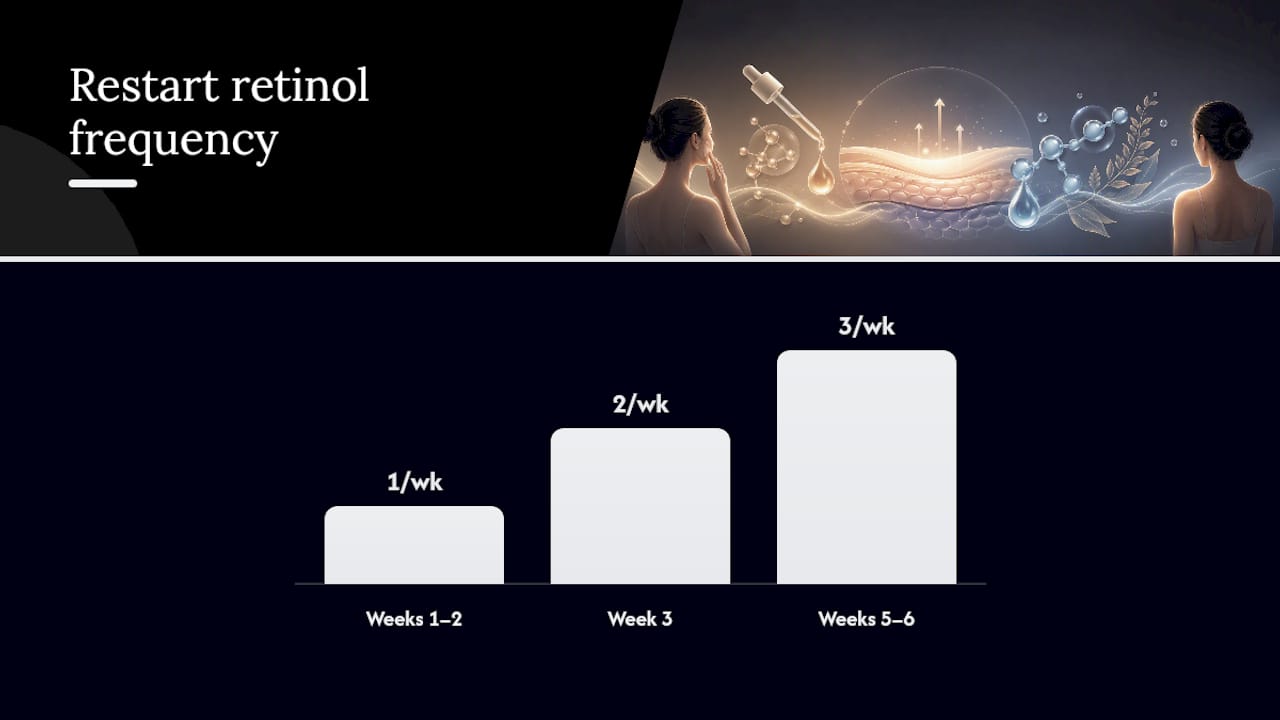
- Cut frequency to once a week. Not every other night, once a week, for the first two weeks.
- Apply the buffering method: moisturize first, wait five minutes, then apply a thin layer of retinol over the moisturized skin. This blunts the initial absorption without eliminating the benefit.
- Increase to twice weekly in week three if there’s zero irritation.
- Add a third weekly application around week five or six, watching closely for any return of stinging or flaking.
- Only move to alternate-night use somewhere between week eight and week twelve, and only if your skin has tolerated every previous step cleanly.
A few tools make this restart smoother. The sandwich method, moisturizer, then retinol, then a second layer of moisturizer, gives even more buffering than standard application and works well for genuinely reactive skin. If retinol itself keeps triggering flares even at low frequency, retinaldehyde is worth considering as an alternative. It converts to retinoic acid one step closer than retinol does, which some people tolerate better while still getting comparable renewal benefits.
Peptide serums and targeted reparative formulas can run alongside this restart phase, supporting collagen signaling and hydration without adding exfoliating stress on top of the retinol you’re carefully reintroducing.
Preventing the Next Flare-Up
The goal isn’t to fear retinol forever, it’s to build habits that let you use it without landing back in recovery mode every few months.
- Patch test any new retinol product on your inner forearm for three consecutive nights before applying it to your face.
- Watch for delayed reactions, since some irritation shows up 48 to 72 hours after application rather than immediately.
- Ramp up frequency slowly even with a product you’ve used before, especially after any break longer than two weeks.
- Pair retinol with barrier-supporting ingredients on the same nights rather than layering multiple actives.
- Wear mineral or well-tolerated sunscreen every single day, since retinol-treated skin sunburns more easily and sun damage compounds any existing irritation.
- Talk to a dermatologist before combining retinol with other actives like exfoliating acids or benzoyl peroxide, since stacking actives is one of the most common causes of unexpected burns.
Consistency beats intensity here. Skin that tolerates retinol well long-term is almost always skin that was introduced to it slowly, not skin that happened to get lucky.
Cellure’s Barrier-First Approach to Repair
Cellure built its 48 to 72 hour barrier plan around the same principle running through this whole guide: calm first, repair second, restart only when the skin is ready. The plan maps specific steps to specific ingredient categories rather than leaving readers to guess what “gentle” actually means.
The approach breaks down into a few core moves:
- Immediate cooling and simplification in the first 24 hours, mirroring the cool compress and stripped-down routine covered above
- Lipid replenishment using a full ceramide, cholesterol, and fatty acid mix rather than a single isolated ingredient
- Ingredient-level education, detailed in Cellure’s guide to barrier-repairing ingredients, so readers understand what they’re applying and why
- A clear handoff point where readers experiencing blistering, spreading redness, or fever are directed to a clinician rather than pushed toward more products
Severe cases always warrant a real conversation with a dermatologist. Cellure’s content exists to fill the gap between “I stopped retinol” and “I know exactly what to put on my face tonight,” not to replace medical care when a reaction has moved past what topical repair can handle.
The Long Game: Why Patience Beats Persistence With Retinol
Most people treat a retinol flare-up like a setback to push through instead of a signal to slow down, and that’s exactly backward. Retinol’s real value shows up over months of consistent, tolerated use, not from a week of aggressive daily application that burns you out of the routine entirely.
The evidence on soothing ingredients matters because it gives you a repair strategy instead of vague reassurance that “it’ll heal.” But the bigger shift is behavioral: build barrier support into your routine permanently, not just when things go wrong. Skin that’s well hydrated and lipid-rich tolerates retinol at higher frequencies with fewer flares, which means the repair habits in this guide aren’t a one-time fix. They’re the foundation that makes retinol worth using at all.
— Sara
Give Your Skin the Repair Ingredients It’s Asking For
Recovering from retinol irritation is really about giving your skin what the science says works: peptides for structural support, tranexamic acid for calming uneven tone, and hydrating actives that rebuild what retinol temporarily strips away. Cellure formulates around that exact logic, targeted serums built with clinically supported bioactive ingredients rather than a single trendy compound.
The Peptide Hydro Lift Serum, Tranexamic Acid Peptide Serum, and Volufiline Serum each address a different piece of the repair equation, hydration, tone, and firmness, so you can rebuild your barrier with the same intention you’ll eventually bring back to retinol. Each is available as a one-off purchase; check the pricing page for current details if you’d rather try one first. Once your skin has been calm and flake-free for a full week, consider starting with a single serum that matches your most stubborn concern rather than jumping straight back into retinol at full strength. Browse the full best-sellers collection to find the formula that fits where your skin is right now.
Sources
The ingredient rankings referenced throughout this article come from a randomized, double-blind patch test on soothing agents measuring retinol-induced irritation directly on skin. Severity-stratified management guidance draws from a clinical review of retinoid dermatitis and retinization, while practical red-flag and hydrocortisone guidance comes from Ubie’s Doctor’s Note and consumer health reporting from Healthline. Mechanistic background on how retinol affects the skin barrier comes from the Cleveland Clinic.
This article is general information, not a substitute for advice from a qualified doctor. Consult a qualified healthcare professional about your own circumstances before acting on anything here.
- Evaluating the Efficacy of Soothing Agents in Mitigating 0.1% Retinol‐Induced Skin Irritation: A Patch Test
- Retinoid dermatitis and retinization: from retinoid structure to tolerability profile and management strategies
- Retinol Burn? Why Your Skin Is Peeling & Medical Next Steps | Ubie Doctor’s Note
- Retinol burn: Symptoms, causes, treatment, and prevention | Healthline
FAQ
How Do You Heal Skin Irritated by Retinol?
Stop using retinol and any other active ingredients immediately, then switch to a minimal routine built around a ceramide-rich moisturizer, cool compresses, and daily SPF. A patch test on soothing ingredients found that combinations of PLG, ceramides, and panthenol reduced retinol-induced irritation most effectively, so look for products listing several of these actives together.
How Long Does Retinol Irritation Take to Heal?
Mild irritation typically clears in 3 to 7 days, while moderate reactions with visible peeling can take 1 to 4 weeks to fully resolve. Severe cases involving swelling or blistering often need prescription care and a longer recovery window, according to guidance on retinol burn timelines.
What Does Retinol Dermatitis Look Like?
Retinol dermatitis typically shows up as redness, dryness, flaking, and a tight, stinging sensation, sometimes progressing to visible peeling or, in severe cases, swelling and blistering. It’s distinct from normal “purging” because it involves genuine barrier damage and inflammation rather than just temporary breakouts as skin adjusts, a distinction covered in reviews of retinoid dermatitis.
How Do You Fix Skin After Retinol Damage Gets Severe?
Severe cases need barrier-focused repair with a full lipid mix (ceramides, cholesterol, fatty acids) plus a short course of 1% hydrocortisone for inflammation, alongside strict avoidance of acids, vitamin C, and fragrance until healed. Any blistering, spreading redness, or fever means it’s time to see a dermatologist rather than continue self-treating.
Is Cellure Suitable for Skin Recovering From Retinol Irritation?
Yes, Cellure’s serums are formulated with bioactive ingredients like peptides and tranexamic acid designed for gentle, results-driven repair, making them a reasonable option once your skin is calm and flake-free. Start with a single serum matched to your main concern before reintroducing retinol, rather than layering multiple new actives at once.