


What Is Cosmeceutical Skincare? Your 2026 Guide
TL;DR:
- Cosmeceuticals are skincare products containing bioactive ingredients that influence skin biology but lack regulatory recognition as a distinct category. They sit between cosmetics and pharmaceuticals, offering potential benefits based on ingredient science, but their efficacy varies and is often not independently verified. Consumers should focus on ingredient transparency, scientific evidence, and targeted concerns to make informed choices about their skincare routine.
If you’ve spent any time reading skincare labels, you’ve probably noticed the word “cosmeceutical” appearing on products that promise everything from collagen rebuilding to pigmentation reversal. The term sounds medical, credible, and precise. But what is cosmeceutical skincare, really? The honest answer is more nuanced than most brands let on. Cosmeceuticals occupy a fascinating space between everyday beauty products and prescription treatments, and understanding that space will completely change how you read ingredient lists, evaluate product claims, and spend your money.
Table of Contents
- Key takeaways
- What is cosmeceutical skincare? Definition and regulatory reality
- How cosmeceutical products work: ingredient science explained
- Cosmeceutical vs. cosmetic vs. pharmaceutical
- Benefits and limitations of cosmeceutical skincare
- Building an effective cosmeceutical routine
- My perspective on cosmeceuticals and what they actually mean for your skin
- Explore Cellure’s science-backed skincare range
- FAQ
Key takeaways
| Point | Details |
|---|---|
| Not a legal category | “Cosmeceutical” has no regulatory definition in the US; products are classified as cosmetics or drugs. |
| Coined in 1984 | Dr. Albert Kligman introduced the term to describe products with therapeutic-like skin benefits. |
| Bioactive ingredients matter | Peptides, antioxidants, and marine extracts are the science behind cosmeceutical claims. |
| Claims vs. evidence | Not all cosmeceutical products are equally backed by clinical data; ingredient quality varies widely. |
| Informed selection wins | Focusing on specific, studied ingredients beats chasing marketing labels. |
What is cosmeceutical skincare? Definition and regulatory reality
The word “cosmeceutical” is a blend of “cosmetic” and “pharmaceutical,” and that hybrid identity tells you almost everything. Dr. Albert Kligman coined the term in 1984 to describe topical products that perform beyond traditional cosmetics by influencing skin biology, but without crossing into prescription drug territory.
Here is the regulatory reality most brands would rather you didn’t know: the FDA does not recognize “cosmeceutical” as a legal product category. Under the Federal Food, Drug, and Cosmetic Act, products are classified as cosmetics, drugs, or both based entirely on their intended use, not their ingredient list. A moisturizer that claims to “hydrate skin” is a cosmetic. A product that claims to “stimulate collagen synthesis” or “treat acne” starts moving into drug territory.
This creates a genuine gray area. Dermatologists recognize that “cosmeceutical” reflects a marketing and clinical concept rather than a scientific or legal distinction. The term describes a formulation philosophy: products built around bioactive ingredients that act on skin physiology in measurable ways, even if they are sold and regulated as cosmetics.
What this means for you as a consumer:
- A product labeled “cosmeceutical” carries no guaranteed standard of efficacy or safety testing beyond standard cosmetic requirements.
- Marketing claims that imply drug-like effects without FDA drug approval are legally problematic, and the FDA has issued warning letters to companies crossing that line.
- The term is most useful as a signal of ingredient ambition, not as a regulatory guarantee.
“The terms ‘cosmetic,’ ‘dermocosmetic,’ and ‘cosmeceutical’ reflect marketing and formulation gradients rather than distinct scientific or legal categories.” — Clinical dermatology research
Understanding this distinction does not make cosmeceutical products less valuable. It makes you a smarter buyer.
How cosmeceutical products work: ingredient science explained
The real story of cosmeceuticals is told through their ingredients. Unlike traditional cosmetics, which primarily sit on the skin’s surface to hydrate, color, or perfume, cosmeceutical formulations are built around bioactive compounds that interact with living skin tissue.

A 2025 PMC review identified peptides, biotics, and marine biopolymers as leading bioactive categories driving anti-aging results. Here is how the most studied ingredient classes actually function:
Peptides are short chains of amino acids that act as biological messengers. Peptides stimulate fibroblast proliferation and collagen synthesis, which translates to firmer, more elastic skin over time. They also support the skin barrier and can reduce uneven pigmentation. The science on peptides for skin in 2026 is among the most credible in the entire cosmeceutical field.
Antioxidants like vitamin C, vitamin E, niacinamide, and resveratrol neutralize free radicals generated by UV exposure, pollution, and metabolic processes. Free radical damage accelerates collagen degradation and melanin dysregulation, so antioxidant protection is genuinely preventive, not just cosmetic.
Alpha hydroxy acids (AHAs) such as glycolic acid and lactic acid accelerate cellular turnover by loosening the bonds between dead skin cells. The practical result is brighter skin tone, reduced appearance of fine lines, and improved texture over consistent use.
Marine extracts and biopolymers are a newer and rapidly growing area. Compounds derived from algae, sea kelp, and marine peptides offer hydration, antioxidant activity, and structural support for the skin matrix.
Vitamins A derivatives (retinoids) are among the most clinically validated bioactive ingredients in existence. Topical retinol increases cell turnover and stimulates collagen, with decades of peer-reviewed research supporting those effects.
Pro Tip: When evaluating any cosmeceutical product, look for bioactive ingredients listed in the first five positions of the ingredient list. Ingredients listed near the bottom are typically present in concentrations too low to produce meaningful biological effects.
Cosmeceutical vs. cosmetic vs. pharmaceutical
The spectrum from lipstick to prescription tretinoin covers a lot of ground. Knowing where cosmeceuticals sit helps you set realistic expectations.
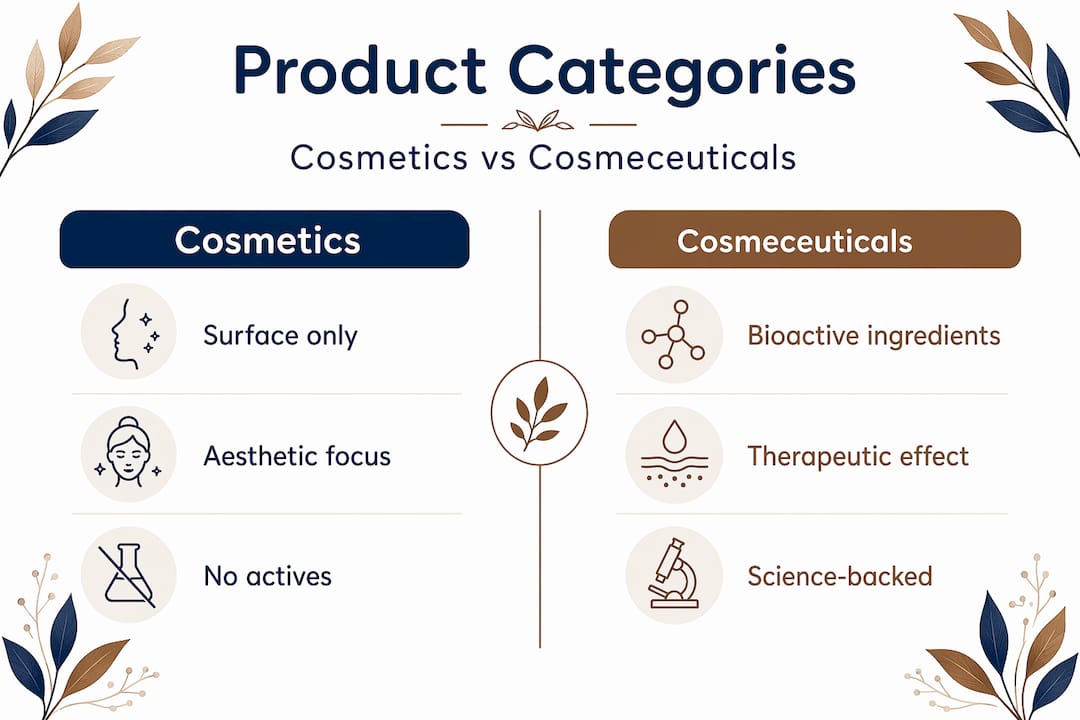
| Feature | Cosmetics | Cosmeceuticals | Pharmaceuticals |
|---|---|---|---|
| Primary purpose | Enhance appearance | Improve skin function and appearance | Treat diagnosed conditions |
| Key ingredients | Fragrance, color, basic moisturizers | Bioactive peptides, AHAs, antioxidants, vitamins | Active drug compounds (e.g., tretinoin, hydroquinone) |
| Regulatory status | FDA-regulated as cosmetics | No legal category; sold as cosmetics | FDA-approved drugs, prescription or OTC |
| Clinical evidence required | Minimal | Variable; often company-funded studies | Rigorous clinical trials required |
| Skin penetration depth | Surface or near-surface | Epidermis to upper dermis | Varies; can reach deeper skin layers |
| Example products | Foundation, basic moisturizer | Peptide serum, AHA exfoliant, vitamin C treatment | Tretinoin cream, prescription hydroquinone |
Research in aesthetic medicine confirms that these categories represent a gradient of formulation intent, not hard boundaries. A well-formulated cosmeceutical serum may genuinely outperform a poorly formulated one within the same category.
The practical takeaway: cosmeceuticals occupy the most interesting and most contested part of this spectrum. They promise more than a standard moisturizer and require no prescription, but they also carry less regulatory oversight than drugs. That freedom is both their appeal and their risk. You can access powerful bioactive ingredients for aging skin without a doctor’s visit. But you also carry the responsibility of evaluating the evidence yourself.
Benefits and limitations of cosmeceutical skincare
The cosmeceutical market is one of the fastest-growing skincare segments, driven by consumers who want results beyond basic cleansing and moisturizing. That demand is legitimate. The cosmeceutical skincare benefits, when products are well-formulated, are real and measurable.
Here is what the evidence genuinely supports:
- Anti-aging and skin rejuvenation. Consistent use of peptide-based and retinoid-containing products produces visible improvements in fine lines, skin firmness, and overall texture. These are not overnight changes; most studies measure outcomes over 8 to 12 weeks minimum.
- Brightening and pigmentation control. Vitamin C, niacinamide, azelaic acid, and tranexamic acid all have credible research supporting their role in reducing hyperpigmentation and uneven tone.
- Barrier reinforcement. Ingredients like ceramides, hyaluronic acid, and certain peptides strengthen the skin barrier, reducing sensitivity and improving moisture retention.
- Acne management. Formulations containing salicylic acid, zinc, and niacinamide address sebum regulation, pore congestion, and inflammation through mechanisms that go beyond surface cleansing.
- Photoprotective effects. Antioxidant-rich cosmeceutical products genuinely complement SPF protection by neutralizing free radicals that physical sunscreens cannot block.
The limitations deserve equal attention. The therapeutic benefits attributed to cosmeceuticals are often described in pharmaceutical-like terms but typically lack the rigorous, independent clinical validation required of approved drugs. Many studies are small, short, or funded by the brands themselves.
Pro Tip: Search for the active ingredient name combined with “randomized controlled trial” or “systematic review” in PubMed, not just the product name. Ingredient-level evidence is more reliable than brand-sponsored product studies.
Formulation quality also matters enormously. A vitamin C serum at pH 4 will behave completely differently than one at pH 7, even with the same ingredient concentration. The science of delivery and stability is part of what separates genuinely effective cosmeceutical products from expensive water.
Building an effective cosmeceutical routine
Getting the most from cosmeceutical products comes down to a few straightforward principles. None of them require a dermatology degree.
- Identify your primary concern first. Anti-aging, brightening, barrier repair, and acne control each call for different bioactive ingredients. Choosing products without a target concern often leads to a cluttered routine with conflicting actives.
- Start with one active at a time. Introducing multiple new ingredients simultaneously makes it impossible to identify what is working and what is causing irritation. Give each new addition at least three weeks before adding another.
- Always patch test. Apply a small amount of any new product to your inner forearm for three to five consecutive days before applying it to your face. This is especially important with AHAs, retinoids, and vitamin C derivatives.
- Respect the order. Apply cosmeceutical actives before heavier moisturizers and always finish with SPF in the morning. Actives applied under occlusion penetrate more effectively, and sunscreen protects the cellular-level work your products are doing overnight.
- Consistency beats intensity. A moderate retinol used every night will produce better results over three months than a high-strength acid used twice a week with frequent breaks due to irritation.
- Consult a dermatologist when you are managing a diagnosed skin condition, considering prescription-strength actives, or experiencing persistent reactions. Cosmeceuticals are powerful tools, but they work best alongside professional guidance when the stakes are higher.
You can find a useful framework for evaluating bioactive ingredient science before committing to a new product category.
My perspective on cosmeceuticals and what they actually mean for your skin
I’ve watched the cosmeceutical conversation evolve for years, and the most persistent problem is not ingredient science. It is marketing outpacing honesty. Brands discovered that pairing words like “clinically proven” with a peptide concentration of 0.01% moves product, and the regulatory landscape in cosmetics gives them plenty of room to do exactly that.
What I’ve learned from following this space closely is that the term “cosmeceutical” is most useful when brands use it to signal formulation commitment, not just a price point. When a brand openly shares its ingredient concentrations, cites independent research, and avoids drug-claim language, that transparency is a stronger signal of quality than any label.
I’ve also noticed that consumers who understand evidence-backed skincare solutions make fundamentally better purchasing decisions. They ask different questions. Not “Does this product work?” but “What is the evidence for this specific ingredient at this concentration for my specific concern?”
My honest take: the industry needs more of this. And so do you. Skip the category label. Read the ingredient list. Look up the actives. The science is accessible and, when you know what to look for, genuinely fascinating.
— Sara
Explore Cellure’s science-backed skincare range
If you’ve made it this far, you understand that the real value in cosmeceutical skincare lives in the ingredients, not the label. Cellure builds every product around that principle. Formulated with clinically supported bioactive ingredients including peptides, tranexamic acid, and polynucleotides, Cellure’s lineup targets real skin concerns at the cellular level without vague claims or hidden formulas.
The Complete Skin Repair Kit is a strong starting point if you want to address firmness, tone, and overall skin renewal together. Each product in the kit was developed around specific bioactive mechanisms, not trend-driven marketing.
For ingredient-level transparency before you commit, the Cellure ingredients page breaks down exactly what is in each formulation and why it belongs there. No guesswork. No filler. Just the science behind skin that performs.
FAQ
What does “cosmeceutical” actually mean?
Cosmeceutical refers to a topical skincare product formulated with bioactive ingredients intended to produce therapeutic-like effects on skin, such as stimulating collagen or reducing pigmentation. The term blends “cosmetic” and “pharmaceutical” but has no legal definition in the United States.
Are cosmeceuticals regulated differently than regular cosmetics?
No. The FDA does not recognize “cosmeceutical” as a separate legal category, so these products are regulated as cosmetics or drugs based on the claims they make, not the ingredients they contain.
What are the best cosmeceutical ingredients to look for?
Peptides, retinoids, vitamin C, niacinamide, AHAs, and marine extracts are among the most research-supported bioactive ingredients used in cosmeceutical formulations, particularly for anti-aging and skin rejuvenation.
How long does it take to see results from cosmeceutical skincare?
Most clinical studies measuring cosmeceutical efficacy run between 8 and 12 weeks of consistent daily use before assessing results. Visible changes in texture and tone often appear earlier, but collagen-level improvements take longer.
Can I use cosmeceutical products with prescription skincare?
Many cosmeceutical products can be combined with prescription treatments, but specific combinations like retinol alongside prescription tretinoin or multiple acids used simultaneously can cause irritation. Consult a dermatologist before layering potent actives.