


Clinically Supported Skincare: What It Really Means
TL;DR:
- “Clinically supported skincare” is an unregulated phrase that often lacks rigorous scientific backing. Genuine proof requires independent, placebo-controlled studies with objective measurements over sufficient study durations, typically 8-12 weeks. Consumers should seek transparent study data and credible evidence to distinguish marketing claims from proven efficacy.
If you’ve spent any time comparing anti-aging serums, you’ve seen the phrase “clinically supported skincare” on just about every label. The meaning of clinically supported skincare is not what most brands imply. The term is unregulated, which means a company can run a 10-person self-assessment over two weeks and technically call the results “clinical.” For anyone serious about skin rejuvenation and anti-aging, that ambiguity isn’t just frustrating. It’s expensive. This article breaks down what the phrase actually requires, how real evidence is gathered, and how to spot the difference between marketing copy and science you can trust.
Table of Contents
- Key takeaways
- The meaning of clinically supported skincare
- How clinical evidence is actually gathered
- Decoding anti-aging claims: what holds up and what doesn’t
- How to choose clinical skincare with confidence
- Clinically supported vs. cosmetic and luxury skincare
- My take on navigating clinical skincare claims
- How Cellure brings real clinical standards to anti-aging skincare
- FAQ
Key takeaways
| Point | Details |
|---|---|
| “Clinically supported” is unregulated | Any brand can use the phrase without independent testing or minimum study standards. |
| Study design determines trust | Randomized, double-blind, placebo-controlled trials with objective instrumentation are the gold standard. |
| Statistical significance isn’t enough | A result can be statistically significant yet too small to see or feel on your skin. |
| Timeline matters for real results | Credible skin improvements typically require 4 to 12 weeks of consistent product use. |
| Transparency signals credibility | Brands that disclose sample size, study duration, and endpoints are worth your attention. |
The meaning of clinically supported skincare
At its core, “clinically supported skincare” should mean that a product’s performance has been evaluated through structured testing under controlled conditions. The reality is considerably messier.
The phrase “clinically proven” is completely unregulated and routinely misused. True clinical proof requires independent testing, dermatologist supervision, objective instrumentation, statistical significance, and a study duration of at least 84 days. Many brands skip most of those requirements. What they substitute instead is short, self-reported satisfaction surveys where participants answer questions like “does your skin feel smoother?” No measurements. No controls. No independent oversight.
Contrast that with what rigorous clinical backing actually demands. The FTC standard for specific skincare claims requires at least two well-controlled, randomized, double-blind, placebo-controlled human clinical studies. Internal surveys or anecdotal testimonials do not qualify. That standard exists specifically because unqualified claims cause real consumer harm.
Here’s where the regulatory picture gets layered. The FDA draws a sharp line between cosmetic products and drugs. A product that only claims to improve appearance stays in cosmetic territory. The moment a brand claims its formula alters skin structure or function, such as “boosts collagen production” or “repairs skin at the cellular level,” that product enters drug classification and faces a completely different set of approval requirements. Most brands are careful to phrase their marketing just below that threshold.
- “Clinically tested” means the product was tested in some form. It says nothing about the quality, size, or design of the study.
- “Clinically proven” implies a higher standard but carries no regulatory definition.
- “Dermatologist-tested” means at least one dermatologist evaluated it. Whether 1 or 1,000 dermatologists were involved is not specified.
- “Clinically supported” ideally references a body of scientific evidence, though again, there is no mandated minimum.
Pro Tip: Search for the brand’s published study data, not just the claim on the label. If they don’t link to it or won’t provide it, treat the claim as marketing language until proven otherwise.
How clinical evidence is actually gathered
Understanding skincare efficacy requires knowing how researchers collect objective measurements. This is where the gap between real science and brand-funded studies becomes obvious.
Credible studies use validated instrumentation to measure what the skin is actually doing. A Corneometer measures hydration levels through electrical capacitance. A Vapometer tracks transepidermal water loss, which is a direct signal of barrier health. A Cutometer applies gentle suction to measure skin elasticity and firmness. 3D imaging systems like Primos or Antera capture wrinkle depth and surface texture with sub-millimeter precision. None of this relies on how participants feel. It measures what is physically happening to the skin.

| Measurement tool | What it measures | Why it matters |
|---|---|---|
| Corneometer | Skin surface hydration | Quantifies moisture without subjective perception |
| Vapometer | Transepidermal water loss | Assesses barrier integrity objectively |
| Cutometer | Skin elasticity and firmness | Detects structural changes in dermis |
| Primos / Antera 3D | Wrinkle depth and texture | Captures surface changes invisible to the naked eye |
| Spectrophotometer | Skin tone and pigmentation | Tracks brightness and evenness with precision |
Study design matters just as much as the tools. Sample size should be large enough to detect real differences, typically 30 or more participants at minimum, and preferably above 60. Duration should match the biological timeline of skin renewal. And the placebo arm needs real thought. Vehicle arms in dermatology trials are themselves active treatments because the base formula, moisturizers, emollients, and film-formers, can improve hydration and texture on their own. A study that only compares the product to nothing is not measuring what the active ingredient contributes.
Then there is the statistical question that trips up even well-educated consumers. A p-value below 0.05 means the result is statistically significant, but it does not mean the result is meaningful to you. A 1% reduction in wrinkle depth can achieve statistical significance with a large enough sample while being completely invisible on your face. Effect size tells you how large the actual change was. Both numbers matter when you are evaluating whether a product is worth your time.
Pro Tip: When a brand publishes study data, look for the effect size alongside the p-value. A result reported only as “statistically significant” without the magnitude of change is a red flag.
Decoding anti-aging claims: what holds up and what doesn’t
Certain claims in the anti-aging space are better supported by science than others. Knowing which ones require the most scrutiny helps you spend your money on what actually works.
Hydration claims are the most reliable in the category. Water content in the stratum corneum responds quickly and measurably to topical ingredients like hyaluronic acid and glycerin. A 93.7% reduction in facial dryness after four weeks is the kind of specific, instrumented result that carries genuine weight. Barrier repair claims, including those tied to ceramides and niacinamide, also have strong independent support.
The claims that require deeper scrutiny include:
- Collagen synthesis claims. Peptides can signal fibroblasts to produce collagen, but the effect takes time and the concentration must be sufficient. Look for studies using 3D imaging or ultrasound to confirm actual structural change, not just participant ratings.
- Volume restoration claims. Products that promise facial “volumizing” effects topically are walking close to drug territory. What is typically being measured is hydration plumping, which is real but temporary and different from tissue volume.
- “Wrinkle reduction” percentages without context. A claim like “wrinkles reduced by 38%” means nothing without knowing what instrument made the measurement, over what duration, with how many participants, and whether the result was statistically significant with a meaningful effect size.
- Brightening and tone-evening claims. These are generally well-supported for ingredients like tranexamic acid and niacinamide, though study duration should be at least 8 to 12 weeks to demonstrate lasting change beyond surface hydration.
Any claim that includes a specific percentage but provides no link to published data, no sample size, and no mention of the measurement method is almost certainly derived from a self-reported survey. That is the lowest tier of evidence in the field.
How to choose clinical skincare with confidence
Practical guidance for evaluating products cuts through the noise faster than any label claim will.
- Look for the study disclosure. Reputable brands publish or link to their clinical trial data, including sample size, study duration, endpoints measured, and statistical results. If that information is absent, the claim is supported by marketing, not science.
- Ask who conducted the study. Brand-funded studies conducted by the brand’s own researchers carry less weight than independently conducted trials. Academic institutions and third-party contract research organizations provide a layer of objectivity.
- Check the duration against biological reality. Skin cell turnover takes roughly 28 days, and meaningful structural changes to the dermis take longer. Expert consensus in 2026 points to photoprotection, targeted actives, and barrier hydration as the foundation of any effective regimen. A study shorter than six weeks rarely captures meaningful dermal change.
- Prioritize condition-specific evidence. A product with strong evidence for hydration does not automatically have evidence for firmness. Look for studies that tested the specific outcome you care about.
- Commit to consistent use. The science-backed serums that show the best results in clinical literature are almost always tested with once or twice daily application over multiple weeks. Sporadic use produces sporadic results, which is not what the studies measured.
Clinically supported vs. cosmetic and luxury skincare
The differences between these categories are real and have practical consequences for what you can expect from a product.
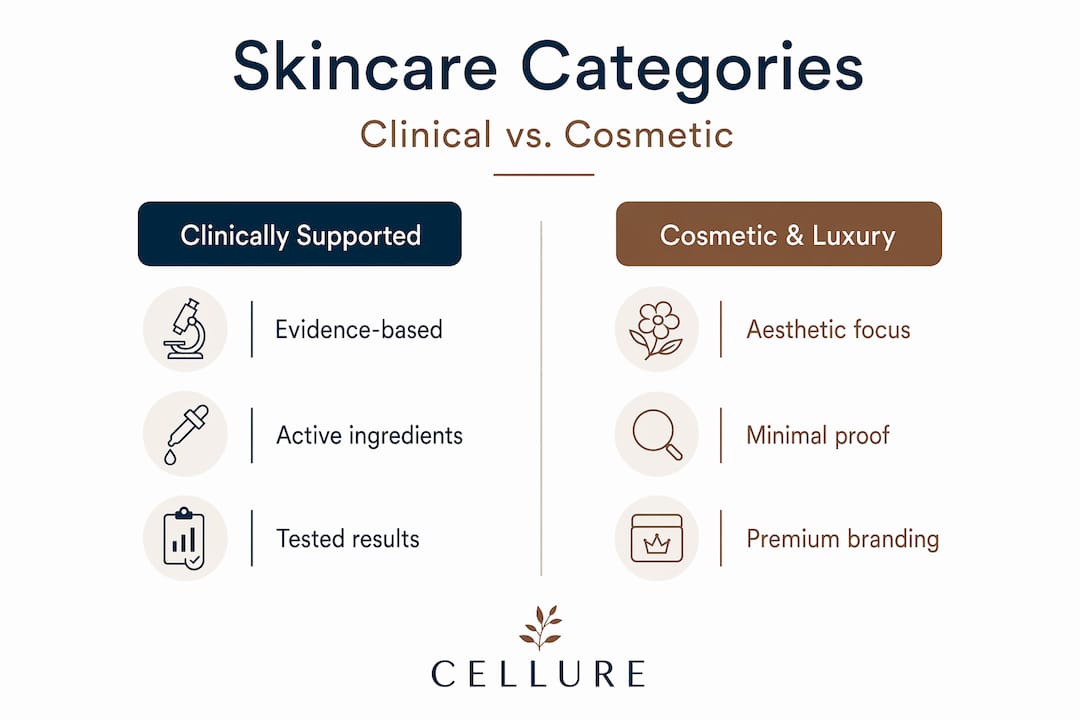
| Category | Regulatory standard | Evidence requirement | Expected results |
|---|---|---|---|
| Clinically supported | High (FTC/FDA scrutiny for specific claims) | Independent trials, objective instrumentation | Predictable, measurable improvements over time |
| Cosmetic / drugstore | Cosmetic safety only | No efficacy evidence required | Variable, often appearance-based benefits |
| Luxury / prestige | Cosmetic safety only | No efficacy evidence required | Texture, sensory experience, minor actives |
Clinically supported products typically contain active ingredients at concentrations that have been studied. Cosmetic and luxury lines can use the same ingredient names but at concentrations too low to produce the effects seen in published research. This is the concentration gap. An ingredient listed on the label does not tell you whether it is present at the 0.1% that creates a nice texture or the 5% that produced results in a trial.
The regulatory gray area to know: skincare products with drug-level claims face FDA approval requirements, while cosmetic-positioned products operate under lighter oversight. This means a brand can market a product with potent actives as a cosmetic as long as its claims stay within cosmetic language. The product might actually work. But without the clinical evidence requirement that comes with drug classification, there is no mandate to prove it.
My take on navigating clinical skincare claims
I’ve spent years reading skincare study disclosures and what strikes me most consistently is how good the marketing has gotten at mimicking science. Brands have learned to use clinical-sounding language, cite p-values in press releases, and reference dermatologist involvement without actually providing the evidence chain that would make those claims meaningful.
What I’ve learned is that longer study durations are almost always the separator. A study that ran for 12 weeks and used 3D imaging to track wrinkle depth tells you something real. A study that ran for four weeks using participant self-assessment tells you how people felt, not what changed. Both can technically be called “clinical.”
The other thing I’ve noticed is that skin individuality gets used as an excuse for weak evidence. “Results may vary” is true. But when a product has been tested on a representative sample with transparent endpoints, variation is accounted for in the statistics. If a brand leans heavily on individual testimonials rather than group-level data, that is not them acknowledging skin individuality. It is them lacking the group-level evidence.
My honest advice: treat clinically supported skincare as a standard you demand proof for, not a phrase you accept at face value. The brands doing the work want to show you their data.
— Sara
How Cellure brings real clinical standards to anti-aging skincare
If you’ve read this far, you now know exactly what to ask for before trusting any brand’s clinical claims. Cellure’s formulations use bioactive ingredients including peptides, tranexamic acid, and polynucleotides at studied concentrations, developed with cellular repair and rejuvenation as the measurable outcome. Every product in the line is built around the evidence quality this article describes: objective instrumentation, meaningful effect sizes, and study durations that match biological skin renewal timelines. The Complete Skin Repair Kit brings together the most evidence-backed actives for firmness, hydration, and tone correction. Explore the full Cellure range and see the clinical rationale behind each formula before you decide.
FAQ
What does “clinically supported skincare” actually mean?
It means a product’s efficacy has been evaluated through structured clinical testing, ideally using objective instrumentation, a control group, and statistically significant results over an adequate study duration. The phrase itself is unregulated, so the quality of the underlying evidence varies widely between brands.
How is “clinically supported” different from “clinically proven”?
Neither term has a legal definition in the cosmetics space, but “clinically proven” implies a higher evidentiary bar. In practice, true clinical proof requires independent, dermatologist-supervised, instrumented studies run over at least 84 days. Most products using either phrase do not meet that standard.
How long does clinically supported skincare take to work?
Credible studies consistently show that meaningful improvements in hydration, texture, and fine lines require 4 to 12 weeks of consistent daily use. Shorter timelines typically capture surface hydration effects rather than structural skin changes.
What should I look for in a clinical study disclosure?
Check for sample size, study duration, whether a placebo or vehicle control was used, the measurement tools employed, and both p-values and effect sizes. Transparent clinical trial data is the clearest signal that a brand’s claims are grounded in real evidence.
Can a skincare product be regulated as a drug?
Yes. If a product claims to alter skin structure or function rather than just improve appearance, the FDA classifies it as a drug, which requires formal approval. Claims like “boosts collagen” or “rebuilds the dermis” push a product toward FDA drug classification and the rigorous evidence standards that come with it.