


Polynucleotides: Maintenance and 8–12 Week Results for Acne Scars
Topical polynucleotides can genuinely support skin repair, calm redness, and smooth mild surface texture, but they aren’t a needle-free substitute for resurfacing or injectable treatment on deep atrophic scars. Randomized and prospective research on polynucleotides is encouraging, though getting the molecule to act meaningfully through a topical vehicle remains the real hurdle. Some skincare brands build serums and kits around that maintenance role rather than overselling what a leave-on product can achieve.
TL;DR:
- Topical polynucleotides can support skin repair and reduce redness but are unlikely to produce significant results on deep atrophic scars unless formulated for deep penetration.
- Evidence from injections and combined treatments shows measurable scar improvement, but topical formulations with proper delivery techniques are less consistent and supported by smaller studies.
- Most users see visible benefits in hydration and texture improvement within 8 to 12 weeks, but significant structural changes from topicals are rare and take longer.
- Effective use requires gentle routines, proper pairing with supportive actives, and caution with strong acids or retinoids to avoid irritation.
- Check product labels for clear ingredient names, appropriate concentrations, stable pH, and credible claims backed by safety or clinical data before purchasing.
Table of Contents
- How Do Polynucleotides Help Repair Acne Scars?
- Does the Evidence Support Topical Use for Acne Scars?
- Who Actually Sees Results With Topical Polynucleotide Serums?
- How to Use a Polynucleotide Serum at Home
- What to Check Before Buying a Polynucleotide Product
- Where Cellure Draws the Line on What Topicals Can Do
- A Simple Way to Start the Maintenance Routine
- Sources
How Do Polynucleotides Help Repair Acne Scars?
Atrophic acne scars form when inflamed breakouts damage collagen faster than the skin can rebuild it, leaving depressed pits where the dermal matrix never fully recovers. Fixing that gap means getting fibroblasts back to work producing collagen and reorganizing the extracellular matrix.
Polynucleotides, chains of DNA fragments derived mostly from salmon or trout sperm, act as a signal that tells skin tissue to ramp up repair. Research on their mechanism points to several overlapping effects that matter for scarring specifically:
- Stimulating fibroblast activity and boosting collagen and extracellular matrix production
- Promoting angiogenesis, which improves blood supply to under-repaired scar tissue
- Reducing local inflammation partly through modulation of HMGB-1 and related cytokines
- Activating adenosine A2A receptor signaling, which is tied to tissue regeneration and reduced oxidative stress
The PI3K–Akt and TGF-β/Smad pathways are the biological machinery behind much of this, driving the collagen upregulation that matters for scar remodeling.
The catch: polynucleotides are relatively large, hydrophilic molecules. Getting them past the stratum corneum in a jar of serum is a very different challenge than injecting them directly into the dermis, which is why formulation and delivery technology decide whether a topical product does anything at all below the surface.
Does the Evidence Support Topical Use for Acne Scars?
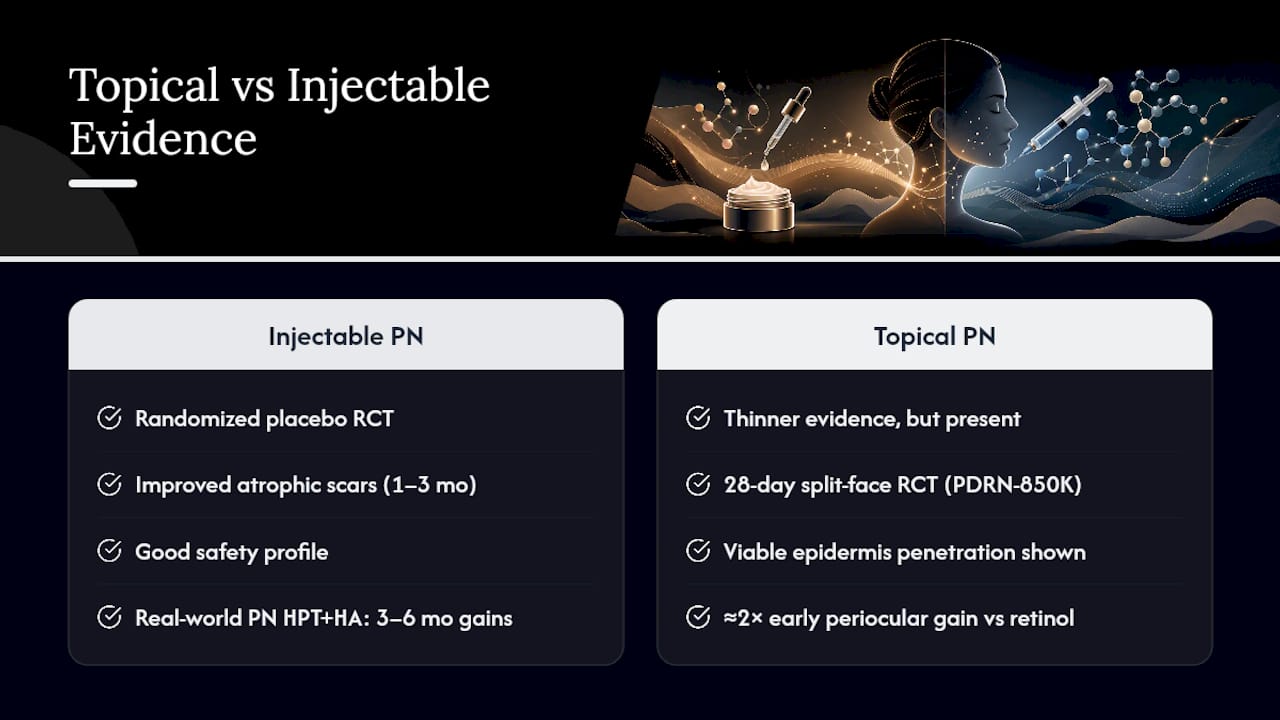
A randomized, placebo-controlled trial of a highly purified polynucleotide injectable found measurable improvement in moderate-to-severe atrophic scars at one and three months, with a good safety profile. Separate real-world prospective research on PN HPT™ combined with hyaluronic acid reported consistent gains on Goodman-Baron scarring scores and Global Aesthetic Improvement Scale ratings over three to six months, using objective 3D imaging like Antera to back up the visual assessment.
Topical evidence is thinner but not nothing. A 28-day, double-blind, split-face trial of a medium-length PDRN formulation, PDRN-850K, showed the molecule reaching the viable epidermis in ex vivo and in vivo testing and produced roughly double the early periocular improvement compared to 0.1% retinol, alongside increases in dermal thickness and matrix proteins.
The consistent thread across this research is that polynucleotides work reliably when delivered where fibroblasts live. Topical formulations that solve the penetration problem show real signals; the ones that don’t are asking a molecule to do dermal-level work from the surface of the skin.
None of these studies are large. Sample sizes run small, follow-up windows are short, and there is currently no head-to-head randomized trial comparing a topical polynucleotide serum against an injectable on acne scars specifically. A narrative review of PN and PDRN use in dermatology draws the same conclusion: topical formats are reasonable for hydration, redness, and support, while structural remodeling still leans on intradermal delivery.
Who Actually Sees Results With Topical Polynucleotide Serums?
Topical polynucleotides fit best as recovery support, not scar erasure. That distinction changes who should reach for a serum versus who needs a dermatologist referral.
Good candidates:
- Anyone recovering from active breakouts who wants to calm post-inflammatory redness faster
- People with mild surface roughness or uneven texture rather than deep pitting
- Skin that needs barrier support and hydration alongside active acne-scar treatments
- Post-procedure skin that needs gentle, non-irritating repair support between treatments
Poor candidates for topical-only treatment:
- Deep ice-pick or boxcar scars, which typically respond better to microneedling, subcision, or laser resurfacing, covered in more detail in this guide to types of skin rejuvenation
- Anyone expecting dermal-level remodeling comparable to injectable PN HPT™ studies
Most consistent users notice better hydration and calmer texture somewhere in the 8 to 12 week range. Real structural change, if it comes at all from a topical, takes longer and rarely matches what a procedure delivers in the same window.
Pro Tip: Track your progress with the same lighting and angle every two weeks. Scar texture changes are subtle enough that memory alone will convince you nothing happened, even when a side-by-side photo says otherwise.
How to Use a Polynucleotide Serum at Home
Building polynucleotides into a routine is less about ritual and more about not canceling out the ingredient with something too aggressive.
- Cleanse, then apply on damp skin. Polynucleotide serums generally go on right after cleansing, before heavier creams, so the active isn’t blocked by an occlusive layer first.
- Pair with gentle co-actives. Niacinamide, panthenol, and humectants like hyaluronic acid support the same repair-and-hydrate goal without fighting the polynucleotide for absorption. Check how often a polynucleotide serum should be used if you’re combining multiple actives in one routine.
- Separate strong actives by time of day. Keep potent retinoids, retinol, or acid exfoliants to a different session, ideally at night on alternating days, rather than layering them directly on top of a fresh application.
- Time it around procedures. After microneedling, chemical peels, or laser sessions, polynucleotides can support the skin’s recovery window once the skin barrier is intact enough to tolerate product. This guide on pairing polynucleotides with at-home microneedling covers timing in more detail.
- Patch-test first. Apply a small amount behind the ear or on the inner forearm for 24 to 48 hours before using it on the face.
- Wear sunscreen every morning. Any actively repairing skin is more sensitive to UV-driven inflammation, which can undo the calming effect you’re working for.
Pro Tip: If you notice persistent redness, stinging, or breakouts that don’t settle within a few days of starting a new serum, stop and see a dermatologist rather than pushing through it hoping the irritation is “purging.”
What to Check Before Buying a Polynucleotide Product
Marketing language around polynucleotides has outpaced the science in places, so the label is where you separate a serious formulation from a trend product.
- INCI name: look for Sodium DNA or PDRN listed clearly, not a vague “marine extract” euphemism.
- Concentration: most credible daily serums sit around 0.3% to 0.5%, with higher percentages reserved for ampoules or post-procedure formats.
- Vehicle and pH: water and glycol-based formulas tend to support stability better than high-ethanol bases, which can destabilize the molecule and irritate healing skin.
- Co-actives: niacinamide, panthenol, and madecassoside are sensible partners; be wary of a polynucleotide serum also packed with strong acids or high-percentage retinoids in the same bottle.
- Claims: any topical promising injectable-level dermal remodeling is overselling. Look for brands that cite real clinical or safety testing instead of adjective-heavy marketing.
| What to check | Look for | Red flag |
|---|---|---|
| Ingredient list | Sodium DNA / PDRN named clearly | Vague “marine DNA complex” with no INCI |
| Concentration | 0.3%–0.5% for daily serums | No percentage disclosed at all |
| Formulation | Water/glycol base, stable pH | Heavy ethanol base, unclear preservation |
| Claims | References to trial or safety data | “Replaces injectables” or similar language |
For a closer look at how these ingredients sit alongside other actives in a real formula, see this breakdown of fortifying skin serum examples.
Where Cellure Draws the Line on What Topicals Can Do

Cellure formulates with polynucleotides, peptides, and tranexamic acid because the mechanism behind cellular repair is genuinely sound, not because a serum can match an injectable. The honest position, and the one worth repeating to anyone shopping for acne-scar solutions, is that topicals support the skin’s own repair process rather than replace procedural correction of deep tissue loss.
Some skincare treatment kits are built for that daily maintenance role, along with recovery support after in-office procedures. For anything beyond mild-to-moderate texture concerns, a dermatologist consult belongs in the plan alongside the routine, and Cellure’s own polynucleotide benefits guide is worth reading for the fuller mechanism breakdown.
— Sara
A Simple Way to Start the Maintenance Routine
Consistency beats intensity when it comes to topical repair, which is exactly what the Complete Skin Repair Kit is built to deliver. It pairs a polynucleotide serum with complementary repair-support products so you’re not guessing at co-actives or concentration ranges on your own.
Apply it as part of your morning and evening routine: cleanse, apply the serum to damp skin, layer supportive products, and finish with sunscreen during the day. It suits anyone managing post-blemish redness, mild surface texture, or recovery days after a professional procedure, without needing to piece together multiple separate products from different brands. If your goal is steady, evidence-aware skin repair rather than a dramatic overnight fix, the kit’s product page has the full ingredient breakdown and usage guidance to get started this week.
Sources
- Expert Perspectives: Evidence-Based Applications of Polynucleotides (PNs) in Aesthetic Medicine and Dermatology
- Preliminary prospective and randomized study of highly purified polynucleotide vs placebo in treatment of moderate to severe acne scars (Aesthet Surg J, 2021)