


Yes, Polynucleotides and At-Home Microneedling Work Together
A measured yes: pairing a topical polynucleotide serum with gentle at-home microneedling is a reasonable, evidence-supported maintenance routine, especially for sensitive skin that can’t tolerate retinoids. The strongest signal comes from a randomized split-face trial where 0.1% PDRN-850K outperformed retinol on fine lines and wrinkles on periocular wrinkles and dermal thickness over 28 days. This isn’t a substitute for injectable or in-clinic treatments, but it’s a legitimate lower-risk lane for gradual firmness, tone, and hydration gains.
For at-home use:
- Stick to needle lengths of 0.25 to 0.5 millimeters on the face.
- Space sessions one to two weeks apart to let the skin barrier recover.
- Apply the polynucleotide serum immediately after, while microchannels are still open.
Key Takeaways
Topical polynucleotides paired with shallow at-home microneedling deliver gradual firmness and hydration gains by activating A2A receptor signaling and collagen synthesis once microchannels open the path for absorption.
| Point | Details |
|---|---|
| Combination is evidence-supported | A split-face trial found 0.1% PDRN-850K beat retinol on periocular wrinkles and dermal thickness. |
| Match needle length to area | Use 0.25 mm near eyes and thinner skin, up to 0.5 mm on cheeks and forehead. |
| Apply serum immediately after needling | Microchannels narrow within minutes, so absorption drops fast if you wait. |
| Avoid actives for 48 to 72 hours | Skip retinoids and strong acids post-session to let repair pathways work uninterrupted. |
| Cellure offers a checklist-matched kit | The Complete Skin Repair Kit pairs a polynucleotide serum with supportive actives and clear usage guidance. |
Table of Contents
- How Polynucleotides Support Skin Repair, Firmness, and Hydration
- Does Microneedling Actually Improve Polynucleotide Absorption?
- What to Look for in a Polynucleotide Serum and Microneedling Kit
- How to Combine Microneedling With a Polynucleotide Serum at Home
- Is At-Home Polynucleotide Microneedling Safe for Everyone?
- A Vetted Starting Point for Your At-Home Routine
- What I’d Tell a Friend Before They Try This
- Sources
How Polynucleotides Support Skin Repair, Firmness, and Hydration
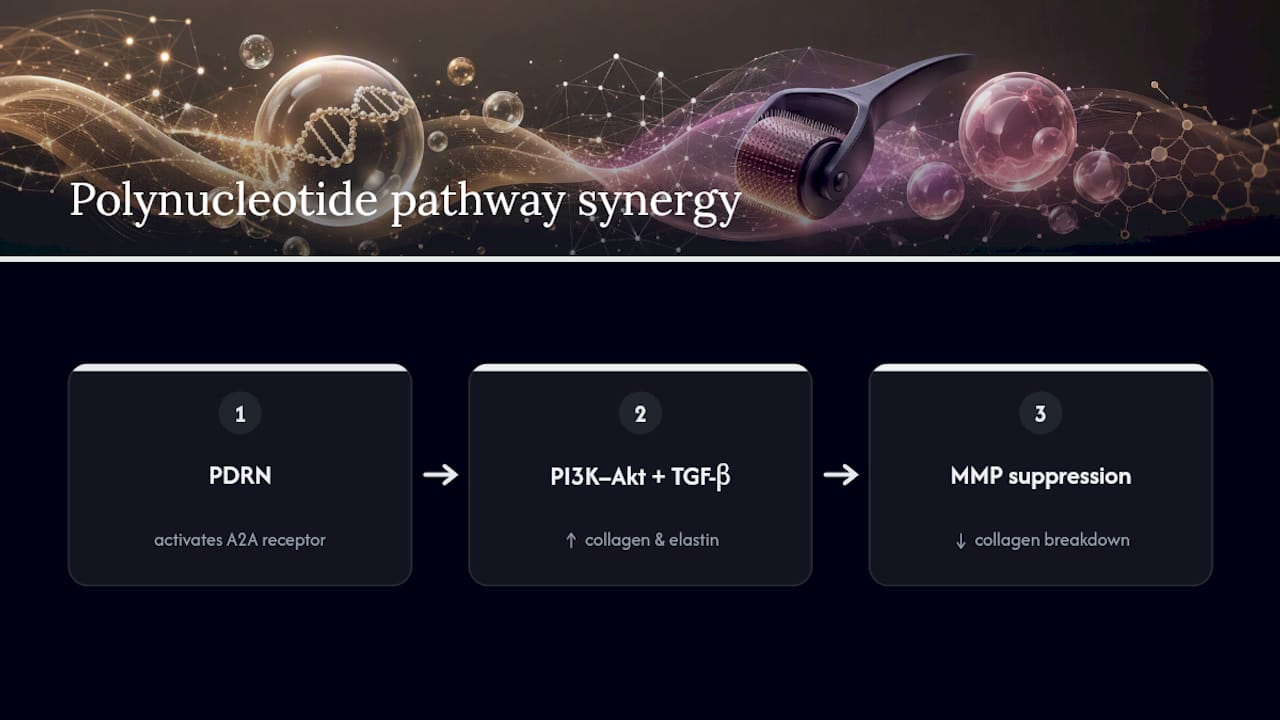
Polynucleotides, often labeled PN or PDRN (polydeoxyribonucleotide) on ingredient lists, are fragments of DNA that your skin cells recognize as repair signals rather than foreign material. The mechanism starts with the A2A adenosine receptor, which PDRN activates on fibroblasts and other skin cells. That activation does two things at once: it dials down inflammatory signaling and it pushes fibroblasts to ramp up collagen I and III production, the structural proteins responsible for firmness.
Underneath that, PI3K–Akt and TGF-β/Smad signaling pathways get switched on together, which upregulates a broader set of collagen and elastin-associated proteins than either pathway alone. These same pathways also suppress MMPs, the enzymes that break down collagen as skin ages. That combination, building structural protein while blocking its breakdown, is the biological case for calling polynucleotides a repair agent rather than just a hydrator.
Speaking of hydration: PDRN’s molecular structure behaves like a hydrogel once it’s on skin, drawing in water and creating an immediate plumping effect independent of any longer-term collagen response. A double-blind clinical trial of a PDRN-rich extract found hyaluronic-acid-like plumping and radiance benefits that matched or beat an HA benchmark.
That said, topical formulations face a real ceiling. Molecular weight and vehicle design determine how much of the active actually reaches living tissue rather than sitting on the surface. Smaller average chain lengths paired with penetration-friendly vehicles correlate with stronger signals in skin, which is exactly where microneedling earns its place in the routine.
Does Microneedling Actually Improve Polynucleotide Absorption?
Intact skin is a poor delivery route for a molecule the size of PDRN. Microneedling changes that by creating temporary microchannels through the stratum corneum, and the evidence for what happens next is more concrete than most skincare claims get. Confocal Raman spectroscopy and ex vivo skin models have tracked PDRN signal moving into viable epidermal layers after the barrier is disrupted, with time-dependent penetration that supports the basic premise: open the channels, and more active gets where it needs to go.
The clinical data backs this up at a structural level. In the split-face comparison against retinol, a medium-length PDRN formulation produced greater improvement in dermal thickness and periocular wrinkle depth over four weeks. That’s a short study window, but it’s a real structural endpoint, not a self-reported glow score.
Here’s the honest caveat: at-home devices don’t reach the depth that in-office microneedling does. Clinical treatments often go deeper into the dermis, triggering a more aggressive wound-healing cascade. At-home tools working at 0.25 to 0.5 millimeters create shallower channels, which means:
- Gentler, more gradual results rather than dramatic single-session change
- Lower downtime and infection risk when done correctly
- A better fit for maintenance between professional treatments than as a replacement for them
Pro Tip: Apply your polynucleotide serum within two minutes of finishing a microneedling pass. The microchannels start narrowing almost immediately, and absorption drops off fast once they close.
What to Look for in a Polynucleotide Serum and Microneedling Kit
Not every serum labeled with “PN” or “PDRN” on the front is formulated the same way, and the device you pair it with matters just as much. Run through this before buying anything:
- Check for a declared concentration or molecular-weight hint. Vague ingredient lists without any indication of purity or sourcing are a weak signal.
- Look for supportive actives in the same formula. Hyaluronic acid, peptides, and antioxidants working alongside polynucleotides tend to produce more consistent hydration and tone results than a single-ingredient serum.
- Confirm the vehicle is designed for penetration, not just a thick, occlusive cream that sits on top of skin.
- Verify purity claims are third-party tested, not just asserted on the label.
On the device side:
- Needle length should be clearly stated and appropriate for facial skin, not borrowed from body-focused specs.
- Stamp and pen-style devices generally offer more control over depth and pressure than rollers.
- Tips should be replaceable and sterile, individually sealed, not reused across sessions.
- Hygiene instructions should be explicit: alcohol disinfection before and after, dedicated storage, and a clear replacement schedule.
Red flags worth walking away from: any topical product implying it works like an injectable, purity claims with no testing behind them, or marketing promising overnight transformation. Polynucleotide skin therapy is a cumulative process, not a single-use fix, and any brand claiming otherwise is overselling the science. A broader look at complementary repair ingredients can help you evaluate what else belongs in the formula alongside PN.
How to Combine Microneedling With a Polynucleotide Serum at Home
A safe routine follows a specific order, and skipping steps is where most at-home problems start.
- Patch test the serum on your inner arm 24 hours before your first session, and confirm skin is free of active breakouts, sunburn, or open irritation.
- Clean everything. Wash your face, disinfect the microneedling device with isopropyl alcohol, and let both dry completely.
- Choose needle length by area. Use 0.25 millimeters around the eyes and thinner areas, up to 0.5 millimeters on the cheeks and forehead.
- Work in light, even passes, moving the device in one direction per pass rather than scrubbing back and forth. Space sessions one to two weeks apart to let skin recover fully.
- Apply the polynucleotide serum immediately after, while channels are open, then follow with nothing else active for the next 48 to 72 hours. Dermatologist guidance recommends holding off on retinoids and strong acids during that window so the skin can focus on repair.
- Layer a ceramide-based moisturizer on top once the serum absorbs, and apply broad-spectrum SPF the next morning without exception.
Pro Tip: On non-microneedling days, applying topical PDRN twice daily still supports maintenance, since dermatologists note it’s well tolerated even without the added delivery boost from microneedling.
Watch for redness lasting more than 24 hours, unusual swelling, or pinpoint bleeding that doesn’t stop quickly. Those are signs to dial back needle length or frequency, not push through.
Is At-Home Polynucleotide Microneedling Safe for Everyone?
Mild redness, light warmth, and a tight feeling for a few hours after a session are normal and typically resolve by the next morning. Anything beyond that deserves attention.
See a clinician if you notice:
- Redness or swelling that persists past 24 to 48 hours
- Pus, increasing warmth, or spreading discoloration, which can signal infection
- Dark spots forming at needle sites, more common in deeper skin tones and a sign to pause and reassess technique
At-home microneedling isn’t appropriate for everyone. Skip it if you’re currently on isotretinoin, have uncontrolled rosacea or active acne, or have a personal or family history of keloid scarring. Regulatory oversight of PDRN and PN products also varies significantly by country, so verified, properly tested formulations matter more here than with most skincare categories.
A Vetted Starting Point for Your At-Home Routine
Hunting for a serum with a real concentration disclosure, a device with sterile replaceable tips, and clear hygiene instructions on your own means piecing together products from different brands and hoping they’re compatible. Cellure built the Complete Skin Repair Kit to remove that guesswork, pairing a polynucleotide-forward serum with the supportive actives, peptides, hyaluronic acid, and barrier-focused ingredients, that the checklist above calls for.
The kit is designed around a starter schedule: microneedling sessions spaced one to two weeks apart, serum applied immediately after each session, and daily maintenance application on the days in between. Everything ships with usage guidance so you’re not guessing at needle length or hygiene steps. If you want more background before you start, the full breakdown of polynucleotide benefits walks through the fibroblast and collagen mechanisms in more depth.
Whatever you use, patch test first and follow the 48 to 72 hour rule around retinoids and acids. Ready to build a routine around a formula that’s already accounted for concentration, vehicle, and hygiene? Start with the Complete Skin Repair Kit and follow the starter schedule from your first session.
What I’d Tell a Friend Before They Try This
The gap I keep seeing is that people treat polynucleotide serums like they’ll perform in-clinic magic through skin that’s never had a microchannel opened in it. That’s backwards. The mechanism only gets interesting once delivery improves, and at-home microneedling is the modest, low-risk way to get there. What impresses me more than the marketing is the split-face retinol comparison: a topical, non-prescription actually beating a gold-standard active on a real structural endpoint. If your skin has never tolerated retinoids, this is worth trying before you write off active skincare altogether. For readers weighing this against in-office options, our skin rejuvenation treatment comparison lays out where each approach fits. If your concerns go beyond maintenance, a dermatologist consult still beats guessing.
Sources
- Topical medium-length PDRN enhances dermal extracellular matrix repair in photodamaged skin via PI3K–Akt/TGF-β–regulated pathways | PLOS One
- Polydeoxyribonucleotide: A promising skin anti-aging agent (ScienceDirect review)
- How to Get the Most From Topical PDRN Products | NewBeauty
- Hyaluronic Acid-like skin plumping and radiance benefits of a Porphyridium PDRN-rich extract (PubMed)