


Multiweight Hyaluronic Acid: Read Labels, See 2 Week Results
Multi-weight hyaluronic acid blends high, medium, and low molecular weight HA in one formula so it hydrates skin at the surface and deeper in the epidermis at the same time. That layered action is why it outperforms single-weight HA on dryness, roughness, and fine lines, with clinical testing showing measurable moisture gains within 30 minutes and visible texture improvements by two weeks.
TL;DR:
- Multi-weight hyaluronic acid formulations combine high, medium, and low molecular weights to hydrate the skin at both the surface and deeper layers, outperforming single-weight products.
- Clinical studies show measurable moisture increases within 30 minutes and visible texture improvements by two weeks of daily use, not overnight.
- Formulation safety is high for general use, but ultra-low fragments below 20 kDa can trigger pro-inflammatory signals, especially in sensitive or compromised skin.
- Combining hyaluronic acid with antioxidants like vitamin C, vitamin E, or peptides extends its durability and can promote the skin’s own HA production over time.
- Proper application involves applying to damp skin, layering with moisturizer immediately, and using consistently twice daily for best results.
Table of Contents
- What Is Multi-Molecular-Weight Hyaluronic Acid?
- How Do Different HA Molecule Sizes Work in Skin?
- What Does the Clinical Evidence Actually Show?
- Is Multi-Weight Hyaluronic Acid Safe for Sensitive Skin?
- Why Do Formulas Pair HA With Antioxidants?
- How Do You Choose the Right Multi-Weight HA Product?
- What’s the Best Way to Apply Multi-Weight HA Serum?
- The Perspective on Multi-Weight HA Formulation
- A Formulated Option Worth Considering
- Sources
- FAQ
What Is Multi-Molecular-Weight Hyaluronic Acid?
Hyaluronic acid is a sugar molecule your body already makes to cushion joints and hold water in skin tissue. On an ingredient label, it usually shows up as sodium hyaluronate (the salt form, smaller and more stable) or hydrolyzed hyaluronic acid (HA that’s been broken into smaller fragments). “Multi-weight” isn’t a separate ingredient. It’s a formulation strategy: blending two or more sizes of the same molecule so each does a different job on skin.
Molecular weight is measured in kilodaltons (kDa), and the ranges consumers encounter generally fall into a few bands:
- High molecular weight (HMW): above 1,000 kDa, sometimes called ultra-high or macro HA
- Medium molecular weight: roughly 50 to 300 kDa
- Low molecular weight (LMW): roughly 10 to 50 kDa
- Oligo or ultra-low weight: below 10 to 20 kDa, used sparingly and with caution
Size determines where the molecule can go. A single strand of HMW HA is too large to pass through the outer skin barrier, so it sits on top and forms a lightweight film that locks in moisture and reduces water loss. Smaller fragments slip between skin cells and settle into the epidermis, pulling water with them. A formula that only uses one size gets one effect. Research on HA delivery systems shows that pairing HMW’s surface film with LMW’s penetration is what gives multi-weight HA its edge, addressing both immediate surface hydration and deeper, longer-lasting moisture retention. Cellure’s take on hyaluronic acid’s core biology breaks down why this size-dependent behavior matters before you even get to product selection.
How Do Different HA Molecule Sizes Work in Skin?
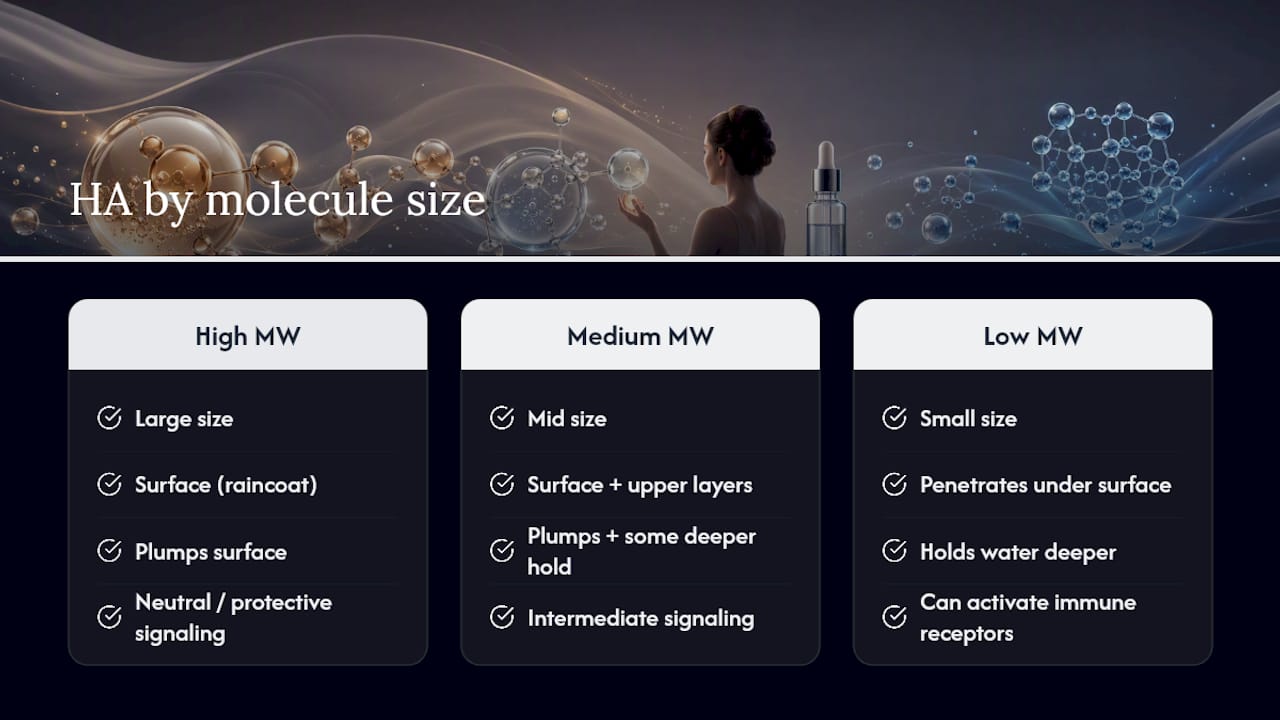
Think of HMW hyaluronic acid as a raincoat and LMW as a sponge. The raincoat stays on the surface and blocks water from escaping. The sponge gets under the surface and holds water where it lands. Neither one does the other’s job, which is exactly why relying on a single molecular weight leaves a gap in how skin actually hydrates.
The mechanism is more than plumbing, though. Preclinical work on HA and inflammatory signaling found that high and low molecular weight HA activate different biological pathways once they interact with skin cells. Larger fragments tend to behave in a more neutral, protective way. Very small fragments can trigger receptors involved in the immune response, including toll-like receptors that signal cellular stress. That doesn’t make LMW HA dangerous at typical skincare concentrations. It does explain why formulators are deliberate about which sizes they include and in what ratio, rather than just chasing the smallest possible molecule for penetration.
Molecular weight isn’t just about how deep an ingredient travels. It changes how skin cells interpret the signal, which is why the same molecule can calm skin at one size and irritate it at another.
For practical purposes, here’s the divide that matters: if your main goal is a plumped, smoothed surface with reduced transepidermal water loss, HMW-dominant formulas do that job well. If you’re targeting fine lines, rough texture, or a dull, dehydrated look that sits deeper than the top layer, you need the LMW fraction doing real work, not just appearing on the ingredient list for marketing purposes.
What Does the Clinical Evidence Actually Show?
The most detailed data on multi-weight HA comes from a clinical evaluation of next-generation, multi-weight HA formulations paired with an antioxidant complex. Researchers tracked skin hydration and clinical grading of dryness, roughness, and fine lines over a set period of daily use, and the results give a realistic timeline for what these formulas can and can’t do.
The headline numbers:
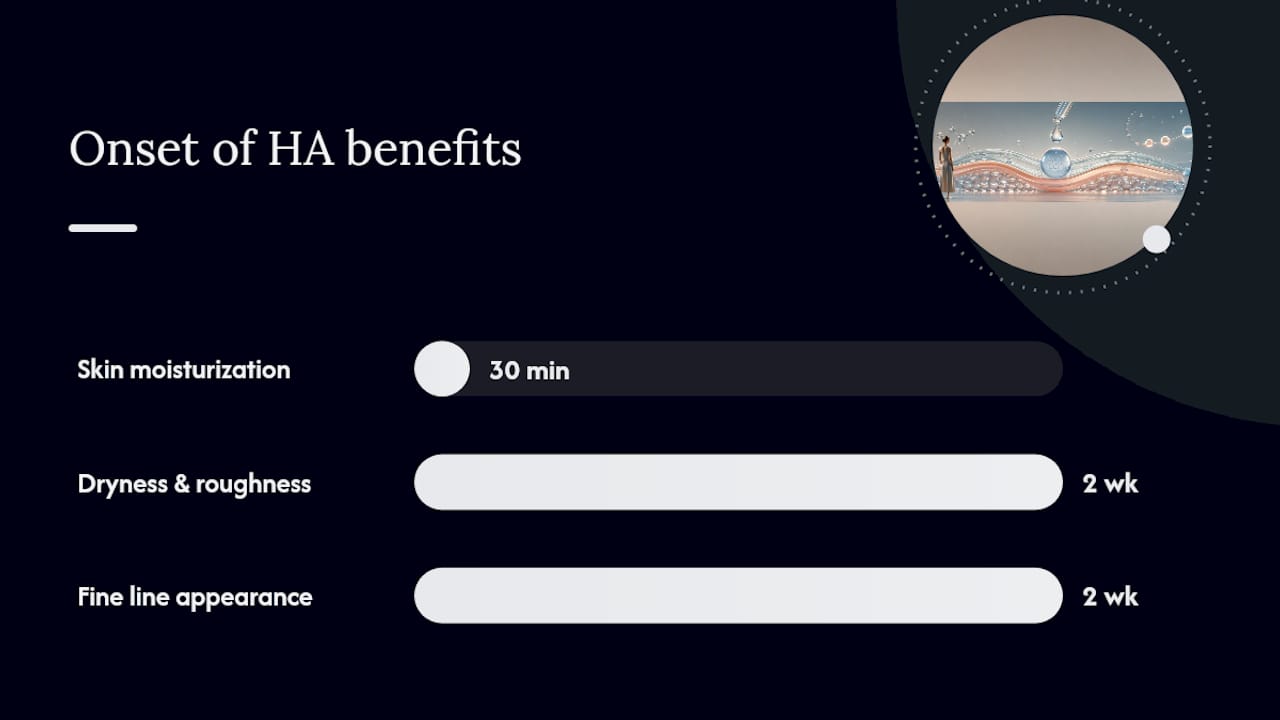
- Measurable increases in skin moisturization appeared within 30 minutes of application
- Clinical grading showed visible improvement in dryness and roughness by the two-week mark
- Fine line appearance also improved within that same two-week window with continued daily use
That timeline matters because it sets honest expectations. Multi-weight HA is fast on hydration, since water-binding starts working almost immediately, but the visible skin-texture changes that people actually screenshot and compare in the mirror take about two weeks of consistent use to show up. It’s not an overnight transformation, and any product claiming otherwise is overselling what the biology supports.
Pro Tip: Judge a multi-weight HA serum on a two-week trial, not a two-day one. Immediate plumping is real, but the roughness and fine-line improvements the research documents need that longer runway.
Study design context matters too. Formulation trials like this one are typically run by the companies developing the technology, which is standard in cosmetic science but worth knowing when you read the results. Sample sizes in these dermatology evaluations tend to run smaller than pharmaceutical drug trials, so treat the findings as a strong directional signal rather than a guarantee for every skin type. Harvard Health’s overview of hyaluronic acid backs the same general pattern: combination serums using multiple molecular weights are the more reliable route to broad hydration benefits, and improvements in dryness and fine lines within one to two weeks are a realistic, evidence-supported expectation. For a deeper look at how consistent use compounds over time, Cellure’s breakdown of hydration science walks through what’s happening at the cellular level during that window.
Is Multi-Weight Hyaluronic Acid Safe for Sensitive Skin?
Hyaluronic acid carries one of the cleanest safety profiles in skincare. Harvard Health notes that irritation risk is low and HA is used across an enormous range of cosmetic products without widespread problems. That general safety consensus holds for most multi-weight formulas on the market.
The nuance lives at the extreme low end of the molecular-weight spectrum. A 2024 scoping review on low molecular weight HA in dermatology flags that ultra-low fragments, generally under 20 kDa, can behave differently than their larger counterparts. In some cell models, these tiny fragments trigger pro-inflammatory signaling rather than the calming, hydrating effect people expect from HA. The review still reports generally positive safety and outcomes for LMW-HA overall. The caution applies specifically to the smallest fragments, not the low-weight category as a whole.
Practical safety steps worth following:
- Patch-test any new HA serum on your inner arm for 24 to 48 hours before applying to your face, especially if your skin is already compromised or reactive.
- Favor formulas built around the roughly 50 kDa range and above rather than sub-20 kDa oligo-HA if your skin is inflamed, freshly exfoliated, or recovering from a procedure.
- If you’ve recently had a laser treatment, chemical peel, or microneedling, use fragrance-free, minimal-ingredient HA products until your barrier has visibly recovered, and check with the clinician who performed the procedure first.
- Anyone managing eczema, rosacea, or a diagnosed skin condition should run new HA products by a dermatologist before daily use, since individual sensitivity varies more than general safety data can predict.
Pro Tip: If a serum lists “hyaluronic acid” with no molecular weight or kDa figure anywhere, assume it could contain a wide, unspecified mix. That’s not automatically a problem, but it makes it harder to judge whether you’re getting the ultra-low fragments the research flags for sensitive skin.
Why Do Formulas Pair HA With Antioxidants?
Hyaluronic acid degrades. Two things break it down on skin: hyaluronidase, an enzyme that cleaves HA into smaller pieces, and oxidative stress from UV exposure and pollution, which fragments the molecule through a different chemical path. Left unchecked, both processes shorten how long an applied dose of HA keeps doing its job.
This is why serious multi-weight HA formulas rarely appear alone on an ingredient list. The same clinical evaluation that documented the two-week improvement timeline tested HA specifically in combination with an antioxidant complex, not in isolation. That pairing addresses two separate problems: antioxidants neutralize the free radicals that degrade HA oxidatively, and certain complementary ingredients help resist enzymatic breakdown, extending how long the molecule stays functional on skin. Cellure’s guide to how antioxidants protect and repair skin covers this stabilization role in more depth.
There’s a secondary benefit worth knowing: some of these antioxidant and peptide pairings appear to support the skin’s own HA production over time, rather than only supplying HA topically. That’s a meaningful distinction, since a formula that helps skin make more of its own hyaluronic acid is working on a different timeline than one that simply deposits the ingredient and waits for it to wash off or degrade.
When you’re reading a label, look for:
- Vitamin C, vitamin E, or ferulic acid listed alongside sodium hyaluronate or hydrolyzed HA
- Peptide complexes, which often appear in the same formulas for their complementary collagen-support role
- Packaging clues like airless pumps or opaque bottles, since both antioxidants and HA degrade faster with light and air exposure
How Do You Choose the Right Multi-Weight HA Product?
Picking a serum shouldn’t come down to whichever bottle has the biggest “hyaluronic acid” text on the front. Here’s a practical checklist:
- Look for explicit molecular-weight language. Labels that mention “multi-weight,” “low and high molecular weight HA,” or list specific kDa ranges are telling you more than a generic “hyaluronic acid” claim.
- Check for antioxidant or stabilizing partners. Vitamin C, vitamin E, ferulic acid, or peptide complexes signal the brand is thinking about HA’s degradation problem, not just its delivery.
- Read the full INCI name. Sodium hyaluronate and hydrolyzed sodium hyaluronate are the most common forms; a mix of both on the ingredient list is a reasonable proxy for a true multi-weight approach.
- Consider the packaging. Opaque, airless pump bottles protect both HA and antioxidants better than clear jars exposed to light and air every time they’re opened.
- Be skeptical of vague concentration claims. “Contains hyaluronic acid” tells you nothing about dose. Percentages matter less than the actual molecular-weight blend and formulation quality behind them.
Texture choice depends on your skin type and climate. Lighter, water-based gel serums with a higher LMW ratio suit oily or combination skin and humid climates, where the goal is hydration without added weight. Richer, cream-based formats with more HMW HA and occlusive partners work better for dry or mature skin in cold or arid conditions, where surface water loss is the bigger problem.
| Skin Concern | Favor This Approach | Watch For |
|---|---|---|
| Surface dryness, flaking | HMW-heavy formulas, richer textures | Sub-20 kDa fragments if skin is compromised |
| Fine lines, rough texture | Balanced multi-weight blend | Vague “contains HA” claims with no weight specified |
| Oily or combination skin | Lightweight, LMW-leaning serums | Heavy occlusives that feel greasy |
| Post-procedure recovery | Minimal ingredient, mid-weight HA | Fragrance, ultra-low MW fragments |
Cellure’s guide to choosing the right serums for aging skin goes deeper into matching formulation type to specific aging concerns beyond hydration alone.
What’s the Best Way to Apply Multi-Weight HA Serum?
Getting the sequencing right matters almost as much as the formula itself, since HA needs moisture nearby to do its water-binding job properly.
- Cleanse first, then apply the HA serum to skin that’s still slightly damp. HA draws water from whatever is available, including the air, so damp skin gives it more to work with than fully dry skin.
- Layer a moisturizer immediately after. This traps the hydration the HA just pulled in and prevents the surface film from evaporating and pulling moisture out of skin instead, a real risk in very dry or low-humidity environments.
- Finish with SPF in the morning. HA doesn’t protect against UV, and sun damage accelerates the oxidative breakdown discussed earlier.
- Apply once or twice daily, morning and night, based on how your skin tolerates it and how dry your environment is.
Multi-weight HA generally plays well with other actives. It layers cleanly under vitamin C in the morning and alongside retinoids at night, since HA’s hydrating role can actually offset some of the dryness retinoids cause. If you’re pregnant, HA itself is broadly considered pregnancy-safe, though it’s worth checking any other actives in your routine, similar to the caution Cellure outlines for tranexamic acid use during pregnancy. Cellure’s layering guide covers the order-of-operations question in more detail if you’re building a full routine around it.
Pro Tip: If a HA serum feels tight or drying an hour after application instead of plump, you likely skipped the moisturizer step or applied it to bone-dry skin. The fix is almost always sequencing, not the product itself.
The Perspective on Multi-Weight HA Formulation
Most of the hyaluronic acid marketing you’ll see treats molecular weight as a footnote, if it mentions it at all. That’s backwards. The size of the molecule is the single biggest lever a formulator has over what the ingredient actually does on your skin, and treating “hyaluronic acid” as one uniform thing is where a lot of disappointment with these products comes from.
The research on molecular-weight-dependent signaling is the part consumers hear about least, and it deserves more attention than the hydration headlines get. Skin doesn’t just absorb HA passively. It reads different sizes as different signals. That’s a reason to respect formulation science, not fear the ingredient.
At Cellure, that thinking shapes how multi-weight HA gets used alongside antioxidants and peptides rather than as a standalone claim. If you have a specific skin condition or you’re recovering from a procedure, talk to a dermatologist about your exact situation. The science here is solid, but your skin’s history isn’t something a serum label can account for on its own.
— Sara
A Formulated Option Worth Considering
If you’d rather not build a routine ingredient by ingredient, Cellure’s Complete Skin Repair Kit takes the layered approach discussed throughout this piece and puts it into one system. It’s built around hydration and barrier repair, targeting the dryness, roughness, and early signs of aging that multi-weight HA is designed to address, while pairing that HA blend with complementary antioxidants and peptides for stability and support.
Nothing about the kit replaces a conversation with your dermatologist if you have a specific skin concern, but for anyone who wants a formulated, done-for-you starting point instead of piecing together five separate serums, it’s a reasonable place to start. Check the Complete Skin Repair Kit product page for the full ingredient breakdown and current availability.
Sources
The clinical evaluation of multi-weight HA formulations anchors the timeline data in this article. The PMC review on HA delivery design explains the size-dependent mechanism in detail. Harvard Health offers consumer-friendly safety context, and the EMJ scoping review covers the low-molecular-weight safety nuance.
- Clinical Evaluation of Next-Generation, Multi-weight Hyaluronic Acid Plus Antioxidant Complex-Based Topical Formulations with Targeted Delivery to Enhance Skin Rejuvenation
- Hyaluronic acid for skin: Benefits, how to use it, and side effects - Harvard Health
FAQ
What Is Multi-Weight Hyaluronic Acid?
It’s a formulation approach that blends multiple sizes of hyaluronic acid, typically high, medium, and low molecular weight, so the ingredient hydrates skin’s surface and deeper epidermal layers at the same time rather than working at just one level.
Why Do Some Dermatologists Have Concerns About Hyaluronic Acid?
The concern isn’t with hyaluronic acid broadly, which has a strong general safety record, but with ultra-low molecular weight fragments under roughly 20 kDa, which some research links to pro-inflammatory signaling in certain cell models.
Is High Molecular Weight Hyaluronic Acid Better Than Low?
Neither is objectively better; they do different jobs. HMW HA forms a surface film that reduces water loss, while LMW HA penetrates the epidermis for deeper hydration, which is exactly why combining both outperforms either one used alone.
What Are the Known Side Effects of Hyaluronic Acid?
Topical HA is generally low-irritation and well tolerated, according to Harvard Health, though sensitive or barrier-compromised skin should be cautious with formulas containing ultra-low molecular weight fragments, since those have shown potential to trigger inflammatory responses in preclinical studies.
How Long Does Multi-Weight HA Take to Show Results?
Hydration improvements can appear within 30 minutes of application, while visible changes in dryness, roughness, and fine lines typically take about two weeks of consistent daily use to show up in clinical grading.