


How to choose the right serums for aging skin
TL;DR:
- Women over 30 should identify their specific aging concerns and target them with evidence-backed ingredients.
- A minimal, consistent routine focusing on one or two issues accelerates results and reduces irritation risks.
- Tracking progress with photos and objective measurements ensures products truly benefit your skin over time.
You’ve spent real money on anti-aging serums that promised firmer skin, faded dark spots, and restored glow, and six weeks later your bathroom shelf looks more hopeful than your mirror does. It’s a frustratingly common experience for women over 30. The good news is that the problem usually isn’t your skin—it’s the guesswork behind your serum selection. Using a methodical, science-backed approach, you can identify your actual aging concerns, match them to ingredients with clinical evidence, introduce products safely, and measure whether they’re truly working.
Table of Contents
- Clarify your top aging skin concerns first
- Match ingredients to your concern: What really works?
- Safety, sensitivity, and picking your starting strength
- How to verify results: Measuring what works for you
- Why a smart, minimal stack outperforms a cabinet full of products
- Upgrade your serum routine with science-backed formulas
- Frequently asked questions
Key Takeaways
| Point | Details |
|---|---|
| Focus on your concerns | Identify whether wrinkles, firmness loss, or uneven tone are your top priorities before choosing a serum. |
| Choose proven ingredients | Select actives like retinoids, vitamin C, hyaluronic acid, and niacinamide for best evidence-backed results. |
| Start slow, go gentle | If in doubt, begin with hydrating serums and patch test potent actives to avoid irritation. |
| Give it time | Allow at least 1–3 months for visible improvements and track progress with notes or photos. |
| Simple routines win | A focused, minimal serum regimen improves results and reduces skin stress versus using too many products. |
Clarify your top aging skin concerns first
Before you buy a single bottle, the most important thing you can do is get specific. Skin aging shows up in distinct, measurable ways, and the mistake most people make is treating it as one vague problem called “getting older.” Identifying your primary goals such as wrinkles, dark spots, or dehydration is the first practical step to targeting the right active ingredients.
Here are the most common concerns women over 30 report, and why each one demands a different solution:
- Surface wrinkles and fine lines: Usually driven by collagen breakdown and repeated muscle movement. These respond best to cell-turnover ingredients and peptides.
- Loss of firmness and sagging: Tied to declining collagen and elastin production, not just surface texture. Requires structural support ingredients.
- Volume loss: Closely related to fat pad redistribution and reduced hyaluronic acid levels in the skin’s deeper layers.
- Hyperpigmentation and uneven tone: Triggered by cumulative UV exposure, post-inflammatory marks, and hormonal shifts. Needs targeted brightening actives.
- Dullness and dehydration: Often the most immediate, visible concern. Tied to a compromised skin barrier and reduced water retention.
Focusing on one or two concerns at a time actually speeds your progress rather than slowing it. When you apply five serums targeting five different issues, you can’t tell what’s working, and you dramatically increase your risk of irritation. Think of it like physical therapy: targeted exercises produce faster recovery than trying to strengthen everything at once.
Pro Tip: Start a simple skin journal or set up a photo log on your phone with consistent lighting and angles. A weekly photo at the same time, same spot, same light source will reveal subtle shifts in texture, tone, and firmness that your daily mirror check will completely miss. Reference this log every four weeks.
Understanding the layered nature of skin aging also sets realistic expectations. Single-ingredient solutions do exist for specific concerns, like a pure vitamin C serum for early pigmentation, but most people over 30 benefit more from using serums for rejuvenation in a structured, layered way rather than relying on any one product to do everything.
Match ingredients to your concern: What really works?
Once you’ve pinpointed your top one or two concerns, the next step is understanding which ingredients actually have clinical data behind them. Marketing language is everywhere in skincare, but the ingredient list tells the real story.
Evidence-backed ingredients for women over 30 include retinoids for wrinkles, vitamin C for brightness, hyaluronic acid for hydration, ceramides for barrier support, and niacinamide for dullness and pigmentation. Here’s a practical breakdown of the major actives and the concerns they address:
| Ingredient | Primary concern addressed | Secondary benefit |
|---|---|---|
| Retinoids (retinol, retinal) | Fine lines, surface wrinkles | Cell turnover, mild brightening |
| Vitamin C (ascorbic acid) | Dullness, hyperpigmentation | Antioxidant protection |
| Hyaluronic acid | Dehydration, volume loss | Plumping surface texture |
| Peptides | Firmness, collagen support | Barrier reinforcement |
| Niacinamide | Uneven tone, enlarged pores | Soothing, barrier support |
| Ceramides | Dry/compromised barrier | All skin types, calming |
| Tranexamic acid | Stubborn pigmentation | Brightening without irritation |
| Polynucleotides | Cellular repair, deep hydration | Elasticity improvement |
Pairing actives strategically multiplies results. Expert-led guidance for mature skin consistently recommends combining antioxidant or brightening ingredients with hydration and firmness-supporting ingredients for the best outcomes in aging skin. For example, using a vitamin C serum in the morning alongside a peptide-rich moisturizer covers both tone and structural support without conflict.
There are pairings to avoid, especially if you’re new to active skincare. Strong retinoids layered directly with AHAs or BHAs (chemical exfoliants) in the same application can cause significant irritation in beginner routines. The same applies to using multiple vitamin C products in one step, which doesn’t double the benefit but does increase sensitivity risk.
You can also give your skin an additional hyaluronic acid boost through topical application or professional booster treatments, which is particularly effective for volume loss concerns that topical serums alone may not fully address.
Pro Tip: Check that key actives appear in the first five to seven ingredients on a label. Active ingredients listed near the very bottom are often present at sub-effective concentrations. And when a brand shows you before-and-after photos only, without listing ingredient percentages or referring to any clinical testing, that’s a signal to look deeper before you buy.
The role of proven serums in a well-designed routine is to deliver targeted actives at concentrations the skin can actually absorb and use. That’s a key distinction between a thoughtfully formulated serum and a general moisturizer.
Safety, sensitivity, and picking your starting strength
Even the most clinically validated ingredient becomes a problem if your skin isn’t ready for it. This is where a lot of well-intentioned routines go sideways. The introduction of multiple strong actives at once, without accounting for skin type, history, or current barrier health, leads to inflammation that sets progress back weeks.
Consider these special circumstances before choosing your strength or formula:
- Sensitive or reactive skin: Start with soothing hydrating serums containing ceramides or niacinamide before introducing retinoids or acids.
- Post-procedure skin (after peels, laser, microneedling): Your barrier is temporarily compromised; only use gentle, fragrance-free hydrating serums until cleared by your provider.
- Dry skin: Your barrier needs reinforcement first. Jumping to a high-strength retinol without adequate moisture support accelerates irritation.
- Perioral dermatitis or rosacea-prone skin: Many active ingredients, even vitamin C at high percentages, can trigger flares.
- Mature skin over 55: Skin becomes naturally drier and thinner with age, requiring lower starting concentrations and more barrier-focused products alongside actives.
Important: If you are pregnant or breastfeeding, retinoid-containing serums are broadly advised against by dermatologists due to systemic absorption concerns. Stick to hydrating, barrier-supportive formulas and consult your OB before adding any new active skincare.
Clinical evidence confirms that retinol and retinoids are effective but require consistent use over weeks and months, and your starting point should match your skin’s actual tolerance, not your ambition for fast results. Begin with a low-concentration retinol (0.025 to 0.1%) applied two or three nights per week, and slowly increase frequency before moving to higher strengths.
A comfort-first approach is genuinely the safest strategy for reactive skin: prioritize hydration and barrier repair before adding any strong active. This isn’t a compromise—it’s how you build a skin foundation that will actually respond well to actives when you introduce them.
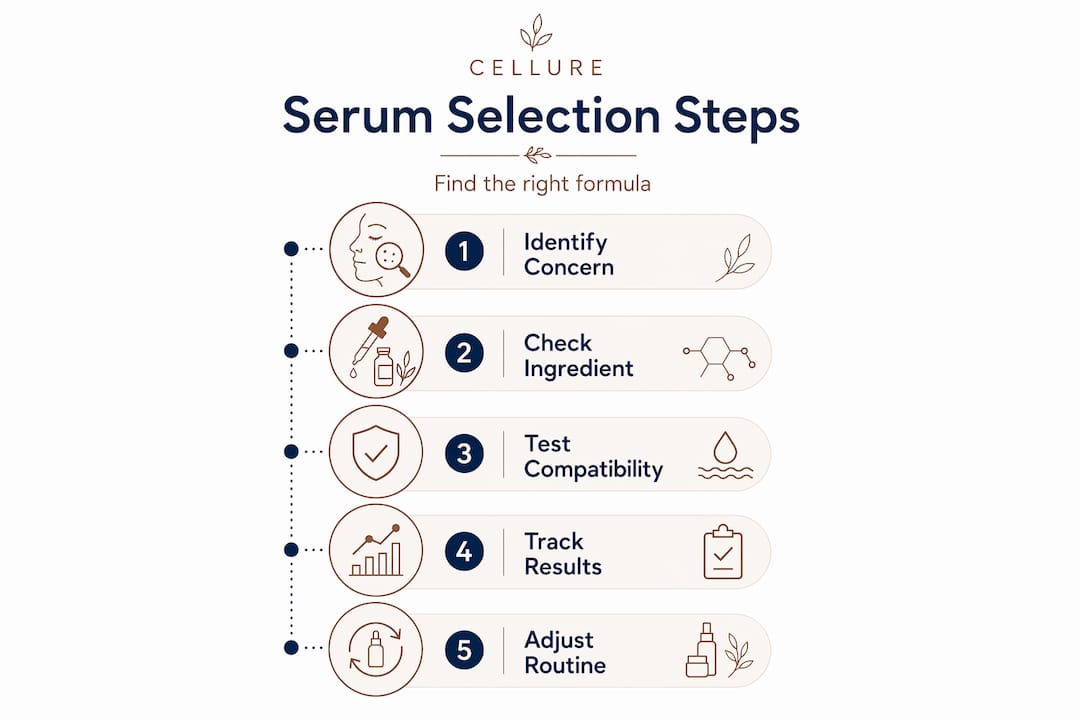
Distinguishing irritation from normal adjustment is also critical. Mild flaking during the first two weeks of retinol use is common and expected. Redness, burning, or stinging that persists beyond 48 hours is a sign to scale back or stop. Real progress doesn’t feel like damage. The gentle anti-aging tips principle applies here: less product, more patience, and a reliable gentle serum guide to follow when you’re reintroducing actives.
How to verify results: Measuring what works for you
You’ve chosen your concern, selected your ingredient, introduced it safely. Now comes the most overlooked part: proving it’s actually working. Without a system for tracking, you’re back to relying on hope and anecdote.
Start here with a step-by-step tracking approach:
- Take your baseline photos before starting any new serum. Use the same device, same lighting, same distance, same time of day.
- Introduce only one new product at a time. If you add three serums simultaneously and your skin improves (or reacts), you won’t know which product is responsible.
- Check in at four weeks for initial texture or hydration changes. Firmness and pigmentation improvements take longer.
- Reassess at eight weeks for more meaningful changes in tone and surface smoothness.
- Evaluate fully at twelve weeks for structural improvements like firmness, elasticity, and deeper wrinkle reduction.
Industry testing supports these timelines. Good Housekeeping’s Beauty Lab uses devices like Visia (a facial imaging system) and the Cutometer (a skin elasticity probe) to measure objective firmness and texture changes, and their evaluations run over at least four weeks to capture meaningful data. Third-party instrumented testing matters far more than brand-produced before-and-after photos.
A powerful example: No7’s Protect and Perfect serum saw a measurable 21% improvement in firmness over four weeks in instrumented trials. That kind of specific, quantified result is the benchmark to look for when evaluating brand claims.
Here’s how subjective and objective methods compare:
| Verification method | Reliability | Best used for |
|---|---|---|
| Brand before/after photos | Low | Awareness only |
| User reviews | Medium | Texture, feel, tolerability |
| Your personal photo log | Medium-High | Visible tone and surface changes |
| Dermatologist skin assessment | High | Firmness, structural changes |
| Devices (Cutometer, Visia) | Very High | Quantified clinical measurement |
For at-home tracking, daily journaling combined with periodic photography is genuinely useful. Note how your skin feels after application, any tightness or redness, and how it looks by midday. Over twelve weeks, patterns emerge clearly. You can also explore advanced results assessment through specialist clinics that offer in-person skin scanning for a more precise picture of what’s changing beneath the surface.
The real science for aging skin is clear: meaningful results require patience measured in months, not weeks. Setting that expectation from day one prevents premature abandonment of formulas that are actually working.
Why a smart, minimal stack outperforms a cabinet full of products
Here’s the counterintuitive reality that most skincare marketing will never tell you: more products rarely equals better skin. In fact, a cluttered routine often works against you.
The routines that produce consistent, long-term improvement follow a predictable logic: one antioxidant or brightener in the morning, one cell-turnover or repair active at night, and a reliable hydrating barrier layer supporting both. That three-pillar framework covers the major mechanisms of visible aging without overwhelming the skin or creating confusion about what’s contributing to your results. The most science-backed approaches in dermatology reflect this same minimalist logic.
There’s also a behavioral dimension that rarely gets discussed. A simpler routine is a consistent routine. Compliance is everything in skincare. A sophisticated four-step evening protocol sounds impressive until a busy Thursday night turns it into nothing. Two products you actually use every day will outperform six products you use sporadically every time.
Chasing the newest trending ingredient also carries real costs. Each new serum you add is a new variable that makes it harder to identify what’s working. Every experimental launch introduces a fresh irritation risk. And the skincare landscape is flooded with ingredients that have theoretical promise but limited peer-reviewed data in actual formulated products on actual human skin.
Our perspective, built from watching how real women respond to evidence-based routines over time, is this: a thoughtful, minimal stack built on transparency and clinical backing will deliver more visible results in twelve months than a revolving door of trending actives ever will. Simplicity isn’t a limitation. It’s the strategy.
Pro Tip: When evaluating any new serum, ask three questions before buying: Does the brand disclose active ingredient percentages? Is there third-party testing or published clinical data? Would removing this product leave a gap in your routine? If the answer to the third question is no, you probably don’t need it.
Upgrade your serum routine with science-backed formulas
If you’ve worked through this guide and feel ready to act on what you’ve learned, the next step is choosing formulas that back up their claims with real ingredients at real concentrations.
At Cellure, every product is built around the principle that your skin deserves specificity, not just promises. Whether you’re addressing pigmentation with a tranexamic acid peptide serum or tackling multiple aging concerns simultaneously with a complete repair kit, each formula is designed with ingredient transparency and cellular-level efficacy in mind. If you’re ready to build a routine you can actually measure results from, explore advanced cellular regeneration solutions developed for real, visible skin improvement.
Frequently asked questions
Are anti-aging serums safe for daily use?
Most hydrating and antioxidant serums are safe for daily use; retinoids require more gradual introduction based on tolerance and may need to be used every other night initially. Always listen to your skin and scale back if you notice persistent irritation.
How long should I test a serum before judging results?
Give any new serum four to twelve weeks before drawing conclusions, using photos and skin-feel tracking as your reference. Good Housekeeping’s Beauty Lab measures firmness and texture changes over at least four weeks to capture meaningful differences.
What if my skin gets red or itchy after starting a serum?
Stop use immediately and return to a gentle hydrating formula until your skin calms down. Experts recommend starting new actives slowly for sensitive or reactive skin, then reintroducing them gradually after the barrier has recovered.
Is it safe to use more than one serum at a time?
Yes, as long as the formulas are compatible. Pairing hydrating with brightening or anti-aging actives works well for mature skin, but avoid layering multiple high-strength actives (like retinoids plus acids) in the same application, especially when starting out.
Can I use retinol serums while pregnant?
No. Retinoids should be avoided during pregnancy and breastfeeding due to safety concerns. Use hydrating, barrier-supportive serums instead and consult your healthcare provider before making any changes to your skincare routine.