


How to Layer Serums for Maximum Skin Benefits
TL;DR:
- Most people unknowingly cancel out their serums by applying them in the wrong order or mixing incompatible ingredients. Applying water-based serums first on slightly damp skin, waiting between layers, and limiting to two or three serums enhances effectiveness and prevents irritation. Understanding serum textures, ingredient roles, and personalized routines helps optimize results and maintain a healthy skin barrier.
Most people who own multiple serums are unknowingly canceling them out. They apply their products in the wrong order, don’t wait between layers, or mix ingredients that actively work against each other. Knowing how to layer serums correctly is the difference between a routine that delivers real results and one that just costs money. This guide breaks down the exact process, from understanding what’s in your serums to building a personalized routine that works with your skin’s biology, not against it.
Table of Contents
- Key takeaways
- How to layer serums: understanding what you’re working with
- Step-by-step serum layering for your daily routine
- Common mistakes and ingredient conflicts to avoid
- Customizing your serum routine for your specific skin goals
- My honest take on serum layering
- Build your best routine with Cellure
- FAQ
Key takeaways
| Point | Details |
|---|---|
| Thinnest to thickest always | Apply water-based serums before gels, then emulsions, then oils for proper absorption. |
| Two serums is often enough | Experts recommend two to three serums per routine to maximize results and minimize sensitivity. |
| Slightly damp skin is best | Applying serums to slightly damp skin improves absorption and prevents stinging from low-pH actives. |
| Some ingredients don’t mix | Retinoids, strong acids, and vitamin C should not be layered together in the same session. |
| Match serums to your skin goals | Build your routine around biological objectives like barrier support first, then active treatment. |
How to layer serums: understanding what you’re working with
Before you can stack serums effectively, you need to know what category each one falls into. Not all serums are created equal, and texture tells you a lot about where a product belongs in your routine.
Serum textures and why they matter
Serums come in four main consistencies, and each behaves differently on skin.
- Water-based serums are the lightest. Think hyaluronic acid and niacinamide. They absorb almost instantly and deliver actives directly into the surface layers of the skin.
- Gel serums have slightly more body. Vitamin C is often formulated as a gel. They sit just above water-based serums in terms of weight and need a clean base to penetrate well.
- Lotion or emulsion serums feel thicker and creamier. Retinol is commonly found in this format. They create a slight film on the skin and work best after lighter layers have been absorbed.
- Oil-based serums are the heaviest. They should always go last because their lipid base can block lighter water-based formulas from reaching the skin if applied first.
The layering order by viscosity follows a simple logic: water-based serums first, then gel serums, then lotion and emulsion types, and oil-based serums last. This sequence mirrors how skin absorbs different molecular weights, from smallest to largest.
Key active ingredients and their roles
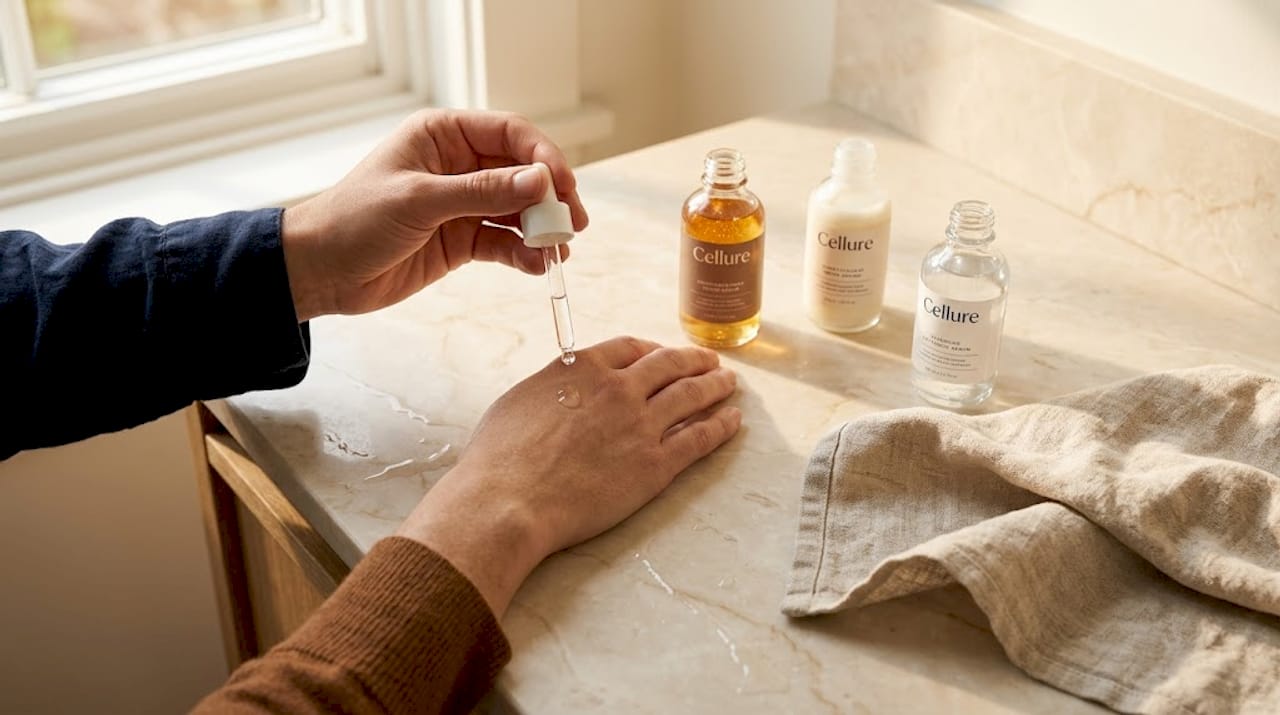
Understanding what each ingredient actually does helps you prioritize which one goes first when you have a choice.
Vitamin C is an antioxidant that brightens skin and supports collagen. It works best applied directly to cleansed skin before anything else, because its low pH requires a clean surface. Hyaluronic acid draws moisture into the skin and works across all layers. It layers beautifully over vitamin C. Niacinamide calms inflammation, minimizes pores, and supports the skin barrier. It pairs well with most ingredients, making it a reliable first layer in a simple routine. Retinol stimulates cell turnover and targets fine lines. Because it is typically in a heavier base and is a potent active, it goes later in a layering sequence and requires care around what it sits next to. Peptides are signal molecules that prompt collagen and elastin production. They are gentle enough to layer with most other actives and work well as a support serum in any routine. You can learn more about applying peptide serums to get the most out of this ingredient category.
Step-by-step serum layering for your daily routine
Getting the order right is only part of the equation. How you prepare your skin, how long you wait between products, and how many serums you use all affect the outcome.
-
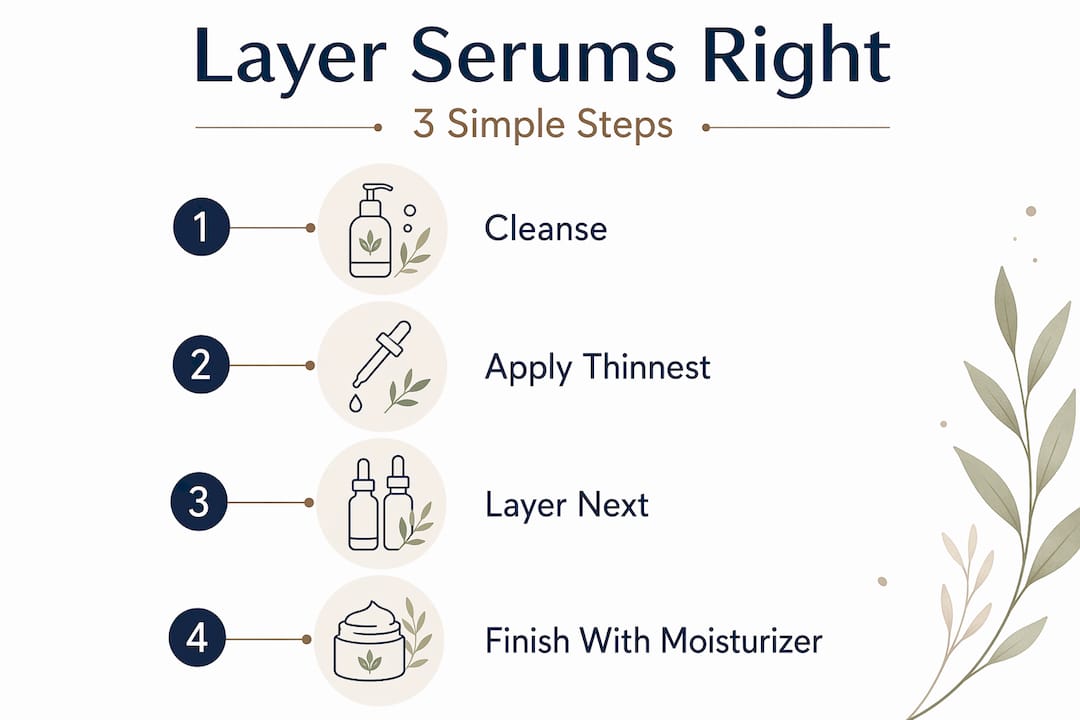
Cleanse thoroughly. Start with a clean face. Any residue from makeup, SPF, or previous products creates a barrier that prevents serums from absorbing properly.
-
Use a toner if it’s in your routine. Toners balance skin pH and provide a primed surface. If you use one, apply it before serums and let it settle for about 20 seconds.
-
Apply to slightly damp skin. This is one of the most overlooked steps. Slightly damp skin optimizes absorption without diluting the product. Completely dry skin can cause stinging from low-pH actives like vitamin C, while fully wet skin dilutes what you apply.
-
Start with your lightest serum. Apply a small amount, usually three to four drops, and press it gently into the skin rather than rubbing. Rubbing disrupts absorption and can pill the product.
-
Wait 30 to 60 seconds before applying the next serum. A brief pause between layers allows each product to begin absorbing and prevents mixing on the surface, which can reduce effectiveness or cause pilling.
-
Apply the next serum in order of increasing viscosity. Work your way from lightest to heaviest. Finish with your thickest serum and then follow with moisturizer to lock everything in.
-
Apply SPF last in the morning. In a morning routine, SPF is always the final step after all serums and moisturizer.
Pro Tip: For your evening routine, this is where retinol and heavier actives belong. Your skin repairs itself overnight, and without sun exposure undoing your actives, the nighttime window is the most effective time for treatment serums.
When it comes to quantity, two to three serums per routine is the sweet spot. More than three provides diminishing returns and increases the risk of sensitivity. A two-serum routine built around one primary active and one support serum is both effective and tolerable for most skin types.
Common mistakes and ingredient conflicts to avoid
Even with the right serums, the wrong combinations can undo your results or irritate your skin. These are the most frequent errors people make when learning how to apply multiple serums.
- Mixing retinol with strong acids or vitamin C. Retinoids should not be layered with vitamin C, benzoyl peroxide, or alpha hydroxy acids in the same session. Combining them increases the risk of irritation without adding benefit. Use them on alternating nights instead.
- Applying serums to completely dry or soaking wet skin. Both extremes reduce effectiveness. Dry skin causes stinging from low-pH actives, and wet skin dilutes your products before they absorb.
- Using too many serums at once. Overloading your skin with four or five serums leads to pilling, reduced penetration, and sometimes reactive skin. Stick to the two-to-three serum rule.
- Not pressing serums in. Rubbing serums across the face creates friction that can ball up the product and prevent even distribution.
- Skipping the wait time. Applying serums back to back without pausing is one of the most common mistakes. That brief 30 to 60 second gap matters more than most people realize.
“The skin can only absorb so much at once. Layering too many products in quick succession doesn’t give your skin more benefits. It gives it more to deal with, often triggering sensitivity or barrier disruption.”
Learning which ingredients conflict with each other is part of knowing the best serums to layer together safely. If you’re newer to actives, start with one active serum and one support serum, then build from there once you know how your skin responds.
Customizing your serum routine for your specific skin goals
The most effective serum layering techniques are not generic. They are built around what your skin actually needs.
Matching serums to your skin concerns
| Skin concern | Primary serum | Support serum |
|---|---|---|
| Loss of firmness | Peptide serum | Hyaluronic acid |
| Uneven skin tone | Vitamin C or tranexamic acid | Niacinamide |
| Sensitivity or redness | Barrier repair serum | Calming peptide serum |
| Fine lines and texture | Retinol (PM only) | Peptide or hyaluronic acid |
| Dehydration | Hyaluronic acid | Ceramide-based serum |
The biological objectives approach means you build your layering sequence around what your skin needs functionally. Start with barrier support, then add protection or hydration, and finish with your active treatment. Applying hydrating and barrier-supporting serums first improves how receptive the skin is to the active treatments that follow.
This framework also informs what Cellure describes as a “cosmetic wardrobe” mindset, where you rotate and adjust serums based on current skin state rather than stacking everything every day. If your skin is having a reactive week, pull back to your gentlest support serum. When your skin is stable, introduce your active back in.
Pro Tip: Keep a simple notes app log for two to four weeks when you introduce a new serum. Note what you applied, in what order, and how your skin looks and feels the next morning. Patterns emerge faster than you’d expect.
For those integrating serums after professional treatments, the protocol changes. Post-microneedling serum application requires sterile, low-irritant products only. Hyaluronic acid goes first, followed by peptides or growth factors. Retinoids and acids should be avoided for 48 to 72 hours after any procedure. Protecting the skin barrier is the priority during healing, and rushing actives back in can cause real damage. For more on why the barrier matters so much in serum routines, Cellure’s guide on skin barrier repair explains the science clearly.
My honest take on serum layering
I’ve seen more skin frustration caused by a bloated, unstructured serum routine than by almost anything else. Someone spends serious money on five different actives, layers them all on every night, and then wonders why their skin is red, flaky, or just not improving. The instinct to do more is understandable, but skin doesn’t reward effort. It rewards precision.
What I’ve found consistently is that people who get the best results from serums are not using the most products. They are using the right two or three, applied in the correct order, at the right time of day, with enough patience between layers. That’s it.
The hardest lesson to internalize is this: vitamin C on Monday night does not need to be layered with your retinol. Use them on different nights. Your skin can handle both, just not at the same time. Most ingredient conflicts come from impatience, not ignorance. Once you accept that your routine can cover multiple goals across the week rather than every goal every day, layering becomes simple and actually enjoyable.
I also think the industry has overcomplicated this. A guide on choosing serums for aging skin should not read like a chemistry textbook. Pick your concern, find the ingredient that addresses it, add one support serum, and learn the order. That’s the whole framework.
— Sara
Build your best routine with Cellure
If you’ve been layering products without a clear plan, the right starting point is a routine built on serums that are formulated to work together from the start. Cellure’s products use bioactive ingredients like peptides, polynucleotides, and tranexamic acid, specifically chosen to target the most common aging concerns including firmness loss, uneven tone, and dehydration. Every formula is designed to layer cleanly, absorb well, and support your skin barrier rather than stress it.
For a practical, curated starting point, the Complete Skin Repair Kit pairs targeted serums in a layering-friendly sequence so you don’t have to guess what goes with what. It’s a strong choice for anyone serious about a results-driven routine. Explore all of Cellure’s targeted serums and layering guidance at cellure.co.
FAQ
What is the correct order of applying serums?
Apply serums from thinnest to thickest. Water-based serums like hyaluronic acid and niacinamide go first, followed by gels like vitamin C, then heavier emulsion or lotion serums like retinol, and oil-based serums last.
How many serums can you layer at once?
Most experts recommend no more than two to three serums per routine. Using more than three rarely improves results and often increases the risk of sensitivity, pilling, or barrier disruption.
Can you layer vitamin C and hyaluronic acid together?
Yes, this is one of the most effective combinations. Apply vitamin C first on cleansed skin, wait two to three minutes, then apply hyaluronic acid on top.
Should you layer serums on wet or dry skin?
Neither extreme is ideal. Slightly damp skin gives the best results, improving absorption without diluting the product or causing stinging from low-pH actives.
Can you layer retinol with other serums?
Retinol should not be layered with vitamin C, strong acids, or benzoyl peroxide in the same session. Instead, alternate these actives across different evenings to get the benefit of both without the irritation risk.
Recommended
Share