


How to Address Loss of Volume: Topical Protocol
The most effective topical approach to address loss of volume is a layered daily regimen combining hyaluronic acid for immediate plumping with signal peptides and polynucleotides (PN/PDRN) for longer-term dermal repair. You can start today with three steps:
- Cleanse, then apply a peptide serum to slightly damp skin
- Follow with a hyaluronic acid plumping serum while skin is still damp
- Finish your AM routine with broad-spectrum SPF 30+
Expect a visible plumping effect within minutes to hours from HA hydration. Measurable firmness gains, backed by clinical trial data, appear from weeks 4–12 with consistent twice-daily use.
Key Takeaways
A layered twice-daily regimen combining HA, signal peptides, and PDRN is the most evidence-backed topical approach to restoring skin volume and firmness.
| Point | Details |
|---|---|
| Start with HA and SPF | Apply hyaluronic acid on damp skin every morning, always followed by SPF 30+. |
| Commit to peptides and PDRN daily | Structural firmness gains require consistent use for 8–12 weeks minimum. |
| Expect early signals by week 4 | Clinical data shows early wrinkle reduction and dermal thickness gains at week 4. |
| Patch test new actives | Test each new serum on your inner forearm for 48 hours before full application. |
| Cellure Complete Skin Repair Kit | Combines HA, peptides, and PDRN in one kit designed for the twice-daily protocol above. |
Table of Contents
- How do topical volumizers actually restore firmness and plumpness?
- What ingredients should you look for to restore volume?
- What does a twice-daily volumizing routine look like?
- What does the research show, and when will you see results?
- Who benefits most, and when should you see a clinician?
- How do you choose the right topical volumizing product?
- What the evidence actually tells us about topical volumizing
- Cellure Complete Skin Repair Kit: where it fits your routine
- Sources
How do topical volumizers actually restore firmness and plumpness?
Topicals work on two timescales. The first is immediate: humectants like hyaluronic acid draw water into the upper skin layers, physically expanding cells and softening the look of fine lines within hours. The second is structural, and that’s where the real science gets interesting.
Signal peptides act as messenger molecules, triggering fibroblasts to produce collagen and elastin. Think of them as a slow-release investment. Polynucleotides and PDRN go further still. According to mechanistic reviews, PDRN activates adenosine A2A receptors and inhibits MMP-1 and elastase, the enzymes that break down your existing collagen and elastin. PN, meanwhile, provides a hydrophilic scaffold and delivers biomechanical cues to fibroblasts through mechanotransduction, a process where physical signals from the ECM environment prompt cells to produce more structural proteins.
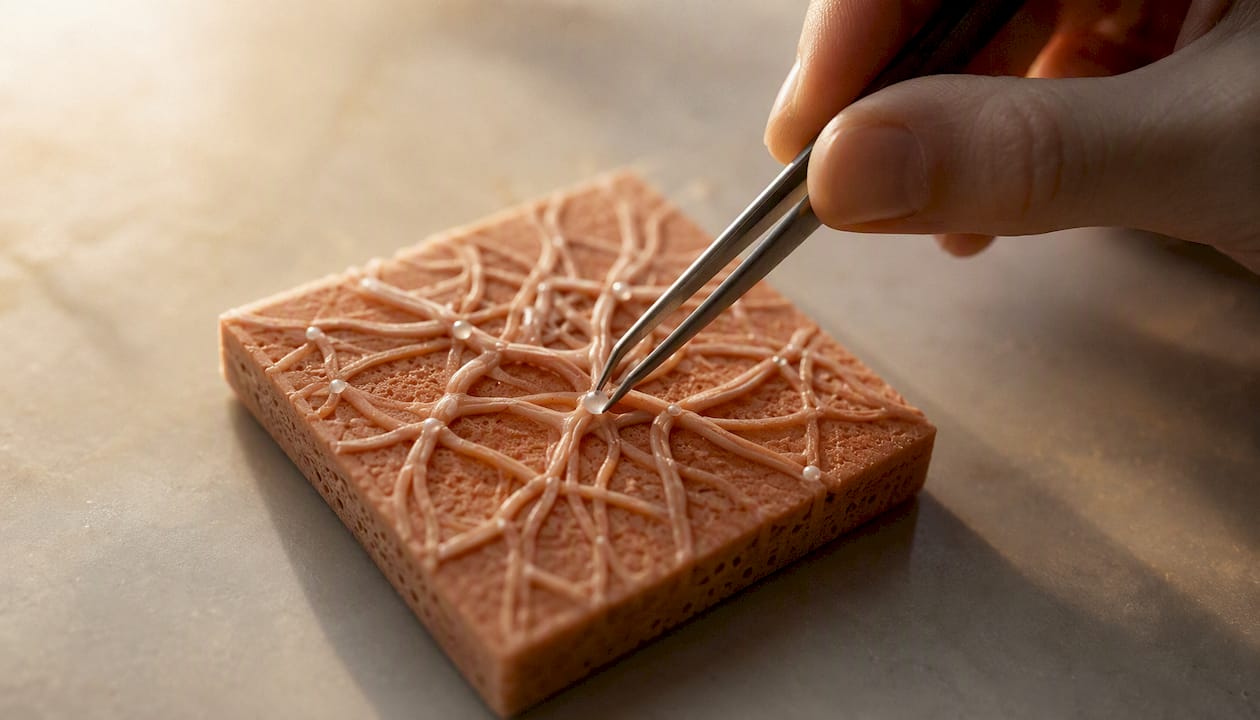
A PLOS One randomized split-face study found that topical 0.1% PDRN-850K activated PI3K–Akt and TGF-β/Smad signaling in dermal fibroblasts and produced roughly two-fold greater improvements in periocular dermal thickness and wrinkle parameters versus identically formulated retinol over 28 days.
One honest caveat: topical delivery has limits. Molecular size, skin barrier integrity, and formulation vehicle all affect how much active reaches viable dermal layers. Results vary by product and individual skin condition.
What ingredients should you look for to restore volume?
| Ingredient | Primary Action | Timeline | Notes |
|---|---|---|---|
| Hyaluronic acid (multi-weight) | Humectant; surface and mid-dermal hydration | Minutes to hours | Low-MW HA penetrates deeper; use on damp skin |
| Signal peptides (matrix-stimulating) | Stimulate collagen/elastin synthesis | 8–12+ weeks | Needs consistent daily use; apply before HA |
| Copper peptides | ECM remodeling, antioxidant support | 8–12 weeks | Avoid mixing with vitamin C in same step |
| Polynucleotides / PDRN | ECM repair, MMP/elastase inhibition, A2A signaling | 4–12 weeks | Synergistic with HA; hybrid HA–PDRN formulas may improve onset |
| Vitamin C / Astaxanthin | Antioxidant; collagen cofactor | 4–8 weeks | Use in AM; stabilized forms preferred |
| Bakuchiol | Retinol alternative; stimulates collagen | 8–12 weeks | Better tolerated than retinol for sensitive skin |
| Ceramides / Niacinamide | Barrier repair; reduces TEWL | 1–2 weeks | Supports delivery of all other actives |
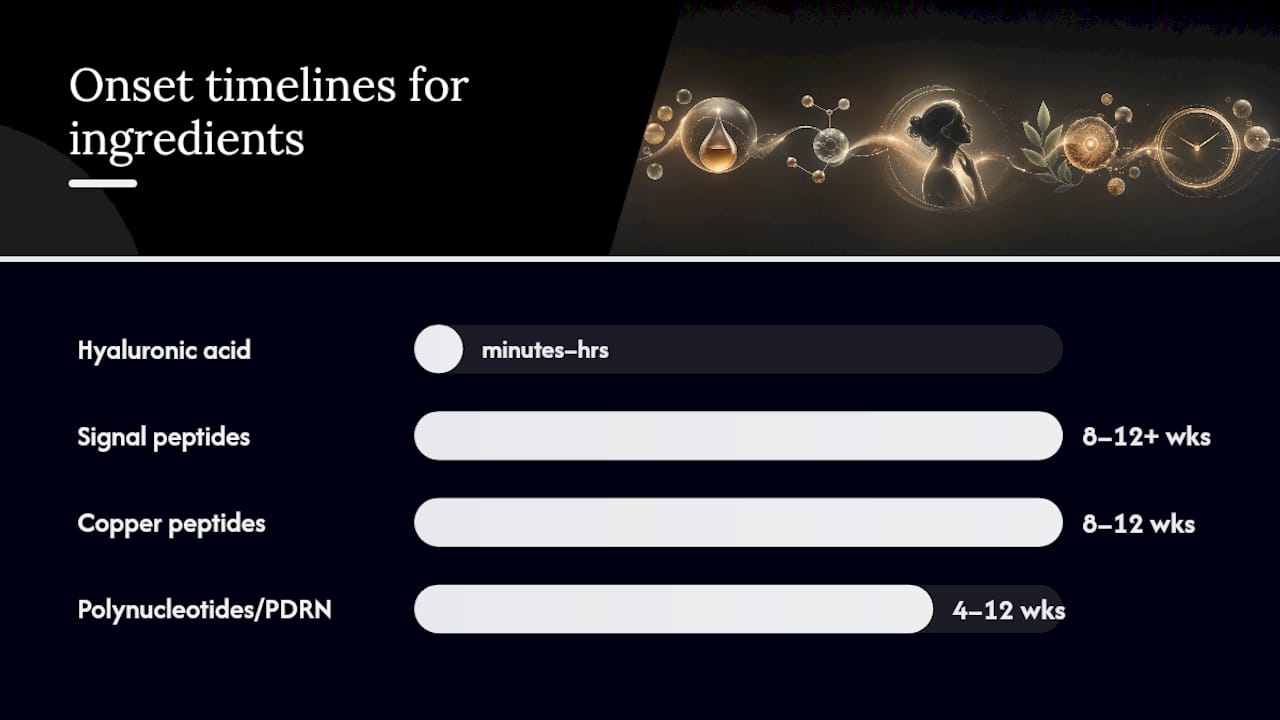
The pairing logic matters as much as the ingredients themselves. Peptides and PDRN address the ECM from different angles: peptides stimulate new protein synthesis while PDRN protects existing collagen from enzymatic degradation. HA amplifies both by keeping the skin hydrated enough for cellular processes to function. For a deeper look at polynucleotide mechanisms, the science behind each class is worth understanding before you buy.
Pro Tip: Apply your peptide serum to clean, slightly damp skin and wait 30–60 seconds before layering HA. This gives peptides direct receptor contact before the humectant seals moisture over the surface.
What does a twice-daily volumizing routine look like?
AM routine
- Gentle cleanser (pH-balanced, non-stripping)
- Antioxidant serum (vitamin C or astaxanthin) on damp skin
- Signal peptide serum; wait 30–60 seconds
- Hyaluronic acid plumping serum while skin is still damp
- Moisturizer with ceramides to seal
- Broad-spectrum SPF 30+ (non-negotiable; UV is the primary driver of ECM breakdown)
PM routine
- Double cleanse if you wore SPF or makeup
- Peptide or repair serum on damp skin; wait 30–60 seconds
- PDRN-containing product or PN serum
- Richer moisturizer or barrier cream
A few practical notes. Use about three to four drops of serum per application; more product does not mean faster results. Extend application down the neck and along the jawline, areas that show volume loss early and are often skipped. For guidance on using peptides effectively, layering order makes a real difference in what your skin actually absorbs.
Before starting any new active, do a 48-hour patch test on the inner forearm. Apply a small amount, cover with a bandage, and check for redness or swelling at 24 and 48 hours.
What does the research show, and when will you see results?
| Timeframe | What you can expect |
|---|---|
| Minutes to hours | HA hydration; visible surface plumping |
| 2–4 weeks | Improved hydration, early wrinkle softening |
| 4–8 weeks | Measurable wrinkle reduction occurs within this period |
| 8–12+ weeks | Increased dermal thickness, elasticity, firmness with peptides/PDRN |
The 28-day split-face PDRN trial adds another data point: structural dermal changes are measurable in under a month with the right formulation. That said, most trials are short, sample sizes are modest, and outcomes depend heavily on formulation quality and concentration. Consistency matters more than any single product choice.
Who benefits most, and when should you see a clinician?
Most adults with mild to moderate volume loss from aging, sun exposure, or recent weight loss are good candidates for a topical volumizing regimen. The 12-week trial specifically included people experiencing rapid weight loss from GLP-1/GIP agonist medications, showing topicals can work even in that accelerated-loss context.
- Tolerability watch-outs: Retinoids and high-concentration vitamin C can cause initial irritation; introduce one new active at a time, every two weeks
- Avoid layering copper peptides with vitamin C in the same routine step; use one in AM, one in PM
- Consult a clinician if you have active rosacea, lupus or other photosensitive autoimmune conditions, eczema flares, or are pregnant or breastfeeding
- Red flags requiring prompt review: sudden asymmetric volume loss, skin thickening, or unexplained firmness changes unrelated to aging
Pro Tip: If you are new to peptides and PDRN, start with one product containing both, rather than layering multiple single-ingredient serums. Fewer variables make it easier to track what is working.
How do you choose the right topical volumizing product?
A solid product should check most of these boxes:
- Contains clinically studied actives: multi-weight HA, signal peptides, and PN or PDRN
- Lists peptide descriptors (e.g., palmitoyl tripeptide-1, oligopeptide sequences) rather than vague “peptide complex” language
- pH-compatible formulation (peptides work best around pH 5–7)
- Packaged in airless pump or opaque container to protect actives from oxidation
- Fragrance-free and low-alcohol in the active serum steps
- Backed by published clinical data or third-party testing, not just brand claims
- Pairs with a daily SPF (no volumizing regimen works long-term without UV protection)
The Cellure Complete Skin Repair Kit meets this checklist: it combines HA, signal peptides, and PDRN in a formulation designed for twice-daily use, with documented bioactive concentrations and packaging that protects ingredient stability. If you want to try before committing to a full kit, sample sizes let you confirm tolerability first.
What the evidence actually tells us about topical volumizing
The conventional wisdom says topicals are maintenance, not treatment. That framing undersells what the newer PDRN and PN research actually shows. A two-fold improvement in dermal thickness versus retinol in 28 days is not a maintenance result.
What the evidence does not support is the idea that any single ingredient does the job alone. The synergy between HA (immediate hydration), peptides (collagen stimulation), and PDRN (ECM protection and repair) is where the real gains come from. Consistency over months, not weeks, is what separates people who see structural change from those who only get temporary plumping.
Cellure Complete Skin Repair Kit: where it fits your routine
Skin that has lost volume needs more than hydration. It needs the full stack: immediate plumping, ECM stimulation, and enzymatic protection against further breakdown.
The Cellure Complete Skin Repair Kit delivers exactly that combination. HA provides the immediate plumping effect in step four of your AM routine. The peptide and PDRN formulas slot into steps three and five of your PM routine, targeting the structural repair that shows up as measurable firmness gains by weeks 8–12. The kit is designed for twice-daily use, fragrance-free, and suitable for sensitive skin. Start your regimen with the Complete Skin Repair Kit and give the actives the consistent daily use the clinical evidence requires.
Sources
The findings cited in this article come from peer-reviewed clinical trials and systematic reviews. Evidence in topical volumizing is growing but still limited by modest sample sizes and short follow-up periods in some studies. For personalized guidance, consult a board-certified dermatologist.
- Topical Volumizing Cream Improves Facial Volume and Skin Health in Adults With Rapid Weight Loss From Pharmacologic (GLP‐1/GIP Agonists), Surgical, or Behavioral Interventions - PMC
- Topical medium-length PDRN enhances dermal extracellular matrix repair in photodamaged skin via PI3K–Akt/TGF-β–regulated pathways | PLOS One