


What Is Volumizing Skincare? A Science-First Guide
TL;DR:
- Volumizing skincare uses topical ingredients to improve skin fullness gradually through hydration and dermal support. Consistent use of active ingredients like peptides and hyaluronic acid offers modest, cumulative changes over 8 to 12 weeks, supporting prevention rather than replacement of fillers. Topicals do not rebuild bone or reposition fat but enhance dermal density and hydration to maintain a youthful appearance.
Volumizing skincare refers to topical treatments designed to restore visible facial fullness, either immediately through surface hydration or gradually through dermal matrix repair. The short version: these products cannot replicate what a filler syringe does, but consistent use of the right actives does produce measurable, cumulative changes in skin thickness, elasticity, and hydration.
- Immediate effect: Humectants like hyaluronic acid draw water into the upper skin layers, creating a temporary plumping effect that fades within hours to a day.
- Lasting effect: Peptides, polynucleotides, and growth factors stimulate fibroblasts and support collagen and elastin production over weeks to months, producing structural improvement that builds with continued use.
Realistic expectation: results are modest and cumulative, not dramatic. Think of topical volumizers as maintenance and prevention, not a replacement for injectables.
Pro Tip: When evaluating a product’s claims, look past “plumping” marketing language. Credible products cite clinical endpoints like elasticity scores, hydration measurements, or transepidermal water loss reduction, and name the specific ingredient mechanism behind each claim.
Table of Contents
- Why your face loses volume as you age
- How volumizing skincare actually works
- Key ingredients to look for and what each one does
- Topical volumizers vs. fillers vs. quick plumping tricks
- How to build a volumizing skincare routine
- Safety, patch-testing, and when to see a professional
- What clinical evidence actually shows
- Key Takeaways
- The case for starting topical volumizing earlier than you think
- Cellure’s Complete Skin Repair Kit fits the routine you just built
- Selected sources and further reading
Why your face loses volume as you age
Facial fullness depends on four distinct tissue layers working together: the underlying bone scaffold, subcutaneous fat compartments, supporting muscle, and the dermal extracellular matrix (ECM). Topical products can meaningfully influence only the innermost two, but understanding all four explains why aging looks the way it does.

Bone remodeling starts in your 30s, gradually reducing the orbital rim and jaw angles that give the face its structural projection. Subcutaneous fat doesn’t simply disappear; it redistributes, with fat pads in the cheeks and temples thinning while fat accumulates lower on the face. Muscle volume also decreases with age, reducing the internal support that keeps skin taut. At the dermal level, collagen and elastin production slows, glycosaminoglycans like hyaluronic acid decline, and the ECM loses the density that gives skin its bounce and thickness.
The result is hollowing at the temples and cheeks, deepening nasolabial folds, and a general loss of the rounded contours associated with youth. Topical actives cannot rebuild lost bone or reposition fat pads, but they can support the dermal matrix and restore some of the hydration and structural density that contributes to visible plumpness.
Key timeline: Collagen turnover and measurable matrix changes occur on the order of 80–120 days, which is why structural actives require 8–12 weeks of consistent use before visible improvement appears.
How volumizing skincare actually works
The cellular mechanism behind plumping splits cleanly into two categories, and most products on the market do only one of them.
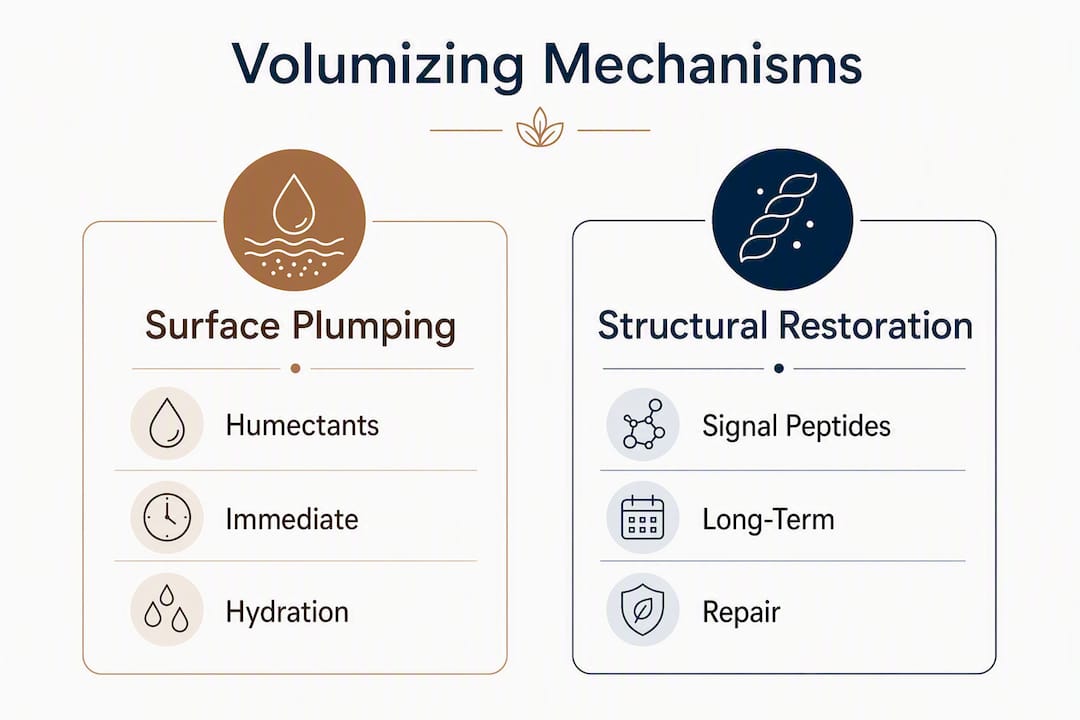
Surface plumping works through humectants. Hyaluronic acid, glycerin, and similar molecules attract water from the dermis and environment into the stratum corneum, increasing turgor pressure and temporarily smoothing fine lines. The effect is real and visible within hours. It is also short-lived; once the product is absorbed and water evaporates, the skin returns to baseline. This is the mechanism behind most “instant plumping” claims.

Structural restoration is slower and more durable. Actives like signal peptides, polynucleotides, and growth factors communicate with fibroblasts, the cells responsible for producing collagen, elastin, and glycosaminoglycans. Over weeks, this stimulation rebuilds ECM density and increases dermal thickness. The shift in the industry has been away from irritation-based quick plumps toward these biologically aligned actives that support fibroblast function and adipocyte behavior.
The practical strategy is to combine both. A humectant serum delivers the immediate visual improvement that keeps you motivated, while matrix-supporting actives do the slower structural work underneath. Neither alone is as effective as the two together.
Key ingredients to look for and what each one does
| Ingredient | Mechanism | Onset of visible effect | Formulation notes |
|---|---|---|---|
| Hyaluronic acid (HA) | Humectant; draws water into skin layers | Immediate (hours) | Water-soluble; apply to damp skin, seal with moisturizer |
| Signal peptides | Stimulate collagen and elastin synthesis via fibroblast signaling | 4–8 weeks | Water-soluble; layer under moisturizer |
| Copper peptides | Support ECM repair and wound-healing pathways | 8–12 weeks | Avoid pairing with strong vitamin C or retinoids simultaneously |
| Polynucleotides / PDRN | Promote cellular regeneration and fibroblast proliferation | 8–12 weeks | Aqueous; typically used in evening routine |
| Growth factors (EGF) | Upregulate cell renewal and ECM protein production | 8–12+ weeks | Sensitive to heat; store properly |
| Volufiline-type actives | Oil-soluble lipid stimulators; may increase subcutaneous lipid storage | Variable; evidence limited | Oil vehicle required for efficacy; small industry trials only |
| Retinoids | Accelerate cell turnover; stimulate collagen indirectly | 8–12 weeks | Start low frequency; avoid with certain actives |
| Vitamin C | Cofactor for collagen synthesis; antioxidant | 4–8 weeks | Unstable in some forms; use L-ascorbic acid formulations |
| Ceramides / squalane | Barrier repair; reduce water loss and support active retention | Days (barrier) | Pair with humectants for best occlusive effect |
A note on Volufiline-type ingredients: small industry studies report modest volume changes in measured volume, but robust peer-reviewed facial trials are limited. The ingredient is worth including in a formula, but it should not be the headline claim.
Formulation signals that actually matter when choosing a product:
- Concentration is reported (or the ingredient appears high on the INCI list)
- The vehicle matches the ingredient’s solubility (oil-soluble actives in oil-based formulas)
- Clinical trial data is cited with measurable endpoints, not just “clinically tested”
- Complementary ingredients are present: HA paired with an occlusive, peptides with barrier support
Pro Tip: Look for peptide-based serums that list specific peptide names (Matrixyl, Argireline, GHK-Cu) rather than generic “peptide complex.” Named actives signal that the formulator chose them for a specific mechanism, not just marketing.
Topical volumizers vs. fillers vs. quick plumping tricks
Understanding the difference prevents both disappointment and unnecessary spending.
- Mechanism: Topicals work through biology, stimulating the skin’s own repair processes. Injectable fillers physically add volume by depositing hyaluronic acid gel or other materials directly into the tissue.
- Immediacy: Fillers deliver results in the chair. Topicals require weeks to months of consistent use.
- Magnitude: Fillers can restore significant structural volume lost to fat redistribution or bone remodeling. Topicals produce subtle, cumulative improvement.
- Duration: Filler results typically last months to years depending on the product and placement. Topical benefits require ongoing use to maintain.
- Quick irritant tricks (cinnamon, menthol, certain acids) cause temporary swelling or vasodilation that mimics plumping for an hour or two. These are not volumizing in any meaningful sense.
When to choose topicals: early signs of volume loss, prevention-focused adults, post-procedure maintenance, or anyone not ready for injectables. When to seek a professional consultation: significant structural fat or bone loss, deep hollowing that topicals cannot address, or when you want faster, more dramatic results.
Topical actives support the skin’s own repair processes. They cannot rebuild deep fat compartments or reposition bone. Dermatologist commentary consistently frames topicals as maintenance tools, not substitutes for structural procedures.
How to build a volumizing skincare routine
Consistency and sequencing matter more than any single product. Here is a practical twice-daily framework:
Morning:
- Gentle cleanser
- Antioxidant serum (vitamin C) on clean, slightly damp skin
- Hyaluronic acid serum while skin is still damp
- Moisturizer with ceramides to seal hydration
- Broad-spectrum SPF 30+ (non-negotiable; UV exposure accelerates collagen breakdown)
Evening:
- Cleanser
- Active serum: peptides, polynucleotides, or growth factors (rotate based on your kit)
- If using a retinoid, apply after the active serum has absorbed; start two to three nights per week and build up
- Richer moisturizer or occlusive balm to seal everything in
Layering rules: Apply thinner, water-based serums first. Oil-soluble volumizing actives (like Volufiline-type ingredients) perform better in oil vehicles and should go on before an occlusive balm. When using retinoids alongside peptides, allow a few minutes between layers or use them on alternating nights until your skin adapts. A solid skincare layering workflow prevents actives from competing or degrading each other.
Timeline expectations:
- Visible hydration: within hours of first use
- Early matrix changes: approximately 4–8 weeks
- Clearer structural improvement: 8–12+ weeks with twice-daily consistency
Pro Tip: Pair oil-soluble lipid-stimulating ingredients with a humectant serum underneath and an occlusive moisturizer on top. The humectant draws water in; the occlusive locks it there; the lipid-stimulating active works in the oil layer between them.
Safety, patch-testing, and when to see a professional
Most volumizing actives are well tolerated, but a few require care.
Patch-test these before full-face use: retinoids, high-strength vitamin C (above 15%), growth factor formulas, and any fragrance-heavy product. Apply a small amount to the inner arm or behind the ear for 24–48 hours before applying to the face.
Actives that need gradual introduction: Retinoids are the most common cause of initial irritation in volumizing routines. Start at the lowest available concentration, use two to three nights per week, and increase frequency only after your skin has adjusted over four to six weeks. Copper peptides should not be layered directly with strong vitamin C or retinoids in the same application; use them at different times of day or on alternating evenings.
Stop use and consult a dermatologist if you experience: severe redness or burning that persists beyond 24 hours, swelling or hives, persistent inflammation especially around the eyes or mucous membranes, or any sign of infection. These are not normal adjustment reactions.
A dermatologist or aesthetic medicine provider is the right next step when topical results plateau, when volume loss is structural rather than dermal, or when you are considering combining topicals with professional procedures like fillers, microneedling, or laser treatments. Topicals and in-office procedures are not mutually exclusive; they work best as a combined strategy.
This article is general educational information, not medical or dermatological advice. Confirm ingredient suitability and any procedural decisions with a qualified professional for your specific situation.
What clinical evidence actually shows
The clinical picture for topical volumizers is encouraging but measured. Two trials are worth knowing.
A 12-week randomized trial in adults following significant weight loss found that twice-daily use of a multi-ingredient topical cream produced measurable increases in facial volume, elasticity, and hydration, with visible wrinkle reduction. The population is specific (post-weight-loss adults), but the trial design and endpoints are rigorous enough to be meaningful.
A separate 16-week trial of a two-step volumizing serum and cream formulation showed statistically superior improvement in target wrinkle areas compared with vehicle controls. Sixteen weeks is a realistic consumer timeline, and the two-step format mirrors how most serious routines are structured.
| Study | Duration | Key outcomes | Caveats |
|---|---|---|---|
| PMC randomized trial (weight-loss adults) | 12 weeks | Increased facial volume, elasticity, hydration; reduced wrinkles | Specific population; twice-daily protocol required |
| JDD two-step volumizing formulation | 16 weeks | Statistically significant wrinkle-area improvement vs. vehicle | Formulation-specific; results tied to full regimen |
| Volufiline small industry studies | Variable | Modest volume changes reported | Non-peer-reviewed; small samples; company-sponsored |
The practitioner consensus is consistent: topicals serve as prevention and maintenance. Dermatologists emphasize that consistent twice-daily use over 8–12 weeks is the minimum threshold for visible matrix benefits, and that the best outcomes come from combining topical maintenance with sun protection and, when appropriate, professional procedures.
Key Takeaways
Volumizing skincare works through two distinct mechanisms, and results depend entirely on choosing the right actives, using them consistently, and giving them enough time.
| Point | Details |
|---|---|
| Two mechanisms, one strategy | Humectants deliver immediate plumping; peptides, polynucleotides, and growth factors rebuild the dermal matrix over 8–12 weeks. |
| Collagen turnover timeline | Matrix changes occur over 80–120 days; visible structural improvement requires consistent twice-daily use for at least 8–12 weeks. |
| Topicals vs. injectables | Topicals are for prevention and maintenance; fillers address significant structural fat or bone loss that topicals cannot reach. |
| Ingredients that matter | Prioritize hyaluronic acid, signal peptides, copper peptides, polynucleotides/PDRN, and barrier-support ingredients like ceramides. |
| Cellure’s approach | Cellure’s Complete Skin Repair Kit bundles peptides, polynucleotides, hyaluronic acid, and barrier actives into a structured twice-daily regimen. |
The case for starting topical volumizing earlier than you think
Most people come to volumizing skincare after they have already noticed significant hollowing or sagging, at which point the honest answer is that topicals alone will not fully reverse the change. The more useful framing is prevention: starting a peptide and polynucleotide regimen in your late 30s or early 40s, when the dermal matrix is still relatively intact, means you are maintaining density rather than trying to rebuild it from scratch.
That said, topicals are genuinely underused as a post-procedure maintenance tool. After fillers or microneedling, the skin’s repair pathways are already activated. Adding a twice-daily regimen with growth factors and peptides during that window can extend and deepen the results. Most people stop at the procedure and skip the maintenance, which is why their results fade faster than they should.
The other underappreciated group: adults who have lost weight rapidly. The 12-week PMC trial focused specifically on this population, and the results were meaningful. Rapid weight loss depletes subcutaneous fat and stresses the dermal matrix in ways that topical actives can partially address, particularly when started early.
The honest ceiling is this: if you have significant structural volume loss, a topical regimen is not a substitute for a professional consultation. But for everyone else, consistent use of the right actives is one of the most cost-effective things you can do for long-term skin quality.
Cellure’s Complete Skin Repair Kit fits the routine you just built
Putting together a volumizing regimen from scratch means sourcing peptides, polynucleotides, hyaluronic acid, and barrier-support ingredients separately, and then figuring out how to layer them without conflicts. Cellure’s Complete Skin Repair Kit does that work for you.
The kit bundles targeted serums formulated with the actives covered in this article: signal peptides, PDRN/polynucleotides, hyaluronic acid, and ceramide-based barrier support. Each formula is designed for sensitive skin and built around the twice-daily structure described above. Cellure’s educational resources on the site go deeper on ingredient mechanisms and clinical references for readers who want to verify the science before committing.
Pro Tip: Introduce one product from the kit at a time, patch-test for 48 hours, and build to the full twice-daily routine over two to three weeks. Your skin adapts better to new actives gradually.
Visit Cellure’s product page to review the full ingredient list and find the routine that fits your skin’s current needs.
Selected sources and further reading
For readers who want to go deeper on the clinical evidence, ingredient science, or practical application:
- PMC randomized trial on topical volumizing cream: The primary clinical reference for 12-week topical volumizing outcomes; read this for methodology and measured endpoints.
- JDD 16-week volumizing formulation trial: Best source for understanding how a two-step serum-plus-cream regimen performs against vehicle controls.
- Harvard Health on hyaluronic acid: Accessible, authoritative overview of HA’s mechanism and realistic expectations.
- Cleveland Clinic on collagen: Clear explanation of collagen’s role in skin structure and what depletes it.
- Cleveland Clinic on hyaluronic acid: Covers both topical and injectable HA with clinical context.
- NIA skin care and aging overview: Government-sourced baseline on age-related skin changes; useful for understanding the biology before choosing products.
- Dermascope on plumping and volumizing technologies: Trade publication overview of the ingredient shift from irritation-based plumps to fibroblast-supporting actives.
- Vogue on Volufiline: Balanced editorial and dermatologist commentary on lipid-stimulating actives and their evidence base.
- Cellure educational blog: Brand-level deep dive on volumizing science and product implementation, including ingredient-specific guidance.