


Gentle Brightening Serums Comparison for Sensitive Skin
TL;DR:
- A gentle, barrier-first brightening serum combining tranexamic acid with hydrating actives effectively improves uneven skin tone. Using the correct active for your goal and introducing it gradually with daily SPF maximizes results while minimizing irritation. Patience of at least eight weeks is essential for visible pigment reduction and glow enhancement.
A low-concentration, barrier-first brightening serum that pairs tranexamic acid with hydrating actives is the gentlest effective approach to uneven tone — and Cellure’s Complete Skin Repair formulation is the recommended option for reactive and aging skin.
TL;DR:
- Best for: Reactive, sensitive, or aging skin dealing with dark spots, post-inflammatory hyperpigmentation (PIH), or uneven tone
- Primary actives: Tranexamic acid, niacinamide, peptides, and hydrating support ingredients
- Expected timeline: Surface glow in 4–8 weeks; meaningful pigment reduction in 8–12+ weeks
- Key rule: Daily broad-spectrum SPF is non-negotiable — without it, brightening gains are undermined regardless of which active you use
Table of Contents
- Which gentle active should you use for your brightening goal?
- How gentle brightening serums actually work
- Comparing the key gentle actives: efficacy, safety, and where to start
- Which actives and formulations suit your skin type?
- How to introduce a brightening serum safely
- How long until you see results?
- Signs of irritation and when to stop
- Why Cellure’s formulation suits reactive and aging skin
- Key Takeaways
- The case for doing less, better
- Cellure’s Complete Skin Repair Kit: a clinic-grade gentle option
- Useful sources and further reading
Which gentle active should you use for your brightening goal?
Matching the active to the goal is the single most important decision in any gentle brightening serums comparison. The wrong active for your concern wastes time; the wrong active for your skin type causes irritation that can worsen pigmentation.
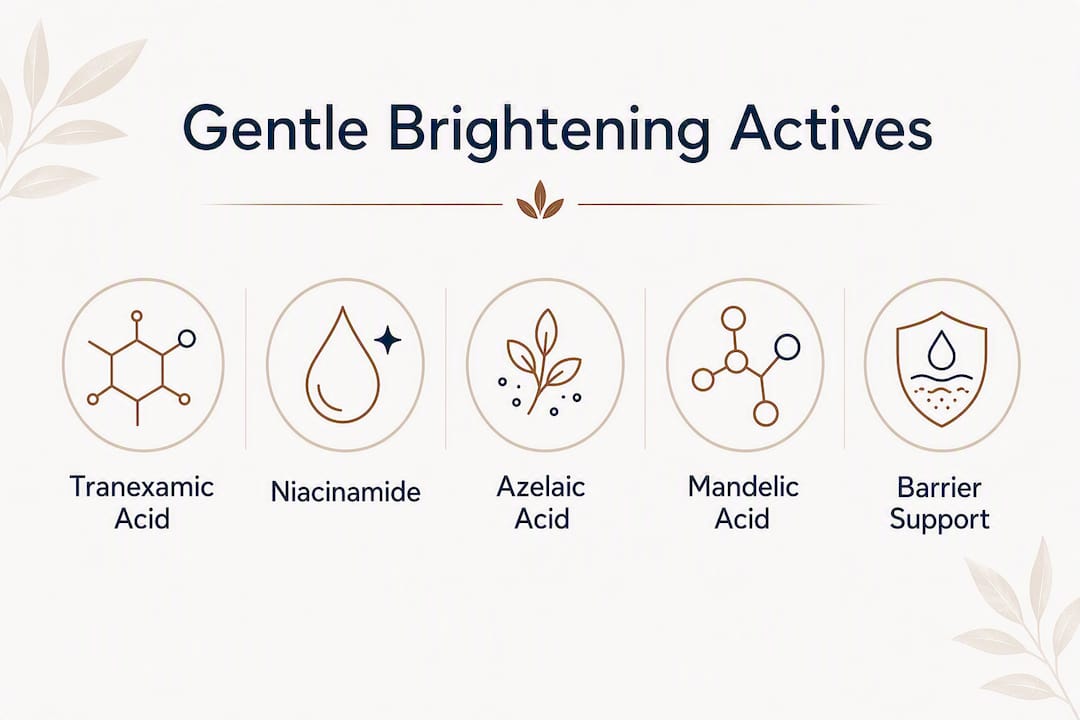
| Brightening Goal | Recommended Gentle Active(s) | Tolerance Flag | Starting Strength |
|---|---|---|---|
| Dark spots / sunspots | Tranexamic acid | Patch-test if rosacea-prone | low concentration suitable for tolerance |
| Post-inflammatory hyperpigmentation (PIH) | Niacinamide + azelaic acid | Avoid high-dose niacinamide if flushing occurs | Niacinamide at a concentration suited for sensitive skin; azelaic acid at a moderate concentration |
| Overall glow / radiance | Vitamin C derivative (MAP or THD ascorbate) | Sensitizing in high UV; always pair with SPF | 5–10% MAP |
| Redness-related discoloration | Azelaic acid | Generally well-tolerated; rare stinging | 10% |
| Melasma-prone skin | Tranexamic acid + licorice extract | Melasma requires dermatologist oversight | 2–3% tranexamic |
| Post-acne marks | Niacinamide + mandelic acid | Introduce mandelic slowly; skip if barrier is compromised | Niacinamide at a concentration suited for sensitive skin; mandelic acid at a moderate concentration |
Dermatologists consistently point out that defining your brightening goal first — sunspots vs. PIH vs. melasma — improves results and cuts unnecessary risk. These categories respond to different mechanisms, so a product that fades sunspots may do nothing for post-acne marks.
How gentle brightening serums actually work
Every brightening serum targets one or more steps in the melanin production and transfer chain. The gentler the mechanism, the less likely it is to trigger reactive inflammation that paradoxically worsens pigmentation.
There are five main mechanism categories:
- Tyrosinase inhibition: Slows the enzyme that converts tyrosine into melanin. Tranexamic acid, kojic acid, and licorice extract work here.
- Melanosome transfer blocking: Stops melanin from moving from melanocytes into surrounding skin cells. Niacinamide is the primary example.
- Antioxidant stabilization: Neutralizes UV-triggered free radicals before they stimulate excess melanin. Vitamin C derivatives and bakuchiol act here.
- Gentle cell turnover: Speeds surface renewal to shed pigmented cells. Mandelic acid (the gentlest AHA) and low-dose bakuchiol support this without the inflammation risk of glycolic acid.
- Barrier support: Keeps the skin’s protective layer intact so actives can work without triggering reactive pigment flares. Peptides, hyaluronic acid, and ceramides play this role.
The gentler mechanisms — melanosome transfer blocking and barrier support — are why niacinamide and azelaic acid are the first-line choices for reactive skin. They address pigmentation without provoking the inflammation that makes things worse. More aggressive mechanisms like tyrosinase inhibition via high-dose kojic acid can be effective but carry a higher irritation ceiling, especially on compromised skin. Detailed ingredient mechanisms and safety considerations are worth reviewing before you commit to a new active.

Comparing the key gentle actives: efficacy, safety, and where to start
The ingredient-level comparison is where most brightening serum reviews fall short. Knowing that niacinamide brightens is less useful than knowing how gently, at what concentration, and for whom.
| Active | Best For | Gentleness | Starting Concentration | Key Caution |
|---|---|---|---|---|
| Niacinamide | PIH, overall tone, barrier support | Very high | moderate concentration suitable for sensitive skin | Flushing at 10%+ in some people |
| Tranexamic acid | Dark spots, melasma, stubborn PIH | High | low concentration suitable for tolerance | Limited long-term data; patch-test |
| Azelaic acid | Redness, rosacea-related discoloration, PIH | High | moderate concentration | Mild tingling on first use |
| Magnesium ascorbyl phosphate (MAP) | Antioxidant support, glow | Moderate-high | moderate concentration | Less potent than L-ascorbic acid |
| Tetrahexyldecyl ascorbate (THD) | Antioxidant + mild brightening | Moderate-high | moderate concentration | Oil-soluble; may not suit very oily skin |
| Licorice extract / glabridin | Redness, mild dark spots | Very high | low concentration suitable for gentle use | Slow results; best as a supporting ingredient |
| Bakuchiol | Gentle turnover, glow | Very high | low concentration suitable for gentle use | Not a direct retinol replacement for pigment |
| Mandelic acid | Surface renewal, mild PIH | Moderate-high | moderate concentration | Avoid on broken or eczema-affected skin |
Niacinamide is the most forgiving entry point. Practitioners recommend a lower concentration for sensitive skin rather than higher strength formulas, which can cause flushing in some people. It blocks melanosome transfer, supports the barrier, and pairs well with almost everything.
Tranexamic acid is the standout for stubborn dark spots and melasma-prone skin. When formulated with hydrating and barrier-supporting ingredients, it stays effective without the irritation ceiling of stronger acids. Cellure’s formulation takes this approach directly.
Azelaic acid is underused. At 10%, it calms redness, inhibits tyrosinase, and evens tone without increasing sun sensitivity — a rare combination. It’s one of the few actives safe to use during pregnancy (with physician guidance).
Mandelic acid deserves more attention in gentle skincare comparisons. Its larger molecular size means slower skin penetration than glycolic or lactic acid, which translates to better tolerance on sensitive or reactive skin. Start at 5% used once or twice a week.
Pro Tip: Niacinamide is one of the best buffer ingredients in a brightening routine. It can reduce the irritation potential of acids and vitamin C derivatives when layered underneath them, making it a smart first step in any multi-active routine.
The science behind brightening ingredients goes deeper than most product labels suggest — understanding the mechanism helps you pick the right active rather than just the most popular one.
Which actives and formulations suit your skin type?
Skin type shapes not just which active to choose but what texture and delivery system will work without causing congestion or stripping.
Sensitive / reactive skin:
- Start with niacinamide 4–5% or azelaic acid 10%
- Choose fragrance-free, lipid-rich or emollient serums that cushion the active
- Avoid layered acid routines until the barrier is stable
Dry skin:
- Pair any brightening active with a hydrating serum (hyaluronic acid, glycerin) underneath
- Lipid-rich formulations or emollient serums prevent the dryness that makes actives sting
- Tranexamic acid in a hydrating base is a strong match
Oily / acne-prone skin:
- Water-based, lightweight serums prevent congestion
- Niacinamide is particularly useful here — it regulates sebum and addresses PIH simultaneously
- Mandelic acid (5–10%) twice weekly can support surface renewal without the comedogenic risk of oil-heavy formulas
Combination skin:
- Apply lighter textures to the T-zone and richer formulas to drier cheek areas if needed
- Niacinamide works across the whole face without adjustment
Melasma-prone skin:
- This requires the most conservative approach. Tranexamic acid and licorice extract are the gentlest options, but melasma is notoriously difficult to self-treat.
- A dermatologist consultation is worth it before committing to a long-term routine.
Special cases: Rosacea, active eczema, or skin that has recently had a procedure (laser, peel, microneedling) needs a barrier-first recovery period of at least 4–6 weeks before any brightening active is introduced. Azelaic acid is the one exception — it can sometimes be used during rosacea management under dermatologist guidance.
The gentle skincare for aging skin framework applies here too: barrier stability first, then targeted actives.
How to introduce a brightening serum safely
The introduction protocol matters as much as the product itself. Reactive skin that gets too much too fast will flare, and that inflammation can trigger the very pigmentation you’re trying to treat.
Step-by-step introduction protocol:
- Stabilize the barrier first. For reactive or sensitive skin, run a deliberately simple routine — gentle cleanser, barrier moisturizer, mineral SPF — for 4–6 weeks before adding any brightening active. This is not optional; it’s the foundation.
- Patch-test before full application. Apply a small amount to the inner arm or behind the ear for 48–72 hours. No reaction? Apply to a small area of the face (jawline or cheek) for another 3–5 days before going full-face.
- Start twice weekly. Apply the serum on non-consecutive nights (e.g., Monday and Thursday). This gives the skin time to respond without accumulating irritation.
- Ramp up gradually. After two weeks with no reaction, move to every other night. After another two weeks, assess whether daily use is appropriate. Not every active needs to be used daily — twice or three times weekly is often enough for results.
- Layer correctly. Apply brightening serums after cleansing and toning, before moisturizer. In the morning, always finish with broad-spectrum SPF 30 or higher.
- Morning vs. night. Vitamin C derivatives are best in the morning (antioxidant protection against UV). Tranexamic acid and niacinamide can go morning or night. Mandelic acid is better at night.
- Retinoid pairing. If you use a retinoid, don’t layer it with a brightening acid on the same night. Alternate nights, or use the retinoid at night and the brightening serum in the morning.
On pH: Mandelic acid and other AHAs work best at a lower pH (around 3.5–4.5). If you’re using a pH-sensitive AHA, apply it before a moisturizer rather than mixing it with a high-pH formula, which can neutralize the active.
Glowing skin tips from professional aesthetics practices reinforce this stepwise approach — the skin responds better to gradual introduction than to a sudden multi-active overload.
How long until you see results?
Expect first perceptible changes in 4–8 weeks for glow and hydration improvements, 8–12+ weeks for meaningful pigment reduction, and longer still for melasma.
The distinction between “glow” and “pigment fade” matters more than most brightening serum reviews acknowledge. An immediate luminosity boost after starting a new serum is usually hydration and optical brightening at work — not actual melanin reduction. Real pigment change takes time because the skin’s renewal cycle runs roughly 28–40 days, and melanin-inhibiting actives need multiple cycles to show visible results.
Timeline by concern:
- Surface glow / hydration: 2–4 weeks (hydration-driven, not pigment-driven)
- Post-acne marks (mild PIH): 6–10 weeks with consistent use
- Dark spots / sunspots: 8–12 weeks minimum; some spots take 4–6 months
- Melasma: 12+ weeks, often requiring professional support alongside topical treatment
Editors and practitioners consistently recommend monitoring for 8–12 weeks before judging whether a product is working for pigment. Switching products every 4 weeks because you haven’t seen dramatic results is one of the most common mistakes — and it resets the clock every time.
Track progress with photos taken under consistent lighting (same time of day, same angle, same distance). A phone camera in natural window light works well. The science-backed results from brightening serums are real, but they require patience and consistency to materialize.
Signs of irritation and when to stop
Knowing when to stop is as important as knowing how to start. Some initial tingling with azelaic acid or mild mandelic acid is normal and usually fades within a few minutes. These signs are not:
- Increasing redness or inflammation that worsens with each application rather than settling
- Stinging that doesn’t fade within 5–10 minutes of application
- New, widespread hyperpigmentation appearing in areas where you applied the product
- Blistering, oozing, or crusting — these indicate a significant reaction and require immediate discontinuation
- Itching or hives beyond the application site, which may signal an allergic response
If any of these occur:
Stop the product immediately. Don’t try to “push through” — irritation-driven pigment flares are a real risk, especially on darker skin tones. Switch to a simple barrier-repair routine: a gentle, fragrance-free cleanser, a ceramide-rich moisturizer, and a mineral (zinc oxide or titanium dioxide) sunscreen. Avoid all exfoliation until the skin has fully settled.
When to see a dermatologist: If redness or pigmentation worsens over 5–7 days after stopping the product, or if you suspect an allergic reaction (hives, swelling), book an appointment. Bring photos of the reaction, a list of every product you were using (including the order of application), and the timeline from first use to first symptom. That information helps a dermatologist identify the trigger quickly.
Why Cellure’s formulation suits reactive and aging skin
Cellure’s Complete Skin Repair Kit is built around the same gentle-first philosophy this article describes: a tranexamic acid base buffered with peptides, hyaluronic acid, and barrier-supporting actives that keep the formula effective without pushing reactive skin past its tolerance threshold.
What the formulation addresses:
- Uneven tone and dark spots via tranexamic acid
- Barrier integrity and hydration via peptides and hyaluronic acid
- Cellular repair and skin renewal via regenerative bioactives (PDRN, EGF, copper peptides)
- Sensitivity management through fragrance-free, tolerance-focused formulation
How to use it within the safe introduction protocol:
- Begin with twice-weekly evening application after cleansing
- Layer under a barrier moisturizer, not over it
- Follow with broad-spectrum SPF 30+ every morning without exception
- Assess at 8 weeks for pigment change; expect glow improvements earlier
Pro Tip: If your skin is particularly reactive, apply a thin layer of your regular moisturizer first, let it absorb for 2–3 minutes, then apply the Cellure serum on top. This “buffering” technique slows absorption slightly and reduces the chance of initial stinging without meaningfully reducing efficacy.
The Cellure approach aligns with what practitioners recommend for reactive skin: stabilize the barrier, introduce a single targeted active, and document progress. The Complete Skin Repair Kit consolidates that protocol into one formulation rather than requiring you to source and layer multiple separate products. For readers who want to understand the full rationale behind why brightening serums work for uneven skin, Cellure’s resource library covers the ingredient science in detail.
Key Takeaways
A barrier-first, single-active introduction protocol with tranexamic acid or niacinamide is the safest and most effective approach to gentle brightening for reactive or sensitive skin.
| Point | Details |
|---|---|
| Match active to goal | Tranexamic acid for dark spots; niacinamide for PIH and barrier support; azelaic acid for redness-related discoloration. |
| Start low, ramp slowly | Begin twice weekly, move to every other night after two weeks with no reaction, then reassess daily use. |
| Timeline is longer than you think | Expect glow in 4–8 weeks; pigment reduction takes 8–12+ weeks of consistent use. |
| SPF is non-negotiable | Daily broad-spectrum SPF 30+ is required — without it, brightening gains are undermined regardless of the active used. |
| Cellure’s recommendation | The Complete Skin Repair Kit pairs tranexamic acid with peptides and hydrators for a tolerance-focused, clinic-grade brightening approach. |
The case for doing less, better
The most common mistake in brightening routines isn’t choosing the wrong active. It’s choosing too many actives at once, then attributing the resulting irritation to “sensitive skin” rather than to an overloaded routine.
The evidence consistently points in one direction: a less-is-more brightening philosophy — stabilize the barrier, introduce one targeted active, give it 8–12 weeks — outperforms the stacked-acid approach for reactive skin. Not because the stacked approach can’t work, but because irritation-driven pigment flares erase progress faster than any serum can create it. The readers who see the most consistent results are the ones who resist the urge to add more when progress feels slow. Patience and a stable barrier are the two most underrated ingredients in any brightening routine.
Cellure’s Complete Skin Repair Kit: a clinic-grade gentle option
For readers who want a single, pre-formulated solution rather than building a multi-product stack from scratch, the Complete Skin Repair Kit from Cellure consolidates the gentle-first brightening protocol into one cohesive system. It pairs tranexamic acid with peptides, PDRN, and hyaluronic acid — the combination this article identifies as the most tolerance-friendly approach for reactive and aging skin.
The kit is available directly through Cellure’s online store, with an optional subscription for ongoing use. Before starting, patch-test on the inner arm for 48–72 hours, and commit to daily SPF as part of the routine from day one. For readers exploring Cellure’s full range of regenerative formulations, the brand’s product line covers lifting, volumizing, calming, and barrier-repair alongside brightening.
Useful sources and further reading
| Source | What it covers |
|---|---|
| PMC: Niacinamide mechanisms and skin applications | Peer-reviewed review of niacinamide’s role in barrier function and pigmentation |
| PMC: Tranexamic acid for hyperpigmentation | Clinical evidence on tranexamic acid for melasma and dark spots |
| PMC: Azelaic acid in dermatology | Review of azelaic acid’s mechanisms, safety, and clinical applications |
| PMC: Vitamin C in skincare | Evidence on ascorbic acid derivatives for photoprotection and brightening |
| PMC: Mandelic acid and AHA tolerability | Comparative tolerability of AHAs including mandelic acid |
| PMC: Hyperpigmentation treatment review | Broad clinical review of topical agents for hyperpigmentation |
| PMC: Bakuchiol as a retinol alternative | Evidence on bakuchiol’s efficacy and tolerability vs. retinol |
| Cellure: Why use brightening serums | Ingredient rationale for gentle brightening, including licorice and bakuchiol |
| Cellure: Brightening serum benefits | Seven evidence-backed outcomes from consistent brightening serum use |
| Cellure: Complete Skin Repair Kit | Product page for Cellure’s tolerance-focused brightening and repair kit |