


Why Hydration Matters in Aging Skin After 30
TL;DR:
- Hydration is crucial for maintaining skin barrier integrity and youthful appearance after age 30. As NMF and lipids decline with age, skin becomes drier, thinner, and more reactive, with increased water loss that accelerates aging. Combining topical moisturizers with internal supplements and proper skincare routines effectively supports hydration, elasticity, and barrier repair over time.
Hydration is the single most important factor in maintaining skin barrier integrity and a youthful appearance after age 30. The skin’s ability to hold moisture declines measurably with age, triggering a cascade of structural changes that no amount of collagen cream can fully reverse. Two terms define this process: transepidermal water loss (TEWL), the rate at which water evaporates through the skin, and natural moisturizing factor (NMF), the collection of water-binding compounds that keep the stratum corneum supple. When both decline together, skin becomes drier, thinner, and more reactive. Understanding why hydration matters in aging skin is the first step toward doing something about it.
Why hydration matters in aging skin: the biology after 30
Aging skin does not simply “dry out.” It undergoes measurable biological changes that compromise its ability to retain water and defend itself. Aging skin shows a decrease in NMF, lipid content, and overall hydration, while TEWL increases, making skin thinner, more sensitive, and drier after age 30. That combination means water escapes faster than the skin can replace it.
The NMF is made up of amino acids, urocanic acid, pyrrolidone carboxylic acid, and other hygroscopic compounds produced naturally in the outer skin layer. As NMF levels drop with age, the stratum corneum loses its ability to bind water from the environment. The result is not just surface dryness. It is a structural weakening of the skin barrier that leads to increased sensitivity, itching, and reduced resilience against irritants.
Lipid depletion compounds the problem. Ceramides, cholesterol, and fatty acids form the “mortar” between skin cells. When these lipids decrease, the barrier becomes porous, and TEWL accelerates. Skin that loses water faster than it absorbs it will feel tight, look dull, and respond poorly to active ingredients.
Key changes that occur in aging skin hydration:
- NMF reduction: Water-binding compounds in the stratum corneum decline, reducing the skin’s ability to hold moisture.
- Lipid depletion: Ceramides and fatty acids decrease, creating gaps in the barrier that allow water to escape.
- Increased TEWL: Water evaporates through the skin at a higher rate, accelerating dryness and fragility.
- Thinning epidermis: The outer skin layer becomes thinner, making it more reactive to environmental stressors.
- Reduced sebum production: Less natural oil means less surface protection against moisture loss.
Pro Tip: Clinical hydration assessments measure TEWL rates and stratum corneum water content rather than relying on how skin feels. If your skin feels “fine” but looks dull and tight, TEWL may still be elevated.
How does hydration affect skin elasticity as you age?
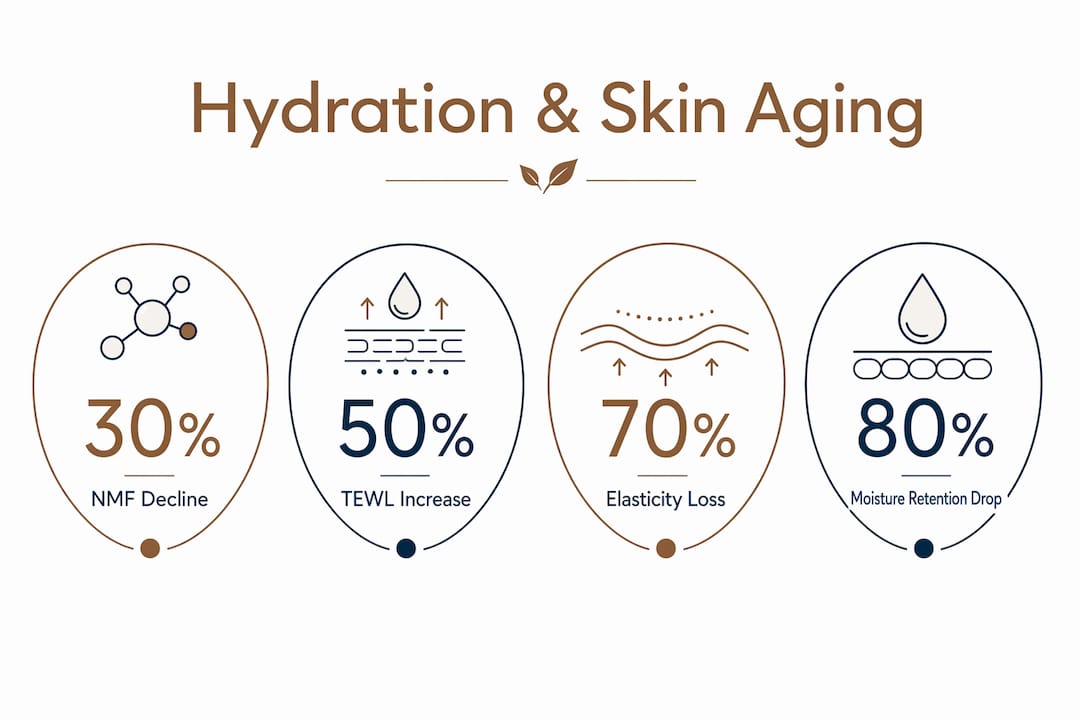
Skin elasticity is not governed by collagen alone. Hydration impacts elasticity independently of collagen loss, and barrier repair with moisture retention is a separate, equally important mechanism. This distinction matters because many people focus exclusively on collagen-boosting products while ignoring the moisture side of the equation.
The protein aquaporin-3 (AQP3) sits at the center of this process. AQP3 regulates transmembrane water permeability in skin cells, playing a direct role in maintaining both hydration and elasticity. When AQP3 activity declines with age, water transport across cell membranes slows, and skin loses its ability to rebound after compression or movement. That loss of rebound is what most people recognize as sagging or crepey texture.
Here is how dehydration affects elasticity at each level:
- Stratum corneum stiffening: When the outer layer loses water, it becomes rigid rather than pliable. Rigid skin cracks and creases more easily under normal facial movement.
- Reduced cellular turgor: Skin cells that are not adequately hydrated shrink slightly. That volume loss translates to a flatter, less plump surface appearance.
- Impaired barrier repair: Hydration status links directly to barrier integrity and mechanical resilience. A compromised barrier cannot repair micro-damage efficiently, which accelerates visible aging.
- Collagen environment degradation: Collagen fibers sit in a water-rich matrix. When that matrix dries out, collagen fibers lose their organized structure and the skin’s mechanical strength declines.
The practical implication is clear. Restoring moisture balance can improve the appearance of elasticity before any collagen-stimulating treatment takes effect. Hydration is the faster, more accessible lever. You can read more about the connection between moisture and firmness to understand how these two factors interact at a cellular level.
Moisturizers vs. oral supplements: what the evidence shows
Not all hydration strategies work the same way. Topical moisturizers and oral supplements target different parts of the hydration problem, and the best results come from combining both approaches.
How topical moisturizers work
Topical moisturizers increase epidermal hydration primarily by reducing TEWL, using a combination of humectants, occlusives, and emollients. Each ingredient class plays a distinct role.
| Ingredient class | Function | Common examples |
|---|---|---|
| Humectants | Attract and bind water to the skin | Glycerin, hyaluronic acid, sodium PCA |
| Occlusives | Form a physical barrier to slow water evaporation | Petrolatum, squalane, dimethicone |
| Emollients | Fill gaps between skin cells to smooth texture | Shea butter, ceramides, fatty acids |
Effective skin hydration requires both humectant-based water-binding and an occlusive lipid barrier to reduce TEWL. Using only one mechanism limits lasting hydration. A hyaluronic acid serum applied without a sealing moisturizer on top will draw water to the surface and then lose it to evaporation, especially in low-humidity environments.
Pro Tip: Apply humectant serums to slightly damp skin, then follow immediately with an occlusive or emollient moisturizer. This two-step approach locks in the water the humectant attracted rather than letting it evaporate.
What oral supplements add
Topical products work from the outside in. Oral supplements work from the inside out, and the clinical evidence is compelling. Oral sodium hyaluronate at 120 mg/day over 12 weeks significantly improves skin hydration, reduces TEWL, enhances elasticity, and decreases wrinkle depth in adults. That result came from a randomized, double-blind, placebo-controlled trial of 150 healthy adults, which is a high standard of evidence for a skincare intervention.
The timeline matters here. Clinical improvements from oral supplements require consistent intake over weeks to yield measurable biomechanical changes. Expect 8–12 weeks before visible results appear. Stopping early is the most common reason people conclude supplements “don’t work.”
Practical hydration strategies for mature skin
Building a hydration-focused routine does not require a complete overhaul. These targeted adjustments deliver the most impact for adults over 30 dealing with dryness, tightness, or loss of suppleness.
- Cleanse gently. Harsh surfactants strip NMF and lipids from the skin surface. Use a low-pH, non-foaming cleanser that does not leave skin feeling tight after rinsing. Tightness after cleansing is a direct sign of barrier disruption.
- Layer your hydration. Apply a humectant serum first, then a moisturizer containing ceramides or fatty acids to seal the barrier. This sequence mirrors the skin’s own two-layer hydration system.
- Use a barrier repair product at night. Skin repairs itself during sleep. A ceramide-rich cream or a product formulated for skin barrier repair applied before bed supports this natural cycle.
- Protect against environmental TEWL triggers. Central heating, air conditioning, and low humidity all accelerate water loss. A humidifier in your bedroom can reduce overnight TEWL without any product application.
- Do not rely on water intake alone. Drinking more water has limited direct effects on skin hydration unless you are systemically dehydrated. Skin hydration is governed mainly by barrier function. Hydrate internally, but do not expect it to replace topical care.
- Consider a barrier repair protocol if your skin is reactive. Compromised barriers need a structured approach before adding active ingredients like retinoids or acids.
- Evaluate supplements at the 12-week mark. Oral hyaluronic acid or collagen peptides need consistent use over months to show measurable changes in hydration and elasticity.
The importance of moisture in skin care is not a trend. It is a biological requirement that becomes more urgent with every decade after 30. Consistent, layered hydration protects the barrier, supports elasticity, and creates the foundation every other anti-aging treatment needs to work.
Key takeaways
Hydration is the biological foundation of aging skin health because it governs barrier integrity, elasticity, and the skin’s ability to repair itself over time.
| Point | Details |
|---|---|
| NMF and lipids decline with age | After 30, the skin loses water-binding compounds and barrier lipids, accelerating dryness and sensitivity. |
| Hydration drives elasticity independently | AQP3 and moisture balance affect skin rebound separately from collagen, making hydration a faster lever for suppleness. |
| Topical products need two mechanisms | Humectants attract water; occlusives seal it in. Using only one limits lasting hydration results. |
| Oral supplements require 12 weeks | Sodium hyaluronate at 120 mg/day improves hydration and elasticity, but only with consistent use over weeks. |
| Drinking water is not enough | Skin hydration is governed by barrier function, not fluid intake alone. Topical care is non-negotiable. |
Hydration first: why I think most anti-aging routines get the order wrong
Most anti-aging routines I see are built around actives: retinoids, vitamin C, peptides, acids. Hydration gets treated as a finishing step, something you add at the end if your skin feels dry. That order is backwards, and it costs people results.
Every active ingredient works better in a well-hydrated skin environment. Retinoids penetrate more evenly. Peptides reach their target receptors more efficiently. Acids exfoliate without triggering reactive dryness. When the barrier is compromised and TEWL is elevated, you are essentially applying expensive ingredients to a leaky container.
What I find most underappreciated is the elasticity connection. People spend significant money on collagen-stimulating treatments and see modest results, then wonder why. The answer is often that dehydrated skin cannot express the elasticity gains those treatments produce. The collagen is there. The moisture matrix to support it is not.
The other thing worth saying plainly: skin hydration science has advanced significantly, and the gap between what the research shows and what most people actually do in their routines is wide. Barrier-supporting hydration restores skin homeostasis and reduces irritation well beyond cosmetic plumping. That is not a marketing claim. It is documented in peer-reviewed literature.
Start with hydration. Build everything else on top of it.
— Sara
How Cellure supports hydration and skin barrier repair
Cellure formulates its serums and treatment kits around the same science this article covers: barrier repair, cellular regeneration, and ingredients that work at the structural level of the skin.
Cellure’s products use bioactive ingredients including peptides, polynucleotides, and tranexamic acid to support skin renewal from the cellular level up. These are not surface-level moisturizers. They are formulated to address the underlying mechanisms of aging skin, including barrier function, firmness, and hydration retention. If you are ready to move beyond basic moisturizing and into targeted, cellular skin regeneration, Cellure’s product range offers a science-backed starting point for adults who want real, measurable results.
FAQ
What is TEWL and why does it matter for aging skin?
TEWL stands for transepidermal water loss, the rate at which water evaporates through the skin’s outer layer. Elevated TEWL is a direct sign of barrier dysfunction and accelerates dryness, sensitivity, and visible aging in skin over 30.
Does drinking more water improve skin hydration?
Drinking water has limited direct effects on skin hydration unless you are systemically dehydrated. Skin moisture is governed primarily by barrier function, so topical moisturizers and barrier repair products are more effective than increased fluid intake alone.
How long does it take for oral hyaluronic acid to improve skin?
Clinical evidence shows that oral sodium hyaluronate at 120 mg/day requires at least 12 weeks of consistent use to produce measurable improvements in skin hydration, elasticity, and wrinkle depth.
What ingredients should a moisturizer contain for aging skin?
An effective moisturizer for aging skin should include humectants such as glycerin or hyaluronic acid to attract water, occlusives such as petrolatum or squalane to seal the barrier, and emollients such as ceramides or fatty acids to repair lipid gaps.
Can improving hydration actually restore skin elasticity?
Yes. Hydration affects elasticity independently of collagen levels through mechanisms including AQP3 water transport and stratum corneum flexibility. Restoring moisture balance can visibly improve skin suppleness before collagen-stimulating treatments take full effect.