


Why Choose Gentle Formulations for Sensitive Skin
TL;DR:
- Gentle skincare formulas use mild surfactants, proper pH levels, and exclude irritants to protect sensitive and aging skin. Research confirms that effective, low-foam cleansers maintain skin barrier integrity without sacrificing cleanliness. Consistent use of barrier-supporting ingredients improves long-term skin resilience and reduces signs of aging.
If you’ve ever been told that gentle products won’t get the job done, you’re not alone. The idea that effective skincare has to sting, strip, or lather intensely is one of the most persistent myths in beauty. Understanding why choose gentle formulations matters is a question of science, not preference. For the 40 to 50% of US adults living with sensitive skin or eczema, and for anyone watching their skin change with age, the formulas you reach for every day can either protect your barrier or quietly damage it.
Table of Contents
- Key Takeaways
- Why choose gentle formulations: the science behind the label
- Benefits for sensitive and aging skin
- Gentle vs. traditional: busting the foam myth
- How to choose gentle formulations for your routine
- Why gentle skincare is a long-term investment
- My honest take after years of watching skin change
- Cellure’s approach to gentle, results-driven skincare
- FAQ
Key Takeaways
| Point | Details |
|---|---|
| Gentle doesn’t mean weak | Mild surfactants can match traditional cleansers in effectiveness with far less irritation. |
| Aging skin needs extra care | Thinner, more permeable barriers in aging skin make gentle formulations a clinical necessity. |
| Foam is not a quality signal | Low-lather products clean just as well and retain moisture better than high-foam alternatives. |
| Barrier ingredients are non-negotiable | Ceramides, niacinamide, and hyaluronic acid are the foundation of any effective gentle routine. |
| Ingredient quality over marketing labels | Clinical testing and precise ingredient selection matter more than “natural” or “clinical” branding. |
Why choose gentle formulations: the science behind the label
The word “gentle” gets applied to so many products that it has started to feel meaningless. But in formulation science, it refers to something specific. A genuinely gentle product is built around mild surfactants, a pH that respects your skin’s natural acid mantle (typically between 4.5 and 5.5), and a deliberate absence of known irritants like sulfates, synthetic fragrances, and harsh preservatives.
The surfactant choice alone tells you a great deal. Traditional cleansers often rely on sodium lauryl sulfate (SLS) or sodium laureth sulfate (SLES), which produce that satisfying foam but strip the skin’s lipid barrier in the process. Advanced mild alternatives like Sodium Methyl Lauroyl Taurate offer cleaning efficacy equivalent to SLES but with only one-tenth the irritation potential. That is not a marginal improvement. That is a different category of product.
Here is what separates a well-formulated gentle product from a mediocre one:
- Mild surfactant system: Taurate or glucoside-based surfactants that clean without disrupting the lipid barrier
- pH alignment: Formulated at or near skin’s natural pH to preserve acid mantle integrity
- Fragrance-free: No synthetic or natural fragrance, which is one of the leading causes of contact dermatitis
- Barrier-supportive actives: Ingredients like ceramides, glycerin, and panthenol that reinforce rather than deplete
- Clinical safety testing: Validated through dermatologist or patch testing, not just marketing claims
Pro Tip: When reading an ingredient list, look at the first five to seven ingredients. They make up the largest percentage of the formula. If you see water, a mild surfactant, glycerin, and a barrier ingredient near the top, you are looking at a genuinely gentle product.
The precision formulation approach matters more than whether a product markets itself as natural or clinical. A product can contain natural extracts and still be highly irritating. Another can be fully synthetic and perfectly biocompatible. What counts is ingredient selection, purity, and concentration.
Benefits for sensitive and aging skin
The benefits of gentle skincare are most visible in two populations: people with reactive or sensitive skin, and people whose skin has begun to change with age. These groups often overlap. And both share a critical vulnerability: a compromised or thinning skin barrier.
Sensitive and aging skin barriers are thinner and more permeable, which means irritants penetrate more easily and moisture escapes more readily. Using aggressive products on this skin type does not toughen it up. It accelerates the damage. This is why understanding what sensitive skin actually is becomes the first step toward choosing the right regimen.

Research-backed ingredients make a measurable difference here. A global consensus on integrated skincare identifies ceramides, hyaluronic acid, and niacinamide as the core of barrier repair, reducing dryness, redness, and sensitivity across a range of skin conditions.
| Ingredient | Primary benefit | Best for |
|---|---|---|
| Ceramides | Restores lipid barrier structure | Dry, sensitive, eczema-prone skin |
| Hyaluronic acid | Deep hydration and plumping | Aging and dehydrated skin |
| Niacinamide | Reduces redness, regulates sebum | Reactive and combination skin |
| Peptides | Supports collagen synthesis | Aging skin with firmness concerns |
| Panthenol (B5) | Soothes and retains moisture | All skin types, especially irritated |
“Dermatologists increasingly emphasize respecting biological thresholds for skin barrier function, especially in vulnerable populations, highlighting the need for gentle, predictable skincare.” (source)
The market is responding to this reality. Consumers are shifting away from sulfate-based body washes and cleansers toward dermatologist-recommended, pH-balanced alternatives, with premium gentle product segments projected to reach 45 to 50% of market value by 2030. This is not a niche trend. It reflects a broader understanding that skin health starts with what you put on it every day.
Gentle vs. traditional: busting the foam myth
Here is the misconception that causes the most damage: people equate foam with clean. If a product doesn’t lather intensely, it feels like it isn’t working. This perception is understandable, but it is not backed by evidence.
Foam volume does not correlate with cleaning efficacy. The foam you see is a surfactant byproduct, not a measure of how well dirt and oil are being removed. Low-foam mild surfactants remove sebum and environmental residue just as effectively as high-foam alternatives, but without stripping the moisture that keeps your barrier intact.
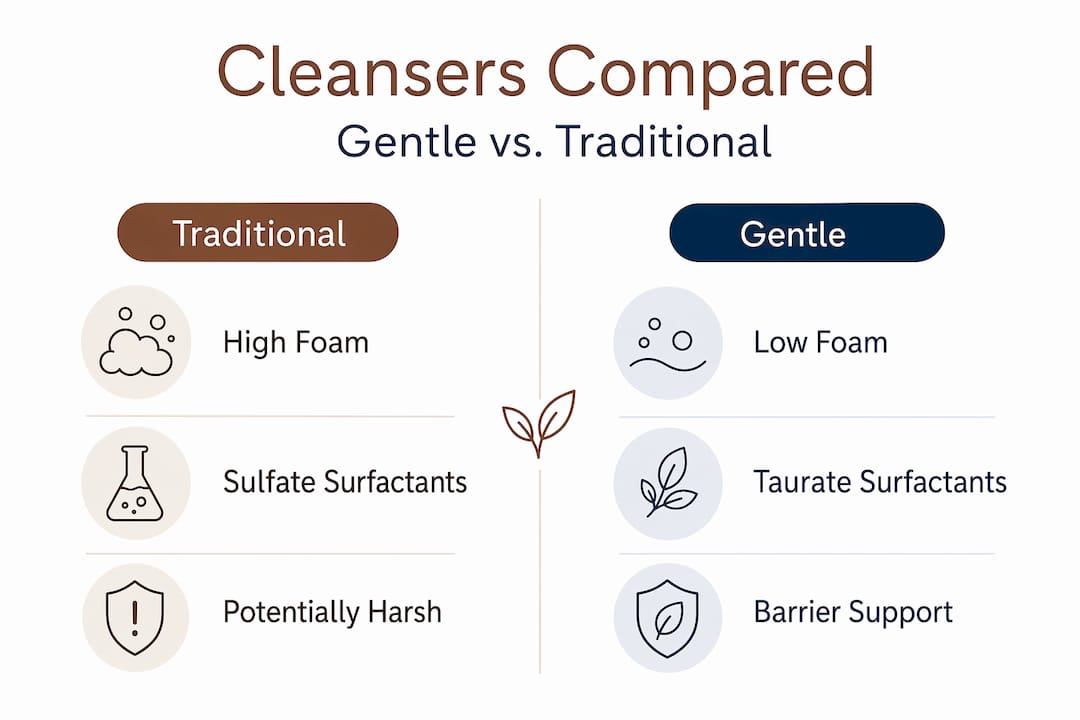
The sensory adjustment is real, though. When you switch from a high-foaming cleanser to a gentle one, the texture feels creamier and the lather is minimal. Many people interpret this as ineffective and go back to their old product. That is the wrong conclusion.
| Feature | Traditional (SLS-based) | Gentle (taurate-based) |
|---|---|---|
| Foam volume | High | Low to moderate |
| Cleaning efficacy | High | High (equivalent) |
| Irritation potential | High | Low (1/10th) |
| Moisture retention | Poor | Good |
| Barrier impact | Disrupts lipids | Preserves barrier |
| Best for | Normal, oily skin | Sensitive, dry, aging skin |
Understanding sensory cues in gentle cleansers is a documented adoption challenge. Education matters here. Once you understand that the absence of foam is a feature and not a flaw, the transition becomes much easier.
Pro Tip: Give any new gentle cleanser a three-week adjustment period before evaluating it. Your skin needs time to recalibrate after years of lipid stripping, and your perception of “clean” will shift once redness and tightness start to fade.
How to choose gentle formulations for your routine
Knowing why gentle formulations work is one thing. Choosing them well is another. Here is how to apply this knowledge practically, especially if your concerns include sensitivity, aging, or both.
Start with your cleanser. It sets the tone for everything that follows. Look for a fragrance-free, pH-balanced formula with a mild surfactant system. Skip anything with SLS, SLES, or synthetic fragrance in the first five ingredients. For aging skin specifically, a cream or milk cleanser often outperforms gel formats because it adds back moisture during the cleansing step.
From there, focus on layering. Applying a barrier-repair serum after cleansing while skin is still slightly damp dramatically improves ingredient absorption. The evidence-based approach to gentle aging skincare prioritizes this layering order: cleanser, hydrating toner or essence, targeted serum, moisturizer, and SPF in the morning.
Key things to prioritize when selecting products:
- Fragrance-free is non-negotiable for reactive or sensitized skin. Even “natural” fragrance from essential oils triggers responses in many people.
- Clinically validated actives like ceramides, niacinamide, and peptides address both barrier repair and aging concerns simultaneously.
- Avoid over-activing your routine. Retinol, acids, and vitamin C are effective but need to be introduced slowly, and always cushioned by barrier-supportive products.
- Look for dermatologist-tested claims with supporting patch test or clinical data, not just logos on packaging.
- Patch test new products on the inner arm for 48 hours before applying to your face.
Pro Tip: If you have aging skin and want to use retinol, sandwich it between two layers of gentle moisturizer. Apply moisturizer first, then retinol, then moisturizer again. This technique dramatically reduces the dryness and peeling that makes people quit retinol before it can work.
The best practices for sensitive aging skin always come back to the same foundation: simplify, strengthen the barrier, and introduce active ingredients one at a time. Less is consistently more effective for reactive skin.
Why gentle skincare is a long-term investment
The case for choosing gentle formulations is not just about avoiding irritation today. It is about what your skin looks like in five and ten years. A compromised barrier accelerates every visible sign of aging: dullness, fine lines, sensitivity, and uneven tone. Protecting that barrier consistently is the single most effective preventive measure you can take.
The shift toward what researchers call skinification of body care reflects this understanding. Ingredient transparency and clinical standards once reserved for facial skincare are now being applied to body products too. Consumers are demanding products that respect skin biology rather than override it.
Gentle formulation advantages compound over time. Skin that is not chronically inflamed retains its repair capacity. Barriers that are not repeatedly stripped can focus on regeneration rather than recovery. For aging skin, this means the difference between skin barrier repair as an ongoing crisis response versus a proactive maintenance strategy. The math is simple. Consistent gentleness outperforms aggressive intervention, every time.
My honest take after years of watching skin change
I’ve spent years reading research, tracking formulations, and watching what actually happens to skin over time. And the pattern is clear. The people who age well, whose skin stays resilient and even-toned through their 40s, 50s, and beyond, are almost never the ones using the most aggressive products.
What I’ve seen most often is a cycle: someone strips their skin with harsh products, their skin produces more oil to compensate, they strip it again, and eventually the barrier breaks down entirely. Then they’re dealing with chronic sensitivity that didn’t exist before. This happens because traditional skincare culture celebrated the feeling of “squeaky clean” as a sign that the product worked. It isn’t. That tight, stripped sensation after cleansing is damage signaling.
My take is this: the skincare industry oversold the idea of “fighting” your skin. Gentle formulations work with your skin’s biology instead. They support what your skin is already trying to do, which is maintain its barrier, retain moisture, and repair itself. That is not a passive or weak approach. It is the most direct path to lasting skin health. I’ve watched people transform chronically reactive skin in under three months simply by removing harsh products and replacing them with barrier-supportive alternatives. Patience and consistency with gentle routines consistently outperform the quick-fix approach. Every time.
— Sara
Cellure’s approach to gentle, results-driven skincare
If you’ve taken the time to understand why gentle formulations matter, the next step is finding products that actually deliver on both fronts: gentle enough for daily use on sensitive or aging skin, and effective enough to produce visible results.
Cellure builds every formula around clinically supported bioactive ingredients: peptides, polynucleotides, tranexamic acid, and ceramide-based barrier actives. Nothing in the lineup uses harsh surfactants, synthetic fragrances, or known sensitizers. For anyone ready to address firmness loss, uneven tone, or chronic sensitivity with one structured routine, the Complete Skin Repair Kit brings all the essential steps together in a single kit designed around barrier repair and cellular regeneration. You can explore the full product range at Cellure and see exactly which ingredients are doing the work.
FAQ
What makes a formulation truly gentle?
A truly gentle formulation uses mild surfactants, a pH aligned with skin’s natural acid mantle, and excludes known irritants like sulfates and synthetic fragrances. Clinical testing for tolerability is the key differentiator between genuinely gentle and simply marketed-as-gentle.
Are gentle skincare products less effective?
No. Research shows that mild surfactants like Sodium Methyl Lauroyl Taurate clean as effectively as traditional SLES formulas with one-tenth the irritation, disproving the idea that effectiveness requires aggression.
Why do gentle formulations matter more for aging skin?
Aging skin has a thinner, more permeable barrier that absorbs irritants more readily and loses moisture faster. Using gentle, barrier-supportive formulations with ceramides and peptides is a clinical priority, not just a comfort preference.
Why doesn’t my gentle cleanser foam much?
Low foam does not mean low performance. Foam is a sensory byproduct of certain surfactants, not a measure of cleansing ability. Mild surfactants clean effectively while retaining moisture and protecting your lipid barrier.
How long before I see results from gentle skincare?
Most people notice reduced redness and tightness within two to three weeks of switching to a gentle routine. Barrier repair and more visible improvements in texture and tone typically appear within six to twelve weeks of consistent use.