


What Is Clinical Grade Skincare? Your 2026 Guide
TL;DR:
- “Clinical grade” skincare is a marketing term with no official regulatory definition or standard, often used without scientific backing. Genuine clinical products use evidence-based active ingredients at tested concentrations and are supported by peer-reviewed studies, unlike many labeled products that simply suggest higher potency. Consumers should evaluate ingredient transparency, clinical data, and proper ingredient concentrations rather than rely solely on branding or claims.
Most people assume that if a product says “clinical grade” on the label, something official is behind that claim. A government agency approved it. A doctor signed off on it. The reality is different, and understanding what is clinical grade skincare actually means will change how you shop. The term has no legal definition, no regulatory standard, and no gatekeeping body controlling who uses it. That does not mean clinical skincare products are worthless. It means you need to know what actually separates the real from the repackaged.
Table of Contents
- Key takeaways
- What “clinical grade skincare” actually means legally
- How to read clinical evidence behind skincare claims
- Clinical grade vs. regular skincare: the real differences
- How to choose clinical skincare products that actually work
- My take on the clinical grade label problem
- Clinically supported skincare from Cellure
- FAQ
Key takeaways
| Point | Details |
|---|---|
| No official definition exists | “Clinical grade” is a marketing term with no FDA or federal regulatory definition. |
| Ingredients and concentration matter | What separates genuine clinical products is evidence-backed actives at tested concentrations. |
| Clinical evidence varies widely | Look for peer-reviewed studies and instrumental data, not consumer satisfaction surveys. |
| Higher potency carries real risk | Strong actives can cause irritation without proper guidance, especially for sensitive skin. |
| Labels mislead, science does not | Evaluate products by their ingredient transparency and published clinical data, not their branding. |
What “clinical grade skincare” actually means legally
Here is the first thing worth knowing: no FDA definition exists for “clinical grade,” “medical grade,” or “professional grade” skincare. Any brand can put those words on a bottle today without meeting a single specific standard. No testing requirement. No minimum concentration threshold. No certification process.
The FDA does regulate skincare products, but it uses two categories. A product is either a cosmetic or a drug. A cosmetic changes the appearance of skin. A drug affects the structure or function of the body. This distinction matters enormously because drugs require clinical trials, safety data, and FDA approval before reaching shelves. Cosmetics do not.
Most products marketed as “clinical grade” are cosmetics. They affect how skin looks, not how it functions at a cellular level, and that keeps them outside drug territory. These terms are marketing language without federal legal meaning. “Medical grade,” “professional grade,” and “cosmeceutical” are used interchangeably across the industry, often for positioning rather than precision.
What the law does require is honesty in advertising. The FTC and the National Advertising Division hold brands to what is called competent and reliable scientific evidence when making health-related claims. That standard means brands cannot say their product clinically reduces wrinkles by 40% without data to back it up. Whether they always follow this is another matter, but enforcement risk is real.
Here is a summary of how skincare products are categorized under current U.S. regulation:
- Cosmetics: No pre-market approval needed. Claims must relate to appearance, not biological function.
- Drugs: Require FDA approval, clinical trials, and proven safety and efficacy data before sale.
- Cosmeceuticals: Not an FDA category. A marketing term used by industry for products between cosmetics and drugs.
- OTC drugs: Things like sunscreen and acne treatments with active ingredients listed on the Drug Facts panel.
Pro Tip: If a skincare product has a Drug Facts panel on the box, it is regulated as an OTC drug and held to stricter standards than a product labeled simply as a serum or cream.
How to read clinical evidence behind skincare claims
Once you accept that the label tells you almost nothing, the next step is learning to read the science behind the product. This is where genuine clinical skincare products separate themselves from those riding the terminology.
The evidence-backed skincare you want to look for is backed by studies with specific, measurable outcomes. Not a customer survey. Not a focus group. Actual controlled research where participants are measured before and after using objective instruments.
Here is how to evaluate the quality of clinical research behind a skincare claim:
- Look for controlled study designs. The gold standard is a double-blind, randomized, placebo-controlled trial. Fewer variables mean cleaner results.
- Check if the study was peer-reviewed. Research published in scientific journals has been reviewed by independent experts, which filters out weak methodology.
- Find quantitative outcomes. A good clinical study measures wrinkle depth, transepidermal water loss, melanin index, or skin elasticity with instruments. Not how many participants “felt” their skin improved.
- Verify ingredient concentrations. Studies are conducted at specific concentrations. If a product uses the same ingredient at a fraction of the studied dose, the results may not apply.
- Assess who funded the research. Industry-funded studies are not automatically invalid, but independent replication strengthens credibility significantly.
A useful benchmark: some brands have 60-plus peer-reviewed studies supporting their formulations, including histological data showing changes in collagen and elastin structure. That is a fundamentally different category than a product citing that 92% of users noticed smoother skin after four weeks.
“Studies reportedly showing ‘98% of consumers saw improvement’ may be superficial; look for objective wrinkle-depth or hydration data.” — Allure
A recent 2026 example worth noting: a clinical study on tripeptide-29 found a 72.5% improvement in skin hydration within 15 minutes and up to 93.7% reduction in dryness over four weeks. That is the kind of specific, quantitative, ingredient-level data that justifies a clinical positioning claim.
Clinical grade vs. regular skincare: the real differences
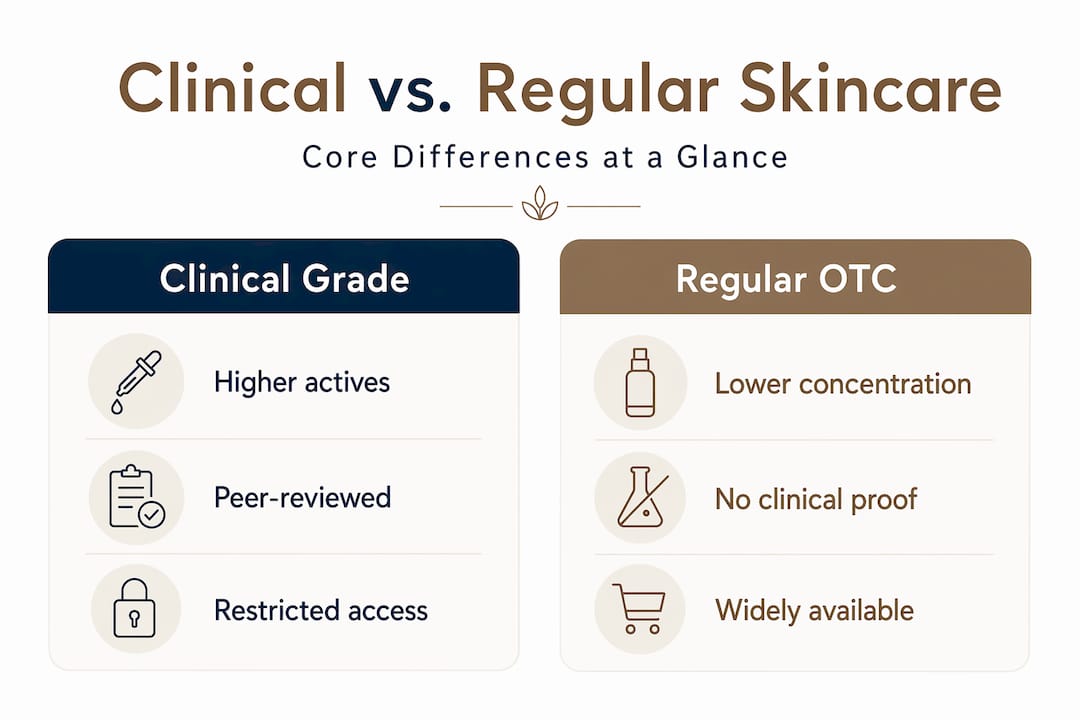
So what actually distinguishes a genuinely clinical-level product from something you pick up at a drugstore? The gap is real, even if the labeling is not regulated.

| Feature | Clinical grade products | Regular OTC products |
|---|---|---|
| Ingredient concentration | Higher, at studied therapeutic levels | Lower, formulated for broad tolerability |
| Clinical testing | Often includes controlled trials with measured outcomes | Typically consumer testing or none |
| Ingredient standards | May use USP-verified actives for purity and potency | Variable; no required purity standard |
| Distribution | Historically through dermatologists; now also online | Mass retail, pharmacy, grocery |
| Formulation complexity | Targeted delivery systems for active penetration | General surface application |
| Price point | Higher, reflecting R&D and testing investment | Budget to mid-range |
USP-verified ingredients like niacinamide and retinol have recognized purity and potency standards that guarantee what is on the label matches what is in the bottle. That kind of verification matters when you are paying for a specific active at a specific dose.
The access issue is shifting. Products were originally sold exclusively via medical professionals but are now increasingly available through authorized online retailers. That is good for consumers but also muddies the distinction further, since the distribution channel used to be one of the clearest signals of a genuinely professional-grade product.
Higher concentration does not automatically mean better results. The FDA has issued warnings about high-potency chemical peels sold online with acid concentrations unsafe for unsupervised use. For sensitive skin especially, a product with gentler, well-studied actives used consistently will outperform an aggressive formula used incorrectly.
Pro Tip: If a brand positions itself as clinical but does not list ingredient percentages or link to any published research, treat the labeling as marketing until proven otherwise.
How to choose clinical skincare products that actually work
Knowing the regulatory gaps means you can stop relying on labels and start applying a sharper filter. Here is how to approach it practically:
- Read the ingredient list critically. Active ingredients should appear near the top of the INCI list, not buried after fragrance and thickeners. Placement reflects concentration.
- Search for the brand’s clinical data. Legitimate clinical skincare lines publish their research. If it is not findable in a few minutes of searching, assume it does not exist.
- Consult a dermatologist before using high-potency actives. Retinoids, high-dose glycolic acid, and similar ingredients carry real risk of overuse damage. A professional consult protects your skin barrier.
- Prioritize ingredient transparency. Brands that list exact percentages and link to published ingredient research are showing confidence in their formulations.
- Check for clinically studied ingredients at meaningful doses. Peptides, polynucleotides, and tranexamic acid all have clinical literature behind them, but only at concentrations shown to produce results.
- Factor in skin tolerability. Clinical skincare for sensitive skin should use bioactive ingredients with anti-inflammatory properties alongside potent actives to minimize reactivity.
Effective skincare depends more on a consistent regimen using evidence-backed ingredients than on any single label claim. A well-formulated product used every day beats a “clinical grade” product used sporadically.
My take on the clinical grade label problem
I have spent years watching the phrase “clinical grade” move from a niche professional skincare term into one of the most overused marketing claims in the beauty industry. What frustrates me most is not that brands use it. It is that most consumers still assume it means something was tested, approved, or validated in a medical setting.
In my experience, the brands actually worth trusting never lead with the label. They lead with the study. They show you the data. They tell you which concentration of which ingredient was tested and what outcome was measured. That approach takes more work and more investment, which is exactly why some brands skip it and just print “clinical grade” on a clean white box instead.
What I have learned is that the real question to ask is not “is this clinical grade?” but “what is the evidence?” Ask a brand to point you to their clinical data. If they hesitate or redirect to consumer testimonials, you have your answer.
For anyone dealing with real aging concerns, like loss of firmness, uneven tone, or volume depletion, finding a brand that treats you like an adult by showing you the science behind their formulas is worth every extra minute of research. You will stop spending money on packaging and start spending it on results.
— Sara
Clinically supported skincare from Cellure
If you have done the research and you want products that back up their claims with real ingredient science, Cellure builds every formulation around bioactive compounds with published clinical support.
The Complete Skin Repair Kit combines peptides, polynucleotides, and tranexamic acid in concentrations designed to address firmness loss, uneven tone, and cellular renewal, not just surface smoothing. Every ingredient reflects a deliberate, evidence-first formulation philosophy. For anyone who wants to understand exactly what they are applying to their skin, Cellure’s ingredient transparency page lays out the science clearly. No vague “clinical grade” promises. Just formulations grounded in regenerative biology.
FAQ
What does “clinical grade skincare” mean?
“Clinical grade skincare” is a marketing term with no official FDA or federal regulatory definition. It generally refers to products formulated with higher concentrations of evidence-backed ingredients and supported by clinical research, but any brand can use the term without meeting specific standards.
Is clinical grade skincare better than regular skincare?
It can be, but only if the products are genuinely backed by peer-reviewed clinical data and use active ingredients at studied concentrations. The label itself does not guarantee quality without verifiable scientific evidence behind the formulation.
Is clinical skincare safe for sensitive skin?
Yes, when formulated with skin barrier support in mind. Clinical skincare for sensitive skin should combine potent bioactives with calming, anti-inflammatory ingredients to minimize reactivity. High-potency actives alone without proper buffering can compromise the barrier over time.
How do I know if a clinical skincare brand is legitimate?
Look for brands that publish peer-reviewed studies, list ingredient concentrations, and provide quantitative clinical data. Consumer satisfaction surveys are not clinical evidence. Objective measurements of hydration, elasticity, or pigmentation are.
Do I need a dermatologist to use clinical skincare products?
Not always, but for high-potency actives like prescription-strength retinoids or strong acid peels, a dermatologist consult reduces the risk of irritation or barrier damage. For peptide-based or polynucleotide formulations, professional guidance is helpful but not strictly required for most skin types.