


For Melasma: 5% Tranexamic Acid Outperforms 20% Azelaic
Tranexamic acid tends to outperform azelaic acid for stubborn, hormonally driven melasma, especially when used topically at 5% or combined with oral dosing under medical supervision. Azelaic acid is generally the better first move for acne-related post-inflammatory hyperpigmentation, since it calms inflammation and controls breakouts while it fades marks. Most dermatology-guided routines eventually use both, layered rather than swapped, with oral tranexamic acid reserved for cases a clinician is actively managing.
TL;DR:
- Topical tranexamic acid at 5% often outperforms azelaic acid for stubborn melasma, especially in resistant cases or when combined with oral treatment under medical supervision.
- Azelaic acid remains the first-line topical for acne-related hyperpigmentation due to its anti-inflammatory, antibacterial, and melanin-inhibiting properties.
- Clinical trials show tranexamic acid provides faster and more significant melasma reduction than azelaic acid, though study sizes are small and results are not definitive.
- Oral tranexamic acid carries risks of thrombosis, requiring blood work and physician oversight, unlike topical formulations that are generally well tolerated.
- Continued sun protection and patience are crucial; significant pigmentation relief can take between eight and twelve weeks, with full results needing three to six months.
Table of Contents
- Tranexamic Acid vs Azelaic Acid: What Is TXA and How Does It Work?
- What Is Azelaic Acid and Why Dermatologists Reach for It?
- Which One Wins in Clinical Trials?
- Is Tranexamic Acid or Azelaic Acid Safer to Use?
- How Do You Choose Between Azelaic Acid and Tranexamic Acid?
- Building a Regimen: Concentrations, Layering, and Timeline
- How Cellure Approaches Tranexamic Acid in Formulation
- A Straightforward Recommendation
- Where Tranexamic Acid Fits Into Your Cellure Routine
- Studies and Reviews Worth Reading
- Sources
Tranexamic Acid vs Azelaic Acid: What Is TXA and How Does It Work?
Tranexamic acid started its clinical life as an antifibrinolytic, a drug used to stop excessive bleeding after surgery or during heavy menstrual periods. Dermatologists noticed something else along the way: patients on TXA for medical reasons saw their melasma fade. That side observation turned into one of the more interesting stories in modern pigment treatment.
The mechanism isn’t just about melanin production. TXA inhibits plasmin activity in keratinocytes, which in turn reduces the release of substances that stimulate melanocytes, the pigment-producing cells in your skin. Melasma also has a vascular component, meaning blood vessel activity under the skin helps drive pigment flare-ups, and TXA’s antiplasmin, anti-angiogenic effects target that pathway too, which is part of why it shows a clinical signal specifically in stubborn melasma that other brighteners often can’t touch.
You’ll encounter TXA in three practical forms:
- Topical serums, typically formulated around 2% to 5% concentration, applied directly to the skin once or twice daily.
- Intradermal or microneedling delivery, where TXA is introduced into the skin’s upper layers for deeper access, often studied in split-face trials against other actives.
- Oral tablets, dosed anywhere from 250mg to 500mg daily in clinical trials, always requiring a prescription and medical oversight.
Clinicians pick the route based on severity and risk tolerance. Mild to moderate melasma usually starts topical. Resistant cases, particularly ones that haven’t responded to hydroquinone or retinoids, sometimes move to oral TXA or in-office microneedling, where split-face studies show meaningful improvement even in small patient samples.
What Is Azelaic Acid and Why Dermatologists Reach for It?
Azelaic acid works through a different door entirely. It’s a dicarboxylic acid, naturally occurring, that inhibits tyrosinase, the enzyme melanocytes need to produce melanin in the first place. Less tyrosinase activity means less new pigment forming, which is useful for melasma but especially useful for acne-related dark spots.
What sets azelaic acid apart is its dual action. It doesn’t just fade pigment. It also has antibacterial and anti-inflammatory properties, which is why it shows up so often in acne treatment plans. If you’re dealing with active breakouts that keep leaving marks behind, azelaic acid addresses both problems at once instead of just chasing the pigment after the fact.
You’ll typically see it formulated at:
- 10%, common in over-the-counter creams and gels for daily maintenance use.
- 15%, a middle strength often used in prescription formulations.
- 20%, the concentration used in most published clinical trials for melasma and post-inflammatory hyperpigmentation.
Tolerability is generally strong. Most people experience mild tingling on application and some initial redness that settles within a couple of weeks. That gentler profile is part of why azelaic acid is often the first-line topical for acne-associated discoloration, particularly for people whose skin reacts poorly to stronger brighteners like hydroquinone.
Which One Wins in Clinical Trials?
The trial data doesn’t hand either ingredient a clean sweep, but the pattern is fairly consistent. In a head-to-head randomized trial, 5% topical tranexamic acid produced greater reductions in MASI scores than 20% azelaic acid in patients with melasma, with a higher percentage of participants reaching “excellent response” status in the TXA group.
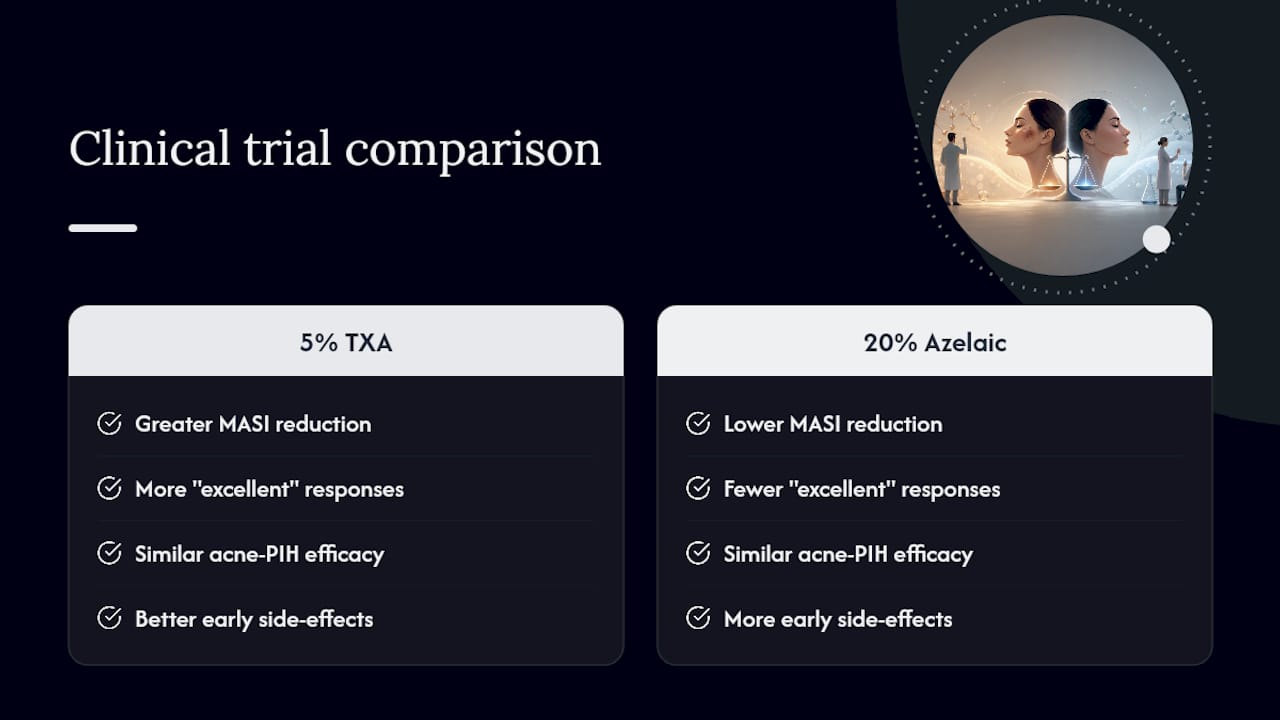
For acne-related PIH specifically, the comparison flips toward parity. A single-blinded randomized trial found that 5% tranexamic acid solution performed about as well as 20% azelaic acid cream for fading post-acne marks, and TXA actually showed a better side-effect profile during the first month.
Combination regimens tell an interesting story too. One trial testing oral TXA paired with a modified Kligman’s formula (a mix of hydroquinone, tretinoin, and a corticosteroid) found it produced faster and higher rates of melasma improvement than oral TXA paired with 15% azelaic acid.
None of this settles the question permanently. Sample sizes across these trials tend to run small, sometimes under 60 participants, and study populations skew toward specific skin tones and geographic regions, which limits how broadly the results generalize. Systematic reviews echo this caution: TXA looks promising across multiple delivery methods, but the evidence base is still underpowered and researchers keep calling for larger, better-controlled trials before anyone declares a definitive winner.
Is Tranexamic Acid or Azelaic Acid Safer to Use?
Topical formulations of both ingredients are generally well tolerated, but the safety conversation changes entirely once oral TXA enters the picture.
On the surface level, azelaic acid’s most common complaints are mild stinging, transient redness, and occasional dryness, especially at the start of treatment. Topical TXA has a similarly mild profile, with irritation being rare and usually tied to formulation strength rather than the ingredient itself.
Oral TXA is a different category of decision. Because it works systemically, it carries a known thrombosis risk in predisposed individuals, including people with a personal or family history of blood clots, certain clotting disorders, or those on hormonal birth control. It can also interact with other medications, which is exactly why it should never be self-prescribed or ordered online without a clinician’s involvement.
A few practical safety habits apply regardless of which ingredient you choose:
- Patch test any new topical on your inner forearm for 48 hours before applying it to your face.
- Start with the lowest effective concentration, especially with azelaic acid above 15%.
- Never begin oral TXA without blood work and a conversation with a physician about clotting history.
Pro Tip: If you’re on hormonal birth control or have a family history of clotting issues, mention it to your doctor before oral TXA even comes up as an option. It’s a five-minute conversation that avoids a serious risk.
How Do You Choose Between Azelaic Acid and Tranexamic Acid?
Matching the ingredient to your actual diagnosis matters more than picking whichever one trends on skincare forums. Here’s a practical rubric:
- If your pigment tracks with hormonal shifts (pregnancy, birth control, perimenopause) and shows up in the classic mask-like melasma pattern, tranexamic acid is usually the stronger starting point, particularly at 5% topical strength.
- If your dark spots trace back to acne, active breakouts, or general inflammation, azelaic acid tends to work better because it treats the underlying inflammation and bacteria alongside the pigment.
- If you’re pregnant or breastfeeding, azelaic acid has a longer track record of topical safety data in that population; oral TXA is generally avoided, and even topical TXA should be discussed with your OB or dermatologist first.
- If you have sensitive or reactive skin, start with azelaic acid at 10% or TXA at 2%, since both are gentler entry points than hydroquinone or high-strength retinoids.
- If six to eight weeks of consistent topical use hasn’t moved the needle, that’s the signal to talk to a dermatologist about combination therapy, oral TXA, or procedural options like microneedling.
Building a Regimen: Concentrations, Layering, and Timeline
A workable routine usually pairs TXA and azelaic acid rather than forcing you to pick one forever. The order matters more than people expect.
Apply products thinnest to thickest. Avoid stacking azelaic acid with other low-pH exfoliating acids like glycolic or lactic acid in the same session, since that combination often triggers irritation without adding benefit.
Timeline expectations should stay realistic:
- Early tone improvement often appears around four weeks with consistent daily use.
- Meaningful MASI score changes in trials generally showed up between eight and twelve weeks.
- Full results for stubborn melasma can take three to six months, sometimes longer for deeper, dermal pigment.
None of it works without daily broad-spectrum sunscreen. UV exposure restimulates the same melanocyte pathways both ingredients are trying to calm, and dermatology consensus consistently points to sun protection as the single biggest driver of whether pigment improvement actually holds. A non-toxic morning routine built around consistent SPF application makes every active ingredient in your routine work harder.
Pro Tip: Take a photo under the same lighting every two weeks. Pigment fades slowly enough that day-to-day mirror checks can trick you into thinking nothing’s happening when it actually is.

How Cellure Approaches Tranexamic Acid in Formulation
Cellure builds its topical tranexamic acid formulas around the idea that pigment control works better alongside cellular repair, not instead of it. Pairing TXA with peptides and polynucleotides supports the skin’s barrier and regenerative processes while the tranexamic acid addresses the pigment pathway directly, rather than treating brightening as an isolated cosmetic fix.
That combination approach shows up across Cellure’s own formulation notes and educational content:
- The brand’s breakdown of tranexamic acid’s role in aging skin covers how it interacts with barrier-supporting actives.
- A practical guide on what tranexamic acid actually does for hyperpigmentation walks through realistic expectations.
If oral TXA is under consideration, that decision stays with a physician. Cellure’s topical formulations are designed to slot into a clinician-guided plan, not replace the conversation about systemic treatment.
A Straightforward Recommendation
Start topical, get a real diagnosis before you buy anything, and save oral tranexamic acid for a conversation with your doctor, not a cart checkout. Patch test first, introduce one active at a time, wear SPF without exception, and take a comparison photo every four to eight weeks. Pigment treatment rewards patience more than intensity. Expect gradual change, not overnight results, and let a clinician weigh in if nothing’s shifted after two months.
— Sara
Where Tranexamic Acid Fits Into Your Cellure Routine
If you’ve settled on tranexamic acid as your starting point, Cellure’s Tranexamic Acid Peptide Serum delivers it at a topical concentration formulated alongside peptides for barrier support, rather than as an isolated brightening agent competing with the rest of your routine.
For readers who want a complete approach instead of piecing one together ingredient by ingredient, the Complete Skin Repair Kit bundles pigment-targeting actives with barrier-repair formulas designed to work in sequence.
A few usage notes worth following regardless of which product you start with:
- Apply the serum on clean, dry skin before heavier creams or oils.
- Give it thirty to sixty seconds to absorb before layering anything else.
- Pair it with a broad-spectrum SPF every morning, no exceptions.
Browse the full lineup at Cellure to find the combination that matches your specific pigment concern.
Studies and Reviews Worth Reading
- The head-to-head trial of 20% azelaic acid vs 5% tranexamic acid for acne-related PIH, showing near-equal efficacy with better early tolerability for TXA.
- A comparative study of oral TXA combination regimens for melasma, contrasting Kligman’s formula pairings against azelaic acid pairings.
- A split-face microneedling trial comparing TXA against vitamin C delivery for melasma.
- A meta-analysis and systematic review evaluating TXA mesotherapy safety and efficacy across delivery methods.
- A randomized trial comparing 5% TXA to 20% azelaic acid directly on MASI score outcomes in melasma patients.
This article is general information, not a substitute for advice from a qualified doctor. Consult a qualified healthcare professional about your own circumstances before acting on anything here.