


A Melasma Skincare Routine That Controls Pigment for Good
The most effective melasma skincare routine is deceptively simple: a tinted broad-spectrum sunscreen every morning, a gentle barrier-supporting cleanser and moisturizer, and exactly one evidence-backed active applied at night, run first as a short induction phase and then tapered into permanent maintenance. Melasma does not respond well to a five-serum stack or a rotating cast of acids. It responds to consistency, restraint, and light discipline that has nothing to do with UV rays alone.
Here is the routine broken into its non-negotiable parts:
- AM: gentle cleanse, optional antioxidant, barrier moisturizer, tinted mineral broad-spectrum sunscreen with iron oxides and SPF suitable for effective daily protection, reapplied midday.
- PM: gentle cleanse to remove sunscreen and makeup, one targeted active (hydroquinone combination cream, azelaic acid, or topical tranexamic acid, moisturizer to buffer irritation.
- Weekly: zero aggressive scrubs, zero unsupervised peels, zero skipped sunscreen days, including cloudy ones.
- Ongoing: reassess at 6 to 8 weeks, then shift from induction potency to a maintenance schedule built to prevent relapse.
Melasma is a chronic condition to manage, not a stain to erase once and forget. The American Academy of Dermatology notes there is no single best treatment, and that durable results come from combining sun protection with topical medication over time, not from one aggressive fix.
That is the whole verdict in one line: control the triggers, treat with intention, then maintain forever. Everything below explains how to execute that without wrecking your skin barrier in the process.
Key Takeaways
Melasma control depends on daily tinted sunscreen, barrier-first gentleness, and one evidence-backed active at a time, run through induction before settling into indefinite maintenance.
| Point | Details |
|---|---|
| Sunscreen is non-negotiable | Wear tinted, iron-oxide sunscreen with SPF 30 to 50-plus daily, reapplied every two hours during real sun exposure. |
| One active at a time | Choose a single nightly active during induction rather than stacking hydroquinone, retinoids, and acids together. |
| Induction has a clock | Expect early change around 4 weeks and a nadir near 6 to 8 weeks before shifting to maintenance. |
| Barrier care isn’t optional | Ceramide-rich moisturizers reduce the inflammation that drives melasma relapse, especially alongside active ingredients. |
| Cellure supports maintenance | The Complete Skin Repair Kit fits the barrier-repair and gentle-brightening phase after induction-level treatment. |
Table of Contents
- What’s the Difference Between a Melasma Treatment Phase and Maintenance?
- How Should Your Morning Melasma Routine Work?
- How Should Your Nighttime Melasma Routine Work?
- Which Ingredients Actually Have Evidence Behind Them?
- Why Does Visible Light Matter as Much as UV for Melasma?
- How Do You Layer Actives Without Triggering a Flare?
- What Habits Make Melasma Worse Without You Realizing It?
- What’s a Realistic Timeline for Melasma Improvement?
- Why “Control, Not Cure” Is the Right Way to Think About Melasma
- Sources
What’s the Difference Between a Melasma Treatment Phase and Maintenance?
Melasma care runs on two distinct clocks, and confusing them is the single most common reason people plateau or relapse. Induction is a short, aggressive campaign to knock pigment down fast. Maintenance is the quiet, indefinite phase that keeps it from creeping back.
Induction typically means up to eight weeks of a higher-potency regimen, often a triple combination cream containing hydroquinone, tretinoin, and a mild corticosteroid. Clinical reviews rank this fixed combination as a first-line induction option because it consistently outperforms any single ingredient used alone during short-term use, according to a systematic review of melasma treatments. Trials tracking response show visible improvement by around four weeks, with pigment reduction typically bottoming out near the six-week mark. That nadir is the cue to reassess, not to keep pushing the same intensity indefinitely.
Maintenance looks nothing like induction. Once pigment has meaningfully lightened, the plan shifts to gentler daily brighteners, azelaic acid or topical tranexamic acid, alongside the tinted sunscreen and barrier care that never stop. Skip this step and relapse is common, since melasma management is best understood as chronic disease control built on trigger reduction and long-term upkeep rather than a one-time cure.
Pro Tip: Don’t stop a corticosteroid-containing cream cold turkey after eight weeks. Step down frequency gradually, moving from nightly to two or three nights a week for a couple of weeks before dropping it entirely, to reduce rebound irritation and avoid the skin thinning that comes with prolonged steroid use.
How Should Your Morning Melasma Routine Work?
Mornings are about defense, not treatment. Every step exists to protect the pigment gains you made the night before, and the order matters more than the number of products.
- Cleanse with lukewarm water. Hot water and heat-generating cleansing tools aggravate melasma by triggering inflammation, so keep this step brief and cool.
- Apply a gentle antioxidant, if you use one. A stable vitamin C derivative or niacinamide can go on before sunscreen, but this step is optional, not mandatory, especially during induction when skin tends to run more reactive.
- Layer a lightweight, barrier-supportive moisturizer. Ceramides and squalane help offset the dryness that comes from nightly actives, and a compromised barrier is one of the biggest drivers of relapse.
- Apply tinted, mineral-forward sunscreen with iron oxides, SPF 30 to 50-plus. This is the step that actually prevents melasma from worsening, and it goes on generously, roughly a nickel-sized amount for the face alone.
- Reapply at midday, particularly if you’re outdoors, near windows, or under strong indoor lighting for extended stretches.
Board-certified dermatologists consistently point to daily broad-spectrum photoprotection and tinted sunscreen with iron oxides as the baseline nobody gets to skip, because visible light, not just UV, drives pigment production in melasma-prone skin. If you wear makeup, a BB cushion or foundation that itself contains iron oxides adds a second layer of visible-light defense on top of sunscreen rather than replacing it.
How Should Your Nighttime Melasma Routine Work?
Nights are for treatment, and treatment works better with fewer moving parts. The biggest mistake people make here is stacking a retinoid, an acid exfoliant, and a brightening serum in the same week and wondering why their skin is inflamed and their melasma looks worse, not better.
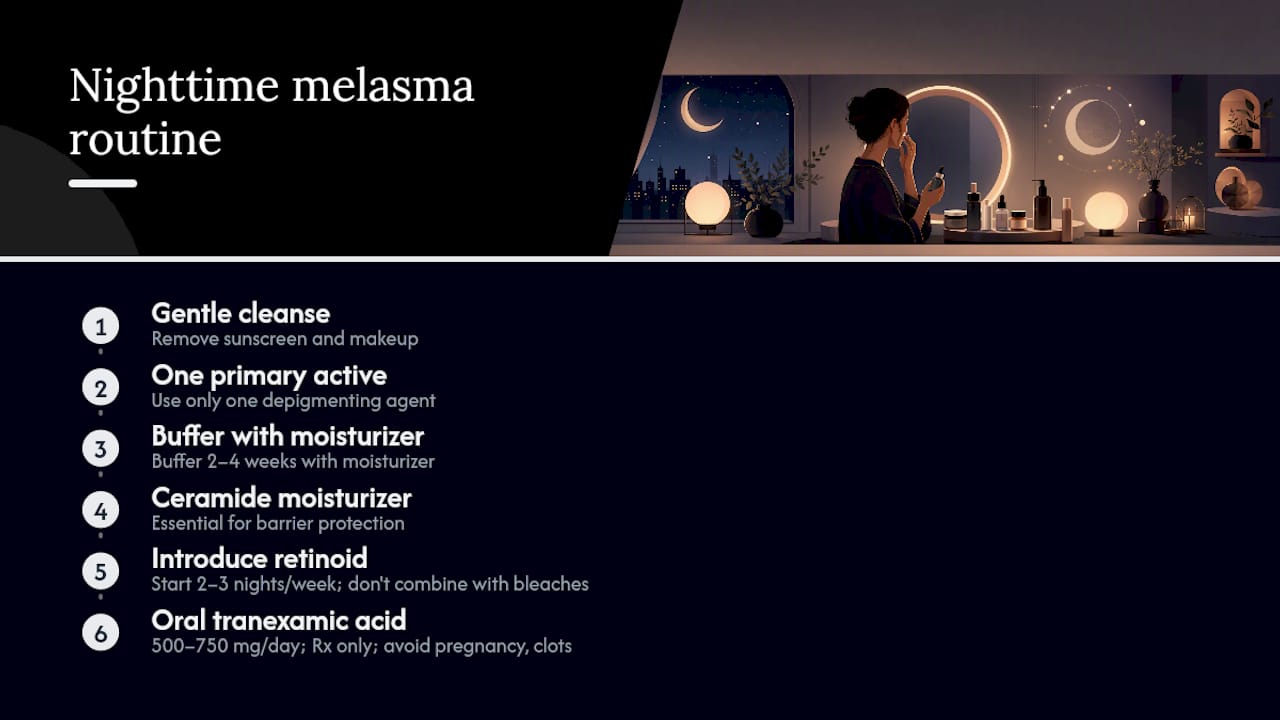
Start with a single gentle cleanse to remove sunscreen and makeup residue, since leftover product buildup can itself be mildly irritating overnight. Choose one primary active for the induction phase, whether that’s a prescribed triple combination cream, topical tranexamic acid, or azelaic acid, and give it room to work without competition from other actives. During the first two to four weeks, buffering with moisturizer before or after the active can meaningfully cut down on stinging and peeling, a sequencing trick that dermatology guidance on practical melasma routines backs consistently.
Barrier compromise and inflammation are two of the biggest drivers of relapse. A ceramide-rich moisturizer isn’t an optional finishing touch when you’re using a depigmenting agent; it’s an active part of the treatment itself, according to the American Academy of Dermatology.
If you’re introducing a retinoid later for texture or maintenance, wait until your barrier is stable and start at low frequency, two to three nights a week, never alongside a strong bleaching agent unless a dermatologist is actively supervising the combination; a gentle option like CeraVe Retinol Serum | Anti-Aging Skincare | SweeTee | SweeTee Beauty can help improve tolerability and support skin barrier recovery.
Oral tranexamic acid deserves its own caution here. Doses of 500 to 750 milligrams daily have shown mild-to-moderate benefit in clinical trials for recalcitrant melasma, but it carries real contraindications: it is not appropriate during pregnancy or breastfeeding, and it should be avoided in anyone with a history of blood clots or clotting disorders. This is a prescription decision, not a self-directed one.
Which Ingredients Actually Have Evidence Behind Them?
Some melasma ingredients have decades of trial data. Others have a good marketing story and a much thinner evidence base. Knowing which is which saves money and skin.
Hydroquinone, especially in the fixed triple combination formula with hydroquinone, tretinoin, and fluocinolone acetonide, remains the most consistently studied induction option and is treated as a first-line choice in dermatology guidelines, per the PMC systematic review. Azelaic acid and topical tranexamic acid sit just behind it as strong, better-tolerated alternatives, particularly for people who need a long-term option that doesn’t carry hydroquinone’s supervision requirements. Oral tranexamic acid adds a systemic option for stubborn cases, used with proper medical screening.
Kojic acid, niacinamide, vitamin C, and cysteamine round out the supporting cast. Evidence for these is real but more moderate, and they tend to shine brightest in maintenance rather than as induction workhorses. No single ingredient does everything; combining agents that hit different points in the pigment pathway, melanin production, cell turnover, and inflammation control, consistently outperforms any one ingredient used alone.
| Active Ingredient | Evidence Strength | Typical Role |
|---|---|---|
| Triple combination cream (hydroquinone + tretinoin + fluocinolone) | Strong, first-line | Induction, up to 8 weeks, supervised |
| Azelaic acid | Strong | Maintenance or hydroquinone alternative |
| Topical tranexamic acid | Strong, growing | Maintenance and adjunct to induction |
| Oral tranexamic acid | Moderate to strong for recalcitrant cases | Adjunct with appropriate dosing and medical supervision |
| Kojic acid | Moderate | Maintenance support |
| Niacinamide, vitamin C, cysteamine | Moderate, emerging | Maintenance, barrier-friendly brightening |
Safety flags worth remembering:
- Limit corticosteroid-containing combination creams to short, defined courses to minimize risk of skin thinning and visible blood vessels.
- Hydroquinone should be used under guidance, particularly for extended periods.
- Oral tranexamic acid is off the table during pregnancy, breastfeeding, or with a personal or family history of clotting disorders.
- Stop and reassess any active that causes burning, peeling, or new redness rather than pushing through it.
Why Does Visible Light Matter as Much as UV for Melasma?
Sunscreen conversations usually stop at SPF, but for melasma that’s only half the picture. Visible light, the light you can actually see, not just UV rays, triggers pigment production in melanocytes that are already primed to overreact. This is why a standard UV-only sunscreen often isn’t enough to stop melasma from creeping back, even with diligent daily use.
Iron oxides change that equation. They’re the pigments that give tinted sunscreens their color, and they physically block visible light the way mineral filters block UV. Randomized trials comparing UV-only sunscreens against tinted UV-plus-visible-light formulas found the tinted versions meaningfully improved outcomes when paired with standard depigmenting treatment.
Tinted formulas containing iron oxides aren’t a cosmetic upgrade for melasma patients. Visible light contributes substantially to pigmentation in susceptible skin, which makes iron oxide protection functionally necessary, not optional.
Aim for broad-spectrum sunscreen with an SPF suitable for effective protection, and reapply regularly during real sun exposure. Mineral filters (zinc oxide, titanium dioxide) tend to be better tolerated on melasma-prone, often sensitive skin, but the honest advice from dermatologists is to pick the formula you’ll actually wear every single day. A cosmetically elegant chemical-mineral hybrid you reapply consistently beats a heavy mineral paste sitting unused in a drawer. If the tint doesn’t match your skin tone well enough for daily wear, layer a BB cushion or foundation containing iron oxides over a plain broad-spectrum sunscreen instead. That combination covers both bases without forcing a compromise on wearability.
How Do You Layer Actives Without Triggering a Flare?
The order you apply products in matters less than most people assume. What actually matters is spacing and restraint, since melasma-prone skin punishes overlap between irritating ingredients far more than it punishes an imperfect sequence.
A workable AM order is cleanse, optional antioxidant, targeted brightener if you use one in the morning, moisturizer, then sunscreen last. PM keeps it simpler: cleanse, one active, moisturizer. When you’re tempted to combine an acid exfoliant with a retinoid or a bleaching agent, don’t. Separate them across different nights, or push exfoliation to a standalone slot two or three times weekly while your primary active runs on the other nights.
Patch testing isn’t optional busywork, it’s how you find out if a new active is going to fight your skin before it fights your whole face. Apply a small amount behind the ear or along the jawline for three consecutive nights, then introduce it to the face at a reduced frequency, three times a week, and only build up toward nightly use over four to six weeks if your skin tolerates it without redness or peeling.
Heat is a trigger dermatology often underdiscusses. Applying actives immediately after a hot shower or an intense workout, while skin is still flushed, increases irritation risk and can provoke the exact inflammation that worsens melasma.
Pro Tip: Let your skin fully cool down, at least 15 to 20 minutes, after exercise or a hot shower before applying any active ingredient. That short wait alone prevents a surprising number of avoidable flares.
What Habits Make Melasma Worse Without You Realizing It?
Some of the most common melasma mistakes look like diligence from the outside. Aggressive treatment isn’t the same as effective treatment, and several popular habits actively work against pigment control.
- Skipping sunscreen on cloudy or indoor days, when visible light from windows and screens still reaches melasma-prone skin.
- Using hot showers, saunas, or hot yoga as a regular routine without factoring in heat’s role as an inflammation trigger.
- Reaching for high-strength exfoliants or gritty physical scrubs, which can cause the exact inflammation-driven hyperpigmentation you’re trying to treat.
- Layering three or four “brightening” products at once instead of committing to one evidence-backed active at a time.
- Booking aggressive lasers or high-fluence light treatments without a dermatologist who specializes in pigmentary conditions, since the wrong device or setting can worsen melasma dramatically.
Safer substitutes exist for nearly every one of these. Swap gritty scrubs for gentle enzymatic exfoliation or a low-concentration AHA used sparingly. Save microneedling for after your barrier has fully stabilized, not during an active flare. And treat any in-office procedure, from superficial peels to lasers, as a decision to make with a specialist who has experience with pigmentary disorders specifically, not general aesthetics.
What’s a Realistic Timeline for Melasma Improvement?
Patience is the least glamorous part of melasma care, and also the most important. Clinical trial data on induction therapy shows early, modest improvement by around four weeks, with pigment reduction typically reaching its lowest point, its nadir, near six to eight weeks. Full remodeling of deeper pigment can take considerably longer, sometimes several months of consistent maintenance.
A meaningful response by six to eight weeks generally shows up as a clear, visible lightening you and people around you can actually notice, not a subtle shift you need side-by-side photos to confirm. If you’re not seeing that kind of change by then, it’s a signal to revisit the plan with a dermatologist rather than pushing the same regimen for months on faith.
There is no single best treatment for melasma. The most effective plans combine consistent sun protection with topical medication, and reserve procedures for after the topical regimen has been optimized, according to the American Academy of Dermatology.
Watch for red flags that mean it’s time to get evaluated rather than adjust your own routine further: rapid new darkening that doesn’t fit the usual slow pattern, widespread irritation or burning, visible skin thinning or spidery blood vessels from steroid overuse, or any reason a prescribed oral medication might be contraindicated for you. In-office options like microneedling or carefully chosen superficial peels have a place for stubborn cases, and lasers are typically reserved for genuinely refractory melasma under specialist supervision, always after photoprotection and topical therapy have been given a real chance to work first.
Why “Control, Not Cure” Is the Right Way to Think About Melasma
Melasma keeps coming back for people who treat it like a problem to solve once. The pigment-producing cells involved don’t get permanently switched off by a good eight-week regimen; they get quieted, and they will reactivate given enough sun, heat, hormonal shifts, or inflammation. That’s why dermatology guidance increasingly frames this as chronic disease management rather than a treatable, resolvable condition.
The practical version of that mindset is straightforward: prioritize photoprotection above every other step, keep corticosteroid-containing treatments to short, defined courses, and consider oral tranexamic acid for genuinely stubborn cases only after appropriate screening rules out contraindications. None of this works in isolation.
The most effective results in practice come from a multimodal approach: suppress melanocyte activity, encourage gentle pigment turnover, calm inflammation, and block the environmental triggers, sun, heat, and visible light, that set the whole cycle off again, as clinicians interviewed by Allure on melasma treatment consistently emphasize.
Living with melasma, day to day
Melasma has a way of making you hyperaware of your own reflection, and that’s worth naming honestly rather than glossing over with product talk. The realistic expectation isn’t flawless, permanent clearing. It’s steady, incremental improvement punctuated by small wins, a shade lighter after six weeks, a good skin day after a stressful month, and enough control that you’re not thinking about it every time you catch a mirror. Cosmetic camouflage, a good tinted sunscreen or an iron-oxide BB cream, isn’t a failure to treat the condition properly. It’s a legitimate part of getting through the treatment phase with your confidence intact while the slower biological work happens underneath.
Where Cellure Fits Into Your Maintenance Routine
Once you’ve moved past induction and into the long maintenance stretch, the goal shifts from aggressive correction to consistent barrier support and gentle brightening, exactly the phase where a well-formulated kit earns its place. The Complete Skin Repair Kit from Cellure is built around barrier-first repair, using ingredients like peptides and polynucleotides alongside gentler brightening support, which lines up with what maintenance-phase melasma skin actually needs: less irritation, more resilience, and steady tone support rather than another aggressive active competing for space.
Here’s how the kit maps onto the routine outlined above:
- Barrier support step: replaces or complements your moisturizer to reinforce a barrier weakened by prior actives.
- Antioxidant step: adds a gentle layer of protection that pairs naturally with your morning sunscreen.
- Supportive brightening step: works as a lower-irritation option once you’ve tapered off induction-strength ingredients.
This kit is designed for maintenance and barrier recovery, not for active induction-phase pigment correction. If you’re still in the early, intensive treatment window or considering a prescription option like a triple combination cream or oral tranexamic acid, talk to a dermatologist first. Once you’ve reached maintenance, explore the Complete Skin Repair Kit as your next step toward keeping the results you’ve already earned.
Sources
- Melasma - StatPearls - NCBI Bookshelf
- Systematic review and recommendations for melasma (PMC10718129)
- Melasma: Diagnosis and treatment — American Academy of Dermatology
- How to Treat Melasma: The Best Skincare and In-Office Treatments — Allure
This article is general information, not a substitute for advice from a qualified doctor. Consult a qualified healthcare professional about your own circumstances before acting on anything here.
Recommended
Share