


30–60 Second Layering for Serum vs Moisturizer: Clinician Tips
Serums deliver concentrated actives to treat specific concerns; moisturizers hydrate and protect the skin barrier. Most routines need both, applied in that order, waiting about half a minute to a minute apart. The exception: very oily skin sometimes gets by with a hydrating serum alone, while dry or aging skin almost always needs the full pairing to see real results.
TL;DR:
- Serums contain highly concentrated actives that penetrate deeper and address specific concerns, requiring careful formulation and targeted application.
- Moisturizers focus on barrier protection and water retention, often containing humectants, ceramides, and occlusives, but do not provide high-potency actives.
- The recommended routine involves applying serum to damp skin followed by moisturizer, with attention to proper order and gradual introduction of potent ingredients.
- Oily skin can often skip heavy moisturizer and rely on lightweight, hydrating serums, while dry and aging skin benefit from both products used in tandem.
- Most skincare issues improve when products are paired properly, with emphasis on patience, correct sequencing, and avoiding overloading skin with multiple actives at once.
Table of Contents
- Serum vs Moisturizer: What Each One Actually Does
- What Is a Moisturizer, and Why Does It Matter More Than People Think?
- Serum vs Moisturizer: The Real Differences That Matter
- Serum, Moisturizer, or Both? A Decision Framework by Skin Type
- How to Layer Serum and Moisturizer for Best Results
- Common Mistakes That Wreck a Good Routine
- Cellure’s Approach: How Sara Applies Serums for Better Results
- What a Serum Actually Is, in Plain Terms
- What a Moisturizer Actually Is, in Plain Terms
- Myths About Serums and Moisturizers That Need Correcting
- How to Tell What Your Skin Actually Needs
- Why the Serum-or-Moisturizer Debate Misses the Point
- Pair Your Serum and Moisturizer With Cellure’s Repair Kit
- Sources
Serum vs Moisturizer: What Each One Actually Does
A serum is a lightweight, highly concentrated formula built to carry active ingredients past the skin’s surface. Harvard Health describes serums as easily absorbed liquids designed to address specific concerns like wrinkles and discoloration, not general maintenance. That’s the whole point of a serum: it’s a precision tool, not a daily-use blanket product.
The common active ingredients tell you what a serum is built to fix:
- Hyaluronic acid pulls water into the skin for an immediate hydration boost.
- Vitamin C brightens tone and works as an antioxidant against environmental damage.
- Peptides signal skin cells to support firmness and structure.
- Retinoids speed up cell turnover, which helps with fine lines and texture over time.
If your concern is specific, like uneven pigmentation or early signs of sagging, a serum is where you’ll see change first. It’s not going to keep your skin from drying out on its own.
What Is a Moisturizer, and Why Does It Matter More Than People Think?
A moisturizer’s job is protection, not treatment. It forms an emollient or occlusive layer on the skin’s surface that slows water loss and helps rebuild the outermost layer of skin, called the stratum corneum. The American Academy of Dermatology points to three ingredient families that make this happen:
- Humectants (glycerin, hyaluronic acid) draw moisture into the skin.
- Ceramides rebuild and reinforce the skin’s natural barrier.
- Emollients and occlusives (oils, petrolatum) smooth the surface and seal moisture in.
Moisturizers can contain active ingredients too, but that’s not their main function. Their job is to keep the barrier intact so everything else, including your serum, actually works.
Serum vs Moisturizer: The Real Differences That Matter
The clearest way to separate these two products is by function: a serum delivers, a moisturizer protects. Serums are formulated with smaller molecules and higher concentrations of actives, which is why they absorb faster and hit deeper layers of skin per drop than a standard moisturizer ever will.
That difference in molecular weight explains a lot of what you notice in daily use:
- Serums feel thinner and disappear into skin within seconds.
- Moisturizers sit on the surface longer and often leave a slight residue, by design.
- A serum under makeup rarely causes pilling; a heavy moisturizer sometimes does.
- Low-dose actives baked into a moisturizer (like a modest amount of niacinamide) are often enough for mild, general maintenance. A dedicated concern, like melasma or deep wrinkles, usually needs the higher concentration only a serum provides.
Marketing muddies this constantly. A “moisturizing serum” and a “hydrating moisturizer with peptides” sound similar on a label, but the base formulation and job each one does are not interchangeable. Read the ingredient list and the concentration claims, not the product name, before deciding what a product is actually for.
Serum, Moisturizer, or Both? A Decision Framework by Skin Type
Matching product to skin type saves you money and irritation. Here’s how to think about it:
- Dry skin: Use both, always. A hydrating serum (hyaluronic acid or glycerin-based) followed by a rich, ceramide-heavy moisturizer addresses both the immediate tightness and the long-term barrier weakness common with dry skin.
- Oily skin: A lightweight, hydrating serum can sometimes stand in for a heavier moisturizer, especially in humid climates. Skin that produces excess oil still needs water, just not necessarily an occlusive layer on top.
- Sensitive or reactive skin: Choose gentler actives (low-percentage niacinamide, centella asiatica) in serum form, and lean on a barrier-repair moisturizer with ceramides to keep irritation in check.
- Anti-aging or pigmentation concerns: A targeted serum, whether vitamin C, retinoid, or peptide-based, does the heavy lifting. The moisturizer’s role here is to support tolerance, not deliver the fix.
- General daily hydration with no specific concern: A quality moisturizer alone may be enough, particularly in cooler months or for people not chasing a specific skin goal.
Reconsider your setup when the seasons change, when you introduce a new active and see redness or tightness, or when a “one product” routine stops keeping up with how your skin actually looks.
How to Layer Serum and Moisturizer for Best Results
Getting the order right matters as much as picking the right products; following a detailed instruction after cosmetic procedures can ensure your skin heals optimally after treatment. Here’s the sequence dermatology sources and skincare formulators consistently recommend:
- Cleanse your face and pat it slightly damp, don’t dry it completely.
- Apply a toner if you use one.
- Apply your serum to damp skin. Applying serum while skin is still a little wet helps active ingredients absorb rather than sit on the surface.
- Wait about 30 to 60 seconds before your next step, giving the serum time to settle in.
- Apply moisturizer to seal everything in and rebuild the barrier.
- In the morning, finish with a broad-spectrum SPF. At night, skip the SPF step entirely.
Antioxidant serums like vitamin C work best in the AM, layered under moisturizer and SPF, since they help fight environmental damage during the day. Retinoids and reparative actives belong at night, since several of these ingredients increase photosensitivity and shouldn’t be worn under direct sun exposure.
Pro Tip: Use two to three drops of serum, no more. Warm it between your fingertips first, then press it into skin rather than rubbing. Rubbing drags actives across the surface instead of helping them absorb.
Common Mistakes That Wreck a Good Routine
The most common mistake is stacking too many potent actives at once. Combining a high-strength acid exfoliant, a retinoid, and a strong vitamin C serum in the same routine is a fast way to compromise your skin barrier rather than improve it.
A few rules keep this from happening:
- Introduce one new active at a time, and give your skin two to three weeks before adding another.
- Start new serums at a lower frequency, every other night, rather than daily, especially with retinoids or acids.
- Pair any new potent serum with a ceramide-rich, barrier-support moisturizer to buffer irritation.
- Powerful actives can stress the skin barrier faster than most people expect, so slow, deliberate introduction matters more than speed of results.
- Stop and see a dermatologist if you notice persistent redness, peeling, swelling, or any sign of an allergic reaction that doesn’t calm down within a day or two.
Cellure’s Approach: How Sara Applies Serums for Better Results
Sara, who writes on skincare formulation for the Cellure blog, applies a simple rule when testing new actives: warm the serum between your palms first, press it into skin rather than rubbing, then wait roughly 30 to 60 seconds before moisturizer. That pause isn’t wasted time. It’s the window where the serum actually settles into skin instead of getting diluted by whatever goes on next.
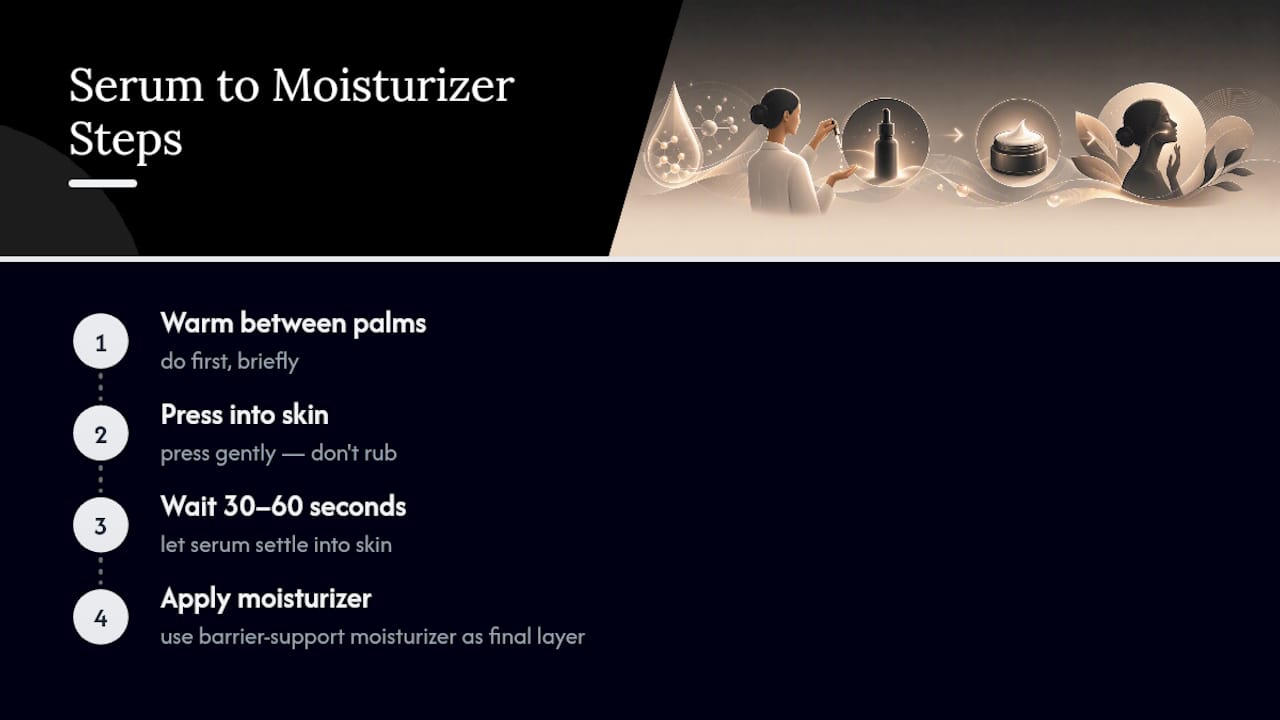
Some skincare brands formulate their serums to be paired with barrier-support moisturizers because potent actives work better, and cause less irritation, when the skin’s barrier stays intact. A step-by-step application guide walks through the technique in more detail, and the layering workflow covers how to build a full routine around it. Readers starting a new potent serum should also read about what makes serums effective for anti-aging before ramping up frequency.
What a Serum Actually Is, in Plain Terms
A serum is a fast-absorbing skincare formula, usually water or oil based, carrying a high concentration of one or more active ingredients in a small amount of product. The lightweight texture is intentional. It’s stripped of the heavier emollients and thickeners you’d find in a moisturizer so the actives can penetrate rather than sit on top of skin.
Serums are sold in small bottles, often with droppers, because a little goes a long way. Two or three drops typically cover the entire face. This is also why serums cost more per ounce than moisturizers: you’re paying for concentration, not volume. A bottle that lasts four to six months of nightly use is doing more per drop than a jar of moisturizer used at the same pace.
Not every serum is formulated the same way, either. A hydrating serum built around hyaluronic acid behaves very differently from a retinoid serum meant to speed cell turnover. Both fall under the same product category, but they solve different problems and belong in different parts of your routine. That’s the detail most shoppers miss when they buy a serum expecting it to do everything a moisturizer does.
What a Moisturizer Actually Is, in Plain Terms
A moisturizer is a topical formula built to reduce water loss from skin and reinforce the outer barrier that keeps irritants out and moisture in. Unlike a serum, a moisturizer’s texture is intentionally heavier. That thickness comes from emollients and occlusive ingredients that stay on the surface longer, which is exactly what allows them to slow moisture evaporation over hours rather than minutes.
Moisturizers come in different consistencies for a reason. Gel formulas suit oily or combination skin because they hydrate without adding heaviness. Cream and ointment formulas suit dry or mature skin because they provide a thicker seal against water loss. Choosing the wrong texture for your skin type is one of the most common reasons people think “moisturizer doesn’t work for my skin,” when really it’s a mismatch between formula and skin type.
Some moisturizers now include SPF, combining daily protection with hydration in one step. A moisturizer with SPF is a reasonable simplification for mornings, but it shouldn’t replace a dedicated sunscreen if you’re spending extended time outdoors, since SPF moisturizers are rarely applied in the thick, even layer that sun protection actually requires.
Myths About Serums and Moisturizers That Need Correcting
The biggest myth is that serums replace moisturizers because they’re “more advanced.” They don’t. A serum with no moisturizer on top is like taking a supplement with no food. The delivery happens, but there’s nothing sealing it in, and the water a hydrating serum draws into your skin evaporates faster without a barrier layer over it.
A second myth: oily skin doesn’t need moisture. Oil production and hydration are separate systems. Skipping moisturizer on oily skin can actually trigger more oil production as skin tries to compensate for the water it’s losing, which is the opposite of what most people are trying to achieve.
Third, more expensive doesn’t mean more effective. Concentration and formulation quality matter far more than price point. Not every skin type needs a serum at all; the incremental benefit depends entirely on the specific concern and formulation, not on how the product is marketed.
Finally, people assume you should apply moisturizer before serum “for extra protection.” That order blocks the serum from reaching skin at all. Sequence matters, and reversing it undoes the entire purpose of using a serum in the first place.
How to Tell What Your Skin Actually Needs
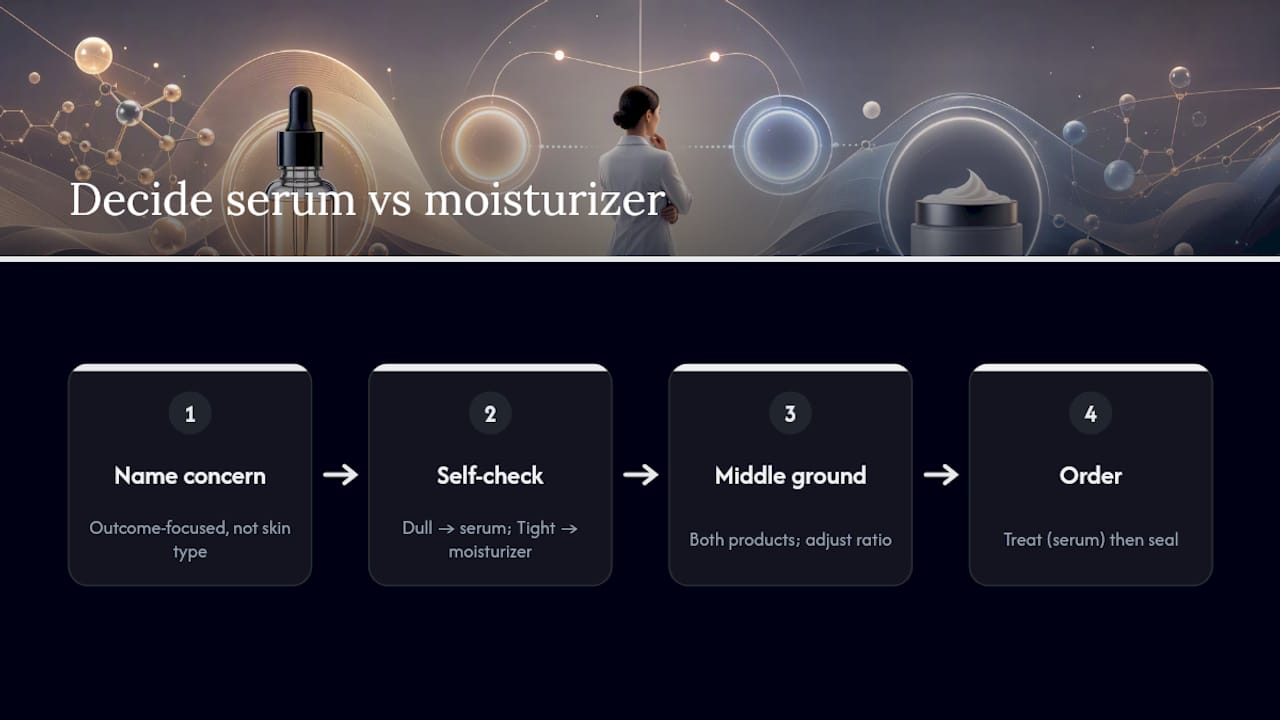
Start by naming your primary concern, not your skin type alone. If you’re chasing a specific outcome, like fading dark spots, softening fine lines, or calming persistent redness, that’s a job for a targeted serum. If your main complaint is general tightness, flaking, or sensitivity to weather changes, that’s a barrier issue, and a moisturizer is the fix.
A quick self-check: does your skin look dull or uneven in daylight, even right after cleansing? That points toward a serum concern; something active needs to change at the cellular level. Does your skin feel tight, flaky, or reactive within an hour of washing your face? That’s a barrier and hydration problem, which points to moisturizer first.
Most people land somewhere in the middle and need both, just in different ratios. Someone with dry, aging skin might use a rich moisturizer twice daily and add a treatment serum only at night. Someone with oily, acne-prone skin might use a thin hydrating serum daily and reserve heavier moisturizer for winter months only.
If you’re not sure where you fall, dermatologists frame the serum and moisturizer relationship simply: treat with the serum, seal with the moisturizer. When in doubt, that order of operations rarely steers you wrong, even if you’re still figuring out which actives belong in the treatment step.
Why the Serum-or-Moisturizer Debate Misses the Point
Most of the debate around serum versus moisturizer treats this like a competition, and that framing is wrong from the start. These products aren’t competing for the same job. The real question readers should be asking isn’t “which one is better,” it’s “which one is my skin actually missing right now.”
Where conventional advice falls short is in treating skin type as a fixed category that determines your routine forever. Skin changes with seasons, stress, hormones, and age. The oily-skin reader who “doesn’t need moisturizer” in July often does by January. The framework matters more than the label you’ve assigned yourself.
If there’s one thing to prioritize, it’s introducing new actives slowly and pairing them with barrier support from day one, not after irritation shows up. Most of the frustration people have with serums comes from skipping that step, not from picking the wrong ingredient. Get the sequence and the pace right, and the products themselves become a much smaller decision.
— Sara
Pair Your Serum and Moisturizer With Cellure’s Repair Kit
Buying a serum and moisturizer separately means guessing whether their ingredients actually work together. Cellure’s Complete Skin Repair Kit removes that guesswork by pairing regenerative serums, built around peptides, tranexamic acid, and polynucleotides, with a supporting moisturizer formulated to reinforce the barrier while those actives do their work.
The kit fits readers dealing with loss of firmness, uneven tone, or the kind of barrier sensitivity that makes introducing new actives risky on their own. Instead of piecing together a routine from three different brands with three different chemistries, everything is formulated to work as one system from the start. Visit the Complete Skin Repair Kit page to see the full ingredient breakdown and find the routine that matches your skin’s specific repair needs.
Sources
- Skin serum: What it can and can’t do — Harvard Health
- Pick a moisturizer — American Academy of Dermatology (AAD)
- Benefits of face serum — Healthline
Recommended
Share