


Skincare Layering Process: Steps for Maximum Results
TL;DR:
- Proper skincare layering requires applying products from lightest to heaviest to maximize absorption and prevent barrier blocking. Waiting 1 to 2 minutes between layers enhances effectiveness, with individual routines tailored to skin type and active ingredients, ensuring optimal results within 6 to 12 weeks. Consistency and correct sequencing are more impactful than the number of products used, emphasizing quality and timing over complexity.
The skincare layering process is the method of applying products in a specific sequence, from lightest to heaviest consistency, to maximize ingredient absorption and visible skin improvement. Get the order wrong and your most expensive actives sit on top of a barrier they cannot penetrate. A basic effective routine requires only three foundational steps: cleansing, moisturizing, and sun protection, with visible improvements appearing within 6 to 12 weeks. Add serums, toners, and treatment actives on top of that foundation and the sequence becomes the difference between results and wasted product.
What is the correct order of skincare routine steps and why does it matter?
Skincare layering is governed by physics: molecular weight and viscosity dictate which product goes first, not personal preference or price point. Lighter, water-based formulas carry smaller molecules that need direct contact with skin to penetrate. Apply a thick cream first and you create a physical seal that blocks everything applied afterward.
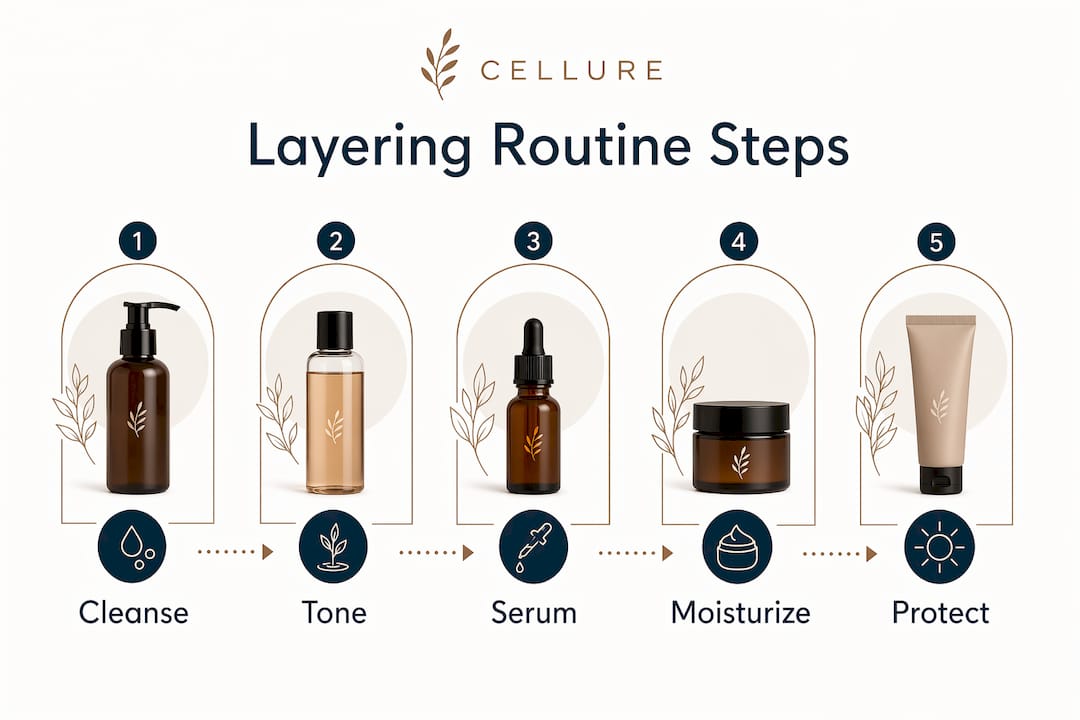
The standard sequence for effective product application runs in this order:
- Cleanser: Removes oil, debris, and residual SPF to give subsequent products a clean surface
- Toner or essence: Rebalances skin pH and adds the first layer of hydration
- Treatment serums: Delivers concentrated actives such as vitamin C, niacinamide, peptides, or acids
- Eye cream: Applied before heavier textures so the thin skin around the eye absorbs it fully
- Moisturizer: Hydrates and begins to seal in the layers beneath
- Facial oil (optional): Sits above water-based products because oil and water do not mix; oil always goes over water
- Sunscreen (AM only): The final step, never buried under additional products
This sequence reflects a core principle: water-based products first, oil-based products last. Heavier creams and occlusives applied too early act as a physical barrier, reducing the penetration of actives by a measurable degree. Skipping this logic is the single most common reason a well-chosen routine underperforms.
Pro Tip: If you are unsure whether a product is water-based or oil-based, rub a small amount between your fingers. Water-based formulas absorb quickly and feel weightless; oil-based ones leave a slight sheen.

Step-by-step morning and evening layering routines
Morning and evening routines serve different biological purposes, so the products and their order shift between the two.
Morning routine
- Gentle cleanser — A low-pH cleanser removes overnight sebum without stripping the barrier.
- Hydrating toner or essence — Pat in, do not rub. This primes skin for serum absorption.
- Antioxidant serum — Vitamin C (L-ascorbic acid) is the gold standard for morning use. It neutralizes free radical damage from UV and pollution before it accumulates.
- Targeted treatment serum — A peptide or brightening serum layered over vitamin C adds a second functional layer. Apply thinner textures before thicker ones.
- Moisturizer — Moisturizers lock in the products beneath and should be fully absorbed before sunscreen goes on.
- Broad-spectrum SPF 30 or higher — Sunscreen is always the last step in the morning. Applying anything over it dilutes the UV filter and reduces protection.
Evening routine
- Oil or balm cleanser — Dissolves SPF, makeup, and sebum. This is the first cleanse in a double-cleanse method.
- Water-based cleanser — Removes residue left by the oil cleanser and preps skin for actives.
- Toner or essence — Same role as morning: pH balance and initial hydration.
- Treatment serum — Evening is the right time for acids (AHAs, BHAs) or niacinamide. These work with the skin’s overnight repair cycle.
- Retinoid (if using) — Retinoids applied at night only, starting with a pea-sized amount every other night. The skin’s adjustment period typically spans several weeks, so patience is not optional.
- Moisturizer — Richer formulas are appropriate at night when the skin barrier is in active repair mode.
- Facial oil (optional) — Applied last to seal moisture in overnight.
The timing between layers matters more than most routines acknowledge. Waiting 1 to 2 minutes between major layers significantly improves absorption and reduces pilling. Immediate layering yields roughly 35% absorption; a 2 to 3 minute interval pushes that figure to 78%. That gap is worth building into your routine.
| Routine | Key active | Timing note |
|---|---|---|
| Morning | Vitamin C serum | Apply before moisturizer; wait 30 seconds before next layer |
| Evening | Retinoid | Every other night; buffer with moisturizer if sensitive |
| Both | Peptide serum | Compatible with most actives; layer after thinner serums |
Pro Tip: Set a 90-second timer after applying your serum. The pause feels unnecessary until you notice your moisturizer stops balling up on your skin.
How to choose and layer products for your skin type
Layering should be tailored to skin type and individual concerns. A routine built for dry, aging skin will actively worsen congestion on oily skin, and vice versa.
For oily and acne-prone skin, the priority is lightweight hydration without occlusion. Gel-based moisturizers and water-based serums work well. Heavy creams and facial oils should be minimized or skipped entirely, since occlusive oils and heavy creams create a barrier that traps sebum and can worsen breakouts. Niacinamide is a strong serum choice here: it regulates oil production and strengthens the barrier without adding weight.
For dry and mature skin, the sequence stays the same but the product textures shift heavier at each step. A hydrating toner with hyaluronic acid, a peptide or ceramide serum, and a rich moisturizer followed by a facial oil at night creates the layered moisture-locking effect this skin type needs. Cellure’s peptide-based serums are formulated specifically for this profile, delivering bioactive support at the cellular level without the heaviness of traditional creams.
For sensitive skin, the most important rule is restraint. Introducing new actives one at a time with a patch test period of 2 to 4 weeks identifies sensitivities before they become full reactions. Fragrance-free, minimal-ingredient formulas reduce the number of potential irritants in each layer. Barrier-supporting ingredients like ceramides, panthenol, and centella asiatica belong in the moisturizer step.
For combination skin, zone-based application is practical. Apply a lightweight gel moisturizer across the full face, then add a richer cream only to dry areas like the cheeks. This avoids over-moisturizing the T-zone while addressing dryness where it actually exists.
The rule that applies across all skin types: apply only one active ingredient per session. Stacking retinoids, AHAs, and vitamin C in the same routine does not compound results. It compounds irritation. Rotate actives across days or between AM and PM instead.
Common mistakes in the skincare layering process and how to fix them
Most layering failures come down to a short list of repeatable errors. Recognizing them is faster than troubleshooting a broken routine from scratch.
- Applying thick creams before serums. This is the most frequent mistake. A dense moisturizer applied before a serum physically blocks the active from reaching the skin. Reverse the order immediately.
- Skipping wait times and causing pilling. Products ball up on the skin when the layer beneath has not absorbed. The fix is the 1 to 2 minute pause between layers, not a different product.
- Using multiple actives in the same session. Retinoids plus AHAs plus vitamin C in one routine is a formula for a compromised barrier. Separate them by time of day or alternate days.
- Skipping sunscreen or applying it too early. Sunscreen placed under a moisturizer loses efficacy. It is always the final step in the morning routine, applied after everything else has absorbed.
- Over-layering products. More steps do not equal better results. Experts consistently note that effective layering prioritizes penetration, not complexity. A five-step routine executed correctly outperforms a ten-step routine applied in the wrong order.
If irritation develops, strip the routine back to cleanser, moisturizer, and SPF for one week. Reintroduce products one at a time, starting with the least active. This reset approach identifies the problem product faster than trying to adjust multiple variables simultaneously.
Pro Tip: Keep a simple log for the first month of a new routine. Note what you applied, in what order, and how your skin responded. Patterns become obvious within two weeks.
Key takeaways
The skincare layering process works because molecular weight and timing govern absorption: apply products from thinnest to thickest, wait 1 to 2 minutes between layers, and use only one active per session to protect the skin barrier.
| Point | Details |
|---|---|
| Order by consistency | Apply water-based, lightweight products first; heavy creams and oils always go last. |
| Timing between layers | Waiting 1 to 2 minutes between steps raises absorption from 35% to 78%. |
| One active per session | Stacking retinoids, AHAs, and vitamin C together causes irritation, not better results. |
| Sunscreen is always last | Applying anything over SPF in the morning dilutes the UV filter and reduces protection. |
| Tailor to skin type | Oily skin skips occlusives; dry and mature skin benefits from richer textures at every step. |
Why I stopped chasing the perfect 10-step routine
I spent a year testing multi-step routines with seven, eight, sometimes ten products applied in sequence. The results were not proportional to the effort. What I found, and what the research consistently confirms, is that the sequence and timing matter far more than the number of products.
The shift that actually changed my skin was adding a 90-second wait between my serum and moisturizer. That single adjustment, not a new product, reduced pilling and visibly improved how my skin looked by the end of the first week. It is the kind of detail that gets buried under product recommendations, but it is the mechanism that makes the whole system work.
I also became more selective about actives. Running vitamin C in the morning and a retinoid every other evening, with nothing else competing in those sessions, produced cleaner results than any stacked routine I had tried. The skin barrier is not a filter that processes everything thrown at it simultaneously. It has limits, and respecting those limits is what separates a routine that works from one that just sounds impressive.
For anyone dealing with aging concerns specifically, the science-backed guidance for mature skin points consistently toward peptides, ceramides, and polynucleotides as the actives worth prioritizing. These ingredients support cellular repair rather than just surface hydration. Pair them with a disciplined layering sequence and the results compound over weeks, not days.
Consistency over six to twelve weeks is the real variable. A three-step routine applied correctly every day will outperform an elaborate one applied inconsistently.
— Sara
Build your layering routine with Cellure
Cellure’s Complete Skin Repair Kit is designed around the exact layering principles covered in this article. Each product in the kit corresponds to a specific step in the sequence, from a gentle prep formula through to targeted peptide and polynucleotide serums, finishing with a barrier-supporting moisturizer.
The formulations use clinically supported bioactive ingredients including peptides, tranexamic acid, and polynucleotides to address firmness loss, uneven tone, and volume reduction at the cellular level. Every texture is calibrated so the products layer correctly without pilling or interference. If you want a routine that removes the guesswork from sequencing and delivers measurable results, the Complete Skin Repair Kit is where to start. You can also explore Cellure’s serum layering guide for deeper guidance on getting the most from each active.
FAQ
What is the correct order for skincare products?
The standard order is cleanser, toner, serum, eye cream, moisturizer, and sunscreen (AM only). Products go from thinnest to thickest consistency so lighter molecules reach the skin first.
How long should you wait between skincare layers?
Wait 1 to 2 minutes between each major layer. Research shows this interval raises absorption from approximately 35% to 78% and prevents product pilling.
Can you layer multiple serums at once?
Yes, but apply them thinnest to thickest and limit active ingredients to one per session. Layering a vitamin C serum with a peptide serum is fine; layering vitamin C with a retinoid or AHA in the same session risks irritation.
Should you use a different routine for oily skin?
Oily skin benefits from gel-based, water-based formulas at every step and should skip heavy occlusives and facial oils. Niacinamide is a strong serum choice for regulating sebum without adding texture.
When do results from a layering routine become visible?
A consistent, correctly layered routine produces visible improvements within 6 to 12 weeks. Actives like retinoids and vitamin C require sustained daily use to deliver measurable changes in tone, texture, and firmness.