


How Scientific Backing Shapes the Claims You Can Trust
Scientific backing calibrates how much confidence you should place in a claim by exposing it to repeatable tests, transparent methods, and independent scrutiny. Before reading further, here is the short version:
- What counts as good backing: A body of evidence from well-designed studies, replicated by independent researchers, published in peer-reviewed journals, with disclosed funding and pre-registered methods.
- How to use evidence when deciding: Match the strength of evidence to the stakes of the decision. For high-stakes choices, wait for systematic reviews or randomized controlled trials (RCTs). For lower-stakes ones, a well-designed observational study may be enough.
- Common limits to watch for: Single studies, small samples, undisclosed conflicts of interest, and results that have never been independently replicated all weaken a claim, regardless of how confidently it is stated.
Key Takeaways
Scientific backing is most reliable when evidence converges across multiple independent, well-designed studies with transparent methods, disclosed conflicts of interest, and replicated results.
| Point | Details |
|---|---|
| Evidence hierarchy matters | Systematic reviews and RCTs provide stronger causal evidence than observational studies, mechanistic work, or expert opinion. |
| Effect size over p-values | Statistical significance alone does not confirm practical importance; always check effect size and confidence intervals. |
| Replication is the real test | A finding replicated by independent teams across different populations carries far more weight than a single study, however large. |
| Transparency builds trust | Disclosed funding, pre-registered methods, and acknowledged limitations are positive signals, not weaknesses. |
| Use a checklist for decisions | Identify the claim, find the primary source, check study type and replication, review effect size, and assess external validity before acting. |
Table of Contents
- What does “scientifically backed” actually mean?
- How the scientific method gives structure to backing
- What types of evidence carry the most weight?
- Quality markers and red flags to check in any study
- Why scientific conclusions change over time
- A practical checklist for evaluating any claim
- How scientific backing shapes real decisions
- What to do when evidence is weak, contradictory, or still emerging
- Why aggregated, transparent evidence earns trust
- Sources
What does “scientifically backed” actually mean?
The role of scientific backing is often misunderstood, partly because the phrase gets used loosely in marketing. A claim is genuinely scientifically backed when it has been tested through repeatable experiments or observations, the methods are transparent enough for others to scrutinize, and the results have survived independent review. That is a higher bar than “a study showed” or “research suggests.”
Two examples make the gap concrete. A claim that a topical peptide improves skin firmness is well-supported when multiple peer-reviewed RCTs show a consistent, measurable effect, and those results hold up in a systematic review. Contrast that with a press release citing a single company-funded, non-peer-reviewed pilot on twelve participants. Both can be described as “backed by research.” Only one actually is.
The term “evidence-based” is the recognized standard across medicine, public health, and clinical research. It means decisions are grounded in the best available evidence, not just any evidence. When you see “scientifically backed” on a product or in a headline, your first question should be: which kind?
That construction is one of the most reliable red flags in marketing copy. A real claim points to a specific, findable source.*
How the scientific method gives structure to backing
The reason scientific backing carries weight is structural, not just because scientists are careful people. The method itself is built to catch errors.
Science relies on evidence that is testable and repeatable. Confidence in a claim grows when many independent tests, using different methods and populations, point the same direction. A single confirmation means little. Convergence across independent lines of evidence means a great deal.
The core features that make evidence trustworthy:
- Falsifiability: A scientific claim must be stated in a way that could, in principle, be proven wrong. Claims that can explain any outcome regardless of the data are not scientific.
- Repeatability: Other researchers, working independently, should be able to run the same test and get comparable results.
- Transparent methods: The study design, data collection procedures, and analysis plan must be reported in enough detail for others to evaluate and replicate.
- Control of bias: Well-designed studies use randomization, blinding, control groups, and pre-registration to prevent researchers from unconsciously steering results.
Scientific self-correction is one of the method’s most underappreciated features. When early studies on a topic are small and preliminary, the community treats them as hypothesis-generating, not definitive. Larger, better-controlled studies then test those hypotheses. When the new data contradicts the old, the consensus updates. That is not a failure of science; it is the system working as intended. The NIH explains that communicators should describe where a study sits in the research process before treating it as settled guidance.
What types of evidence carry the most weight?
Not all evidence is equal, and knowing the hierarchy is the single most practical skill for evaluating a claim. For causal questions, the hierarchy runs roughly as follows, from strongest to weakest:
- Systematic reviews and meta-analyses of multiple RCTs
- Individual randomized controlled trials with adequate sample size and blinding
- Well-designed cohort and case-control studies (observational)
- Mechanistic studies, animal studies, and in vitro (cell culture) work
- Expert opinion, case reports, and anecdotes
As the Science Media Centre notes, systematic reviews and randomized trials provide stronger causal inference than case reports or expert opinion for health claims. That does not make observational studies useless. A large, well-controlled cohort study can establish a strong association and generate hypotheses worth testing in trials. Mechanistic studies tell you how something might work at a cellular level, but they rarely tell you whether it works in a living person at a relevant dose.
| Evidence type | Causal strength | Main limit |
|---|---|---|
| Systematic review / meta-analysis | Highest | Quality depends on included studies |
| Randomized controlled trial | High | Costly; may lack real-world generalizability |
| Observational (cohort, case-control) | Moderate | Confounding; cannot prove causation |
| Mechanistic / animal / in vitro | Low for humans | Extrapolation to humans often uncertain |
| Expert opinion / anecdote | Lowest | Susceptible to bias and selective memory |
The strength of evidence also depends on how directly the study population and conditions match your situation. A trial conducted on a specific demographic may not generalize to everyone, even if the design is excellent.
Quality markers and red flags to check in any study
A study being peer-reviewed and published does not automatically make it trustworthy. Peer review improves quality but is not infallible. What you want is a cluster of positive signals, not just one.
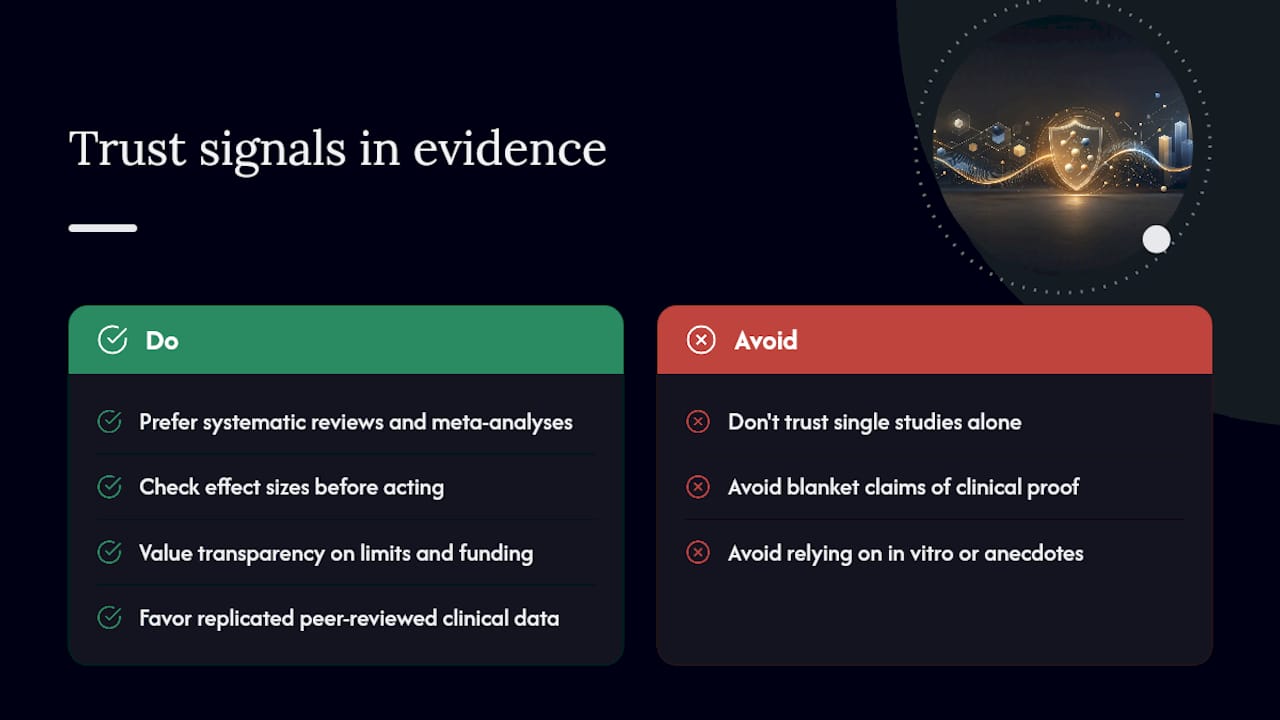
Trust signals to look for:
- Peer review in a journal with editorial standards and post-publication scrutiny
- Independent replication by researchers with no connection to the original team
- Pre-registration of the hypothesis and analysis plan before data collection
- Effect size and confidence intervals reported alongside p-values
- Sample size large enough to detect a meaningful effect (statistical power)
- Transparent data and methods, available for others to check
- Funding sources and conflicts of interest disclosed
Responsible research practice requires transparency about data handling and the basis for any decision to omit or modify data. When that transparency is absent, the finding is harder to trust regardless of where it was published.
Red flags:
- A single small study with no replication
- Selective reporting (only positive outcomes published)
- Undisclosed industry funding or conflicts of interest
- Sensational headlines that outrun the actual finding
- Results extrapolated far beyond the studied population
A common example: a headline reads “New compound reverses aging in cells.” The actual study tested the compound on isolated cell cultures in a lab dish, with no human participants. The headline is technically traceable to the study, but the extrapolation is enormous. Effect size matters too. Statistical significance (a low p-value) tells you the result probably wasn’t random chance. It does not tell you the effect is large enough to matter in practice. Always look for the effect size and its confidence interval.
Pro Tip: When reading a study abstract, note the study type, sample size, and primary outcome in the first thirty seconds. If the abstract doesn’t state those three things clearly, that itself is a signal worth noting before you read further.
Why scientific conclusions change over time
Changing guidance is one of the most misunderstood features of science. When recommendations shift, many people read it as evidence that scientists don’t know what they’re doing. The opposite is usually true.
Initial findings on any topic tend to come from small, exploratory studies. Those studies are valuable for generating hypotheses, but they are underpowered to settle questions. Publication bias compounds the problem: positive results are more likely to be published than null results, which skews the early literature toward overestimates of effect size. As the NIH points out, changing guidance often reflects new data and self-correction, not a failure of the original science.
Measurement error, short follow-up periods, and sampling limits all constrain what early studies can show. When larger trials with longer follow-up and more representative samples are run, they sometimes confirm the early finding, sometimes shrink the estimated effect, and occasionally reverse it. The reversal gets the headlines. The dozens of confirming replications rarely do.
A concrete pattern: a small pilot study suggests a dietary supplement improves a biomarker. The study has forty participants and runs for a certain duration. A subsequent meta-analysis finds a smaller effect that disappears when controlling for diet. The supplement industry cites the pilot. The meta-analysis is the better guide.
A practical checklist for evaluating any claim
When you encounter a claim described as scientifically supported, you can assess its actual strength in under five minutes with a consistent process. The one-sentence template: “This claim is [strong/moderate/weak] because the evidence comes from [study type], has [has/has not] been replicated, and the effect size is [large/small/unreported].”
- Identify the specific claim. Strip away the marketing language and state exactly what is being asserted (e.g., “ingredient X reduces wrinkle depth by Y% in Z weeks”).
- Find the primary source. Look for a journal citation, not a press release or brand website. If none exists, the claim is unsupported.
- Check the study type. Is it an RCT, an observational study, or a mechanistic study? Use the hierarchy above to calibrate how much causal weight it carries.
- Check sample size and duration. Fewer than a hundred participants or a follow-up shorter than the claimed effect window should raise caution.
- Look for peer review and replication. Has the finding appeared in a peer-reviewed journal? Have independent teams reproduced it?
- Check effect size and confidence intervals, not just p-values. A statistically significant result with a tiny effect size may be real but practically irrelevant.
- Review funding and conflict disclosures. Industry-funded studies are not automatically wrong, but undisclosed funding is a red flag.
- Search for a systematic review or meta-analysis. If one exists on the topic, it outweighs any single study.
- Assess external validity. Does the study population match your situation? A trial on one demographic may not generalize to another.
Steps 3, 4, 5, and 7 all flag problems. The claim is not well-supported, regardless of the percentage cited. For a deeper look at how this plays out with specific ingredients, clinical studies in skincare offer a useful sector-specific walkthrough.
How scientific backing shapes real decisions
The stronger the evidence, the higher the confidence and the lower the need for precautionary hedging. That principle holds across policy, clinical practice, and consumer choices, though each context weighs additional factors.
Policy: Governments and regulatory agencies use evidence alongside risk assessment. When evidence is strong and consistent, policy can move with confidence. When it is early or contested, decision-makers often apply a precautionary approach, especially where the cost of being wrong is high. The strength and context-dependence of evidence means that urgency sometimes requires acting on moderate evidence rather than waiting for certainty.
Clinical practice: Medical guidelines are built from systematic reviews of the best available trials. Shared decision-making between clinician and patient then factors in individual values, risk tolerance, and circumstances. A treatment supported by multiple large RCTs warrants a different conversation than one supported by a single pilot.
Consumer choices: Here, cost, personal risk, and values all enter the equation alongside evidence. A consumer buying a skincare product with strong clinical backing for its active ingredients is making a lower-risk choice than one buying a product whose claims rest on in vitro data alone. Resources like evidence-based serums show how clinical evidence translates to specific product formulations. For ingredient-level research, a resource like GHK-Cu peptide evidence illustrates how supplier-level data can supplement your own evaluation.
Pro Tip: When evidence is early and the stakes are personal, ask yourself: what is the realistic downside if this doesn’t work or causes harm? Low downside with plausible mechanism? Reasonable to try. High downside with weak evidence? Wait for stronger data.
What to do when evidence is weak, contradictory, or still emerging
Pause major decisions for high-stakes matters, seek higher-quality evidence, or rely on interim expert consensus where delay is genuinely harmful. That is the practical default when the evidence base is thin.
Four concrete actions when you’re in this situation:
- Search for a meta-analysis or systematic review on the topic. If one doesn’t exist yet, treat all individual studies as preliminary.
- Prefer replicated findings over novel ones. A result that has appeared in three independent studies across different populations is more reliable than a single striking finding, even if the single study is larger.
- Ask for the effect size. A contradictory literature often resolves when you look at effect sizes: studies may disagree on statistical significance but agree that the effect, if real, is small.
- Consider the downside risk. For decisions with reversible, low-cost consequences, acting on moderate evidence is often reasonable. For irreversible or high-cost decisions, the evidence bar should be higher.
Two scenarios: A consumer product claims to reduce hyperpigmentation based on two small trials with no replication. The product is low-cost and the ingredient has a plausible mechanism. Reasonable to try while monitoring for results, using a checklist like tracking signs of effective skincare. No replication exists. For a patient, the right move is to discuss with a clinician and wait for larger trials before switching from an established treatment. Public trust in science is strengthened, not weakened, when researchers and communicators acknowledge that uncertainty openly.
Why aggregated, transparent evidence earns trust
The single most reliable signal that a body of evidence deserves confidence is convergence: multiple independent research teams, using different methods, arriving at similar conclusions. A single study, however well-designed, is a data point. A coherent body of evidence that converges across methods is the actual standard of confidence.
What I find most underappreciated is how much transparency does for trust. Research shows that perceived researcher integrity and honest disclosure of limitations are directly linked to public trust in science. Researchers who acknowledge what their study cannot show are more credible, not less. The same logic applies to brands and communicators: a product page that cites specific trials, discloses funding, and acknowledges the limits of the evidence is more trustworthy than one that claims blanket “clinical proof.”
My practical recommendation: default to systematic reviews and meta-analyses as your anchor, check effect sizes before acting on any single finding, and treat transparency about limitations as a positive signal rather than a weakness. That habit serves you well whether you’re evaluating a health claim, a policy proposal, or a skincare ingredient.
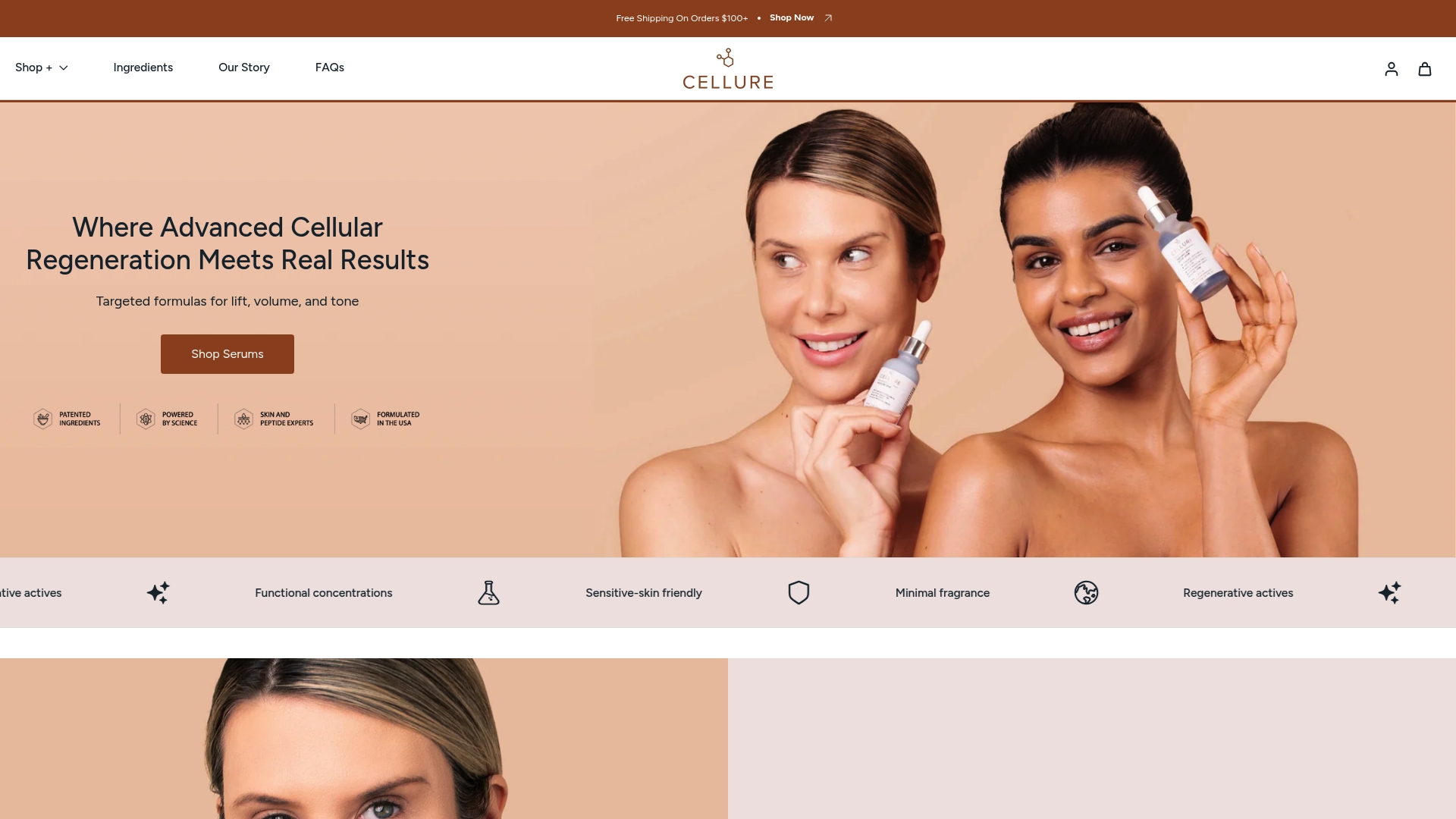
Cellure formulates its serums and treatment kits around bioactive ingredients with clinically supported evidence, including peptides, polynucleotides, tranexamic acid, and hyaluronic acid. Each formulation reflects the same evidence hierarchy described in this article: prioritizing ingredients with replicated, peer-reviewed clinical data over those backed only by in vitro or anecdotal support. If you want skincare grounded in the same standards you’ve just read about, explore Cellure’s range of cellular repair serums and kits.
Sources
These resources let you go deeper on any aspect of evaluating scientific evidence:
- Science relies on evidence
- Explaining How Research Works | National Institutes of Health (NIH)
- Science Shorts 3: The Strength of Scientific Evidence
- Scientific Principles and Research Practices - Responsible Science
- Types of scientific evidence - Science Media Centre