


The Role of Clinical Studies in Skincare Explained
TL;DR:
- Clinical studies verify the safety and effectiveness of skincare products through controlled, measurable trials. They produce objective data on ingredient performance, helping consumers and professionals make informed choices. Only well-designed, independent research provides trustworthy evidence to support marketing claims.
Clinical studies in skincare are defined as controlled scientific investigations that confirm whether a product is both safe and effective before it reaches consumers. They transform marketing claims into measurable, reproducible data. Without them, ingredient promises like “reduces wrinkles” or “brightens skin” remain unverified. The role of clinical studies in skincare is to provide that verification, using tools like corneometers, cutometers, and Tewameters alongside rigorous study designs. Ingredients such as Thiamidol and isorhamnetin have been evaluated through exactly this process, producing specific, quantifiable results that separate genuine performance from wishful thinking.
How do clinical studies scientifically evaluate skincare products?
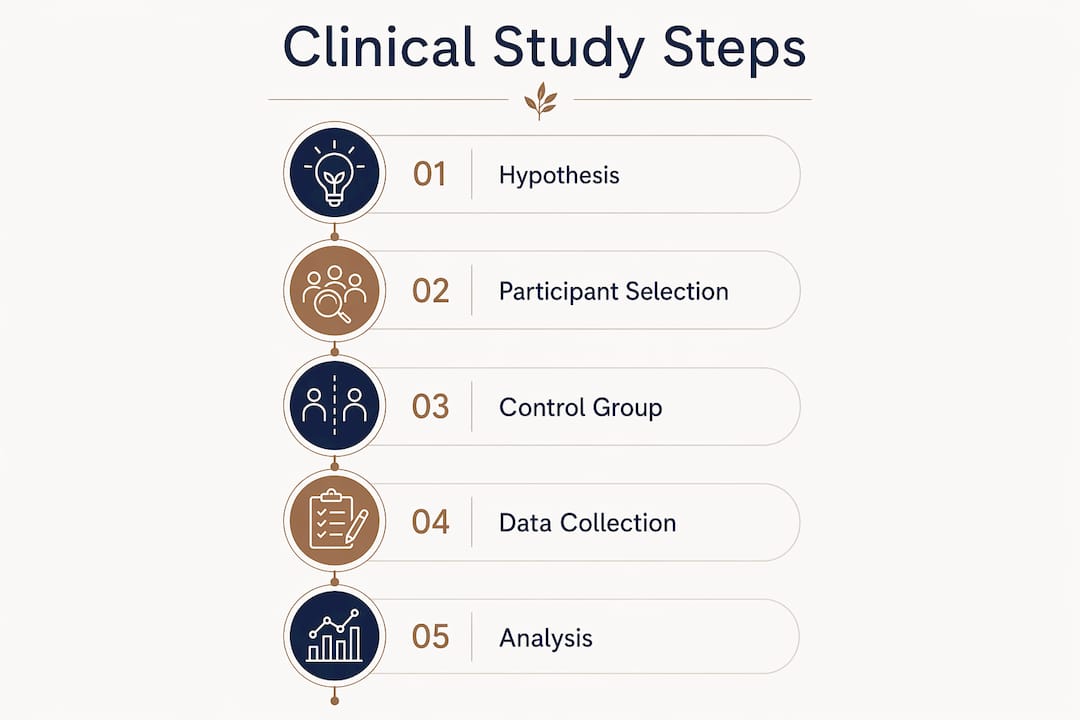
Clinical research in skincare products follows a structured methodology designed to isolate what an ingredient actually does to skin. The gold standard is the randomized controlled trial, or RCT, where participants are randomly assigned to either the active product or a placebo. This design prevents bias and ensures that any measured improvement comes from the ingredient itself, not from expectation or coincidence.
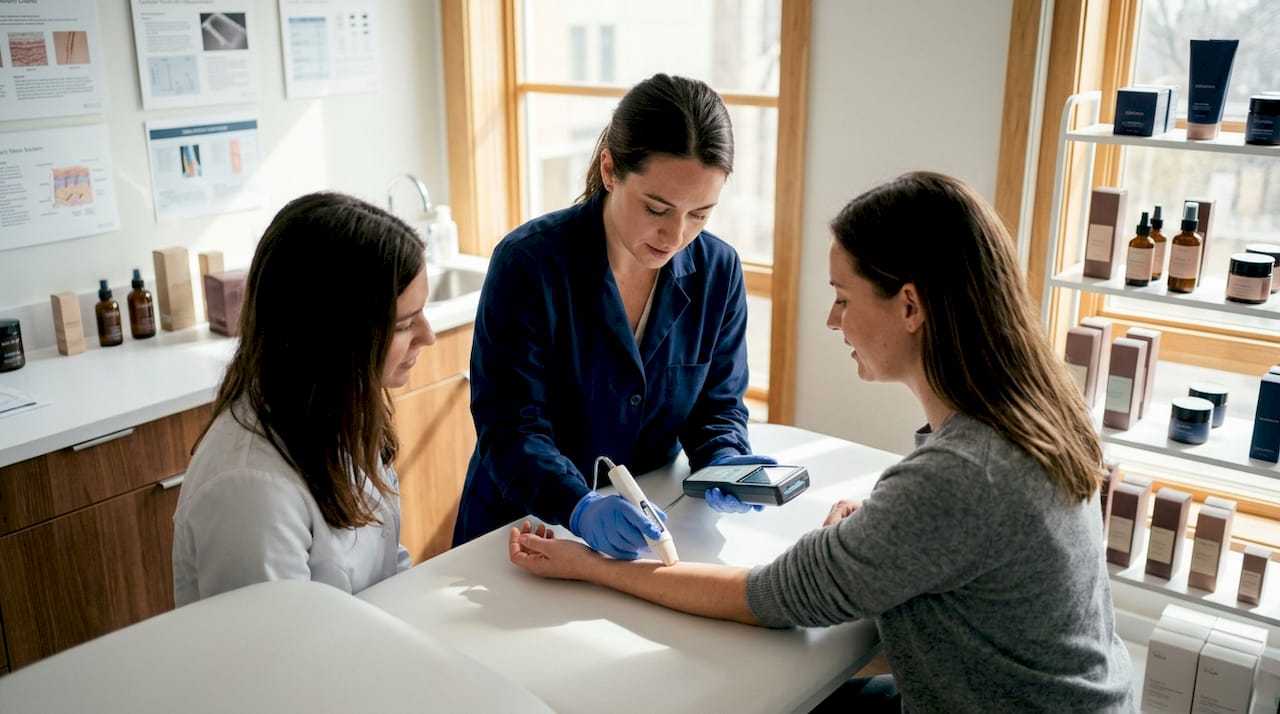
Objective measurements are central to this process. Standardized tools like corneometers measure skin hydration, cutometers assess elasticity, and Tewameters track water loss through the skin barrier. High-resolution imaging captures changes in wrinkle depth and skin texture over time. These instruments remove subjectivity from the evaluation.
Study endpoints define what counts as success. Researchers set specific targets before the trial begins, such as a measurable reduction in wrinkle depth or a statistically significant increase in hydration. Statistical significance confirms that results are not due to chance. Safety monitoring runs in parallel, tracking adverse reactions across participants with different skin types and tones.
Key elements of a well-designed skincare clinical trial include:
- Randomization and blinding: Participants and often researchers do not know who receives the active product, preventing expectation bias.
- Control groups: A placebo or vehicle control isolates the effect of the active ingredient from the base formulation.
- Instrumental measurement: Objective devices replace self-reported impressions for hydration, sebum, elasticity, and pigmentation.
- Adverse effect tracking: Safety monitoring across skin types identifies irritation, sensitivity, or unexpected reactions before a product launches.
- Statistical analysis: Results must cross a significance threshold to be reported as a genuine effect.
Pro Tip: When reading a skincare brand’s clinical claims, check whether the study used a control group. A trial without one cannot prove the product caused the improvement.
What measurable benefits have recent skincare clinical studies demonstrated?
Recent clinical evaluations have produced specific, striking results that illustrate the real impact of well-formulated ingredients. These numbers are not marketing estimates. They come from controlled trials with defined endpoints and instrumental measurement.
A 0.2% Thiamidol cream reduced hyperpigmentation scores by 36.1% over 12 weeks, compared to just 16.1% in the vehicle control group. That gap confirms the active ingredient drove the improvement, not the base cream. For consumers dealing with uneven skin tone, this kind of data is far more useful than a vague “brightening” claim.
Wrinkle reduction has also been quantified with precision. A cream containing 4% Aliophen reduced wrinkle depth by 15.9% after 56 days of twice-daily use. That result came from high-resolution imaging, not self-assessment. It gives both consumers and dermatologists a concrete benchmark for evaluating anti-aging products.
Hydration and sebum control show equally clear outcomes. A dual-purpose serum increased skin hydration by up to 72.5% over four weeks of use. Separately, an isorhamnetin-based cream decreased sebum content by 21.1% on the forehead after 28 days. These results come from corneometer and sebumeter readings, not participant surveys.
| Ingredient | Measured outcome | Trial duration |
|---|---|---|
| 0.2% Thiamidol | 36.1% reduction in hyperpigmentation | 12 weeks |
| 4% Aliophen | 15.9% reduction in wrinkle depth | 56 days |
| Dual-purpose serum actives | Up to 72.5% increase in hydration | 4 weeks |
| Isorhamnetin (Opuntia ficus-indica) | 21.1% decrease in sebum content | 28 days |
“Tracking multiple skin parameters simultaneously, such as hydration, sebum, and pigmentation, gives a far more complete picture of how an ingredient performs across different skin concerns.”
How do clinical trials improve consumer and professional confidence?
Clinical trials build trust in a way that no marketing campaign can replicate. When a dermatologist recommends a product, they are staking their professional credibility on it. They need evidence, not testimonials. Peer-reviewed trial data gives them that foundation.
For consumers, the difference between a clinically validated product and an unsubstantiated one is the difference between a verified claim and a guess. Products with published trial data can state specific outcomes, such as a percentage improvement in hydration or a measurable reduction in wrinkle depth. Products without that data can only offer vague language.
Retailers and healthcare professionals also use clinical data as a selection filter. A product backed by an RCT with a control group and instrumental measurement is far easier to recommend than one supported only by before-and-after photos. This is why clinical validation has become a competitive differentiator in the skincare market.
| Product type | Evidence basis | Professional endorsement |
|---|---|---|
| Clinically validated | RCT data, instrumental measurement, peer review | High. Dermatologists and retailers can cite specific outcomes. |
| Anecdotally supported | Consumer testimonials, before-and-after photos | Low. No objective benchmark for professionals to reference. |
Pro Tip: Ask whether a brand’s clinical data has been published in a peer-reviewed journal. Brand-commissioned studies that remain unpublished carry significantly less weight than independently reviewed research.
What limitations must you consider when reading skincare clinical studies?
Clinical studies are not infallible. Industry-funded trials can influence study design, endpoint selection, and how results are reported. A brand that funds its own research has an incentive to design a study that shows favorable outcomes. This does not make the data false, but it does require scrutiny.
Short trial durations are a common limitation. Many skincare studies run for four to twelve weeks. Skin aging is a long-term process, and short-term improvements in hydration or wrinkle depth may not persist. Practitioners rely on independent, long-term studies to validate whether benefits hold beyond the initial measurement window.
Additional limitations to watch for include:
- Small sample sizes: A trial with fewer than 30 participants may not produce statistically reliable results across diverse skin types.
- Homogeneous study populations: Trials conducted on a narrow demographic may not reflect how a product performs on different skin tones or ages.
- Subjective self-assessment: Studies that rely heavily on participant-reported outcomes rather than instrumental measurement are more vulnerable to placebo effects.
- Lack of independent replication: A single study, even a well-designed one, carries less weight than findings replicated across multiple independent trials.
- Unpublished data: Brand-commissioned studies that are not submitted for peer review cannot be independently verified.
Understanding these limitations does not mean dismissing clinical data. It means reading it critically. A well-designed, independently reviewed trial with a large, diverse sample and long follow-up period is the most reliable form of evidence available in skincare science.
How to use clinical study data to choose better skincare products
Applying clinical research to real purchasing decisions requires knowing what to look for and what to ignore. The process is more straightforward than most people assume.
-
Look for specific, measurable claims. A claim like “reduces wrinkle depth by 15.9% in 56 days” is clinically grounded. A claim like “visibly smoother skin” is not. Specificity signals that a study with defined endpoints was conducted.
-
Check for a control group. Any trial worth citing used a placebo or vehicle control. Without one, there is no way to know whether the product caused the result or whether skin simply improved on its own.
-
Identify the measurement tools used. Corneometers, cutometers, and Tewameters produce objective data. Studies that rely solely on participant surveys or visual grading by researchers carry more subjectivity. Look for signs of effective skincare grounded in instrumental measurement.
-
Assess whether diverse skin types were included. A product tested only on light skin tones may not perform the same way on deeper tones. Inclusive trial populations produce more broadly applicable results.
-
Check trial length and follow-up. Four weeks is enough to measure hydration. Twelve weeks or more is needed to assess meaningful changes in pigmentation or wrinkle depth. Longer trials with follow-up measurements provide stronger evidence of lasting benefit.
-
Prioritize independent or peer-reviewed research. Studies published in journals like the Journal of Cosmetic Dermatology or Cosmetics (MDPI) have passed external review. Brand white papers have not. Both can contain valid data, but peer-reviewed research carries more credibility.
Understanding what clinical grade skincare actually means helps you apply these criteria confidently. The goal is not to become a researcher. It is to ask the right questions before you invest in a product.
Key Takeaways
Clinical studies are the only reliable method for confirming that a skincare ingredient does what its label claims, using objective measurement tools and controlled trial designs to produce verifiable results.
| Point | Details |
|---|---|
| Clinical trials validate claims | RCTs with control groups convert marketing language into measurable, reproducible data. |
| Instruments remove subjectivity | Corneometers, cutometers, and Tewameters produce objective skin measurements that self-reports cannot. |
| Recent studies show real results | Thiamidol reduced hyperpigmentation by 36.1%; a dual-purpose serum increased hydration by up to 72.5%. |
| Industry bias is a real risk | Short, brand-funded trials may overstate benefits; independent peer-reviewed research provides stronger validation. |
| Consumers can apply this knowledge | Specific claims, control groups, diverse populations, and peer review are the four criteria worth checking before buying. |
Why I think most people are reading clinical claims completely wrong
The skincare industry has gotten very good at using the language of science without the substance of it. I have reviewed product pages that cite “clinically tested” as a selling point while linking to a study with no control group, 20 participants, and a four-week follow-up. That is not clinical validation. That is marketing dressed in a lab coat.
What frustrates me most is that the actual data, when it exists, is genuinely impressive. A 36.1% reduction in hyperpigmentation from Thiamidol. A 72.5% hydration increase from a well-formulated serum. These are real numbers from real trials. They do not need embellishment. The problem is that brands with weaker evidence have trained consumers to accept vague claims as equivalent to rigorous proof.
My advice to both consumers and healthcare professionals is the same: treat “clinically tested” as a starting point, not a conclusion. Ask what was tested, on whom, for how long, and whether the study was independently reviewed. The brands that can answer those questions clearly are the ones worth trusting. The ones that cannot are telling you something important about their evidence. The future of skincare credibility belongs to brands that publish their data, test on diverse populations, and commission long-term independent research. That bar is not unreasonably high. It is just rarely met.
— Sara
Cellure’s approach to clinically supported skincare
Cellure formulates its products around bioactive ingredients with documented clinical backing, including peptides, tranexamic acid, and polynucleotides, each selected for their measurable effects on skin repair and regeneration.
The Complete Skin Repair Kit brings together these validated actives in a targeted system designed to address firmness loss, uneven tone, and hydration decline. Every formulation reflects the same standard this article describes: specific ingredients, measurable outcomes, and science that holds up to scrutiny. For consumers and healthcare professionals who want skincare grounded in real clinical research, Cellure’s product range offers a transparent starting point. You can also learn more about cellular regeneration science behind the full product line.
FAQ
What is the role of clinical studies in skincare?
Clinical studies confirm whether a skincare product is safe and effective by measuring specific outcomes like hydration, wrinkle depth, and pigmentation using objective instruments. They convert ingredient claims into verifiable, reproducible data.
How do randomized controlled trials differ from other skincare tests?
RCTs assign participants randomly to active or placebo groups, which isolates the ingredient’s effect from other variables. This design is the most reliable method for proving that a product caused an observed improvement.
Can a short clinical trial still produce valid skincare results?
Short trials of four to eight weeks can reliably measure hydration and sebum changes. Longer trials of twelve weeks or more are needed to assess meaningful improvements in pigmentation or wrinkle depth with lasting validity.
How can I tell if a skincare brand’s clinical claims are credible?
Look for specific percentage outcomes, named measurement tools, a control group, and publication in a peer-reviewed journal. Vague claims like “clinically tested” without these details are not sufficient evidence of efficacy.
Why do dermatologists rely on clinical trial data when recommending products?
Dermatologists need objective, reproducible evidence to stake their professional credibility on a recommendation. Peer-reviewed trial data with instrumental measurement gives them a defensible, science-based foundation for endorsing specific products.