


Polynucleotides for Skin: A Science First Look at What Topicals Can Do
Topical polynucleotides can genuinely improve hydration, support the skin barrier, and calm inflammation with regular use, but they are not a substitute for injectable-level dermal remodeling. Think of them as maintenance, not overhaul: best paired with routines like microneedling for better delivery, and best chosen from brands that disclose their formulation. The approach, built on transparent ingredient lists and complementary actives, reflects that realistic middle ground.
TL;DR:
- Formulations with disclosed molecular weight, hydrolysis claims, and delivery technology are more likely to effectively deliver polynucleotides into the skin.
- Clinical evidence supports visible improvements within weeks for specific, well-formulated products, but true dermal remodeling requires consistent use over at least four weeks.
- Topical polynucleotides are better suited for maintenance and hydration support rather than significant skin remodeling, which is typically achieved through in-office injections.
- Products promising “injectable results without a needle” often overstate their capabilities, and transparency on ingredients and delivery methods is crucial for trustworthy claims.
- Regular application, especially after cleansing and before heavier products, combined with paired actives like hyaluronic acid or peptides, enhances efficacy and long-term skin benefits.
Table of Contents
- How Polynucleotides for Skin Actually Work
- What Does the Clinical Evidence Actually Show?
- What to Look for When Buying a Polynucleotide Serum
- How to Use Topical Polynucleotides for the Best Results
- How Are Polynucleotide Injectables Used in Clinical Practice?
- Polynucleotides vs. Hyaluronic Acid and Growth Factors: What’s the Real Difference?
- Are There Side Effects or Risks With Polynucleotide Skincare?
- How Long Do Results Last and How Often Should You Use It?
- Are Polynucleotide Skincare Products Regulated?
- Cellure’s Take on Formulating With Polynucleotides
- Why the Complete Skin Repair Kit Is Built for This Exact Approach
- Sources
How Polynucleotides for Skin Actually Work
Polynucleotide molecules, often shortened to PN or referenced as PDRN when derived from salmon or trout DNA, work through two connected mechanisms. They activate the adenosine A2A receptor on fibroblasts, and they supply nucleotide building blocks through what researchers call the salvage pathway. Both effects push fibroblasts to produce more collagen and dial down inflammatory signaling, according to a narrative review of polynucleotide biology.
That biology is well established in wound healing and injectable contexts. The harder question for a jar or bottle sitting in your bathroom is whether the same molecules can get where they need to go from the surface of your skin. Molecular weight decides that almost entirely.
- Large, intact PN strands are too big to cross the stratum corneum, which behaves like a filter with roughly a 500 dalton cutoff.
- Hydrolyzed or fragmented PN, sometimes marketed as low molecular weight polynucleotides, stands a better chance of penetrating.
- Encapsulation and particle delivery systems are additional engineering steps brands use to shrink the effective size of what reaches living skin cells.
This is the core distinction between a topical serum and an injectable skin booster. An injection places the molecule directly into the dermis, bypassing the barrier altogether. A topical product has to earn its way through skin that evolved specifically to keep foreign molecules out. That does not make topical polynucleotide skincare pointless. It does mean the formulation details matter more than the ingredient name on the label.
What Does the Clinical Evidence Actually Show?
The most cited topical trial found a 0.1% PDRN-850K eye cream outperformed 0.1% retinol on wrinkle depth, dermal thickness, and firmness over 28 days, in a randomized, double-blind, split-face study with imaging and biomarker data behind it, not just before-and-after photos. Researchers also documented increased extracellular matrix proteins in treated skin, according to the PDRN-850K split-face study, giving the results a mechanistic backbone rather than a purely cosmetic one.
That trial matters because it used a specific, disclosed molecular weight rather than an unnamed “polynucleotide complex.” The same research describes formulation techniques such as condensing DNA fragments into monodisperse particles with adjusted surface charge, engineering meant specifically to solve the penetration problem rather than ignore it.
Outside that trial, the evidence picture thins out fast. Most of what we know about polynucleotide efficacy for skin still comes from injectable use in aesthetic medicine and from wound care, where the molecule is applied directly to compromised or open tissue rather than intact skin. Dermatology commentators have pointed out that many topical PN products never disclose molecular weight or in vivo delivery data at all, which means their claims of collagen production and dermal repair often rest on the ingredient’s reputation rather than on evidence specific to that product, per expert commentary on PDRN serum claims.
The practical takeaway: early, visible improvements like plumping and smoother texture are plausible within weeks. True dermal remodeling, the kind measured by biopsy or high-resolution imaging, has only been demonstrated with specific, disclosed formulations under controlled conditions, and typically over four or more weeks of consistent use.
What to Look for When Buying a Polynucleotide Serum
Reading a polynucleotide serum label with any skepticism will save you money and disappointment. A few checkpoints separate a formula built on real delivery science from one riding on ingredient-name popularity.
- Molecular weight or hydrolysis claims. A brand that names its molecular weight range, or explicitly states its PN is hydrolyzed or fragmented for smaller particle size, is telling you it has thought about the 500 dalton problem.
- Delivery technology disclosure. Encapsulation, liposomal delivery, or particle-condensation methods signal an actual attempt at getting the molecule past the barrier, not just a marketing bullet point.
- Concentration claims read in context. A high percentage of polynucleotides means little if the formulation cannot deliver it into skin. Concentration is only meaningful alongside a credible delivery method.
- Complementary actives. Formulas that pair PN with hyaluronic acid, peptides, or ceramides tend to perform better in practice, since these ingredients support hydration and barrier repair even when PN penetration is limited.
- Red flag language. Any product promising “injectable results without the needle” is overselling what a topical can plausibly do given current formulation science.
Pro Tip: If a product page cannot tell you the molecular weight or delivery method behind its polynucleotide claim, assume the visible benefits are coming mostly from its other ingredients, not the PN itself.
How to Use Topical Polynucleotides for the Best Results
Polynucleotide serum belongs early in your routine, right after cleansing and before heavier creams or oils, so the formula has direct contact with clean skin. Patch-test any new PN serum on your inner forearm for 24 hours before applying it to your face, especially if you have reactive or compromised skin.
- Cleanse and pat dry. Residue from cleanser can interfere with absorption of any active, including PN.
- Apply the PN serum to slightly damp skin. A humid surface can help humectant-rich formulas spread evenly and may support uptake.
- Follow with a barrier-supporting moisturizer. Sealing in the serum reduces water loss and supports the calming effects associated with PN.
- If pairing with at-home microneedling, apply the serum immediately after the session, when the skin’s temporary micro-channels are most open to topical actives. Then follow with gentle, fragrance-free aftercare for the following 24 to 48 hours. This pairing is one of the more sensible ways to bridge the delivery gap that limits stand-alone topical PN and microneedling routines.
- Skip PN application on freshly irritated, sunburned, or actively broken skin, and hold off pairing with retinoids or exfoliating acids on the same night.
Set your expectations by timeline. Surface changes such as improved hydration and a slightly plumper look often show up within two to four weeks. Anything resembling true dermal remodeling asks for either a validated low molecular weight formulation used consistently for eight to twelve weeks or longer, or an in-office procedure that delivers the molecule past the barrier directly.
How Are Polynucleotide Injectables Used in Clinical Practice?
Injectable polynucleotide treatments, often called skin boosters, follow a different protocol entirely from anything sold over the counter. A trained provider administers a series of micro-injections into the mid-to-deep dermis, typically across two to four sessions spaced two to four weeks apart, followed by maintenance sessions every few months depending on the treatment area and the patient’s skin condition.
Providers commonly use fine needles or cannulas to distribute the product evenly across zones like the under-eye area, cheeks, neck, or hands, targeting tissue that has lost density or hydration. Because the product bypasses the skin barrier by design, injectable protocols carry stricter screening requirements than any topical: a consultation to rule out active skin infections, autoimmune conditions, or allergies to the source material, plus a review of any blood-thinning medication.
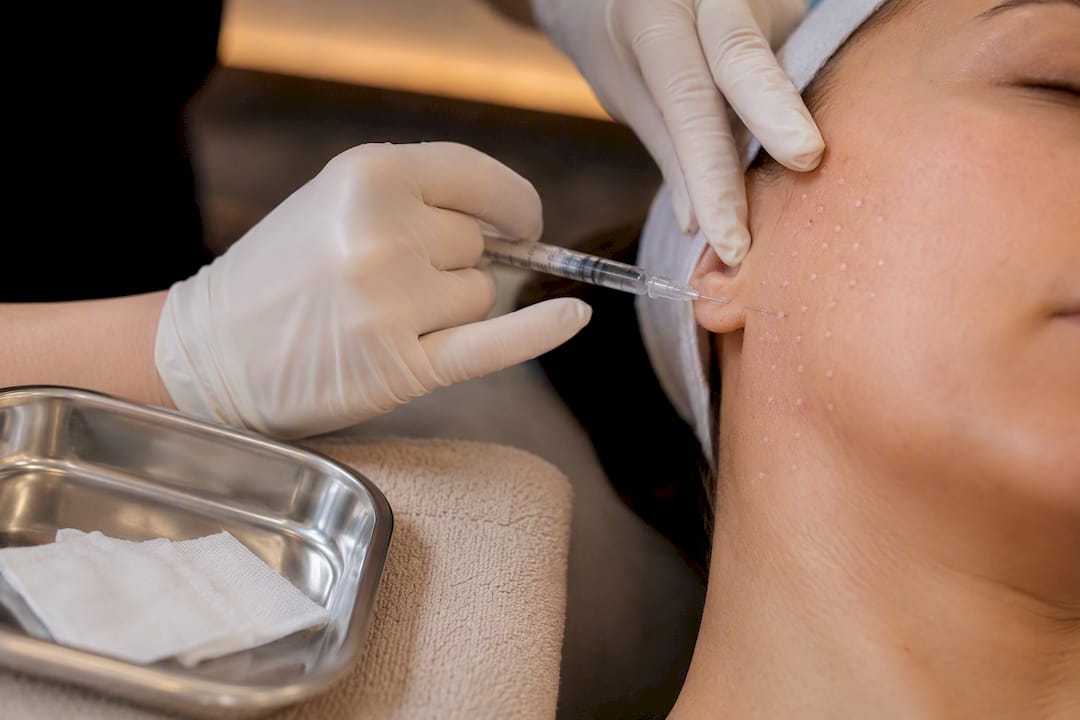
Recovery after injectable sessions usually involves mild swelling or bruising at injection sites for a few days. This is a meaningfully different risk and commitment profile than a nightly serum, which is precisely why topical polynucleotides are better understood as a maintenance and prevention tool rather than a do-it-yourself version of the clinical procedure. Anyone considering injectable treatment should discuss candidacy and protocol specifics directly with a licensed provider rather than relying on general information.
Polynucleotides vs. Hyaluronic Acid and Growth Factors: What’s the Real Difference?
Polynucleotides, hyaluronic acid, and growth factor serums often sit side by side on the same shelf, but they solve different problems.
Hyaluronic acid is primarily a humectant. It draws and holds water in the skin, delivering fast, visible plumping, but it does not meaningfully signal fibroblasts to build new collagen on its own. Its effects are largely surface-level and temporary, fading as the molecule turns over.
Growth factor serums aim to signal skin cells more directly, often using peptide fragments or lab-derived proteins to mimic the cell-signaling molecules involved in tissue repair. Evidence for topical growth factors is mixed and highly formulation-dependent, with penetration and stability challenges similar to those facing polynucleotides.
Polynucleotides occupy a middle position. Their mechanism, A2A receptor activation plus nucleotide salvage support, is more directly tied to collagen synthesis and inflammation control than hyaluronic acid’s hydration effect. But polynucleotides face the same molecular size hurdle that limits many growth factor formulas when applied topically rather than injected.
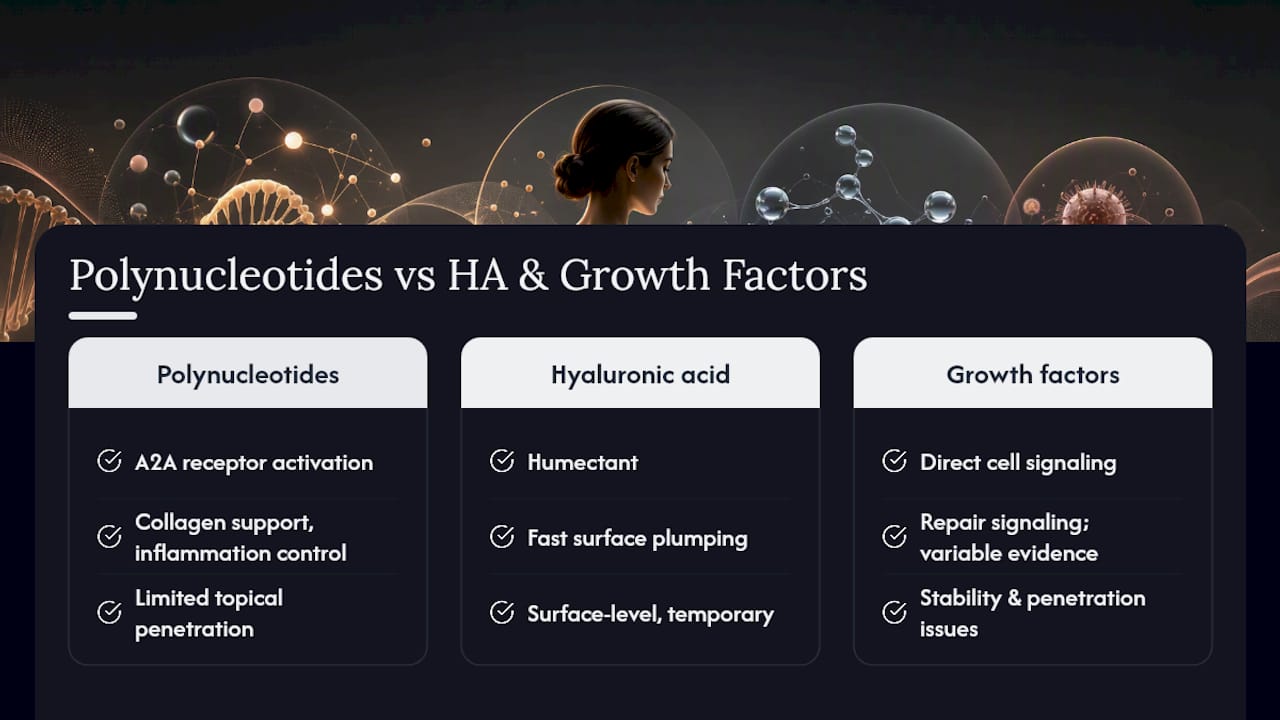
The most effective approach for most people is not choosing one ingredient over the others but combining them. A serum that layers polynucleotides with hyaluronic acid and select peptides addresses hydration, barrier support, and fibroblast signaling simultaneously, which is more realistic than expecting any single active to do everything.
Are There Side Effects or Risks With Polynucleotide Skincare?
Topical PDRN and polynucleotide formulas are generally well tolerated, including in sensitive areas like the skin around the eyes, according to the polynucleotide and PDRN review covering clinical use across dermatology. That said, “well tolerated” is not the same as “risk free for everyone.”
Mild redness, temporary tingling, or dryness can occur, particularly with new formulas or when a product is layered with actives like retinoids on the same night. Because polynucleotides are typically derived from fish DNA sources such as salmon or trout, anyone with a known fish allergy should check ingredient sourcing before use and patch-test regardless of allergy history.
Sensitivity attributed to a “polynucleotide serum” is often actually caused by co-formulated ingredients, fragrance, preservatives, or high concentrations of other actives rather than the PN itself. This is exactly why reading a full ingredient list matters more than reacting to a single buzzword on the front label. Anyone who is pregnant, breastfeeding, or managing an active skin condition such as eczema or rosacea should run any new active, PN included, past a dermatologist before adding it to a routine, since most clinical testing does not include those groups.
How Long Do Results Last and How Often Should You Use It?
Topical polynucleotide benefits behave more like a gym habit than a one-time fix. Consistency drives the outcome far more than any single application. Hydration and barrier improvements documented in trials typically require ongoing use over four or more weeks to become measurable, and those gains recede if the product is dropped entirely.
For most people building a long-term routine, a nightly or twice-daily topical PN serum, layered under moisturizer, sustains the hydration and calming benefits with no need for breaks. If pairing with periodic at-home microneedling, spacing sessions two to four weeks apart with serum application immediately afterward gives the skin time to recover between treatments while still reinforcing results. Skin that responds well to a complementary peptide and PN routine tends to show the most durable improvement in tone and texture over several months, not several weeks.
Anyone using topical PN as maintenance alongside occasional in-office treatments, injectable or procedural, should treat the topical as the daily foundation and the clinical work as periodic reinforcement, rather than expecting either one alone to carry long-term results.
Are Polynucleotide Skincare Products Regulated?
Topical polynucleotide products sold as cosmetics fall under standard cosmetic regulation rather than drug regulation in the United States, which means brands are not required to prove clinical efficacy before selling a PN-labeled serum. That regulatory gap is exactly why formulation transparency, disclosed molecular weight, delivery method, and clinical testing data, matters so much when evaluating a product’s claims.
Injectable polynucleotide treatments sit in a different regulatory category entirely, since they involve a medical device or injectable substance administered by a licensed provider, subject to the approval and oversight standards that apply to injectable aesthetic products in a given market. That distinction is part of why this guide focuses on topical use: the claims a topical product can honestly make are narrower, and the oversight is lighter, than what applies to a clinical injectable. Consumers evaluating a topical PDRN product should treat manufacturer claims with the same scrutiny they would apply to any cosmetic ingredient without a required efficacy standard.
Cellure’s Take on Formulating With Polynucleotides
Sara oversees how Cellure evaluates emerging actives like polynucleotides, and the position is deliberately unglamorous: this ingredient works best as part of a formula, not as a headline claim standing alone. Cellure prioritizes disclosed, complementary ingredient combinations, pairing PN with proven skin repair actives like peptides and hyaluronic acid rather than betting everything on one molecule’s marketing appeal.
The honest caveat matters just as much as the formulation choice. Topical polynucleotides support maintenance, hydration, and barrier resilience. They are not a replacement for a dermatologist’s evaluation of significant volume loss or deep wrinkling, and anyone considering that level of correction should talk to a licensed provider about injectable options rather than expecting a serum to close that gap.
— Sara
Why the Complete Skin Repair Kit Is Built for This Exact Approach
The Complete Skin Repair Kit gives you the layered approach this guide keeps circling back to, instead of one polynucleotide serum asked to do every job at once.
The kit combines targeted serums addressing hydration, barrier repair, and gentle regenerative support, with ingredient lists disclosed up front rather than hidden behind vague naming. That transparency is exactly what the evaluation checklist in this guide asks you to look for: complementary actives working together, formulation details you can actually check, and no promise of injectable-grade results from a bottle. If you have been trying to piece together a routine from single-ingredient products, the kit does that layering for you in one purchase. Visit the Complete Skin Repair Kit page to see the full ingredient breakdown and find the right starting point for your skin.
Sources
Recommended
Share