


How Bioactives Affect Skin: Science and Results
TL;DR:
- Bioactives are compounds that target skin’s aging, inflammation, and repair pathways at the molecular level. Clinical trials show they reduce wrinkles, improve hydration, and promote youthful skin profiles through multi-pathway actions. Delivery methods like nanocarriers and hydrogels enhance their penetration and effectiveness.
Bioactive compounds are defined as naturally derived or synthetic molecules that directly influence biological processes in skin cells, targeting pathways linked to aging, inflammation, and repair. Understanding how bioactives affect skin goes beyond reading ingredient labels. These compounds work at the molecular level, modulating oxidative stress, collagen breakdown, and barrier function in ways that measurably change how skin looks and behaves. Polyphenols, peptides, fatty acids, and hyaluronic acid derivatives each act through distinct mechanisms, making ingredient selection a science rather than a guessing game.
How bioactives affect skin aging pathways
Extrinsic skin aging is caused primarily by cumulative oxidative stress and inflammatory signaling. Bioactives reduce this damage by modulating reactive oxygen species (ROS), key transcription factors, and enzymes that break down the skin’s structural proteins. The result is a measurable slowdown in visible aging.
The main biological pathways that bioactives target include:
- Oxidative stress and ROS. Free radicals generated by UV exposure and pollution damage cell membranes, DNA, and proteins. Polyphenols and flavonoids neutralize ROS directly, reducing this cellular damage before it accumulates.
- NF-κB and AP-1 signaling. These inflammatory transcription factors drive the production of pro-inflammatory cytokines and matrix metalloproteinases (MMPs). Bioactives like resveratrol and curcumin suppress both pathways, reducing chronic low-grade inflammation in skin tissue.
- Matrix metalloproteinases (MMPs). MMPs are enzymes that degrade collagen and elastin in the extracellular matrix (ECM). Elevated MMP activity is a direct cause of wrinkle formation. Bioactives that inhibit MMP expression preserve structural proteins and maintain skin firmness.
- Skin barrier and ECM repair. Beyond intercepting damage, bioactives like ceramide precursors and fatty acids support the synthesis of barrier proteins and ECM components. This repair enhancement restores hydration retention and skin resilience.
Bioactives that modulate multiple pathways simultaneously produce stronger outcomes than those targeting a single mechanism. This systems-level action is what separates clinically effective bioactives from simple antioxidants.
What clinical evidence shows about bioactive effects on skin
Recent randomized controlled trials confirm that the effects of bioactives on skin are measurable, not theoretical. Studies published in 2026 provide some of the clearest molecular and clinical proof to date.
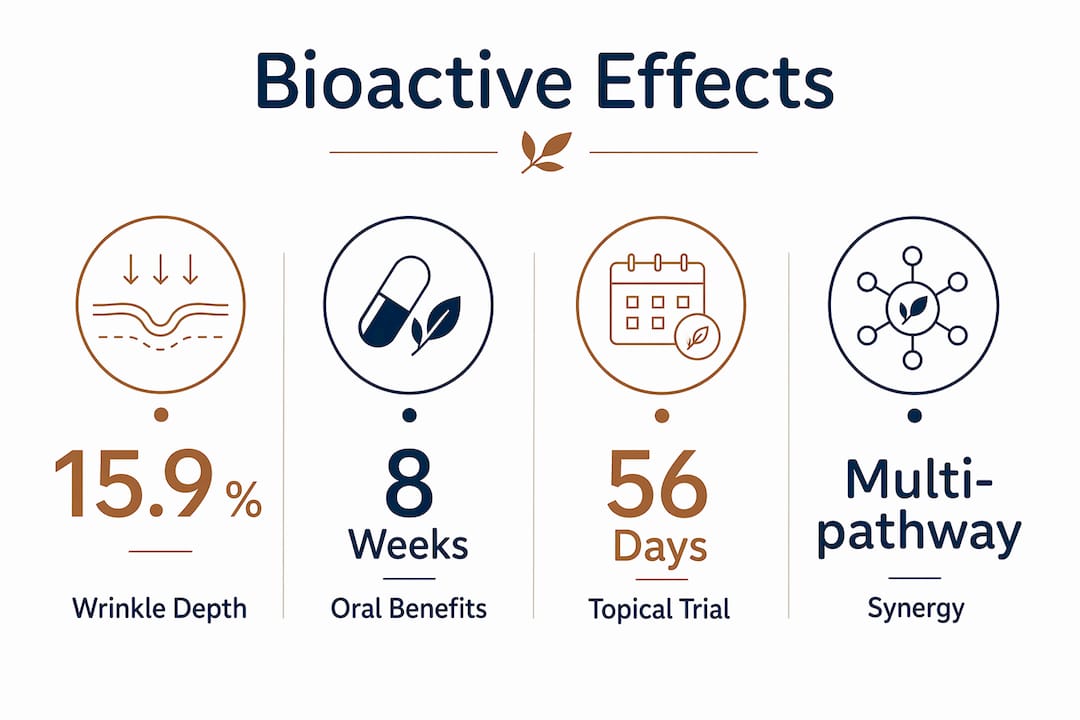
| Bioactive | Route | Duration | Key outcome |
|---|---|---|---|
| Aliophen® (4% cream) | Topical | 56 days | Wrinkle depth reduced up to 15.9%; improved pigmentation and firmness |
| Quinoa bioester | Topical | 30 days | Skin proteomic age shifted 11–16 years younger |
| Piceatannol | Oral | 8 weeks | Increased facial hydration; reduced wrinkle severity vs. placebo |
| Sodium hyaluronate | Oral | 12 weeks | Improved hydration, elasticity, and reduced transepidermal water loss |
A 56-day clinical trial of 4% Aliophen® cream in women aged 45–65 confirmed reductions in wrinkle depth up to 15.9%, alongside improvements in pigmentation and skin firmness, with no serious adverse events. That result matters because it links a specific bioactive concentration to measurable biomechanical change in real skin.
The quinoa bioester study is arguably the most striking. Proteomic analysis combined with machine learning showed that 30 days of topical application shifted participants’ skin molecular profiles to those associated with skin 11–16 years younger. The mechanism involved upregulation of antioxidant enzymes, barrier proteins, and protease inhibitors simultaneously.
Oral bioactives produce comparable results through a different route. Piceatannol supplementation over eight weeks significantly improved hydration and reduced wrinkle severity in a double-blind placebo-controlled trial. Oral sodium hyaluronate over 12 weeks improved hydration, elasticity, and barrier function with objective skin measurements confirming the benefits.
Pro Tip: When evaluating bioactive skincare products, look for clinical data that specifies the concentration used and the measurement method. A study showing “improved hydration” with no measurement tool cited is far less reliable than one using corneometry or transepidermal water loss readings.
For a broader look at proven bioactive examples across aging concerns, Cellure’s resource library covers the molecular evidence in detail.
How delivery methods change bioactive efficacy
The bioactive compound itself is only part of the equation. How it reaches the target cells in skin determines whether it works at all. Formulation technology is the factor most often overlooked by people choosing skincare products.

| Delivery system | Release profile | Best suited for | Limitation |
|---|---|---|---|
| Standard emulsion | Fast, uncontrolled | Immediate surface hydration | Poor penetration to deeper layers |
| Nanocarriers | Controlled, targeted | Anti-inflammatory, antioxidant bioactives | Higher formulation cost |
| Peptide hydrogels | Controlled, sustained | ECM remodeling, barrier repair | Requires specific pH stability |
Nanocarrier delivery systems enhance skin penetration of plant-derived bioactives by affecting stratum corneum lipids and membrane fluidity. This physical change in the skin’s outer layer allows bioactives to reach viable epidermal cells where they can modulate pro-inflammatory cytokines and immune signaling. Without this delivery advantage, many potent bioactives remain on the skin surface and degrade before reaching their target.
Hydrogel formulations offer a different advantage. Peptide-enriched hydrogels show controlled release kinetics, with roughly 75–80% peptide release within hours, followed by a sustained secondary release. This profile reduces skin redness and irritation while supporting longer-term ECM remodeling. Dermatological testing on these formulations confirms safety without sensitization.
Release speed matters for the type of effect you want. Fast release better supports acute anti-inflammatory responses. Slow, sustained release supports the longer-term collagen and barrier remodeling that reduces wrinkle depth over weeks. A common formulation pitfall is assuming that a high in vitro bioactivity reading translates directly to clinical results. Bioavailability at the target tissue, not potency in a lab dish, determines real-world outcomes.
Pro Tip: Check whether a product specifies its delivery technology. Terms like “nanoencapsulated,” “liposomal,” or “hydrogel matrix” indicate that the formulator has addressed penetration. Products that list only the active ingredient without delivery context may not deliver it where it counts.
Cellure’s approach to peptide delivery science explains how controlled-release formulations translate molecular activity into visible skin repair.
Which bioactives work best for specific signs of aging
Choosing the right bioactive compound depends on the skin concern you are targeting. Each class of bioactive compounds for skin health acts through a different primary mechanism.
- Polyphenols (resveratrol, quercetin, curcumin). These compounds are the strongest antioxidant and anti-inflammatory bioactives available. They suppress NF-κB and AP-1 signaling, reduce MMP activity, and protect against UV-induced oxidative damage. Best suited for skin with chronic sun exposure, uneven tone, and early wrinkle formation.
- Peptides (signal peptides, carrier peptides, enzyme-inhibitor peptides). Peptides stimulate collagen and elastin synthesis, inhibit MMP activity, and support barrier repair. Signal peptides like palmitoyl pentapeptide-4 directly trigger fibroblast activity. Best suited for loss of firmness and wrinkle depth.
- Fatty acids and bioactive esters. Linoleic acid, ceramide precursors, and quinoa bioester support the lipid matrix of the skin barrier. They reduce transepidermal water loss and improve resilience. Best suited for dry, sensitive, or barrier-compromised skin.
- Hyaluronic acid derivatives (sodium hyaluronate). Oral and topical sodium hyaluronate improves hydration and elasticity. Clinical evidence confirms benefits at both the surface and deeper dermal layers. Best suited for dehydrated skin with reduced volume and elasticity.
- Piceatannol and stilbene-class compounds. These exhibit anti-inflammatory and antioxidant properties that translate to measurable hydration and wrinkle improvements when taken orally. Best suited as a complement to topical routines.
Combining bioactives from different classes produces synergistic improvements rather than additive ones. A peptide serum paired with a polyphenol-rich antioxidant layer addresses both the structural repair and the oxidative damage that drives further breakdown. The key is sequencing them correctly and avoiding combinations that destabilize each other’s pH or delivery system.
For a detailed breakdown of anti-aging treatment options supported by clinical trials, including bioactive-based approaches, the evidence base is well documented across dermatology resources.
Key Takeaways
Bioactives improve skin by targeting oxidative stress, inflammatory signaling, and ECM repair simultaneously, with clinical trials confirming measurable reductions in wrinkle depth, improved hydration, and younger molecular skin profiles.
| Point | Details |
|---|---|
| Multi-pathway action | Bioactives that target ROS, NF-κB, MMPs, and barrier repair together produce stronger results than single-mechanism ingredients. |
| Clinical proof exists | Trials of Aliophen®, quinoa bioester, piceatannol, and sodium hyaluronate confirm measurable improvements in wrinkle depth, hydration, and skin age. |
| Delivery method matters | Nanocarriers and hydrogels significantly improve bioactive penetration and control release kinetics, directly affecting clinical outcomes. |
| Match bioactive to concern | Polyphenols target oxidative damage, peptides address firmness, fatty acids repair the barrier, and hyaluronate restores hydration. |
| Oral and topical routes complement each other | Oral piceatannol and sodium hyaluronate improve skin from within, working alongside topical formulations for broader coverage. |
What I’ve learned about bioactives that most product labels won’t tell you
The research on bioactives is genuinely exciting, but the gap between a published study and a product on a shelf is wider than most people realize. I’ve spent years reading clinical trials and comparing them to what actually ends up in formulations, and the disconnect is consistent.
The biggest misconception is that a high concentration of a bioactive automatically means better results. The quinoa bioester study is a perfect example of why that logic fails. The molecular age reversal it demonstrated was not about flooding the skin with a single antioxidant. It came from a compound that modulated multiple pathways at once, including antioxidant enzymes, barrier proteins, and protease inhibitors. Single-pathway thinking produces single-pathway results.
The second thing I’d push back on is the idea that topical and oral bioactives are interchangeable. They are not. Oral sodium hyaluronate reaches the dermis through systemic circulation. Topical peptides work at the epidermal and upper dermal level. Using both is not redundant. It is complementary coverage of different tissue depths.
My practical advice: prioritize products that disclose their delivery technology alongside their active ingredients. A nanoencapsulated polyphenol at 0.5% concentration will outperform a standard emulsion at 2% every time, because the former actually reaches the cells that need it. The skin barrier repair literature makes this point clearly. Formulation is not a secondary detail. It is the mechanism.
— Sara
Cellure’s Complete Skin Repair Kit puts the science to work
The research on bioactive compounds for skin health is clear: results come from multi-ingredient formulations with verified delivery systems, not single-ingredient products.
Cellure’s Complete Skin Repair Kit combines clinically supported bioactives including peptides, tranexamic acid, and polynucleotides in formulations designed for cellular-level repair. Each product in the kit addresses a distinct aging pathway, from oxidative damage to barrier dysfunction, reflecting the multi-target approach that clinical evidence consistently supports. The kit is formulated for all skin types, with gentle delivery systems that prioritize both efficacy and tolerability. If you are ready to apply the science, the kit is a direct starting point.
FAQ
What are bioactives in skincare?
Bioactives in skincare are naturally derived or synthetic compounds that influence biological processes in skin cells, including oxidative stress reduction, collagen synthesis, and barrier repair. They differ from inert ingredients because they produce measurable molecular changes in skin tissue.
Do bioactives help skin with aging?
Yes. Clinical trials confirm that bioactives like Aliophen®, piceatannol, and sodium hyaluronate reduce wrinkle depth, improve hydration, and restore elasticity through targeted molecular mechanisms. The quinoa bioester study showed a proteomic skin age shift of 11–16 years after 30 days of topical use.
How do delivery systems affect bioactive results?
Delivery systems determine whether a bioactive reaches its target cells in viable skin layers. Nanocarriers and hydrogels significantly improve penetration and control release kinetics, while standard emulsions often leave bioactives on the skin surface where they degrade before acting.
Can you take bioactives orally for skin benefits?
Oral bioactives work through systemic circulation and reach deeper dermal layers that topical products cannot access as effectively. Oral piceatannol and sodium hyaluronate both show significant improvements in hydration, elasticity, and wrinkle severity in double-blind placebo-controlled trials.
Which bioactive is best for wrinkles?
Peptides are the most direct choice for wrinkle reduction because they stimulate collagen synthesis and inhibit MMP activity. Polyphenols complement this by reducing the oxidative and inflammatory signals that accelerate collagen breakdown in the first place.