


8–12 Week Results: Peptides vs Retinol When Sensitivity Matters
Retinol wins on raw evidence for fine lines, texture, and photoaging when your skin can tolerate it. Peptides win on gentleness, making them the better call during pregnancy or for reactive skin. Most people who stick with a routine long term end up using both: peptides to support and buffer, retinol to drive the deeper structural change. The one hard rule that survives every scenario is sunscreen, because retinoids raise your skin’s sensitivity to UV light.
TL;DR:
- Peptides act as cellular messengers that promote collagen and elastin production, but they usually require 8 to 12 weeks for noticeable effects.
- Retinol converts to retinoic acid within the skin, with clinical evidence supporting significant wrinkle reduction over 8 to 12 weeks, and stronger results from tretinoin.
- Retinoids cause skin irritation, redness, and increased photosensitivity, requiring gradual introduction and daily sunscreen use to prevent damage.
- During pregnancy, peptides are safe options with no known teratogenic risks, whereas retinoids are contraindicated due to birth defect concerns.
- Combining peptides and retinol in routines can boost adherence and results, with effects optimized by spaced application—peptides in the morning and retinol at night.
Table of Contents
- Peptides vs. Retinol: What Peptides Actually Do in Your Skin
- Retinol, Retinaldehyde, and Tretinoin: How the Retinoid Family Works
- Peptides or Retinol: A Decision Framework by Goal
- Retinol, Pregnancy, and Sun Sensitivity: What You Need to Know
- How to Layer Peptides and Retinol in the Same Routine
- What the Research Actually Shows About Both Ingredients
- Cellure’s Perspective on Peptides in an Anti-Aging Routine
- Cellure’s Peptide Serums for Every Stage of Your Routine
- Sources
- FAQ
Peptides vs. Retinol: What Peptides Actually Do in Your Skin
Peptides are short chains of amino acids that act like chemical messengers. Instead of forcing a change the way retinoids do, they signal skin cells to behave a certain way, usually telling fibroblasts to produce more collagen or telling the skin’s repair machinery to switch on. That signaling approach is why peptides tend to be so much gentler than retinoids: they’re not stripping or accelerating cell turnover, they’re nudging existing biology.
Not all peptides do the same job, which is a distinction most product labels blur. A few examples worth knowing:
- Palmitoyl pentapeptide-4 (commonly sold as Matrixyl) is one of the more studied cosmetic peptides, with trials showing modest, replicated improvements in fine lines over 8 to 12 weeks.
- Copper peptides (GHK-Cu) are associated with wound-healing and tissue-remodeling signals, and they’re often positioned as a support ingredient rather than a standalone anti-aging star.
- Signal peptides in general aim at collagen or elastin production, while carrier peptides are built to deliver trace minerals like copper or manganese into skin.
Formulation matters more with peptides than with almost any other skincare category. Peptides are relatively large molecules, and plain water-based versions struggle to get past the skin’s outer barrier. That’s why better formulas use lipid conjugation or liposomal carrier systems to help the peptide actually reach living tissue instead of sitting on the surface. A peptide serum from a brand that’s invested in how peptides work in skincare at the formulation level will typically outperform a cheaper version with the same peptide name on the label but no delivery system behind it.
Timeline expectations matter too. Peptides are not fast. Most people see meaningful texture or firmness changes over 8 to 12 weeks of consistent use, not days. That’s slower than some marketing suggests, but it lines up with how signaling-based ingredients actually work: they’re asking cells to build something new, and building takes time. If you’re comparing copper peptides vs. retinol for a sensitive-skin routine, expect a slower, quieter kind of progress rather than a dramatic before-and-after at week two.
Retinol, Retinaldehyde, and Tretinoin: How the Retinoid Family Works
Retinol is a vitamin A derivative that your skin has to convert twice before it becomes active. Retinol converts to retinaldehyde, and retinaldehyde converts to retinoic acid, the form that actually binds to skin cell receptors and speeds up cell turnover while stimulating collagen production. Tretinoin skips both conversion steps because it’s already retinoic acid, which is why it’s prescription-only and noticeably stronger than anything sold over the counter.
That conversion chain explains a lot about why OTC retinol feels gentler than a dermatologist’s script. Each conversion step loses potency, so by the time retinol becomes retinoic acid in your skin, you’re getting a fraction of what tretinoin delivers directly.
The evidence gap between the two is real and worth knowing before you buy. Clinical trials on tretinoin have produced a deep, consistent record of reducing fine lines and reversing signs of photoaging, backed by decades of randomized controlled trials. OTC retinol has a thinner research record. It’s still effective, just less thoroughly proven at the population level, and results tend to be more incremental.
Side effects follow the same potency curve. Expect:
- Dryness and flaking during the first several weeks
- Redness or a stinging sensation, especially on freshly cleansed skin
- Increased photosensitivity, which raises sunburn risk if sunscreen is skipped
These reactions are common enough that dermatology literature refers to them as retinoid dermatitis, a recognized adjustment-phase response rather than a sign the product is wrong for you. The standard fix is starting at two to three nights a week and building up slowly, something covered in more detail in the safety section below. Most people who stick with a gradual ramp-up see visible texture improvement by 8 to 12 weeks, with continued gains in fine lines and tone over 3 to 6 months.
Peptides or Retinol: A Decision Framework by Goal
The right pick depends less on which ingredient is “stronger” in a lab and more on which one you’ll actually use consistently. Here’s how the tradeoffs break down by common priorities:
| Goal | Better pick | Why |
|---|---|---|
| Deepest wrinkle reduction | Retinol (or tretinoin) | Strongest RCT record for photoaging reversal |
| Sensitive or reactive skin | Peptides | Lower irritation risk, no adjustment phase |
| Pregnant or trying to conceive | Peptides | No teratogenic risk profile; retinoids are contraindicated |
| Daytime use | Peptides | No added photosensitivity |
| Fastest visible change | Retinol | Cell turnover effects show up before collagen-signaling effects |
| Long-term adherence | Combination | Lower irritation supports consistent use |
Adherence tends to beat theoretical potency in the real world. A retinoid with superior trial data does nothing for your skin if irritation makes you quit after three weeks. That’s part of why combination regimens pairing peptides with a low-dose retinoid have matched prescription-level results in some trials while improving early tolerability. The peptide isn’t replacing the retinoid’s mechanism; it’s helping you stay in the game long enough for the retinoid to work.
A simple three-question flow can settle most cases:
- Can you tolerate retinoids without significant flaking or redness? If yes, a retinoid should anchor your routine.
- Are you pregnant, nursing, or trying to conceive? If yes, skip retinoids entirely and build your routine around peptides.
- Do you want a gentle daytime option regardless of your nighttime routine? If yes, peptides are the better fit for morning use, since they carry no sunscreen mandate on their own.
Skin type nudges this further. Rosacea-prone or eczema-prone skin usually does better starting peptide-first and introducing retinol slowly, if at all. Someone with resilient, non-reactive skin and a clear anti-aging goal can generally move faster toward a retinoid-led routine.
Retinol, Pregnancy, and Sun Sensitivity: What You Need to Know
Retinoids are contraindicated during pregnancy. High-dose oral retinoids carry documented birth defect risk, and while topical absorption is much lower, the standard clinical guidance is to avoid topical retinoids during pregnancy and while trying to conceive, then check with a clinician before resuming. Peptides carry no such warning. Dermatology reviews describe them as low-irritation actives with no established teratogenic risk, making them the default safe choice for that window.
Sunscreen isn’t optional if retinol or tretinoin is in your routine. Retinoids increase how easily UV light damages skin, so daily broad-spectrum SPF 30 or higher is a requirement, not a suggestion, for anyone using them.
Practical irritation management comes down to a few habits:
- Start at two to three nights a week, not nightly, for the first month.
- Apply retinol onto dry skin, not damp skin, to reduce sting.
- Buffer with a moisturizer before or after application if peeling starts.
- Skip a night or two entirely if you’re flaring, then resume at a lower frequency.
Pro Tip: If your skin turns red and tight within minutes of applying retinol, you’re overdoing the dose or the frequency, not proving the product is “working.” Redness that lasts more than a day or two, along with burning, swelling, or blistering, is a signal to stop and see a dermatologist rather than push through.
How to Layer Peptides and Retinol in the Same Routine
Layering order matters because retinol needs a stable pH to convert properly, and some peptides can degrade or lose effectiveness if stacked incorrectly. The safest, most commonly recommended structures:
- Peptide serum in the morning, retinol at night. This splits the actives by time of day and avoids any interaction question entirely.
- Peptide on non-retinol nights. If you’re using retinol three nights a week, apply a peptide serum on the other nights to keep skin supported without doubling up on actives simultaneously.
- Retinol first, wait 20 to 30 minutes, then peptide and moisturizer. This works for retinol-tolerant skin that wants both actives at night.
The “retinol sandwich” is worth knowing if you’re prone to irritation: apply a plain moisturizer, wait a few minutes, apply retinol, then follow with another layer of moisturizer. That buffer reduces direct contact time and irritation without meaningfully diluting the retinoid’s effect, per the same ramp-up guidance dermatologists give for adjustment-phase reactions.
Sample starting points:
- Retinol-tolerant skin: Peptide serum in the morning under sunscreen; retinol at night, four to five nights a week, sandwiched with moisturizer.
- Sensitive skin: Peptide serum morning and night; retinol two nights a week to start, always sandwiched, increasing frequency only if no flaking appears after two weeks.
- Pregnant or nursing: Peptide-first routine only, no retinol, with a check-in with your OB or dermatologist before adding anything else active.
Pro Tip: Copper peptides and retinol together can work, but copper peptides are best used on separate nights from retinol rather than layered directly, since copper can interact with certain antioxidants like vitamin C. Keeping them on alternating nights sidesteps the question entirely.
What the Research Actually Shows About Both Ingredients
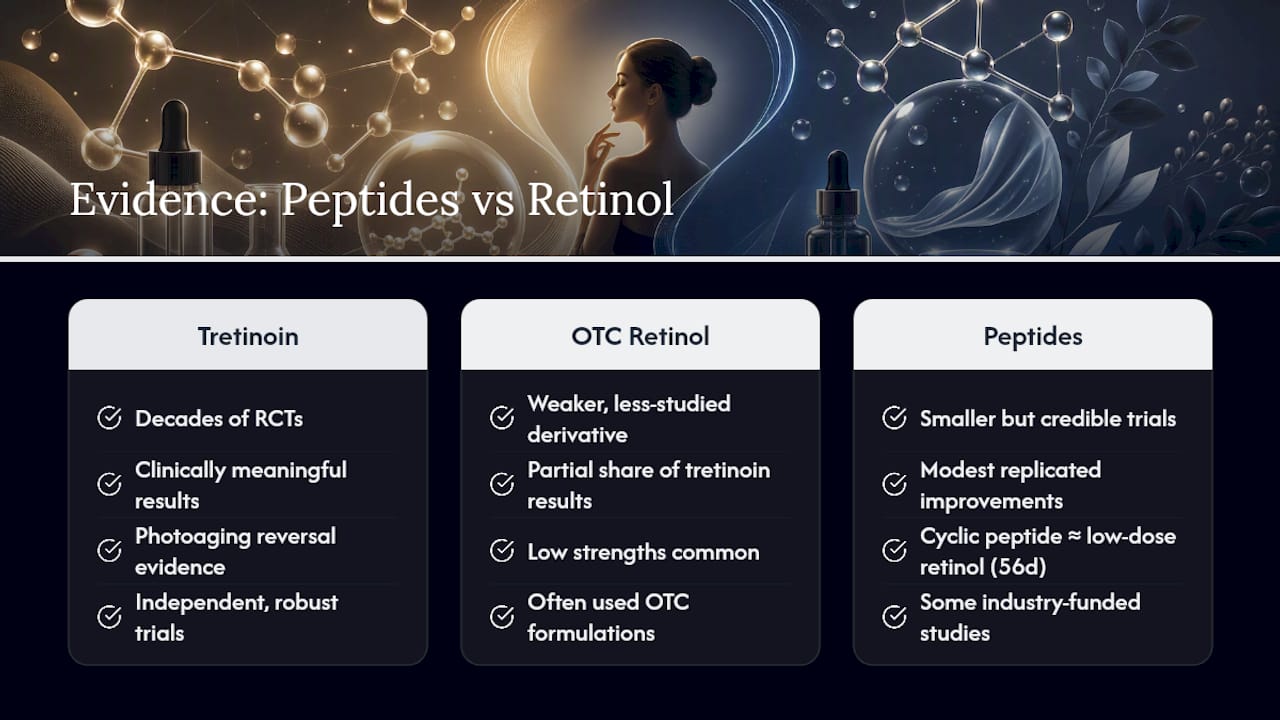
Retinoid trials, particularly on tretinoin, remain the gold standard for anti-aging evidence. Multiple RCTs and systematic reviews show clinically meaningful wrinkle reduction and photoaging reversal, a record OTC retinol shares only partially, since it’s a weaker, less-studied derivative.
Peptide trials tell a smaller but still credible story. Palmitoyl pentapeptide-4 has replicated modest improvements in split-face studies, and a 2025 head-to-head trial pitting a cyclic peptide serum against low-dose retinol found the peptide performed comparably over 56 days. That result is genuinely interesting, but the retinol comparator was a very low strength, so it doesn’t overturn tretinoin-grade evidence, it just shows peptides can compete against weak retinol formulations specifically.
The honest takeaway from the trial data: no single peptide study yet rivals the decades of tretinoin evidence, but the newer cyclic peptide research suggests the gap is narrower than the “retinol always wins” narrative implies, especially against lower-strength retinol products.
Industry sponsorship is worth flagging on the peptide side, since several of the better-known trials were funded by the ingredient’s manufacturer. That doesn’t invalidate the findings, but it’s a reason to weigh peptide claims a notch more skeptically than independently run retinoid research. The practical conclusion holds either way: consistent use beats theoretical potency, and Sara’s work at Cellure focuses on translating that trial-level nuance into product formulations people will actually stick with night after night.
Cellure’s Perspective on Peptides in an Anti-Aging Routine
Cellure builds its serums around peptides because they solve the problem most anti-aging routines fail at: staying power. A retinoid might win on paper, but a gentle, well-formulated peptide serum is what keeps someone in a routine long enough to see any results at all, retinoid or not. That’s the philosophy behind every serum Cellure develops.
Sara’s approach at Cellure centers on functional peptide concentrations and delivery systems that actually reach skin, not just labels that name-drop an ingredient. If you’re building a routine around copper peptides and retinol, the goal is always the same: make the gentle option strong enough to matter.
— Sara
Cellure’s Peptide Serums for Every Stage of Your Routine
Cellure’s approach to peptides isn’t about replacing retinol, it’s about giving you a gentler option that fits the routines above, whether that’s a morning layer, a non-retinol night, or the only active you use during pregnancy.
Cellure sells its formulas individually so you can match the product to the routine, not the other way around. A few starting points:
- PEPTIDE HYDRO LIFT SERUM works well as the morning peptide layer in a retinol-tolerant routine, or as a twice-daily option for sensitive skin skipping retinol altogether.
- TRANEXAMIC ACID PEPTIDE SERUM pairs peptides with tranexamic acid for uneven tone, a solid pick if pigmentation is your bigger concern alongside fine lines.
- VOLUFILINE SERUM targets volume and firmness loss, useful for anyone whose main goal is structural aging rather than surface texture.
Each is available individually on the best sellers collection, where you can compare which one fits the gap in your current routine. If hydration and firmness are the priority, start with the PEPTIDE HYDRO LIFT SERUM product page for the full ingredient breakdown before you add it to your nightly or morning lineup.
This article is general information, not a substitute for advice from a qualified doctor. Consult a qualified healthcare professional about your own circumstances before acting on anything here.
Sources
- Review of topical retinoids and adverse effects (PMC6073405)
- Dermatology review on peptides and topical actives (PMC6832239)
- Griffiths et al. and related retinoid clinical literature
- Robinson et al. (Matrixyl clinical data) and similar peptide trials
- Controlled trial of combination cosmetic regimen vs tretinoin
FAQ
What do Koreans use instead of retinol?
Korean skincare routines often favor gentler actives like peptides, PDRN (polynucleotide), and niacinamide layered into multi-step routines, partly because the culture emphasizes barrier health over aggressive exfoliation. PDRN in particular has grown popular as a regenerative alternative that doesn’t carry retinol’s irritation profile.
Do peptides actually work for wrinkles?
Yes, though the effect is modest and product-dependent rather than dramatic. Palmitoyl pentapeptide-4 has shown replicated improvements in fine lines over 8 to 12 weeks in clinical trials, though the evidence base is smaller than retinoids’ and some studies carry industry sponsorship.
Which is best for anti-aging, retinol or peptides?
Retinol (and prescription tretinoin) has the deeper evidence record for reducing wrinkles and reversing photoaging when tolerated. Peptides are the better choice for sensitive skin, pregnancy, or daytime use, and many routines use both for complementary benefits.
What should you not layer with peptides?
Copper peptides specifically can interact with certain antioxidants like vitamin C, so it’s best to use them on separate nights rather than in the same application. Otherwise, peptides layer well with most actives, including retinol, when spaced by time of day or night.
Can you use copper peptides with retinol at the same time?
Yes, but alternating nights is the safer approach rather than applying both in the same session, since copper peptides can reduce the effectiveness of certain paired ingredients. Using copper peptides in the morning and retinol at night avoids the issue entirely.
How long does it take to see results from peptides vs. retinol?
Retinol typically shows texture changes within 8 to 12 weeks, with continued improvement over 3 to 6 months. Peptides work on a similar or slightly slower timeline, usually 8 to 12 weeks for visible firmness or fine-line changes, since collagen signaling takes time to produce measurable results.
Recommended
Share