


1,500 kDa Marques Cutoff Decides PDRN vs Polynucleotides for Skin
PDRN and polynucleotides sit on the same biological spectrum, but molecular weight splits them into two different tools. PDRN, generally under 1,500 kDa, diffuses fast and drives repair and calming effects, which makes it the better fit for post-procedure recovery or inflamed skin. Higher-molecular-weight polynucleotides, at or above that same 1,500 kDa mark, form a viscoelastic gel that acts more like scaffolding, better suited to long-term dermal support and gentle volumizing. Both trigger the same receptor pathway; they just move and behave differently once they get there.
TL;DR:
- PDRN, with a molecular weight under 1,500 kDa, diffuses quickly and is ideal for rapid repair, calming inflammation, and post-procedure recovery.
- Polynucleotides at or above 1,500 kDa form a gel-like scaffold that provides long-lasting dermal support and mild volumizing effects over time.
- The molecule’s size influences behavior: smaller fragments act as fluids for fast signaling, while larger ones create a persistent, supportive matrix in tissue.
- Clinical benefits from either molecule typically require multiple sessions over several weeks, with results gradually building rather than appearing after a single treatment.
- Buyers should prioritize molecular weight disclosure and purification quality over marketing claims to ensure effective, safe results.
Table of Contents
- PDRN vs Polynucleotides: Key Differences at a Glance
- What Makes PDRN and Polynucleotides Molecularly Different?
- Do PDRN and Polynucleotides Work the Same Way in Skin?
- Which Skin Concerns Respond Better to PDRN or PN?
- How Delivery Method Changes What You Actually Get
- Are PDRN and Polynucleotide Treatments Safe?
- A Practical Checklist for Choosing Between PDRN and PN
- Matching the Molecule to Your Skin Goal
- How Cellure Approaches Polynucleotide Science in Topical Skin Care
- Why Molecular Weight Transparency Should Drive Your Decision
- Bring Polynucleotide Support Into Your At-Home Routine
- Key Research Behind This Comparison
- Sources
- FAQ
PDRN vs Polynucleotides: Key Differences at a Glance
The dividing line between these two ingredient classes comes down to a single number: molecular weight. Recent reviews have proposed calling this line the Marques Polynucleotide Cutoff, set at 1,500 kDa. Below that threshold, you’re working with PDRN. At or above it, you’re working with polynucleotides (often just called PN in clinical literature).
That size difference isn’t academic trivia. It determines how the molecule behaves once it’s in the skin, and that behavior determines what it’s good for.
- PDRN (roughly 50 to 1,500 kDa): Behaves like a low-viscosity fluid, diffuses quickly through tissue, and clears faster. Typically used for rapid repair, calming irritation, and post-procedure recovery.
- Polynucleotides (≥1,500 kDa): Forms a porous, gel-like network in tissue that resists rapid clearance, according to comparative research on polynucleotide and polydeoxyribonucleotide behavior. Better suited to sustained dermal support and mild volumizing.
- Hybrid formulations: Blend lower-MW and higher-MW fractions to get quick receptor activation alongside longer scaffolding. These are increasingly common in both injectable and topical products, though brands don’t always disclose the ratio.
- Formulation forms: PDRN shows up most often in topical serums and lower-viscosity injectables; PN dominates in gel-based injectables and mesotherapy formulations designed to sit in tissue longer.
Where this gets confusing for shoppers is labeling. A product marketed simply as “PDRN” or “polynucleotide” rarely lists actual molecular weight, so the name on the bottle tells you less than you’d think. If you’re comparing options, PDRN vs PN framing matters far less than the MW spec, if the brand publishes one at all.
What Makes PDRN and Polynucleotides Molecularly Different?
PDRN and polynucleotides are both derived from purified DNA fragments, typically sourced from salmon or trout gonads, then broken down through enzymatic or chemical processes into chains of nucleotides. The distinction that matters clinically is chain length, and chain length is what molecular weight actually measures.
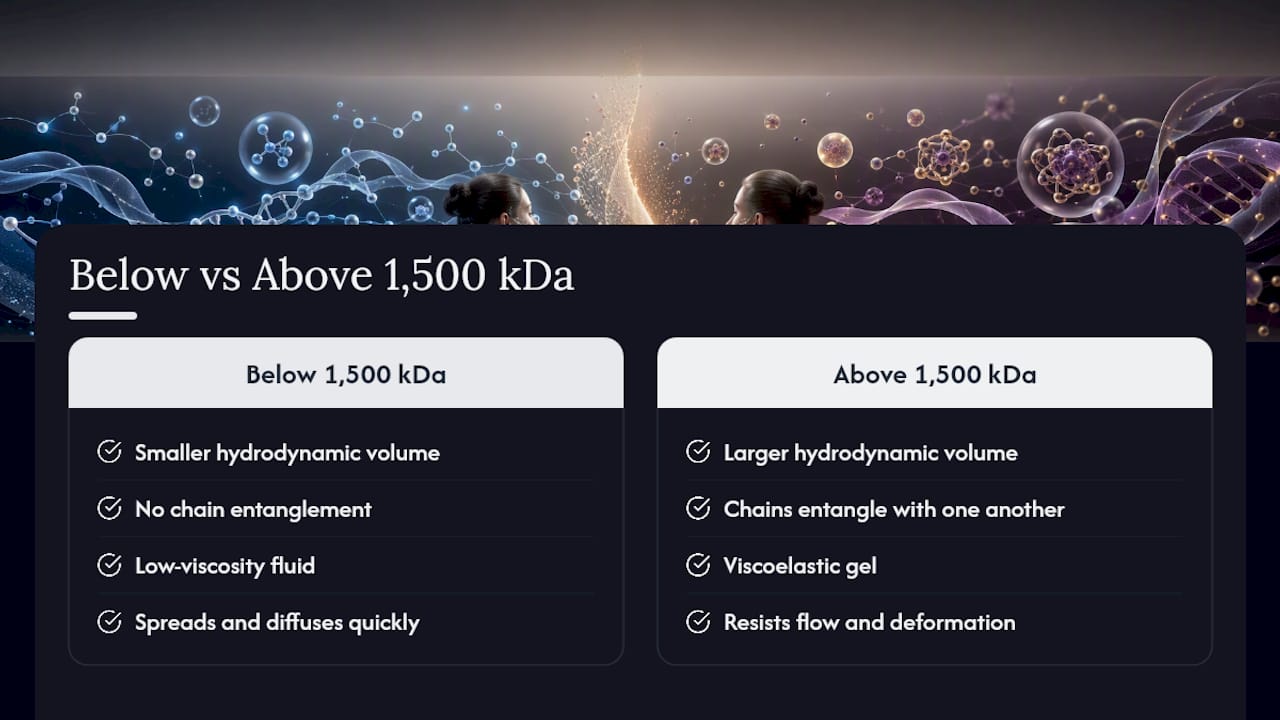
A comprehensive review bridging PDRN and PN science frames this as more than a naming convention. Shorter DNA fragments, those under the 1,500 kDa Marques cutoff, occupy a smaller hydrodynamic volume. Picture a tangled ball of string: a short piece of string forms a small, loose tangle, while a long piece of string, coiled the same way, occupies far more space and gets caught on itself. That’s chain entanglement, and it’s the physical reason longer nucleotide chains behave so differently in tissue.
At higher molecular weights, chains begin to entangle with one another, and that entanglement is what produces viscoelasticity. The solution stops behaving like a simple liquid and starts behaving like a gel, one that can stretch, resist deformation, and slowly return to shape after being pushed. This is the same physical principle behind why hyaluronic acid fillers with higher cross-linking feel firmer and last longer than a thin lubricating gel. Lower-MW PDRN, lacking that entanglement, moves through tissue more like a low-viscosity fluid: it spreads, diffuses, and gets cleared faster.
Purification matters as much as size. Raw DNA extracted from fish gonads carries proteins, lipids, and other cellular debris that can trigger immune responses or degrade product stability. Pharmaceutical-grade PDRN and PN undergo multi-step purification, typically involving enzymatic digestion, filtration, and sterilization, to strip out everything except the nucleotide chains themselves. A product that skips rigorous purification isn’t just less effective; it carries a meaningfully higher risk of local irritation or immune reaction.
This is also where a lot of consumer confusion starts. “PDRN,” “PN,” and “polynucleotides” get used almost interchangeably in marketing copy, even though a narrative review on dermatologic use points out that this loose terminology creates real ambiguity in both product labeling and published research. Two products labeled “polynucleotide serum” could contain meaningfully different molecular weight distributions, and you’d have no way to tell from the packaging.
The practical takeaway: molecular weight, not the name on the label, determines diffusion speed, degradation rate, and whether a product behaves like a fluid or a gel once it’s on or in your skin. If a brand won’t disclose it, treat that as a gap in information, not a neutral detail.
Do PDRN and Polynucleotides Work the Same Way in Skin?
Yes, at the receptor level. Both PDRN and polynucleotides act as agonists of the adenosine A2A receptor, and this shared mechanism is the reason the two ingredient classes produce overlapping benefits despite their different physical behavior. A comparative review of their molecular mechanisms confirms that A2A activation is the common thread running through both.
When adenosine A2A receptors get activated, a cascade follows: fibroblasts ramp up collagen synthesis, new blood vessel formation (angiogenesis) increases to support tissue repair, and inflammatory signaling gets dialed down. That combination, more structural protein, better blood supply, less inflammation, is why both PDRN and PN show up in wound healing, post-laser recovery, and general skin quality protocols.
There’s a second, complementary mechanism at work too: the nucleotide salvage pathway. Rather than synthesizing new purines and pyrimidines from scratch, cells can recycle degraded nucleotide fragments, and PDRN/PN supply exactly that raw material. In tissue under repair, where cellular turnover is high, this salvage pathway effectively hands cells a shortcut, sparing them the metabolic cost of building nucleotides from nothing at a moment when they need to divide and repair quickly.
Where the two classes diverge is timing, not target. Because PDRN fragments are smaller, they diffuse through tissue and reach receptors faster, producing what researchers describe as more of a burst-type signaling pattern: quick onset, quicker clearance. Higher-MW polynucleotides, held in place longer by their gel-like structure, release signaling more gradually. The same reviews describing shared A2A mechanisms specifically flag this kinetic difference as tied to fragment size, not to any difference in the receptor interaction itself.
Think of it like the difference between a fast-acting pain reliever and an extended-release formula containing the identical active ingredient. Both hit the same target. One gets there quickly and fades; the other builds more slowly and holds steady. Neither is objectively better. It depends entirely on whether your priority is rapid intervention or sustained support.
This is the piece that gets lost in a lot of oversimplified comparisons: PDRN and PN aren’t competing mechanisms. They’re the same mechanism running at two different speeds, which is exactly why choosing between them is a question of treatment timeline, not treatment philosophy.
Which Skin Concerns Respond Better to PDRN or PN?
Matching the molecule to the goal comes down to one question: are you trying to calm and repair something quickly, or build lasting structural support? PDRN’s fast diffusion and burst-style signaling make it the stronger fit for acute situations. Higher-MW polynucleotides, with their scaffold-like persistence, fit longer-horizon goals better.
Where PDRN tends to lead:
- Post-procedure recovery after laser resurfacing, microneedling, or chemical peels, where fast anti-inflammatory action matters
- Under-eye skin, where thinness and fragility favor a lighter, quicker-clearing molecule
- Scalp treatments aimed at calming inflammation tied to hair thinning
- General redness, sensitivity, or barrier-compromised skin needing rapid calming
Where higher-MW polynucleotides tend to lead:
- Broader facial rejuvenation protocols targeting overall skin quality over months
- Areas with early volume loss where mild scaffolding support helps
- Deeper wrinkles and dermal thinning, where sustained structural presence outperforms a fast-clearing fluid
- Maintenance protocols spaced further apart, since the gel persists longer between sessions
On evidence quality, it’s worth being direct: strong head-to-head clinical trials comparing PDRN against PN directly are still limited. A narrative review of the dermatologic literature notes that much of the current guidance rests on mechanistic reasoning, smaller observational studies, and practitioner-reported outcomes rather than large randomized trials pitting one molecule against the other. That doesn’t mean the underlying science is weak. The A2A mechanism and MW-behavior relationship are well documented. It means the specific claim “PN outperforms PDRN for X indication by Y percent” usually isn’t backed by the kind of large trial that would let you state it with real statistical confidence.
Outcome windows also vary by molecule and delivery. Practitioners commonly report visible improvements in skin quality, texture, and hydration within three to four weeks of a treatment series for either molecule, with results building over a course of sessions rather than appearing after one visit. For acne scarring specifically, maintenance protocols for polynucleotide treatments often describe an 8 to 12 week window before full results stabilize.
The practical implication for decision-making: if a clinic or brand promises one molecule is definitively superior to the other across the board, that claim is running ahead of what the comparative evidence actually supports. The honest answer is “it depends on what you’re treating and how fast you need results,” not a universal winner.
How Delivery Method Changes What You Actually Get
The molecule matters less than how it reaches your skin. This is the part of the PDRN vs polynucleotides conversation that gets skipped most often, and it’s arguably the most consequential variable in whether either ingredient does anything meaningful for you.
Topical serums face a hard physical limit: the stratum corneum. Intact skin barrier is built specifically to keep large molecules out, and PDRN and PN, even at their smaller end, are considerably larger than the molecules that cross skin easily. A piece covering PDRN skincare’s actual penetration limits makes this point plainly: topical products face real barriers to reaching deeper skin layers, and in-office delivery methods produce more pronounced clinical effects when structural regeneration is the actual goal.
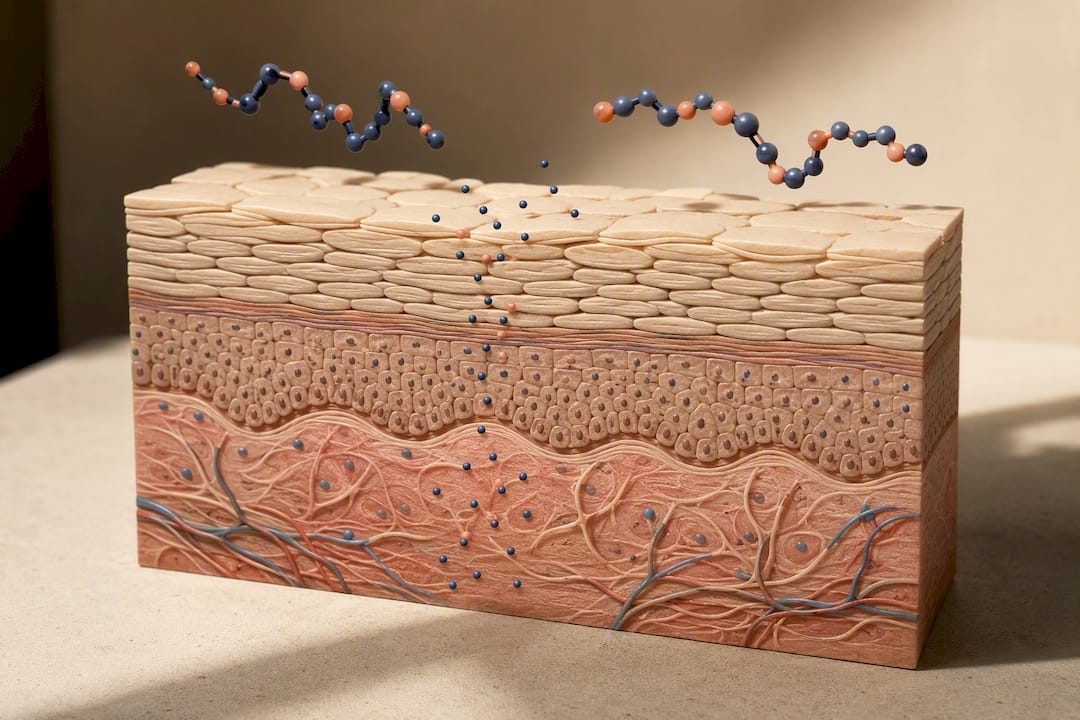
That doesn’t make topical formulations pointless. It means their realistic job is surface-level support and maintenance between more targeted interventions, not a stand-in for deeper regeneration.
How delivery routes stack up:
- Topical serums: Best for surface hydration, antioxidant-adjacent support, and maintaining results between clinical treatments. Limited penetration past the outer skin layers.
- Microneedling-assisted topicals: Creating temporary micro-channels through the stratum corneum lets topical PDRN/PN reach deeper than they could unassisted, meaningfully changing what you can expect compared to serum alone on intact skin.
- Mesotherapy (micro-injections): Delivers the molecule directly into the mid-dermis, bypassing the barrier problem entirely, which is part of why in-clinic results tend to outpace at-home routines.
- Deeper injectables: Used for volumizing and scaffolding applications, typically with higher-MW PN formulations chosen specifically for their gel-forming, longer-residence properties.
Practitioner reports also flag a technical wrinkle worth knowing: because higher-MW PN behaves like a gel rather than a fluid, injection technique differs. Comparative clinical research notes that needle gauge and injection depth need adjustment for PN specifically, since its viscoelastic properties can create palpable irregularities in thin-skinned areas like under the eyes if technique doesn’t account for that difference. This is one reason under-eye treatments more often lean on PDRN rather than PN.
For anyone building an at-home routine, pairing topical polynucleotides with microneedling is a genuinely reasonable strategy to close some of that penetration gap, and it’s a meaningfully different proposition than expecting a serum alone to replicate injectable results.
Are PDRN and Polynucleotide Treatments Safe?
Both molecules carry a generally favorable safety profile, but “generally favorable” isn’t the same as “risk-free,” and the risks that do exist trace almost entirely back to purification quality rather than the molecule itself.
Common, expected side effects with injectable delivery include temporary redness, mild swelling, bruising at injection sites, and occasional tenderness that resolves within a few days. These are standard for any injectable and aren’t specific to PDRN or PN.
Rarer concerns center on immunogenicity, meaning the potential for the immune system to react to residual proteins or contaminants left over from extraction if purification wasn’t thorough. This is where product quality diverges sharply from product to product. Salmon and trout DNA extraction involves breaking down cellular material that includes proteins the immune system can recognize as foreign if they aren’t fully removed. Rigorous multi-step purification, filtration, and sterilization dramatically reduce this risk; cutting corners on purification raises it.
This is also where marketing claims deserve real scrutiny. A product calling itself “PDRN” or “polynucleotide” tells you almost nothing about its actual purity, concentration, or molecular weight distribution unless the brand publishes that data. Reviews indexed on databases like PubMed Central consistently point out that transparency about molecular weight and formulation specifics materially changes outcomes and should be standard disclosure, not a bonus detail buried in a technical data sheet.
If a brand’s product page leans entirely on words like “advanced,” “bio-active,” or “next-generation” without ever stating a molecular weight range or purification method, that’s a gap worth noticing. It doesn’t necessarily mean the product is unsafe. It means you’re being asked to trust marketing language in place of information you’d reasonably want before something goes into your skin, whether topically or by injection.
A Practical Checklist for Choosing Between PDRN and PN
Here’s a working framework for evaluating any PDRN or polynucleotide product or treatment plan, whether you’re a consumer comparing serums or a practitioner vetting a supplier.
- Define your primary goal first. Fast repair and calming point toward PDRN; sustained scaffolding and mild volumizing point toward higher-MW PN.
- Ask for the molecular weight range. A credible brand or clinic should be able to state whether their product falls above or below the 1,500 kDa cutoff.
- Ask about purification method. Multi-step enzymatic and filtration processes reduce immunogenic risk; vague answers here are a red flag.
- Ask what evidence supports the specific formulation, not just the ingredient class broadly. General A2A mechanism studies aren’t the same as data on the exact product.
- Ask about delivery method and expected depth of penetration. A topical claiming injectable-level results deserves skepticism.
- Ask about typical treatment cadence and how many sessions are realistically needed before assessing results.
- Check whether the area being treated is thin-skinned (under-eye, neck) where PN’s gel properties may require adjusted technique.
- Watch for absolute claims like “guaranteed results” or “replaces filler,” which oversell what either molecule reliably does.
Red flags worth walking away from: no molecular weight disclosure at all, marketing that treats “PDRN” and “polynucleotide” as pure synonyms with no distinction, and any claim that a topical product matches injectable outcomes.
Pro Tip: Before booking an injectable PDRN or PN treatment, ask your practitioner directly which molecule they’re using and why they chose it for your specific area. A practitioner who can explain the MW rationale in plain terms is a much stronger signal than one who just says “it’s the newest thing.”
Matching the Molecule to Your Skin Goal
For under-eye hollowing or fine lines, PDRN’s fast clearance and gentler profile in thin skin generally make it the better starting point over higher-MW PN. For post-laser or post-peel recovery, PDRN’s anti-inflammatory speed is the priority, and most protocols favor it specifically because of that burst-style action.
For long-term texture improvement and overall skin quality, treatment plans more often lean on higher-MW polynucleotides or a hybrid blend, since the scaffolding effect supports results over a longer stretch between sessions. For mild volume concerns where you’re not ready for filler but want more structural support than a serum offers, PN-based injectables occupy a useful middle ground, though they’re not a substitute for filler when significant volume loss is the issue.
Across most in-office protocols, expect a series of three to four sessions spaced two to four weeks apart, with visible improvement typically building progressively rather than appearing after the first treatment. Reasonable results at three sessions generally mean texture and hydration; changes at the deeper structural level tend to need the full series plus a maintenance rhythm afterward.
Topical adjuncts make sense as maintenance between clinical visits or for someone not yet ready for an in-office procedure. They don’t make sense as a replacement for injectable treatment when the goal is deeper structural change. Knowing which category your goal falls into is most of the decision.
How Cellure Approaches Polynucleotide Science in Topical Skin Care
Cellure formulates around bioactive ingredients selected for their documented role in cellular repair, and polynucleotides are one part of that broader ingredient strategy, alongside peptides and tranexamic acid, rather than a standalone miracle claim. That distinction matters given how loosely “polynucleotide” gets used across the skincare market.
Given the penetration limits topical formulations face, Cellure positions its polynucleotide-containing serums as a realistic maintenance layer: something used consistently to support skin quality between more intensive treatments, not something marketed as a substitute for injectable protocols. That’s a meaningfully more honest framing than the “replaces your dermatologist” claims that show up elsewhere in this category.
Realistic expectations for a topical polynucleotide serum, used consistently, center on improved hydration, smoother texture, and calmer overall skin tone over weeks of regular use, in line with what broader research on polynucleotide skin benefits supports for topical delivery specifically. That’s a genuinely different outcome profile than what injectable PN delivers, and Cellure’s positioning doesn’t claim otherwise.
Why Molecular Weight Transparency Should Drive Your Decision
The biggest problem in this category isn’t the science. The A2A mechanism is solid, and the MW-behavior relationship is well documented across the reviews cited throughout this piece. The problem is that product marketing rarely reflects that science with any precision.
I’d argue most people comparing PDRN vs polynucleotides are asking the wrong first question. “Which one is better” matters less than “what molecular weight is actually in this bottle or syringe,” because that number predicts behavior far more reliably than the label does. A skilled practitioner using a well-purified, appropriately-sized molecule for the right indication will consistently outperform someone using a “premium” product with no disclosed specs, regardless of which name is on the packaging.
If you take one thing from this comparison, take this: ask for the number before you ask for the name.
— Sara
Bring Polynucleotide Support Into Your At-Home Routine
Clinical polynucleotide treatments handle the deep, structural work, but what you do between appointments shapes how long those results actually hold. Cellure’s best-selling serums, including the Volufiline Serum, Peptide Hydro Lift Serum, and Tranexamic Acid Peptide Serum, are built around clinically supported bioactive ingredients formulated for cellular repair, not as a stand-in for injectable treatment, but as consistent daily support for firmness, tone, and hydration.
Each serum is sold individually so you can target your specific concern, whether that’s volume, brightness, or barrier repair. If you’d rather address multiple aging signs at once, the Complete Skin Repair Kit bundles complementary formulas designed to work together as a fuller at-home regimen. Start by identifying which concern is your priority right now, then browse the collection to find the serum built around it.
Key Research Behind This Comparison
- The MDPI review bridging PDRN and PN definitions established the 1,500 kDa Marques cutoff and its link to rheological behavior.
- A Pharmaceutics comparative review detailed the shared A2A receptor mechanism and MW-linked kinetic differences.
- The PMC comparative study documented viscoelastic gel behavior in higher-MW PN versus fluid PDRN and its impact on injection technique.
- A PubMed narrative review flagged terminology inconsistency in the literature and the current lack of large head-to-head trials.
Sources
- From Polydeoxyribonucleotides (PDRNs) to Polynucleotides (PNs): Bridging the Gap Between Scientific Definitions, Molecular Insights, and Clinical Applications of Multifunctional Biomolecules
- Comparison of Polynucleotide and Polydeoxyribonucleotide in Dermatology: Molecular Mechanisms and Clinical Perspectives
- Comparison of Polynucleotide and Polydeoxyribonucleotide … (PMC article)
- Polynucleotides and polydeoxyribonucleotides in dermatology – A narrative review
FAQ
Which Is Better, PDRN or Polynucleotides?
Neither is universally better. PDRN suits fast repair and calming needs, thanks to its rapid diffusion; higher-molecular-weight polynucleotides suit sustained structural support, thanks to their gel-like persistence in tissue, per the Marques Polynucleotide Cutoff framework. The right choice depends on the specific goal, not a blanket ranking.
What Do Dermatologists Say About PDRN Products?
Most clinical commentary treats PDRN as a skin-quality booster that modulates the cellular repair environment rather than a substitute for fillers or neurotoxins. It’s most consistently recommended for post-procedure recovery, calming, and hydration support rather than volumizing.
Is PDRN Salmon Sperm?
PDRN is typically derived from purified DNA extracted from salmon or trout gonad tissue, then broken down and processed into shorter nucleotide chains through enzymatic purification. The final ingredient bears little resemblance to the raw source material once purification is complete.
Are Polynucleotides Actually Worth It?
For skin quality goals like texture, hydration, and mild structural support, higher-MW polynucleotides have a reasonable mechanistic and observational basis, though large head-to-head trials against alternatives remain limited, according to a narrative review of the current evidence. Whether they’re “worth it” depends heavily on delivery method and realistic expectations. Topical serums support maintenance; in-office delivery is needed for deeper structural change.
Can I Use PDRN and Polynucleotide Products Together?
Yes, hybrid approaches combining both are increasingly common, since PDRN offers fast initial receptor activation and PN offers sustained scaffolding. At home, that often means pairing a topical polynucleotide serum with routine care, while reserving injectable PDRN or PN for in-office treatment.
Recommended
Share