


Topical PDRN: What It Actually Does for Aging Skin
Topical PDRN (polydeoxyribonucleotide) is a serum ingredient with real translational research behind it, not just marketing buzz. This article covers PDRN in over-the-counter serums and treatment kits only, not the clinician-administered injections some clinics offer. Used consistently, topical PDRN supports hydration, barrier repair, and a gradual improvement in texture, tone, and firmness as it activates the same cellular repair pathways behind collagen production.
Expect realistic gains, not filler-level results:
- Better hydration and a smoother surface within a few weeks
- Gradual support for collagen and elastin over months of steady use
- A gentler alternative to retinoids for people with reactive or photoaged skin
If you have sensitive skin, are recovering from a procedure, or just want a maintenance step between more aggressive treatments, topical PDRN is worth adding. Pick a well-formulated serum with disclosed molecular weight, and give it at least six to eight weeks before judging results.
Key Takeaways
Topical PDRN activates A2A adenosine receptors to support collagen and barrier repair, delivering measurable but gradual results that work best as daily maintenance rather than a replacement for injectable treatments.
| Point | Details |
|---|---|
| Mechanism matters | PDRN triggers fibroblast activity through A2A receptor binding, supporting collagen and ECM production over time. |
| Formulation beats concentration | Molecular weight, vehicle, and sourcing transparency predict performance better than a printed percentage. |
| Evidence is real but limited | A 28-day split-face study showed PDRN-850K outperforming retinol on periocular measures, though timelines were short. |
| Consistency drives results | Give any topical PDRN serum 4 to 8 weeks minimum before judging hydration, texture, or firmness changes. |
| Cellure’s kit simplifies selection | The Complete Skin Repair Kit pairs PDRN with compatible actives for sensitive skin and maintenance-focused routines. |
Table of Contents
- How Topical PDRN Works on Skin
- Is There Real Clinical Evidence for Topical PDRN?
- How to Use PDRN Serum in Your Routine
- How to Choose a Topical PDRN Serum or Kit
- Sources
How Topical PDRN Works on Skin
PDRN’s effect on skin starts with a receptor most shoppers have never heard of: adenosine A2A. When PDRN fragments contact skin cells, they bind this receptor and trigger a signaling cascade that pushes fibroblasts to ramp up production of collagen, elastin, and other extracellular matrix components, according to a narrative review of polynucleotides in dermatology. That is the biological reason PDRN shows up in serums marketed for firmness and tone rather than just surface hydration.
Molecular weight decides whether any of that happens at the skin’s surface versus deeper down; choosing products with proven formulation is easier when browsing skincare designed for effective delivery. Native PDRN molecules are large, and large molecules struggle to cross the stratum corneum. That’s why formulation matters more than concentration claims printed on a bottle.
- Fragment size control. Lower molecular weight preparations, including the PDRN-850K variant studied in recent translational research, show time-dependent penetration into viable epidermal and dermal layers in ex vivo and pilot human testing.
- Delivery vehicle. Hydrophilic bases and encapsulation techniques help shuttle PDRN fragments past the skin’s outer barrier instead of leaving them sitting on the surface.
- Companion humectants. Ingredients like hyaluronic acid keep the skin surface hydrated, which appears to support PDRN’s penetration and comfort during use.
Procedure-assisted delivery, meaning PDRN applied right after microneedling or laser resurfacing, gets the ingredient past the barrier entirely through channels the procedure creates. That’s a different use case from daily topical layering, but the same product can serve both roles.
Pro Tip: Skip any serum that lists “PDRN” with no molecular weight or sourcing detail. That omission alone tells you more about a product’s rigor than any splashy percentage on the front label.
Is There Real Clinical Evidence for Topical PDRN?
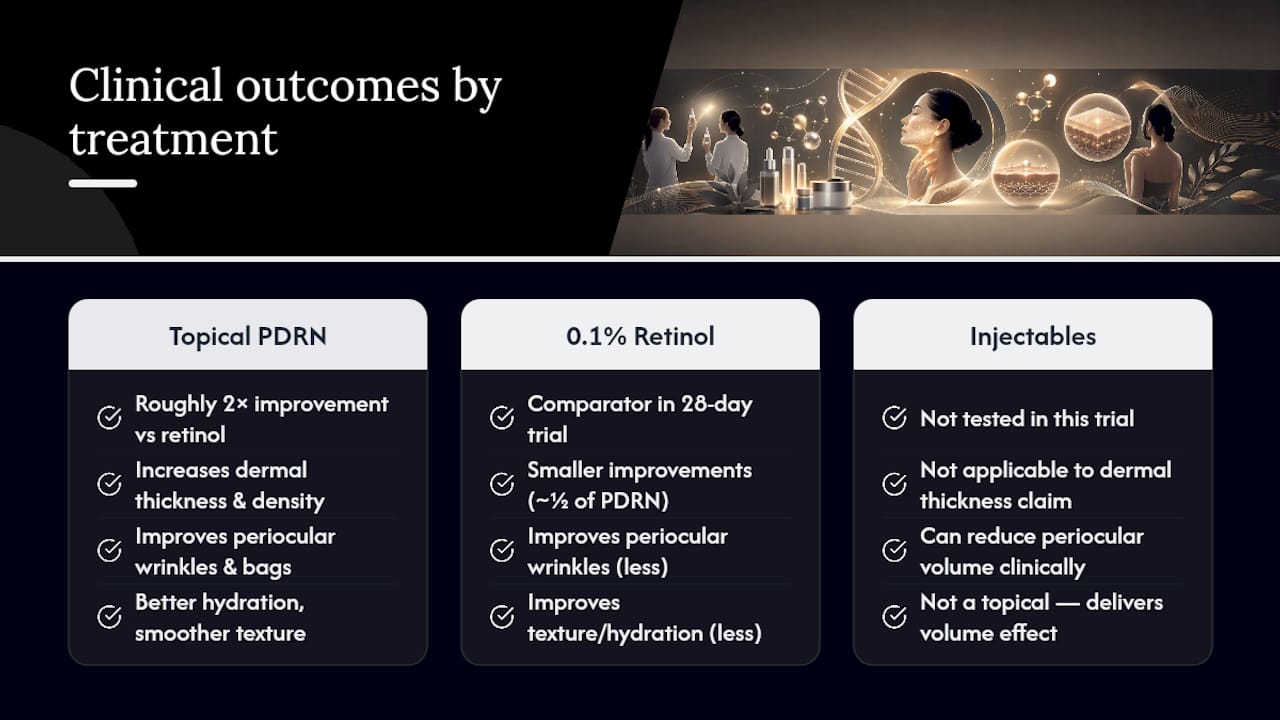
Yes, and it’s stronger than most skincare ingredients get. A randomized, double-blind, split-face trial tested 0.1% PDRN-850K topical cream against 0.1% retinol over 28 days, and the PDRN side came out ahead on multiple measures.
Participants using PDRN-850K saw roughly two-fold greater improvements in periocular wrinkles, dermal thickness and density, and under-eye bags compared with the retinol side, with good tolerability throughout the study, according to the PDRN-850K split-face study.
That’s a meaningful data point for a topical, since retinol is the ingredient most dermatologists still treat as the anti-aging benchmark. The same research used Raman spectroscopy and ex vivo skin models to confirm that PDRN-850K’s signal actually reaches viable epidermal and dermal tissue over time, rather than sitting inert on the surface. Translational work on this formulation also points to activation of PI3K–Akt and TGF-β/Smad signaling in fibroblasts, pathways tied to matrix repair, giving the visible results a plausible cellular explanation.
Twenty-eight days is a short window, though, and it tested one specific formulation against one comparator. Commercial PDRN products vary enormously in fragment size, sourcing, and vehicle, so a study on PDRN-850K doesn’t automatically apply to every serum on a shelf labeled “PDRN.” Penetration also remains harder for larger PDRN molecules, which is why formulation quality, not just the presence of the ingredient, decides whether a given product performs anything like the study data.

What the evidence supports: better hydration, smoother texture, and early measurable changes in dermal thickness. What it does not support: the kind of deep scar remodeling or filler-level volume restoration that injectable treatments or in-office procedures can deliver. If you want that level of correction, a topical serum is maintenance, not a substitute.
How to Use PDRN Serum in Your Routine
Topical PDRN slots in early, right after cleansing, so it can reach skin before anything heavier seals it off.
- Cleanse and tone, then apply PDRN serum to slightly damp skin, which helps the formula spread evenly.
- Use 2 to 3 drops (or a pea-sized amount for creams) morning, evening, or both, pressing it in rather than rubbing.
- Wait 30 to 60 seconds before layering moisturizer, and finish the morning routine with SPF.
- Commit to 4 to 8 weeks minimum before judging results. Collagen remodeling isn’t instant at any concentration.
Layering with actives needs a little sequencing. Vitamin C works best applied first, with a short wait for pH to settle before other actives go on. Hyaluronic acid on damp skin ahead of PDRN can improve absorption for both. If you also use retinol, PDRN’s anti-inflammatory profile can actually buffer some of retinol’s irritation, but alternate nights rather than stacking them in the same application if your skin runs sensitive.
After microneedling or laser treatment, topical PDRN can go on immediately if your provider approves it, since the procedure opens channels that let the formula reach deeper layers than daily topical use alone allows. Skip strong acids or retinoids for 48 to 72 hours post-procedure regardless of what else is in your routine, since compromised skin barriers don’t tolerate exfoliants well. For more on how daily actives and clinic treatments complement each other, see this guide on combining serums with in-office procedures.
How to Choose a Topical PDRN Serum or Kit
Not every bottle labeled “PDRN” performs the same, and the label rarely tells the whole story on its own.
- Check for molecular weight or sourcing disclosure. A brand willing to state fragment size or supplier data is signaling it understands what actually drives topical performance, not just the parts-per-million number on the front.
- Look for a hydrophilic, humectant-rich vehicle. Hyaluronic acid and other barrier-supporting ingredients help PDRN work rather than just sit on skin.
- Watch for red flags. Injection-equivalent claims, vague “PDRN complex” listings with no concentration, and promises of dramatic change in days are all signs of a formulation cutting corners.
- Decide between a single serum and a full kit. A kit pairs PDRN with complementary actives like peptides or tranexamic acid that are formulated to work together, which matters more than most shoppers realize since mismatched actives can cancel each other out or irritate skin. Cellure’s own guide to complementary skin repair ingredients breaks down which pairings actually make sense.
| Selection Criterion | What to Look For |
|---|---|
| Molecular weight | Disclosed fragment size or reference to low molecular weight processing |
| Vehicle and delivery | Hydrophilic base, humectants like hyaluronic acid, minimal irritants |
| Labeling transparency | Clear PDRN concentration, not just a vague ingredient mention |
| Product format | Single serum for targeted use; kit for a full regenerative routine |
What to Expect and How to Stay Safe
Expect early hydration and softer texture within four to six weeks, with structural changes to dermal thickness building gradually over several months of steady use. Reactions are typically mild, think slight tingling or temporary redness, rather than the kind of true allergy that warrants stopping immediately. Because some PDRN is sourced from fish DNA, check labels if you have seafood allergies; plant-derived alternatives exist for that reason. Sensitive and photoaged skin, along with post-procedure maintenance routines, tend to benefit most. See a dermatologist if irritation persists past a few days.
Why Topical PDRN Fits a Regenerative Skincare Approach
Topical PDRN earns its place in a regenerative routine because it works with skin’s own repair signaling instead of forcing rapid turnover the way stronger actives do. Dermatologists describe it as a supportive, maintenance-tier ingredient, and the split-face data backs that framing. My advice: pick a serum with disclosed formulation details, pair it with daily SPF, and give it real time. Regeneration is a process, not a single event.
— Sara
Try Cellure’s Complete Skin Repair Kit
Choosing individual actives one at a time is where a lot of home routines go wrong, since PDRN, peptides, and hydrators need to be balanced rather than layered at random. The Complete Skin Repair Kit solves that by pairing PDRN with complementary bioactives formulated specifically to work together, so you’re not guessing which combination actually supports collagen without triggering irritation.
The kit suits sensitive skin especially well, since every formula in it is built around gentle, barrier-first repair rather than aggressive exfoliation. It’s also the more practical starting point if your goal is a maintenance routine you can stick with for months rather than a single serum you’ll outgrow in a few weeks. Explore the Complete Skin Repair Kit and see whether it fits the routine you’re building.
Sources
- PDRN-850K topical study (PLOS ONE)
- Polynucleotides and PDRN in dermatology (ScienceDirect review)
- How to get the most from topical PDRN products (NewBeauty)
Recommended
Share