


Calm Niacinamide Redness in 48 to 72 Hours With a Clinician Backed Plan
Niacinamide usually calms redness by strengthening the skin barrier, but a small share of people get the opposite reaction: stinging, blotchiness, or a rash. If your skin flared after starting a niacinamide product, stop it now, drop every other active in your routine, and switch to a bare-bones barrier repair routine for a few days. Most reactions settle fast once the irritant is removed.
TL;DR:
- Formulas above 5% niacinamide that are poorly buffered or low pH can cause irritation, especially when layered with acids or exfoliants.
- Sudden redness from niacinamide often results from reactions to other ingredients or regimen overload, not the ingredient itself.
- Most skin reactions to niacinamide resolve within 48 hours after stopping the product and avoiding actives or irritants.
- Reintroduce niacinamide gradually at low concentrations after skin recovery, testing on small areas and spacing out application from acids.
- Persistent or worsening symptoms beyond two weeks require consulting a dermatologist and possibly patch testing for allergens.
Table of Contents
- Niacinamide Redness: What To Stop And Do In The First 48 Hours
- How Does Niacinamide Help Redness? The Mechanism Explained
- Why Does Niacinamide Cause Redness For Some People?
- Is It A Niacinamide Reaction Or Something Else?
- The 48 to 72 Hour Plan For Calming Niacinamide Redness
- How To Reintroduce Niacinamide Without Triggering Redness Again
- When To Stop And See A Dermatologist
- Why Cellure Takes A Barrier First Approach To Redness
- Rebuilding Calm Skin With Cellure’s Gentle Formulas
- Sources
- FAQ
Niacinamide Redness: What To Stop And Do In The First 48 Hours
The first move is subtraction, not addition. Pull the new niacinamide product and anything else you added recently, including AHAs, BHAs, retinoids, or high-strength vitamin C. Layering actives is the single most common reason a normally calming ingredient suddenly stings.
For the next two to three days, keep the routine boring on purpose:
- Wash with a fragrance-free, low-foam cleanser, morning and night.
- Apply a plain emollient moisturizer right after cleansing to trap moisture.
- Wear mineral sunscreen if you’re heading outside; inflamed skin burns faster.
- Use cool (not ice-cold) compresses instead of exfoliating or scrubbing.
- For genuinely severe swelling or burning, ask a pharmacist about a short course of over-the-counter 1% hydrocortisone before using it yourself.
- Snap a daily photo in the same light. Redness that looks dramatic in person often reads as mild improvement day over day, and photos catch that.
Pro Tip: Keep the receipt or product label handy. If you end up seeing a dermatologist, they will want to know the exact concentration and the full ingredient list, not just “a niacinamide serum.”
How Does Niacinamide Help Redness? The Mechanism Explained
Niacinamide’s main trick is rebuilding the barrier that keeps irritants out and moisture in. It raises ceramide production and pushes keratinocytes to make more filaggrin and loricrin, the structural proteins that hold the skin’s outer layer together, a pathway confirmed in in vitro testing on cultured keratinocytes. A stronger barrier means fewer triggers reaching the nerve endings and blood vessels that cause visible flushing.
On top of that, niacinamide stabilizes mast cells and dials down the inflammatory signals that keep capillaries dilated, which is part of why a comprehensive review on niacinamide’s cosmeceutical uses notes tolerability even at 10% concentration in some trials. The clinical record backs this up directly. A 12-week randomized split-face trial using 5% topical niacinamide found measurably less red blotchiness compared with the untreated side of the face. Separately, clinical testing on 382 participants with winter xerosis showed statistically significant redness reduction by day 15, continuing through day 29.
None of that guarantees results for every product on a shelf. Concentration, pH, the surrounding formula, and what else you’re applying that day all shape whether niacinamide calms your skin or aggravates it.
Why Does Niacinamide Cause Redness For Some People?
If niacinamide is generally this well tolerated, why does it wreck some people’s skin? Usually it’s not the ingredient itself but everything around it.
- Concentration and buffering: Poorly buffered formulas above 5% can sting or flush skin that would tolerate a gentler version fine.
- Low-pH neighbors: Pairing niacinamide with acidic vitamin C (L-ascorbic acid) or AHA/BHA exfoliants can increase permeability and irritation, especially when applied back to back.
- Regimen overload: Adding niacinamide the same week as a new retinoid, benzoyl peroxide, or a fragranced toner makes it nearly impossible to know which product is the culprit.
- True allergy versus irritation: Textbook allergic contact dermatitis to niacinamide itself is uncommon. Far more often, the reaction traces back to preservatives, fragrance, or alcohol denat in the same bottle.
- Transient flushing: Some people confuse a brief warm, pink sensation on application with a reaction, when it fades within minutes and never recurs.
Niacinamide also behaves nothing like oral niacin, which is known for causing flushing through vasodilation. Topical niacinamide lacks that flushing mechanism entirely, so if you’re getting a persistent flush, look elsewhere in your routine for the trigger.
Is It A Niacinamide Reaction Or Something Else?
Timing tells you a lot. Stinging or flushing that hits within minutes to a couple of hours points to irritant contact dermatitis or simple sensitivity, not a true allergy. A rash that builds over two or three days, especially with dryness, scaling, or itching, looks more like delayed eczematous dermatitis, which often traces back to a different ingredient in the formula.
The pattern matters too. Uniform pink or red blotchiness across the treated area usually signals irritation. Clustered pustules or bumps suggest something else entirely, like a reaction to a heavy oil or comedogenic ingredient, not niacinamide.
Run a simple stop-and-wait test: halt the product, and if redness fades within 24 to 48 hours, you’ve found your answer. A patch test on the inner forearm for 24 to 72 hours before reintroducing anything to your face confirms it further. A rash that keeps spreading, blisters, or looks infected needs a clinician, not a wait-and-see approach.

The 48 to 72 Hour Plan For Calming Niacinamide Redness
Once you’ve stopped the suspected product, the next few days are about giving the barrier room to recover.
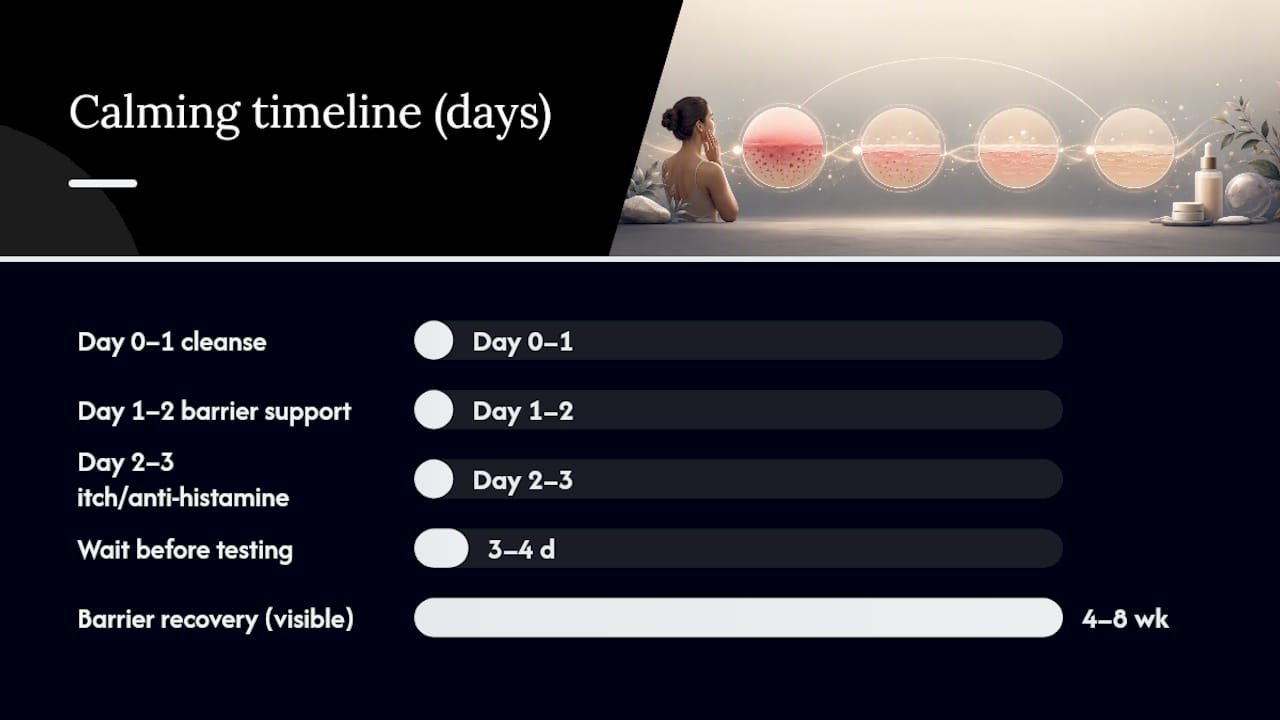
- Day 0 to 1: Cleanse gently, apply a plain emollient moisturizer twice daily, and use mineral sunscreen during the day. Skip every active ingredient, no exceptions.
- Day 1 to 2: If your skin tolerates it, reintroduce a barrier-support ingredient with a strong safety record, like panthenol, ceramides, or palmitoylethanolamide (PEA), all of which showed significant redness reduction alongside niacinamide in clinical testing without added irritation.
- Day 2 to 3: For itching, an oral antihistamine can help you sleep and stop scratching, which only worsens barrier damage. Reserve over-the-counter 1% hydrocortisone for short, occasional use on severe inflammation. It is not meant for daily long-term use on the face.
Most mild irritation visibly improves within a few days once the trigger is removed. Barrier-driven redness, the kind tied to genuine dryness and inflammation rather than a one-time irritant, tends to take longer, with visible improvement in the four to eight week range once you’re using calming ingredients consistently. If you see no change after a week of strict basics, or the skin gets worse instead of better, that’s your signal to see a clinician instead of waiting it out.
Pro Tip: Resist the urge to add something new the moment redness fades. Give your skin at least three or four calm, boring days before testing anything else, including sunscreen switches or a new moisturizer.
For a fuller walkthrough of this protocol, Cellure’s guide on triage and barrier repair for niacinamide irritation covers the same steps in more depth, and the brand’s general guide to calming irritated skin applies whether the trigger was niacinamide or something else entirely.
How To Reintroduce Niacinamide Without Triggering Redness Again
Once your skin has been calm for at least a week, reintroduce niacinamide slowly and in isolation.
- Patch test first: apply the product to a small area of skin, like behind the ear or on the inner forearm, and wait 24 to 72 hours before judging the result.
- Start at a low concentration, ideally 2% to 5%, applied every other day rather than twice daily.
- Increase frequency only if two full weeks pass with zero stinging, flushing, or dryness.
- Apply niacinamide serum before heavier moisturizers, and space it at least 15 to 20 minutes from low-pH actives like vitamin C or exfoliating acids.
- If irritation returns at the same low dose, stop for good and consider patch testing through a dermatologist to rule out a specific allergen.
| Reintroduction step | What to do | Signal to proceed |
|---|---|---|
| Patch test | Apply to forearm or behind ear | No redness after 72 hours |
| Low dose start | 2 to 5% niacinamide, every other day | No stinging after 1 week |
| Frequency increase | Move to daily use | No irritation after 2 weeks |
| Layering | Space 15 to 20 minutes from acids | Comfortable, calm skin |
A sensitive-skin serum guide can help you pick a formula suited to reactive skin if you’re starting from scratch rather than returning to a product you already own.
When To Stop And See A Dermatologist
Some symptoms mean skip the home protocol entirely. Blisters, swelling around the eyes or mouth, or any trouble breathing need urgent care immediately, not a wait-and-see approach. A rash that persists beyond two weeks of strict basic care, or keeps spreading despite stopping every active, warrants a dermatology visit.
Bring your product list, timeline of when symptoms started, and photos from each day. A dermatologist may run patch testing to identify the specific allergen, since rare allergic reactions to niacinamide do occur even though they’re uncommon, and can prescribe short-term treatments the drugstore doesn’t carry.
Why Cellure Takes A Barrier First Approach To Redness
Redness rarely has one clean cause, which is why Cellure’s formulas lean on gentle, well-tolerated actives instead of maximum-strength percentages. Peptides and tranexamic acid support skin recovery without the layering conflicts that trip up sensitive skin. Dermatology guidance on rosacea triggers backs this same principle: simplify the routine before adding anything new. That’s the philosophy behind every barrier-repair resource Cellure publishes, including its tretinoin recovery protocol for readers dealing with active-ingredient fallout more broadly.
— Sara
Rebuilding Calm Skin With Cellure’s Gentle Formulas
Once your skin has settled, the goal shifts from damage control to steady, low-drama maintenance. Many advanced skincare brands emphasize clinically supported bioactive ingredients at functional concentrations, formulated gently enough for sensitive, reactive skin rather than maximum-strength percentages that gamble on tolerance.
Look for products built around peptides, tranexamic acid, and barrier-supportive vehicles rather than one aggressive active layered on top of another. Cellure’s Peptide Hydro Lift Serum supports hydration and barrier comfort at $60, and the Tranexamic Acid Peptide Serum targets tone and redness-prone skin without the pH conflicts that trip up DIY-layered routines, also at $60. Patch test any new serum on your forearm for 48 to 72 hours before applying it to your face, the same rule that applies to niacinamide reintroduction. Browse the full best-sellers collection or explore Cellure’s complete range at Cellure to find a formula that matches where your skin is right now, not where you wish it were.
Sources
- Clinical and in vitro evaluation of new anti-redness cosmetic products in subjects with winter xerosis and sensitive skin - PMC
- Bissett et al., 2005 — 5% topical niacinamide randomized split-face trial
- Niacinamide: What It Is and Skin Benefits — Cleveland Clinic
This article is general information, not a substitute for advice from a qualified doctor. Consult a qualified healthcare professional about your own circumstances before acting on anything here.
FAQ
Does Niacinamide Help Reduce Redness?
Yes, for most people. Clinical testing found that 5% topical niacinamide reduced red blotchiness over a 12-week period compared with untreated skin, largely by strengthening the skin barrier and calming inflammatory signals.
How Can You Tell If Your Skin Doesn’t Tolerate Niacinamide?
Watch for stinging, burning, or flushing within minutes to hours of application, especially if it happens every time you use the product. A rash that builds over a few days with dryness or itching suggests a different trigger in the formula, not necessarily niacinamide itself.
What Does A Niacinamide Reaction Actually Look Like?
Most reactions show up as uniform pink or red blotchiness, sometimes with mild stinging, rather than pustules or bumps. True allergic reactions are rare, so persistent or spreading redness more often points to a preservative, fragrance, or a low-pH active layered nearby.
Should People With Rosacea Avoid Niacinamide?
Not necessarily. Niacinamide’s barrier-repairing and anti-inflammatory properties are one reason it appears in redness-focused formulas, but people with rosacea should still follow dermatology guidance on avoiding known triggers and introduce any new active slowly, one at a time.
How Long Does It Take For Niacinamide Redness To Heal?
Mild irritation from a single trigger product often improves within a few days once you stop using it. Barrier-driven redness that built up gradually typically takes four to eight weeks of consistent, gentle care to visibly improve.
Recommended
Share