


Methods for Firming Delicate Skin: A Science-Based Guide
TL;DR:
- Firming delicate skin involves stimulating collagen and elastin production through internal, topical, and physical methods. A layered approach targeting fibroblast activity and skin density yields the best long-term results, complemented by consistent sun protection and proper technique. Clinical evidence supports using collagen supplements, retinoids, peptides, and gentle massage for visible, sustained improvements over time.
Firming delicate skin is defined as the process of stimulating collagen and elastin production in the dermis while preserving the skin’s structural integrity. The most effective methods for firming delicate skin combine internal supplementation, topical active ingredients, and non-invasive physical techniques. Clinical evidence confirms that no single approach delivers lasting results. A layered strategy addresses the root causes of sagging: declining fibroblast activity, reduced dermal density, and cumulative environmental damage. Understanding why skin firmness matters is the first step toward building a regimen that actually works.
Which scientifically proven ingredients support firming delicate skin?
The most clinically supported oral supplement for skin firmness is hydrolyzed collagen peptides. Oral collagen peptides at 2.5 grams daily increase procollagen type I by 65% and elastin by 18% after 8 weeks. That result comes from the matrikine pathway: hydrolyzed peptides reach dermal fibroblasts through the bloodstream and directly trigger procollagen synthesis. This is structural rebuilding, not surface coating.

Oral sodium hyaluronate adds a second layer of support. Sodium hyaluronate at 120 mg daily over 12 weeks significantly improves dermal density, hydration, and elasticity in adults. Denser, better-hydrated dermis resists mechanical deformation, which is what sagging actually is.
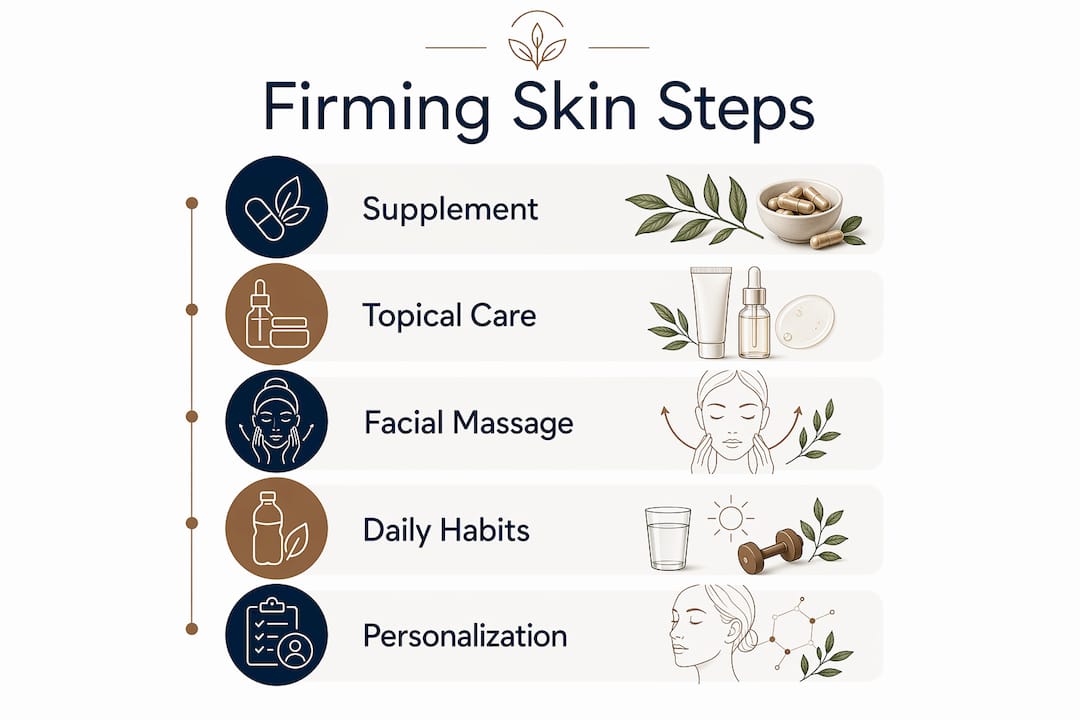
On the topical side, the most effective actives fall into two categories: collagen remodelers and temporary film-formers.
Collagen remodelers (long-term structural change):
- Retinoids stimulate collagen production in the upper dermis and inhibit enzymes that break collagen down. Retinoids remodel the dermis by increasing fibroblast activity over weeks to months of consistent use.
- Peptides signal fibroblasts to produce more collagen. The best peptides for skin in 2026 include matrikines, carrier peptides, and signal peptides, each targeting a different step in collagen synthesis.
- Vitamin C protects existing collagen from free radical degradation and is a required cofactor for collagen cross-linking. Without adequate vitamin C, newly synthesized collagen is structurally weak.
Temporary film-formers (instant surface effect):
- Film-formers like pullulan create a visible tightening effect within minutes but produce no long-term structural change. They work by forming a thin film on the skin surface that contracts as it dries.
The distinction matters because many adults mistake that instant tightening sensation for actual collagen remodeling. Sustained improvements depend on fibroblast stimulation for structural rebuilding, not surface film formation. Use film-formers for events. Use retinoids, peptides, and vitamin C for results.
Pro Tip: Apply your retinoid or peptide serum to slightly damp skin. Moisture improves absorption and reduces the irritation risk that makes many people quit before seeing results.
Clinically tested moisturizers containing pro-retinol and hyaluronic acid can visibly firm and smooth delicate skin within one week of twice-daily use. That timeline is fast by dermatological standards. It reflects the hydration-driven component of firmness, not full collagen remodeling, which takes 8–12 weeks minimum.
How can facial exercises and massage firm delicate skin safely?
Facial exercises work by toning the muscles beneath the skin, which creates a lifted, firmer appearance over time. The skin sits on top of a muscular scaffold. When those muscles weaken with age, the skin above them loses its support structure and begins to sag. Targeted exercises rebuild that scaffold without any procedure.
The recommended protocol for non-invasive results is straightforward:
- Choose targeted movements. Focus on the cheeks, jawline, and neck. Exercises like cheek puffs, jaw clenches, and neck tilts directly address the areas most prone to visible sagging.
- Set a consistent schedule. Facial exercises performed 10–15 minutes daily, 5–6 times per week, improve firmness by toning underlying muscles. Skipping days breaks the progressive overload effect that makes muscles respond.
- Always use a slip agent. Apply a facial oil or serum before any massage or exercise that involves skin contact. Dry friction on delicate skin accelerates mechanical damage and can worsen sagging over time.
- Use upward and outward motions. Proper massage technique uses upward and outward movements with light to medium pressure to promote lymphatic drainage. Downward pressure or aggressive pulling stretches the dermis in the wrong direction.
- Stop at the first sign of redness or irritation. Delicate skin has a lower tolerance for mechanical stress. Redness after massage is a warning, not a sign of effectiveness.
The biggest mistake adults make with facial massage is applying too much pressure in a downward direction. Facial massage must employ slip agents and focus on lymphatic drainage rather than skin stretching to avoid accelerating dermal sagging. More pressure does not mean more results. It means more damage.
Pro Tip: Refrigerate your facial oil or serum before your morning massage session. The cooling effect reduces puffiness and temporarily tightens pores, making the massage feel more effective and reducing post-exercise redness.
What daily habits protect and maintain skin firmness?
Daily protective habits are the foundation that makes every other firming method work. Without them, topical actives and supplements fight against ongoing collagen destruction rather than building on a stable base.
The core daily habits that preserve dermal firmness are:
- Sunscreen, every day. UV radiation is the single largest external cause of collagen degradation. Consistent sunscreen use, along with avoiding smoking and limiting caffeine, directly supports collagen preservation and skin elasticity. SPF 30 minimum, reapplied every two hours in direct sun.
- Moisturize with active ingredients. A plain moisturizer hydrates. A moisturizer with hyaluronic acid, ceramides, or peptides hydrates and supports the dermal matrix. Choose the latter.
- Avoid smoking entirely. Smoking reduces blood flow to the dermis and generates free radicals that break down collagen at an accelerated rate. No topical product compensates for active smoking.
- Limit caffeine intake. High caffeine consumption impairs collagen production by reducing skin hydration and constricting blood vessels that supply nutrients to the dermis.
- Eat for your skin. A diet rich in vitamin C, zinc, and amino acids provides the raw materials fibroblasts need to synthesize collagen. Leafy greens, citrus, eggs, and lean protein are direct inputs into the collagen production pathway.
Hydration deserves special attention. Dehydrated skin loses its plumpness and appears looser than it actually is. Drinking adequate water daily and using topical humectants like hyaluronic acid keeps the dermis visually firm even before any structural remodeling occurs. The science-backed steps to restore firmness consistently place hydration at the top of any maintenance protocol.
How should you personalize your firming regimen by age?
Skin firming is not a one-size-fits-all protocol. The right intensity of intervention depends on how much collagen loss has already occurred and how quickly the skin can respond to stimulation. Non-invasive firming strategies should be stratified by age and severity, with younger adults focusing on maintenance and older adults integrating more intensive approaches.
| Age group | Primary focus | Recommended intensity |
|---|---|---|
| 20s–30s | Prevention and maintenance | Daily SPF, vitamin C serum, light peptide moisturizer |
| 40s–50s | Active remodeling | Retinoids, oral collagen peptides, consistent facial exercises |
| 60s and above | Structural support | Combined oral and topical actives, professional non-invasive treatments |
Adults in their 40s and 50s with moderate sagging get the most benefit from combining oral collagen peptides with topical retinoids and a consistent exercise routine. The proven steps for youthful skin at this stage require patience. Collagen remodeling takes a minimum of 8 weeks to show measurable results, and full structural improvement often takes 3–6 months.
Adults over 60 may benefit from adding energy-based non-invasive clinical treatments, such as radiofrequency or focused ultrasound, to their home regimen. These procedures stimulate deep collagen contraction and new synthesis in ways that topical products cannot reach. They are not replacements for a daily routine. They are additions to one.
One warning applies across all age groups: do not rely on temporary tightening products as your primary firming strategy. Film-formers give an immediate visual result that disappears when you wash your face. They are useful for confidence on a specific day. They are not a substitute for the structural work that peptides, retinoids, and collagen supplements perform over time.
Key takeaways
Effective skin firming requires combining internal supplementation, active topical ingredients, and consistent physical techniques to rebuild collagen and elastin from within the dermis.
| Point | Details |
|---|---|
| Oral collagen peptides work | 2.5 grams daily increases procollagen by 65% and elastin by 18% after 8 weeks. |
| Retinoids and peptides remodel | These actives stimulate fibroblasts for structural change, unlike film-formers that only coat the surface. |
| Massage technique matters | Use upward and outward motions with a slip agent to avoid stretching and damaging delicate skin. |
| Daily SPF is non-negotiable | UV exposure degrades collagen faster than any supplement can rebuild it. |
| Personalize by age | Match the intensity of your regimen to your current level of collagen loss for the best results. |
What I’ve learned about firming skin that most guides get wrong
The most common mistake I see is treating instant tightening as proof that a product works. That tight, slightly dry feeling after applying a film-former is not collagen synthesis. It is a polymer contracting on your skin surface. It washes off. Real firming is invisible in the moment and visible after weeks.
The second mistake is inconsistency. Adults start a retinoid, see mild irritation in week two, and stop. That irritation is often the retinoid working. The skin is adjusting. Dropping the routine at that point means restarting the clock every time, and the clock for collagen remodeling is already slow.
Facial massage is genuinely useful, but only when done correctly. I have seen adults who massage daily with no slip agent and wonder why their skin looks worse after six months. Mechanical stress on delicate skin without lubrication accelerates sagging. The technique is not optional.
The most underrated part of any firming regimen is diet and sun protection. Adults spend money on serums and skip sunscreen. That is the wrong order of priorities. UV damage destroys collagen faster than any topical product can rebuild it. Protect first. Repair second.
Patience is the actual active ingredient in skin firming. The adults who see real structural change are the ones who commit to a layered protocol for three to six months without expecting weekly miracles.
— Sara
Cellure’s Complete Skin Repair Kit for delicate skin
Adults who want to put these methods into practice without assembling a regimen from scratch have a direct option.
Cellure’s Complete Skin Repair Kit combines clinically supported bioactive ingredients, including peptides and collagen-stimulating actives, into a coordinated system designed for delicate skin. The kit addresses both the internal and topical sides of firmness support, using formulations gentle enough for sensitive skin types while delivering the ingredient concentrations that clinical evidence supports. For adults who want a science-backed starting point rather than a trial-and-error approach, the Complete Skin Repair Kit is a direct match for the layered strategy this guide outlines.
FAQ
What is the fastest way to firm delicate skin?
Clinically tested moisturizers with pro-retinol and hyaluronic acid can visibly firm skin within one week of twice-daily use. For structural collagen remodeling, oral collagen peptides at 2.5 grams daily show measurable results after 8 weeks.
Can facial exercises actually tighten skin?
Facial exercises tone the underlying muscles that support skin structure, improving lift and firmness over time. Results require 10–15 minutes daily, 5–6 times per week, performed consistently over several weeks.
What is the difference between a film-former and a collagen-stimulating ingredient?
Film-formers like pullulan create a temporary surface tightening effect that disappears when washed off. Collagen-stimulating ingredients like retinoids and peptides trigger fibroblast activity for structural, long-term firmness improvements.
Is sunscreen really necessary for skin firming?
Sunscreen is the most protective step in any firming regimen. UV radiation degrades collagen faster than topical actives can rebuild it, making daily SPF application a prerequisite for any firming strategy to work.
How do I adjust my firming routine as I age?
Adults in their 20s and 30s benefit most from prevention: daily SPF and a peptide moisturizer. Adults in their 40s and 50s should add oral collagen peptides and a retinoid. Adults over 60 may benefit from adding professional non-invasive treatments to their home routine.